I read 140 books this year, which is a major accomplishment for me. It's nearly double what I read last year.
I'm not feeling particularly gleeful about racking up these numbers because I know it's unlikely I'll come near reaching them next year or maybe ever again. The 48 Hour Book Challenge helped, but let's face it, it was my reading duties as a Cybils panelist that enabled--no! required me!--to do this kind of reading.
I took the month of December off to read and was probably only working part-time in November so I could cybilize. I probably won't be able to take that much time off from work again any time soon, so this may be the high point of my career as a reader.
I read only two books this past week. I feel like such a loser.
Sunday, December 31, 2006
No Fairy Queens Dancing In This One
As a general rule, if I'm going to read a book about elves or other creatures of that nature, I prefer that they carry weapons. If I'm going to read about dragons, I want them to be destroying major cities. I don't really care for the trappings of what I think of as high fantasy. Fairy queens make me cringe.
The Last Dragon by Silvana de Mari includes a lot of high fantasy trappings--elves, dragons, dragon eggs, cryptic prophecy, a sword, a great many beans, hunters, and orphans, to name a few--but, unlike many fantasies, it doesn't take them all that seriously. Our dragon is something of an anti-hero, with a jaded outlook. And we first meet our elf when he is a clueless (and I mean clueless) child whose ineptitude and innocence draws the pity of two travelers who expected to hate him.
The storyline meanders a bit, with the elf Yorsh separating from his human companions in order to put in a long, long, trying period as, you might say, a midwife and then meeting up with his friends' daughter years later. She has fallen on hard times, and Yorsh isn't exactly the prince she's been waiting for.
The writing style is elegant with some sophisticated vocabulary in places, so this may be an elf and dragon story for kids in the upper end of the middle grade spectrum.
The Last Dragon by Silvana de Mari includes a lot of high fantasy trappings--elves, dragons, dragon eggs, cryptic prophecy, a sword, a great many beans, hunters, and orphans, to name a few--but, unlike many fantasies, it doesn't take them all that seriously. Our dragon is something of an anti-hero, with a jaded outlook. And we first meet our elf when he is a clueless (and I mean clueless) child whose ineptitude and innocence draws the pity of two travelers who expected to hate him.
The storyline meanders a bit, with the elf Yorsh separating from his human companions in order to put in a long, long, trying period as, you might say, a midwife and then meeting up with his friends' daughter years later. She has fallen on hard times, and Yorsh isn't exactly the prince she's been waiting for.
The writing style is elegant with some sophisticated vocabulary in places, so this may be an elf and dragon story for kids in the upper end of the middle grade spectrum.
Saturday, December 30, 2006
A Potter Movie I'd Like To See
I didn't discover Beatrix Potter until I had offspring. We were all very fond of her books, though I can't really put my finger on why. I don't do cute, so that wasn't it. I think that perhaps there was an edginess behind the fluffy critters that attracted us.
So, I was happy to see that Salon has lots of good things to say about the new movie Miss Potter.
So, I was happy to see that Salon has lots of good things to say about the new movie Miss Potter.
A Window Into A Too Common Part Of The Book Business
I only started reading Bookseller Chick a month or two ago. She recently announced that the bookstore she works for will be closing. Bookstore closings have become very common in recent years, and people who are interested in the book business might want to check in with her to read what she has to say over the next few weeks. Unfortunately, Bookseller Chick is going to have an up close and personal view of what leads up to bookstore closings and what comes next for booksellers who are no longer able to sell books.
Friday, December 29, 2006
I'm Being Buried Here, Folks
The new Horn Book arrived today. I don't think I even opened the last one. I'm not even sure where it is.
I haven't read Newsweek in at least a month, maybe more, and I gave up reading the daily paper about two weeks ago. And, of course, there are any number of print-outs of articles floating around here for me to go over.
We have to have our Cybils list in tomorrow night. I can't wait to see what's been going on in the world while I've been reading.
I haven't read Newsweek in at least a month, maybe more, and I gave up reading the daily paper about two weeks ago. And, of course, there are any number of print-outs of articles floating around here for me to go over.
We have to have our Cybils list in tomorrow night. I can't wait to see what's been going on in the world while I've been reading.
I Rest My Case
I told you just yesterday--just last night--that soon all eyes would be turned to spring books. Well, sure enough. Here we go.
Thursday, December 28, 2006
More Post-Cybils Plans
My Cybils experience will be coming to a close soon. While it's made me think about any number of things, two of them are weighing on my mind today.
1. I can't help but dwell on how short an amount of time books have to catch the attention of the public. Many books will pretty much disappear soon after their publishing season. We've been promoting all these Cybils nominees, but what will happen to them once the reading period is over? The spring book season will be upon us soon, and people will be turning their attention to the books that will be coming out in March, April, and May. (And June, of course, which is when my next book comes out.)
2. I've always been concerned about the fact that children's literature may not have that much to do with children. As I've said over and over again, children have very little part in the production of the literature created for them. All people in the kidlit blogging and review world can do is promote books we think children will like or books we think they should like. Or we may just be promoting books we ourselves like.
And what about when a young reader doesn't agree with us? Who's right and who's wrong or is anyone right or wrong? I've read that sometimes people have to be "educated" to enjoy certain types of literature, meaning they have to be exposed to a certain type of education. Is that all that's going on? The young haven't been educated the way we have and thus aren't able to appreciate what we're able to appreciate? Okay, but what about the types of literature they do appreciate? Is it of lesser value because we don't like it and they do?
I'm hoping to be able to continue considering these issues in the weeks and maybe months to come. One of the young relatives I gave Cybils books to on Christmas Day has already started reading and responding to them. He's into his twenties now but still closer to the YA and child reading experience than I am. And starting next week he's going to be spending his days with fifth graders.
Occasionally I'll be reconsidering Cybil nominees in light of BDT's response to them or maybe even in light of his students' responses to them. This will kill two birds with one stone--it will get some Cybil titles out in front of the public once more and it will enable us to hear the response of a young(er) reader and compare it to that of an old(er) one.
I'm psyched.
1. I can't help but dwell on how short an amount of time books have to catch the attention of the public. Many books will pretty much disappear soon after their publishing season. We've been promoting all these Cybils nominees, but what will happen to them once the reading period is over? The spring book season will be upon us soon, and people will be turning their attention to the books that will be coming out in March, April, and May. (And June, of course, which is when my next book comes out.)
2. I've always been concerned about the fact that children's literature may not have that much to do with children. As I've said over and over again, children have very little part in the production of the literature created for them. All people in the kidlit blogging and review world can do is promote books we think children will like or books we think they should like. Or we may just be promoting books we ourselves like.
And what about when a young reader doesn't agree with us? Who's right and who's wrong or is anyone right or wrong? I've read that sometimes people have to be "educated" to enjoy certain types of literature, meaning they have to be exposed to a certain type of education. Is that all that's going on? The young haven't been educated the way we have and thus aren't able to appreciate what we're able to appreciate? Okay, but what about the types of literature they do appreciate? Is it of lesser value because we don't like it and they do?
I'm hoping to be able to continue considering these issues in the weeks and maybe months to come. One of the young relatives I gave Cybils books to on Christmas Day has already started reading and responding to them. He's into his twenties now but still closer to the YA and child reading experience than I am. And starting next week he's going to be spending his days with fifth graders.
Occasionally I'll be reconsidering Cybil nominees in light of BDT's response to them or maybe even in light of his students' responses to them. This will kill two birds with one stone--it will get some Cybil titles out in front of the public once more and it will enable us to hear the response of a young(er) reader and compare it to that of an old(er) one.
I'm psyched.
Wednesday, December 27, 2006
What's This Thing Really About?
We're experiencing meltdown here at Chez Gauthier. Everything is falling apart, and I'm no longer able to read a Cybils book every twenty-four hours or so. Of course, we're at the point in the nominating process where we're about to draw blood as we fight over the final five, so the reading is just about done, anyway.
As a result, I took a little time off to read a New Yorker article I heard about through the New England Society of Children's Book Writers and Illustrators listserv. Goodnight Mush was written by Elizabeth Kolbert, whose qualification for writing about children's books appears to be that she wrote a book about global warming.
I am always trying to write essays, myself, so when I read essays written by others I'm always obsessively studying them trying to determine message, ability to stay on topic, topic and concluding sentences for paragraphs, and other such boring things. Goodnight Mush starts out as if it's about bedtime story picture books, meaning books about children or characters going to bed. Then it moves on to what appear to be this year's picture books (though I don't really know), which may or may not include children or characters going to bed. I haven't read Walter the Farting Dog Goes on a Cruise but the description at Amazon doesn't say anything about bedtime for Walter. Though a couple of the books Kolbert discusses do involve someone going to sleep, they don't all seem to and thus...does this article stay on topic?
Kolbert's article ends with a longer discussion of the ultimate bedtime story, Goodnight Moon by Margaret Wise Brown. Though I've read Goodnight Moon aloud plenty of times, I can't say I've ever really seen what's the big deal about it. Not a whole lot of story there, if you know what I mean. So I was really fascinated by Kolbert's concluding paragraph in which she says, "Time moves forward, and the little bunny doesn't stand a chance. Parent and child are, in this way, brought together, on tragic terms. You don't want to go to sleep. I don't want to die. But we both have to."
Oh! Now I get it!
Interestingly enough, this conclusion to the article is about Goodnight Moon but does it conclude an article about other picture books?
I really am obsessed with essays.
Anyway, I find it very interesting that the New Yorker asked Kolbert to write this article because she really doesn't seem to like picture books. Okay, maybe she asked to write it, but, still, she really doesn't seem to like picture books. In her opening paragraph she asks "why do we tell stories to our children?" Her answer is, "In my experience, mostly it is to get them to shut up." She calls books instruments of control. "I will read this to you, and then you will go to sleep. End of story."
I'm not going to touch that.
This is the kind of article that gets kidlit people all riled up. In reality, it's not anything for us to get our knickers in a twist over. It's an article that isn't truly about anything, it's just a number of random shots at a topic.
As a result, I took a little time off to read a New Yorker article I heard about through the New England Society of Children's Book Writers and Illustrators listserv. Goodnight Mush was written by Elizabeth Kolbert, whose qualification for writing about children's books appears to be that she wrote a book about global warming.
I am always trying to write essays, myself, so when I read essays written by others I'm always obsessively studying them trying to determine message, ability to stay on topic, topic and concluding sentences for paragraphs, and other such boring things. Goodnight Mush starts out as if it's about bedtime story picture books, meaning books about children or characters going to bed. Then it moves on to what appear to be this year's picture books (though I don't really know), which may or may not include children or characters going to bed. I haven't read Walter the Farting Dog Goes on a Cruise but the description at Amazon doesn't say anything about bedtime for Walter. Though a couple of the books Kolbert discusses do involve someone going to sleep, they don't all seem to and thus...does this article stay on topic?
Kolbert's article ends with a longer discussion of the ultimate bedtime story, Goodnight Moon by Margaret Wise Brown. Though I've read Goodnight Moon aloud plenty of times, I can't say I've ever really seen what's the big deal about it. Not a whole lot of story there, if you know what I mean. So I was really fascinated by Kolbert's concluding paragraph in which she says, "Time moves forward, and the little bunny doesn't stand a chance. Parent and child are, in this way, brought together, on tragic terms. You don't want to go to sleep. I don't want to die. But we both have to."
Oh! Now I get it!
Interestingly enough, this conclusion to the article is about Goodnight Moon but does it conclude an article about other picture books?
I really am obsessed with essays.
Anyway, I find it very interesting that the New Yorker asked Kolbert to write this article because she really doesn't seem to like picture books. Okay, maybe she asked to write it, but, still, she really doesn't seem to like picture books. In her opening paragraph she asks "why do we tell stories to our children?" Her answer is, "In my experience, mostly it is to get them to shut up." She calls books instruments of control. "I will read this to you, and then you will go to sleep. End of story."
I'm not going to touch that.
This is the kind of article that gets kidlit people all riled up. In reality, it's not anything for us to get our knickers in a twist over. It's an article that isn't truly about anything, it's just a number of random shots at a topic.
Tuesday, December 26, 2006
Retiring The Pants
The original Sisterhood of the Traveling Pants didn't grab me. Nonetheless, I recognize that the series' retirement is a little bit of an event.
I definitely would have missed this if not for bookburger.
I definitely would have missed this if not for bookburger.
This One Might Blow The Young Ones' Minds
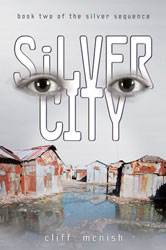
Silver City by Cliff McNish is the second in what the author is calling The Silver Sequence. The book stands alone remarkably well, in large part because the writing is so intense and the situation the characters find themselves in is so horrific.
In a just a few pages McNish establishes the scenario--a child who is a few miles long hovers in the sky so that he can provide protection to the children of the world who are gathering beneath him. They are being mysteriously called there because something is coming through space to devour them.
Okay, it's not exactly probable. But the writing is so self-assured and, as I already said, intense, that you have to accept it. I didn't spend any time wondering how this could have happened or how the core characters developed the abilities they have.
Many writers have been unable to pull off a lot more likely situations.
Though it is clear that the children are still endangered at the end of the book, there is a complete story here.
Subscribe to:
Posts (Atom)