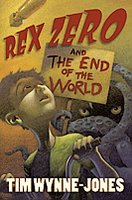
I've had mixed feelings about the
Tim Wynne-Jones books I've read to date.
Loved one.
Didn't love one. And one seems to have been
just okay for me, dude.
But I feel as if he wrote
Rex Zero and the End of the World just for me.
Ottawa, the city that young Rex Norton-Norton moves to with his British-eccentric family, is the only Canadian city I really know much about. When Rex rides his bike, Diablo, around the city, I can recognize the references to the
Rideau Canal (I biked along it in Ottawa just last fall), and I even know who
Diefenbaker was. The French used by the damaged World War I vet in the book is just about at my reading level. I only had to use my French-English dictionary once.
But
Rex Zero and the End of the World has a sense of place in time as well as geography. It's set in the early 1960s during the cold war, and the kids in this story are just plain scared. And what they're scared of is the bomb. Some of their parents are building personal air raid shelters, or, as members of government (Ottawa is the capitol of Canada, remember) eligible to head out to the not-so-secret
Diefenbunker to sit out the radiation expected after a nuclear attack that the kids expect will turn anyone not protected into mutants.
Rex's parents are pillars of common sense, but his older sisters are just plain brilliant at collecting misinformation. When one of them comes home with a story she's heard about the cosmonauts who are then circling the globe being able to spy on them, to actually look into their bedrooms, Rex's father says, "Nonsense." His mother, perhaps even more practically, advises them to keep their curtains closed.
Rex, new to the city, finally falls in with a group of friends who have something more to fear. They are certain that a panther that had escaped from the
Granby Zoo has made its way into Ottawa.
If you could choose between being afraid of a panther that might tear you apart and being afraid of a bomb that might turn you into a mutant, should you survive it, which way would you go?
Believe it or not, though, this is a funny book. At the same time that you're feeling for these kids because they are living in fear, you're laughing at the things they do and say.
My only quibble is that I think Rex made a little too much of an intuitive leap in solving the panther problem. And, okay, maybe the beatnik was too obviously a device to get information out about the WWI veteran. But when a book is enjoyable and interesting, we can shrug off a couple of quibbles, can't we?
I've read a couple of reviews that suggested there was too much period detail in this book. No more than
The Wednesday Wars, I'd say, which was also a 60s book published last year.
Rex Zero, though, has a much more coherent storyline and doesn't try to improve us with anything remotely like Shakespeare.
Rex Zero has just come back this month with
Rex Zero, King of Nothing

