Showing posts with label bullet journals. Show all posts

Tuesday, October 29, 2024

Time Management Tuesday: Specifically Planning What You're Going To Do

It is still ADHD Awareness Month, but instead of reading widely on the subject, I am still focused on J. Russell Ramsay's article Why the ADHD Brain Prioritizes the Less Important Task--And How CBT Improves Prioritization Skills in ADDitude. (Maybe I'm a little hyperfocused?) Today I'm interested in the second part of the article, about improving prioritization skills.

First off, CBT is cognitive behavioral training, which Ramsay simply describes as a type of brain training. So, we've got that out of the way.

The first suggestion Ramsay makes was the one that I found particularly meaningful. He called it "Attach manual, step-by-step descriptions to must-do tasks."  I think this just means specifically break down tasks.

This concept jumped out at me, because just a few days before I read this article, I happened to have a week when I only had an hour here or there to write. One evening I decided I wouldn't just write the next day, I would work on Dinner at Shirley Farr's House. And I wouldn't just work on Shirley Farr, I would begin by moving a section of the piece about my family to the beginning of the essay, instead of beginning with Shirley Farr. I wanted this memoir to be related to my writing about eating. Plus, it was a memoir. It should be about a personal experience involving Shirley Farr, not about Shirley Farr. I suspect someone could write a book about her, but it won't be me.

Knowing what I was specifically going to do before I sat down to work was hugely helpful. It was as if I didn't have to start the job, it was already started. What's more, being able to get that kind of start made it easier to continue. 

Maybe We Could Think in Terms of Goals and Objectives


Okay, that one example of how I had broken down a writing task should not convince anyone that attaching a step-by-step description to writing is a best practice for that job. Because one is not a statistically significant number. But think of a "must-do task" as a goal and the "step-by-step descriptions" as objectives. Now we're talking about something we have experience with.

"Writing tomorrow" is big and overwhelming. Also, morning is a lot of time. Surely, I can use some of that to see what's trending on X and go to Facebook, not just to look at my wall but to check a bunch of my groups to see if something has happened that I've missed. (I belong to many, many Facebook groups.) 

But those of us who are accustomed to working with goals and objectives can see that "writing tomorrow" is the must-do goal we need to do. Of course, we need to assign step-by-step objectives to that goal. 

What am I going to write tomorrow?
  • I'm going to work on Project C
    • I'm going to start with looking at yesterday's work
    • I'm going to work on the section related to _________
    • I'm going to create a voice
    • I'm going to maintain the voice
    • I'm going to shorten the part about__________ 
The point being that if we apply objectives or step-by-step descriptions to "going to write tomorrow," when we sit down to work, we know exactly what we have to, and are going to, do. Yes, that makes work easier. You know what else it does? It gets rid of the anxiety about what we're going to do. What a relief.


A Good Time to Mention Bullet Journals?


It appears that it's been five years since I've mentioned bullet journals here. The official bullet journal website defines bullet journals as a "mindfulness practice designed as a productivity system." I love that. It is so what I want to be me. However, I found the original bullet journal method way too complex for me. I modified the system to meet my needs and continue to do so. Why, I just added a new section to my journal a couple of weeks ago.

I get a lot done with a bullet journal. Though, of course, never as much as I want to. Also, sometimes in order to get a long-standing task done, I have to put it in my bullet journal. But that's okay!

An example of how my simplistic bullet journal works.

Week of Oct. 27th Work Section  (I may add more during the week):
  • Submit scifi story
  • Submit reprint story
  • Plan next writing projects (I could have got more detailed with this, as in "check started work on laptop" and "check journal.") / 
  • Humor/Raw Dog post
  • TMT post (that's this one) 
  • Register for workshop
  • Update website.
Week of Oct. 27th Food Section (I will probably add more during the week. Also, this is usually cooking related.):
  • gf cider doughnuts
  • gf cider biscuits
Each week has additional sections for other aspects of my life. Strike throughs mean a task is done. A slash means I've started it.

My point here is that I think that if you work with some kind of bullet journal system, it seems as if what you're doing is, indeed, attaching "manual, step-by-step descriptions to must-do tasks," as Ramsay describes in his ADDitude article. So you may not be surprised to hear that a few years ago, while doing some reading about bullet journals, I learned that Ryder Carroll, who created the bullet journal system, has ADHD. 

ADDITION: I mentioned a few weeks ago that we have a family member who has recently been diagnosed with ADHD. This is a child I'm talking about. So today I thought I'd take a look see if there's anything about bullet journals/journaling for kids. I'm having a hard time finding something that isn't focused on the idea of "journals" and not "productivity," let alone "mindfulness designed as a productivity system." My gut feeling is these kids don't need to keep records of what they have done or their creativity and personalities. They need help focusing on what they need to do and getting things done. Which is what the original bullet journal is about.

I will keep looking!


Tuesday, January 15, 2019

Time Management Tuesday: Time To Set Up Those Bullet Journals

This month my Facebook page has been humming with people talking about setting up their bullet journals for the new year, so I thought I'd rerun a post from just last October in which I discussed my attempt to keep a bullet journal. I am still keeping a bullet-like journal with major concentration on planning by week and day, a little work with planning over the course of the year, and none at all by the month.

New page layout
Last fall I found I found a new page format to use that is far more organized, though, of course, more labor intensive. But, then, that's bullet journals for you.

Do other people suffer from bullet journal anxiety? On the last day of my reading retreat, I found myself becoming anxious because I was going home to a bullet journal page for this week that hadn't been filled out. I didn't get much reading done that day.

Oct. 16, 2018 I Break Down And Try A Bullet Journal 

I finally tried a bullet journal more than a year ago, but I've never had time to write up how things went with it.

That's not true. Of course, I had time. I chose to use my Time Management Tuesday writing time writing about other things. A family member asked about bullet journals a couple of weeks ago, which motivated me to use some time to write about the bullet journal experience now.

The first thing you have to understand about bullet journals is that they are to-do lists kept in a formal journal with items preceded by coded symbols like bullets. Thus the name. (I wanted to get that out of the way.) The to-do lists are pretty elaborate, so much so that some people supposedly keep keys of their coding system. But they're to-do lists, nonetheless. That is not to denigrate them. I am a big fan of to-do lists. But when I first heard about bullet journals, I got the impression they were some kind of magical cure-all. I found them more hard work than magical. (Remember that key for the code.) Some of the work I found hard I never did. (The table of contents and the codes, to name two.) Others I've continued to use after the trial ended.


How Bullet Journals Work


It seems to me that the most basic thing about bullet journals is that they allow you to break down your time so you can identify what you have to do and when you can find time to do it.
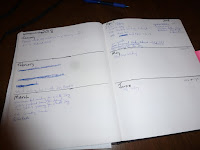
The Year--I still do this.

The Year. You'll start by breaking down the year. You divide a few pages in to 12 blocks, one for each month. Ten you enter what you have to do each month. You'll be updating this as time passes. I do, anyway. I don't know everything that's going to happen in September and October a the beginning of the year.

This aspect of bullet journals seems like a good idea. If you have a day job and/or family responsibilities that are going to be heavier some months than others, it's helpful to know that ahead of time. This will give you an idea of when during the year you've got your best shot at writing time. If you're a full-time writer and do things like teach at certain points of the year, you want to know that's coming up. You can block out time for revision, for working with an editor on books that are coming out, on marketing. You can commit time to new projects. You want to do NaNoWriMo? Put it in the bullet journal, and keep in mind that you'd better not plan for a lot of other things in November.

I've continued to do this kind of year-ahead planning.
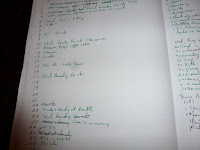
The Month--I don't do this.
The Month. The next division of time is one month. You'll write out a number for each day of the upcoming month and then briefly note what you expect to be going on in your life that day.

This aspect of bullet journals also seems like a good idea, especially for part-time writers who have to contend with other kinds of work. You'll see when you have free days or at least free-ish days to work.  However, I found it to be a lot of work and gave it up after a couple of months.

Other Things You Can Do. According to this BuzzFeed article on bullet journals (language warning, in case you care about that), you can dedicate pages to things you want to keep track of. In which case, you probably would want that table of contents that I didn't bother with. I often keep track of when I exercise or how long, for instance, and I could have made a couple of pages for that. I didn't because that would be making things more complicated, and I am a simple sort.
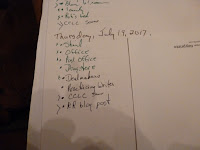
The Day--Meh.
The Day. My understanding is that the next unit of time you'll work with in bullet journals is the day. If you're into coding, this would be a time to use that. There are codes you can use to indicate you've finished something or want to shift it to another day.

I wasn't crazy about this breakdown. The coding for one thing. All I need to know is that I have something to do, not whether the thing I have to do is an "event" or is some kind of "note" or is "scheduled." If it's on my list, I expect to have to do it, whatever it is. And once I do it, I'd rather just cross it out than have a code for "completed."

More importantly, though, I was used to breaking my day down still more. I separate my professional work that I do in forty-five minute segments, from home/life maintenance work that I try to knock off in the fifteen minute breaks between those forty-five minute segments. (You know...the unit system.)  And I don't like to pin myself down to doing a lot of things on a specific day, because if I don't get to many of them, well, how much does that stink? I think in terms of a week. Then if I don't get Monday's work done until Wednesday or Thursday, I'm still good.

I have found sites on-line that offer weekly plans for bullet journals. But they still seem to deal with a week of days.
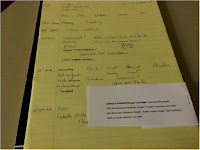
My Weekly Yellow Pad System
The Week. I've been working with a week for years, as you can see to your right. All on one page. My work life. My personal life. Yoga. Walking and biking. After two months of trying a formal bullet journal with a monthly list and day notes, I went back to my weekly planning, but just put it in that nice black book I'd bought instead of using yellow legal pads. That's mainly because I'm cheap and had paid for thing and was out of legal pads.

So Am I Keeping A Bullet Journal Now?  


My first thought is no, I'm not. I can't bring myself to stick to the bullet journal format, so I'm not keeping a bullet journal.

However, in snooping around the Internet, I found some interesting sites relating to bullet journals.

My point is, there are people out there messing with the bullet journal system, making it work for them. Maybe this thing has escaped out into the wild and is mutating, mutating in any number of ways to meet any number of needs.

So maybe I am keeping a bullet journal. And maybe if you try one, you'll end up keeping one, too.

Tuesday, October 16, 2018

Time Management Tuesday: I Break Down And Try A Bullet Journal

I finally tried a bullet journal more than a year ago, but I've never had time to write up how things went with it.

That's not true. Of course, I had time. I chose to use my Time Management Tuesday writing time writing about other things. A family member asked about bullet journals a couple of weeks ago, which motivated me to use some time to write about the bullet journal experience now.

The first thing you have to understand about bullet journals is that they are to-do lists kept in a formal journal with items preceded by coded symbols like bullets. Thus the name. (I wanted to get that out of the way.) The to-do lists are pretty elaborate, so much so that some people supposedly keep keys of their coding system. But they're to-do lists, nonetheless. That is not to denigrate them. I am a big fan of to-do lists. But when I first heard about bullet journals, I got the impression they were some kind of magical cure-all. I found them more hard work than magical. (Remember that key for the code.) Some of the work I found hard I never did. (The table of contents and the codes, to name two.) Others I've continued to use after the trial ended.

How Bullet Journals Work


It seems to me that the most basic thing about bullet journals is that they allow you to break down your time so you can identify what you have to do and when you can find time to do it.
The Year--I still do this.

The Year. You'll start by breaking down the year. You divide a few pages in to 12 blocks, one for each month. Ten you enter what you have to do each month. You'll be updating this as time passes. I do, anyway. I don't know everything that's going to happen in September and October a the beginning of the year.

This aspect of bullet journals seems like a good idea. If you have a day job and/or family responsibilities that are going to be heavier some months than others, it's helpful to know that ahead of time. This will give you an idea of when during the year you've got your best shot at writing time. If you're a full-time writer and do things like teach at certain points of the year, you want to know that's coming up. You can block out time for revision, for working with an editor on books that are coming out, on marketing. You can commit time to new projects. You want to do NaNoWriMo? Put it in the bullet journal, and keep in mind that you'd better not plan for a lot of other things in November.

I've continued to do this kind of year-ahead planning.

The Month--I don't do this.
The Month. The next division of time is one month. You'll write out a number for each day of the upcoming month and then briefly note what you expect to be going on in your life that day.

This aspect of bullet journals also seems like a good idea, especially for part-time writers who have to contend with other kinds of work. You'll see when you have free days or at least free-ish days to work.  However, I found it to be a lot of work and gave it up after a couple of months.

Other Things You Can Do. According to this BuzzFeed article on bullet journals (language warning, in case you care about that), you can dedicate pages to things you want to keep track of. In which case, you probably would want that table of contents that I didn't bother with. I often keep track of when I exercise or how long, for instance, and I could have made a couple of pages for that. I didn't because that would be making things more complicated, and I am a simple sort.

The Day--Meh.
The Day. My understanding is that the next unit of time you'll work with in bullet journals is the day. If you're into coding, this would be a time to use that. There are codes you can use to indicate you've finished something or want to shift it to another day.

I wasn't crazy about this breakdown. The coding for one thing. All I need to know is that I have something to do, not whether the thing I have to do is an "event" or is some kind of "note" or is "scheduled." If it's on my list, I expect to have to do it, whatever it is. And once I do it, I'd rather just cross it out than have a code for "completed."

More importantly, though, I was used to breaking my day down still more. I separate my professional work that I do in forty-five minute segments, from home/life maintenance work that I try to knock off in the fifteen minute breaks between those forty-five minute segments. (You know...the unit system.)  And I don't like to pin myself down to doing a lot of things on a specific day, because if I don't get to many of them, well, how much does that stink? I think in terms of a week. Then if I don't get Monday's work done until Wednesday or Thursday, I'm still good.

I have found sites on-line that offer weekly plans for bullet journals. But they still seem to deal with a week of days.

My Weekly Yellow Pad System
The Week. I've been working with a week for years, as you can see to your right. All on one page. My work life. My personal life. Yoga. Walking and biking. After two months of trying a formal bullet journal with a monthly list and day notes, I went back to my weekly planning, but just put it in that nice black book I'd bought instead of using yellow legal pads. That's mainly because I'm cheap and had paid for thing and was out of legal pads.

So Am I Keeping A Bullet Journal Now?  


My first thought is no, I'm not. I can't bring myself to stick to the bullet journal format, so I'm not keeping a bullet journal.

However, in snooping around the Internet, I found some interesting sites relating to bullet journals.

My point is, there are people out there messing with the bullet journal system, making it work for them. Maybe this thing has escaped out into the wild and is mutating, mutating in any number of ways to meet any number of needs.

So maybe I am keeping a bullet journal. And maybe if you try one, you'll end up keeping one, too.

Tuesday, February 09, 2016

Time Management Tuesday: Planning You Can See

At the end of the year, I heard about bullet journals twice, once from Facebook friend Erin Dionne and then from blogging buddy Melissa Wiley, in just a matter of days. These journals were recommended for planning over periods of time, so I was interested. (Plus if you hear about something totally new to you twice in a short period of time, that is a sign you should do something about it.) The bullet journal appears to be adaptable to individual users. For those of us who like planning we can see, for real, versus planning in our heads, which all too often ends up being pretty much imaginary, bullet journals are definitely worth a look.

See how much I like journals?
I REALLY like journals


Journals And Me


I am fond of journals. After many, many years of traditional writers' journals, I've moved on to a journal computer program for that material. And I have some kind of psychological dependence on planning.

But I found the how-to video for bullet journals as planners a little complicated, especially since it looks as if I'd have to do it regularly. It involves dealing with more than one page and a bunch of numbers. I don't think I want to take the time to do it. Knowing me as well as I do, I don't think I would take the time to do it. I don't think merging a traditional journal with planning will work for me, as much as I love those two things.

The Yellow Notepad System

My Yellow Notepad


I'm sticking to my yellow notepad system. I lay out my week on Monday mornings with plans for work, what  I want to do with those fifteen minute breaks (often home/personal stuff) after I've put in a forty-five minutes of work, what I'm going to do in the evening, and now content marketing strategy. (To be covered another week.) I try to have task options for every part of the day, though I may not do them on the day I planned them for. I'm happy if I get them done by the end of the week.

I'm sure this yellow notepad business looks as complicated to other people as bullet journals look to me.

The Value Of A Plan You Can See


The point is, though, that planning with something visual, paper or on a computer if that works for you, keeps what you want to do in front of you, making it harder for you to go off task. If, like me, you get a big jolt from crossing items off the plan as they're done, a visual plan becomes even more important.