Agent Kristin of Pub Rants has an interesting post on specific kidlit titles in the U.S. vs. the UK.
She also has a post on What UK Children's Editors Want.
Training Report: Two uninspired segments for the 365 Story Project. Some modest desk cleaning. However, my desk doesn't get anywhere near as horrible as it used to because I bought some horizontal files that look very much like this. The beauty of these things is that you can keep just as much garbage on your desk as you ever did, but it's organized so you are tricked into thinking your desk is clean.
That is important writing how-to knowledge that I'm passing on here. How to keep your desk from overwhelming you.
Thursday, April 30, 2009
Wednesday, April 29, 2009
How Great Is This?
I saw a friend this morning from my old writers' group, and...she has an agent! One I've heard of and seen interviewed on blogs. Talk about a major step forward.
I will report back when the agent sells something for her.
This news has started me thinking once again about how I might be looking for an agent soon. As part of my preparation for that ordeal, I've skimmed some of Nathan Bransford's Be An Agent for a Day posts. He put up 50 query letters so that his hundreds of followers could play agent and respond to them.
Note that many of the letters begin with a carefully composed hook. Query letter advice articles tell you to do that.
Here is what I'm thinking of for my hook:
Look, I've been around the track a few times. I'm tired of making the trip by myself, but I want to remain in the driver's seat. I do not like to ride with others. I get nervous when someone else is behind the wheel. I find that other drivers often have too heavy a foot. Or else they go the other way and take forever to get anywhere. Or they tailgate. Or they don't pay attention to what they're doing. What I'm really looking for is someone to ride shotgun for me.
I think that makes my point, don't you? Or am I over extending the metaphor?
Training Report: Two segments done and several planned. I also did some desk cleaning and found some promotional material I picked up last summer for Clarkesworld Magazine. Note the editors' very clear instructions about what they consider hard sells.
I will report back when the agent sells something for her.
This news has started me thinking once again about how I might be looking for an agent soon. As part of my preparation for that ordeal, I've skimmed some of Nathan Bransford's Be An Agent for a Day posts. He put up 50 query letters so that his hundreds of followers could play agent and respond to them.
Note that many of the letters begin with a carefully composed hook. Query letter advice articles tell you to do that.
Here is what I'm thinking of for my hook:
Look, I've been around the track a few times. I'm tired of making the trip by myself, but I want to remain in the driver's seat. I do not like to ride with others. I get nervous when someone else is behind the wheel. I find that other drivers often have too heavy a foot. Or else they go the other way and take forever to get anywhere. Or they tailgate. Or they don't pay attention to what they're doing. What I'm really looking for is someone to ride shotgun for me.
I think that makes my point, don't you? Or am I over extending the metaphor?
Training Report: Two segments done and several planned. I also did some desk cleaning and found some promotional material I picked up last summer for Clarkesworld Magazine. Note the editors' very clear instructions about what they consider hard sells.
All Things Picture Book
Booklights, a new children's book blog at PBS Parents, opens with lots of discussion of picture books.
Author Paula Yoo is establishing National Picture Book Writing Week, which will be coming up May 1 through 7. She's shooting for 7 picture books in 7 days.
I'm wondering if just anyone can start up a national week, and, if so, what kind of national week I'd like to set up. I will probably be dwelling on this for months, if not years.
Author Paula Yoo is establishing National Picture Book Writing Week, which will be coming up May 1 through 7. She's shooting for 7 picture books in 7 days.
I'm wondering if just anyone can start up a national week, and, if so, what kind of national week I'd like to set up. I will probably be dwelling on this for months, if not years.
Tuesday, April 28, 2009
Not To Be Confused With...
ShelfTalker: A Children's Bookseller's Blog
The Shelf Talker
ShelfTalker is a member of the kidlitosphere. The Shelf Talker is "a weekly rundown of news, gossip and recommendations from and about authors on tour."
There just aren't that many names out there.
The Shelf Talker
ShelfTalker is a member of the kidlitosphere. The Shelf Talker is "a weekly rundown of news, gossip and recommendations from and about authors on tour."
There just aren't that many names out there.
Critique Partners
Tomorrow I'm meeting for coffee (or, in my case, hot chocolate because I'm already quite over stimulated, thank you very much) with a friend I met in a writers' group. We met twice a month, took work home to read, discussed it at meetings, etc. The usual thing. I was the only published writer in the group, and I did miss the networking type chat that you get from meeting with other writers who are at your same rung on the ladder. (I don't know how much networking I'd be able to do with the authors of international bestsellers.) But several of these people were very fine readers, and the friend I'm going to see tomorrow actually put her finger right on what was wrong with the picture book manuscript I was working on that eventually became A Girl, a Boy, and a Monster Cat. The manuscript needed to be A Girl, a Boy, and a Monster Cat, not a picture book.
Since I'm seeing Lynda tomorrow morning, I have writers' groups on my mind this evening. So I was interested to see Becky Levine's blog post Critique Partners--Why Start With One? In it, she talks about building a critique group and suggests you start with just one critique partner.
It's an interesting idea.
Training Report: In spite of another chaotic day, I managed to get two segments done for the 365 Story Project. The need to report here does force me to try harder.
Since I'm seeing Lynda tomorrow morning, I have writers' groups on my mind this evening. So I was interested to see Becky Levine's blog post Critique Partners--Why Start With One? In it, she talks about building a critique group and suggests you start with just one critique partner.
It's an interesting idea.
Training Report: In spite of another chaotic day, I managed to get two segments done for the 365 Story Project. The need to report here does force me to try harder.
Monday, April 27, 2009
A Good Sunday
Yesterday I walked over to the UConn Co-op from a family member's home, a little under a two-mile walk round trip. I went over the weekend before, too, but hadn't brought any money with me. Thus the return trip.
The UConn Co-op is an independent bookstore, unlike some college bookstores that are run by chains. So you don't get the same old, same old when you're walking through its offerings.
Take graphic novels, for instance. When I look at the graphic novels at chain bookstores, I see a lot of superhero stuff and manga. The Co-op had a lot of the more unique, individual novels told graphically that I tend to be more interested in, as well as nonfiction, such as French Milk, that looked appealing.
I overheard something interesting while I was there. For some reason, a lot of parents and family groups were wandering around yesterday. (Perhaps the elders were there to make sure their kids hadn't been arrested at a spring break party.) One young man directed his family's attention to the book area by saying, "There's the Barnes & Noble stuff." Then he pointed out where the computer items were kept and maybe the tee-shirts, etc.
Think about it: When the big box bookchains first opened, they were modeling themselves on bookstores. Now people have to compare a bookstore to a Barnes & Noble in order to understand what goes on in one?
What are they teaching these young people at college these days?
Anyway, I blew my entire Christmas Co-op gift card on Leonard Marcus's Minders of Make Believe. I have a copy from the library, but I've already renewed it once, and I've only read a few pages. But those few pages made me want to underline like crazy! Lots of facts! About Puritans! I love the Puritans! Plus Marcus uses footnotes. Do you know how often I read nonfiction that has no footnotes? Do you have any idea how much that annoys me? So I decided I wanted my own copy.
So I'm walking back with my purchase, and I'm thinking that I can't start reading it until I finish reading Budo Secrets by John Stevens because I read only one nonfiction book at a time, and a guy from the dojang loaned me this thing maybe half a year ago. I would never mention Budo Secrets here because it's not related to my blog subjects, but as I was walking back to my in-laws' house, I suddenly realized that I could use a Budo Secrets-type book in the 365 Story Project! That means it is related.
I also realized that the 365 Story Project has no grandparents, and what's that about? The kids in the episodes are only ten and fourteen years old. What are the chances that all four of their grandparents would be dead? I decided I had to do something about that.
So it was quite a productive hour--a nearly two-mile walk, a happy wander in the Co-op, a book purchase, and some 365 Story Project work.
Training Report: I was away from the house a lot last week, which is why posting here was spottier than usual. I managed to get seven episodes written for the 365 Story Project, though, and a short story manuscript submitted to a journal. I was able to do that much because on Monday I happened to work out what the next seven or more episodes would be about. This means that either A. my father was right and a job well planned is a job half done; or B. I have now reached that stage at which if I'm given any topic I'll blurt out something about it no matter what.
I've got to step it up a notch or five or six because I'm still more than a month behind with these 365 Story stories. Trying to catch up is keeping me from working on other projects. I knocked off three segments today, though.
Sunday, April 26, 2009
Can You Believe It? I Found Still Another Dad Book
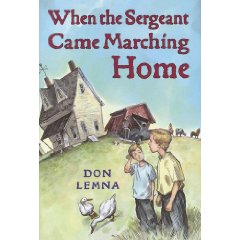
Four or five weeks ago, I was in a library and decided I wanted to read something I'd heard absolutely nothing about. I was going to pick a mystery book off the shelf. (By which I mean not the genre but a mystery to me.) I settled on When the Sergeant Came Marching Home by Don Lemna because it's set after World War II (historical novel) in Montana (where a family member lives). It was a good choice because though the book was reviewed in journals, including a starred review in Booklist, I didn't find a whole lot about it on-line. Most mentions came from library blogs, posting about new purchases.
When the Sergeant Came Marching Home is a retro boys' book. It reminded me of the Soup books by Robert Newton Peck, which were popular at Chez Gauthier a few years back, in that they're realistic tales about two young boys set in an earlier period in the twentieth century. My impression when visiting schools is that most kids no longer know who Soup is, and I wonder if any of those old boys-having- adventures-while-growing-up books are read much anymore. I still hear a lot (at least on-line and at listservs) about Little Women and Anne of Green Gables but not so much about Homer Price. So today's young readers may be ready for Sergeant's ten-year-old narrator Donald and his younger brother Pat.
The basic story line that holds these stories together involves Donald's dismay when his father comes home after World War II and moves his family away from the small city where they'd been living without him to a quite rundown farm. Rundown as in no electricity and an outhouse. Donald is so distraught about this turn of events that he can't bring himself to refer to his father as anything but "the Sergeant," his title when he left the military.
For those of us familiar with the old boys' adventure stories, a lot of the situations in When the Sergeant Came Marching Home will sound...ah, well, familiar. But they didn't seem stereotypical to me. I think, instead, I might call them classic. You have your outhouse story and your pain-in-the-neck minister Dad doesn't like coming to dinner story and your build a spaceship story. Plus you've got the red-headed Irish mom who doesn't take any crap from the Sergeant even though he did clear the Nazis out of Europe and the beloved teacher at the one-room schoolhouse.
Perhaps these tales go down so well because Donald can be very drole. The beloved teacher, for instance, "had actually trained for a singing career and had only been held back from it at the last moment by her voice." Plus the father-son story adds a little twist, making these adventures a little more than unrelated episodes.
Adult readers of this book can have some fun with a few of the characters. A squatter on the family's land, who may or may not have known Lawrence of Arabia, and a very funny neighbor in the market for "a good Christian workin' woman who don't take to fancy-dancing around and all that prettifying stuff" could, with just a little tweaking, become the guest villains on Law and Order SVU. I was reading along going, "No, kids, no! Don't go in there!" "No! Don't eat that!" "For the love of God, don't get in his truck!" Ah, but the past is a foreign country; they do things differently there. Heinous criminals were fewer and farther between back in the era in which this book is set. It was interesting the way I kept projecting my present day fears unto those quirky guys from another time.
Friday, April 24, 2009
Pondering Adult Characters In Children's Books
Tim Byrd, whose book Doc Wilde and the Frogs of Doom will be published next month, and I were getting acquainted over at his blog yesterday. He started me thinking about the possibility of adult protagonists in children's literature, and you guys know that anything I think about has a good chance of ending up here.
Tim says that he's "not a huge believer in the necessity of making kids the sole, or even primary, viewpoint characters in fiction aimed at them." He talks about all the books "focusing on adults" that he read as a child. He adds that "in choosing stories to read, the age of the characters was never a consideration."
I think kids probably aren't aware of seeking out characters of a certain age. And they don't have to. They have access to all the kinds of books Tim talks about reading when he was a kid--"Tarzan, Conan, Sherlock Holmes, Robinson Crusoe, The Three Musketeers"--as well as the spy stories and mysteries I latched onto while still pretty young. They can find pretty much whatever they want. I don't think there's any compelling need to place adults in primary roles in what we think of as children's literature.
Tim describes his editor as leaning toward wanting to see a child in a protagonist's role in children's books. When I started publishing children's fiction, I had an editor who definitely believed that. She made a believer of me. In large part, this is probably because I like definition. I like to try to focus and remain on task. If children's books aren't about children, then what the heck are they? How am I supposed to go about doing what I do? But in part I'm with my editor about the need for a central child character in children's books because I believe all of us read to make connections with others, to feel a sense of community with someone like ourselves or someone we would like to be. Children can read adult books for those times when they want to connect with someone like Sherlock Holmes, someone they want to be like. Children's books ought to provide them with with opportunities to connect with someone more like the selves they are now.
Adult main characters can work in children's books. But I think that happens when the adult characters are outsiders of some type. Think Skullduggery Pleasant, for instance, who, as a skeleton, can't be said to fit into society very easily. Or at all. Our social order is run by adults, making children outsiders. Outsider child readers can connect with outsider adult characters.
Diana Wynne Joneshas said about the protagonists in children's books, "It follows that they usually have to be fairly strong, dynamic characters, and some of them have to be people that children will follow willingly into the action. For this reason, it was thought at one time that the main characters always had to be children. This turns out not to be true...as long as someone in the story is likeable, understandable or a loveable rogue and so on."
By likeable and understandable, I assume she means likeable and understandable to a child reader. And what is a "loveable rogue" but an outsider? Think of Howl in Wynne Jones own Howl's Moving Castle. Perhaps these rogues also work best in a buddy story, one in which the buddy is a child or at least a younger character. Think, again, Skullduggery Pleasant and Howl's Moving Castle.
As a result of reading Tim's post, I've decided to move Minders of Make-Believe by Leonard Marcus to the top of my To Be Read pile. I'm hoping he'll discuss this subject. Have we always felt that children should be center stage in children's books? Or back in the day when books for children were more instructive were they filled with adult characters for them to model themselves upon?
Tuesday, April 21, 2009
This Caused Me To Take A Second Look
Today I received an e-mail with "New Book: Ultimate Guide to Submissions" in the subject line. The book in question was not an ultimate guide to submitting written work for publication but Tap Out Textbook: Ultimate Guide to Submissions for Grappling.
Seriously, I saw that subject line and thought about manuscript submissions. Nothing else.
Training Report: Over the weekend I managed to get two segments written for the 365 Story Project. Then I did one yesterday and two today. I also finished revising the short story I've been working on and submitted it today, which means I have four manuscripts out. That's a lot for me. We also got the press kit up at the website this morning. By me, of course, I mean Computer Guy.
Seriously, I saw that subject line and thought about manuscript submissions. Nothing else.
Training Report: Over the weekend I managed to get two segments written for the 365 Story Project. Then I did one yesterday and two today. I also finished revising the short story I've been working on and submitted it today, which means I have four manuscripts out. That's a lot for me. We also got the press kit up at the website this morning. By me, of course, I mean Computer Guy.
Sunday, April 19, 2009
Blomance And Training
By way of Jen Robinson's Book Page, I found The Trouble With Blogging at Sarah Miller: Reading, Writing, Musing...".
Sarah raises a couple of interesting "con" points in her discussion of the pros and cons of blogging. For one thing, she wonders if the kidlitosphere is less dynamic than it used to be. Personally, I think that what has happened over time is that we've become less wild and woolly. Kidlit blogs are no longer a ground-breaking idea. The frontier aspect is gone. What's more, when the kidlitosphere first began to explode, there was a lot of excitement because bloggers were finding each other. Let's call it...blomance. Now we've all known each other for a while. We know what to expect from each other. But we're missing the wildness of our youth.
The second interesting point Sarah makes is about how fragmenting the number of Internet opportunties have become and what a problem that is for writers. (Probably for people in other fields, too.) Blogging and social networking do take time from a writer's work, and then if you're keeping journals of some kind, as Sarah mentions, that's another activity that takes from the big writing project.
There are solutions to that problem. The one Sarah is trying is to take a break from blogging for a while. My solution is that I've made the decision that I won't do social networking.
Why am I sticking with blogging instead? In addition to believing that it has helped market my writing, I'm continue to blog because it is writing. I've been listening to Outliers by Malcolm Gladwell. In that book, Gladwell says that it takes 10,000 hours to achieve mastery in any field. By that he does not mean 10,000 hours cranking out manuscripts that are immediately embraced by publishers and turned into books. He means 10,000 hours of grunt work, rehearsal time, practice, study, and learning the ropes before you get to the point of succeeding in a field.
That just happens to fit in very nicely with the training model I've been thinking about in relation to writing. You never stop training, you never stop honing your skills, you always expect that you need to improve the most elementary things you know about your field. Training is and always will be a part of your life, you train for the sake of training, you train because you want to train.
Blogging is nonfiction writing, and I'm interested in writing nonfiction. Blogging, therefore, is part of my training.
Sarah raises a couple of interesting "con" points in her discussion of the pros and cons of blogging. For one thing, she wonders if the kidlitosphere is less dynamic than it used to be. Personally, I think that what has happened over time is that we've become less wild and woolly. Kidlit blogs are no longer a ground-breaking idea. The frontier aspect is gone. What's more, when the kidlitosphere first began to explode, there was a lot of excitement because bloggers were finding each other. Let's call it...blomance. Now we've all known each other for a while. We know what to expect from each other. But we're missing the wildness of our youth.
The second interesting point Sarah makes is about how fragmenting the number of Internet opportunties have become and what a problem that is for writers. (Probably for people in other fields, too.) Blogging and social networking do take time from a writer's work, and then if you're keeping journals of some kind, as Sarah mentions, that's another activity that takes from the big writing project.
There are solutions to that problem. The one Sarah is trying is to take a break from blogging for a while. My solution is that I've made the decision that I won't do social networking.
Why am I sticking with blogging instead? In addition to believing that it has helped market my writing, I'm continue to blog because it is writing. I've been listening to Outliers by Malcolm Gladwell. In that book, Gladwell says that it takes 10,000 hours to achieve mastery in any field. By that he does not mean 10,000 hours cranking out manuscripts that are immediately embraced by publishers and turned into books. He means 10,000 hours of grunt work, rehearsal time, practice, study, and learning the ropes before you get to the point of succeeding in a field.
That just happens to fit in very nicely with the training model I've been thinking about in relation to writing. You never stop training, you never stop honing your skills, you always expect that you need to improve the most elementary things you know about your field. Training is and always will be a part of your life, you train for the sake of training, you train because you want to train.
Blogging is nonfiction writing, and I'm interested in writing nonfiction. Blogging, therefore, is part of my training.
Subscribe to:
Posts (Atom)