Showing posts with label Deep Work. Show all posts

Tuesday, July 31, 2018

Time Management Tuesday: I Need Something Simple

Another library patron is waiting for The Deep by Cal Newport, so I'm going to wrap up my thoughts on the book.

Recall that Newport defines "deep work" as "Professional activities performed in a state of distraction-free concentration that push your cognitive capabilities to their limit. These efforts create new value, improve your skill, and are hard to replicate." He spends half his book arguing the value of deep work and the threats to it. Some interesting points:

  • Some people thrive without working in depth, but they tend to be high level CEO's whose jobs involve making decisions, not generating new work. Someone else in the organization does that for them.
  • The trend toward open and distracting office space and use of social media for business decrease workers' ability to do deep work.
The second half of the book involves ways to get into deep work. I found a lot of this aimed toward privileged workers who are in positions in which they can cut themselves off from others so they can work deeply in a monastic manner or can periodically devote a large chunk of time to deep work while eliminating other kinds. It's a bit of a fantasy for most writers who are often working jobs, writing/editing for hire, and/or dealing with families.

Newport talks about: 1. Attention fragmentation, when our attention is...fragmented and we're not able to concentrate, a concept I like. 2. Mastering hard things (like staying on task for deep work) requires deliberate practice. He says it's actually more important than natural talent. Deliberate practice I can get behind, too.

What that deliberate practice should be/can be I'm not clear about, though. The rest of the book is filled with disciplines and reasons, examples and tips. James Le does an excellent job of describing the book content in his blog post The 6 Productivity Strategies to Integrate Deep Work into Your Professional Life.

For myself over the last few weeks I've often had days filled with appointments and telephone calls when I could only write a few sentences. When I have that little time, I need to work on work, not on time management so I can work. Time management has to be something that doesn't require a lot of time and effort.

I'm still thinking about trying to develop some kind of slow work process. Since I've admitted that I sometimes only get a couple of sentences a day written, I know it could be argued that I'm well down that road.


Tuesday, July 24, 2018

Time Management Tuesday: Is The Internet Really Fragmenting Your Attention, Or Is It Something Else?

This week, we continue with our summer read, Deep Work by Cal Newport. 


Newport writes about "fragmented attention," which occurs when we are distracted, taking our attention away from work goals. Or, as he says, deep work, "Professional activities performed in a state of distraction-free concentration that push your cognitive capabilities to their limit. These efforts create new value, improve your skill, and are hard to replicate."  For writers, that would be writing. Newport describes a study that "found that an interruption, even if short, delays the total time required to complete a task by a significant fraction."

He makes very clear that he believes the Internet, and social media in particular, and e-mail are the big fragmenters of attention. He quotes another writer as saying, "Twitter is crack for media addicts." He calls one subsection of a chapter of his book "The Cult of the Internet." "Cult," like "crack," rarely has good connotations. Another entire chapter is called "Quit Social Media." I think that speaks for itself.

I like the expression "fragmented attention." I think it definitely describes a real situation, the way our attention is broken by what is going on around us. In my experience, though, Internet-related activities just are not that big a fragmenter.

What's Been Fragmenting My Attention For Over Ten Years


I have definitely been suffering from fragmented attention since the end of May. Here's what's been going on:

  • A family member, who isn't well under the best of circumstances, became ill with a life-threatening condition and then suffered a stroke. She rallied.
  • A sibling and I visited her skilled nursing facility daily, then slowly cut back to two to three times a week each.
  • For a month or so I was reporting several times a week by e-mail to siblings on my visits. Other days, I received reports from the sibling doing the visiting.
  • I e-mailed multiple cousins about their aunt's condition. (I really ought to send them an update.)
  • I was involved with a cousin visit.
  • Because of our family member's impaired state, one of her hearing aids ended up on the floor of her room and was destroyed. This meant contacts with her audiologist, and a trip to the audiologist's office to pick up a new hearing aid and have it synced with her other hearing aid, so I was at the snf twice that day.
  • During this time, a paperwork problem came up for my family member that was totally unrelated to her condition. This involved two calls to an attorney on my part. A call and stop on my husband's part. My sister then had to meet with another attorney, and the two of us ended up going into his office.
  • An out-of-state family member was in town twice this summer. 
  • Two other family members needed medical testing in June, and I was assisting with babysitting and rides for that. (Everything worked out, but it ended up being three consecutive days.)
  • I visited another elderly family member a few times because her primary caregiver was sick.
  • I caught whatever he had and was sick for two days.
  • I've been shopping for both elders.
  • I had to go to urgent care twice this past week for an unattractive skin infection that, thank goodness, isn't in a particularly obvious place. 
  • I had to drive a family member back to Vermont this weekend.
As I mentioned here last month, this kind of thing has been going on in my family, to one degree or another, over and over again, for over ten years.

What Has NOT Been Fragmenting My Attention For Over Ten Years


I bored you with that long list describing how I've been using my time recently to make a point. Notice, please, that nowhere in the above section did you see any of the following:

  • Twitter
  • Facebook
  • Blogging
  • E-mail (Thank you, God, for e-mail for keeping family members up-to-date. Imagine having to contact one person at a time by phone or mail.)
  • Social media, in general
  • The Internet, in general
The kind of family issues I addressed above are not unique to me. They happen to many people in all walks of life.  Add childcare to that for those with children. For writers and other creatives, add day jobs. And, yet, it's the Internet that is so often targeted as destroying our ability to work. Life problems, not so much.

Why The Internet Is So Easy To Blame


Cal Newport is not the only writer to see the Internet as a major player in distraction or work problems. There's been talk of Internet addiction for years. Arianna Huffington writes frequently about our relationship with technology. (She has concerns.) Twitter and Facebook are routinely described as time wasters for writers. For everybody.

Material on managing work time while putting out fires all over your family over and over again isn't as easy to find. (Please feel free to prove me wrong with links in the comments.)

I think there's a simple reason for this: A piece of writing on managing time or work that only points out problems and offers no solutions isn't going to be terribly useful or popular. The Internet, however, is a problem with a solution. We can grit our teeth and limit our surfing time during the workday. We can avoid Facebook or leave Twitter. We can schedule when we check or respond to e-mail. But most of us don't have what it takes to grit our teeth and ignore elderly, young, and ill family members.

So Is It Hopeless, Gail?


A dear family member has made it clear that my positive attitude is very possibly my worst trait. So, of course, I don't believe those of us with unending family problems are in a hopeless situation.

I have some ideas I'm toying with while I'm using my little bits of time to write a couple of sentences now and then on my major writing project, continue my Saving the Planet & Stuff promotion, and continue trying to submit. (I got two submissions out the week before last. Then an out-of-state family member arrived. August is another month.)

Here's something interesting I've noticed: Last summer we also had family issues here...a surgery...an elder moving...a baby arriving and landing in the NICU. I ended up not working at all for a while. I haven't had to do that so far this year. I'm not working a lot, but I'm managing to get some things done. I have some thoughts about why that's happening, too.

As always, stay tuned.

Tuesday, July 10, 2018

Time Management Tuesday: A Summer Read...”Deep Work”

Last week I said I was going to consider whether the concept of  “deep work” could have any connection to “slow work.” Slow work, to the best of my knowledge, seems to be more about dealing with spiritual issues and slowing down to enjoy life rather than slowing down a work pace as a way to work more efficiently and do more, which would make me enjoy life a whole lot more. Deep work, a term coined by Cal Newport, a computer science professor at Georgetown University, is a "skill that allows you to quickly master complicated information and produce better results in less time."

Okay, "quickly" seems as if it shouldn't have anything to do with "slow," but if producing "better results in less time" ends up meaning putting in fewer hours, that's slowing down as far as I'm concerned. Also, Newport is writing about working in an "information economy" or "new economy." He's not writing about writing.

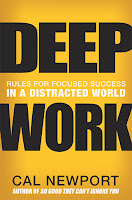
But I've found my best time management ideas in books that were about managing other kinds of work.Therefore, I have a copy of Newport's book Deep Work: Rules for Focused Success in a Distracted World. A summer read is something I think I can manage while continuing to recover from an elder's most recent health crisis. And if it leads to better use of whatever I have for work time when I start living the new normal, boolyah!

An Introduction To Deep Work


In Newport’s introduction to his book, he defines deep work as "Professional activities performed in a state of distraction-free concentration that push your cognitive capabilities to their limit. These efforts create new value, improve your skill, and are hard to replicate." Examples for writers would be...ah...writing. Creating new content.

Deep work sounds like working in flow.  Hmm. Unless flow states are used in order to work deep. One leads to another?

Newport argues that most “most modern knowledge workers” are “rapidly forgetting the value of going deep.” The reason? “Network tools.” By which he means, among other things, the social media that has become part of writers’ work, now that we do a big chunk of our own marketing.  This type of work Newport calls “shallow work."

He describes shallow work as "Noncognitively demanding, logistical-style tasks, often performed while distracted. These efforts tend to not create much new value in the world and are easy to replicate." Examples for writers would be growing a Twitter following, promoting books on Twitter, maintaining a presence on Goodreads, etc.

Shallow work is the enemy of deep work. "...fragmented attention cannot accommodate deep work, which requires long periods of uninterrupted thinking.”

So far, none of this is really news. In fact, Newport says that, himself. His more original argument is that as our culture shifts toward spending more and more time in the shallows, opportunities exist for the people who are capable of working deep. Because there aren't that many of them.

Think of this in terms of writing. For writers, marketing is the shallows. It doesn't require the kind of depth that producing new content does. (For  professional marketers, this may not be the case. Marketing may be their deep work, at least coming up with new marketing ideas.) I know one writer who has been writing successfully for many years describe how the percentage of time she spends writing has gone down, as she's had to spend more and more time promoting herself. I know of another writer who felt her first book sold, in part, because the publisher believed she had the marketing skills and drive to promote it. This is a case of a writer being rewarded for being good at shallow work or at least spending time doing it.

Nonetheless, no matter how good we are at the shallow stuff at some point we have to go deep enough to generate some content. Without the deep work, there's no need for the shallow work.

More to follow.