Showing posts with label 2012. Show all posts

Friday, October 15, 2021

One Thing Leads To Another

Last month I took a humor writing workshop through the Thurber House in Columbus, Ohio. Now, I could go on at great length here about the significance of this. My first humor writing workshop. Mr. Carswell telling me in 10th grade that something I'd written was Thurberesque. Visiting Thurber House in 2014. Liking the idea of Thurber more than liking his work. Yes, I could go on about all that, but...

Oh, wait. I just did.

Okay, what I really am interested in talking about now is the reading list provided by my workshop instructor, Janine Annett. It was two pages. I was so excited when I got it. Love me a reading list.

It included four humorous novels, one of them being Dear Committee Members by Julie Schumacher. It's written in letters, and at first I thought it was going to be one of those novels in letters back and forth between a couple of characters, which I really don't care for. But, no, these were all letters of recommendation from one college professor who is slowly (not too slowly) revealed to us. There is a story arc for him and at least one of his students. And it's all very entertaining.

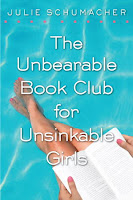
But that's not why we're here, folks! We're here because when I looked up Julie Schumacher, I discovered that she wrote a book called The Unbearable Book Club for Unsinkable Girls. A YA book I liked a lot back in 2012. Really, I thought it was a "marvelous, mainstream novel..." Evidently I'd had it with paranormal YA at that point. 

I believe I've often been disappointed when I've read the work of an author who has written for both adult and YA audiences. But that most definitely wasn't the case here. I'm going to read some of Schumacher's other work, because I often worry that someone will ask me the name of a favorite author. And, of course, I don't have one. But Schumacher could end up qualifying.

Now, to tightly tie my Schumacher reading experience back to the workshop I took--Dear Committee Member was on Janine Annett's, the workshop leader's, reading list. Additionally, it won the Thurber Prize for American Humor in 2015. She was the first woman to win the award.

Thurberesque.

Sunday, October 10, 2021

Sickbed Reading

Where I lived for 5 days.
Well, I lost an entire week of my life to an illness that wasn't Covid. I was out of commission for four days, though, and the following two days were up and down. I imagine I'll be napping this afternoon, too. I was sick enough that I even had to give up tweeting virtual author appearances, because I tagged a random guy with the same name as an author involved. I was able to read, but I kept moving back and forth between books. Not a lot of concentration.

Though maybe I do that, anyway.

I did, however, finish some interesting things. 

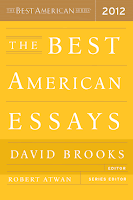
The Best American Essays 2012 I've had this thing on my Kindle for, I don't know, seven or eight years? Whenever it became available as a deal. I'd read a few of the essays, but it wasn't something I looked forward to getting back to, obviously.


Recently, I've been reading essays on Medium, where I've wondered if essays aren't just a bit different. I find them longer than I'd prefer. Rambling. Not staying on subject. Sometimes more personally focused than I'm interested in reading.

The essays in 2012 were also longer than I'm interested in reading. Sometimes authors will write about something, then relate it to books they've read, which should be enlightening, but... There was one essay about boredom that put me to sleep at least twice one morning on a particularly sick day. I woke up in the night, couldn't get back to sleep, thought, I'll try some more of that boredom essay. Knocked me right out. It was great.

Another essay was of interest to me, because it was about the author's friend who was beautiful. Doesn't sound as if the guy was someone you'd want to know, though. The author veered off into discussions of beauty. I didn't love the essay, but it made me think that maybe I'm not all that interested in beauty as a subject. That's significant because there is a character in 143 Canterbury Road whose beauty is remarked upon. I need to think about that.

Two essays I particularly liked: Killing My Body to Save My Mind by Lauren Slater and Outlaw by Jose Antonio Vargas. Both these essays are very personal. But they stay on task, making them on the short side for these kinds of volumes, and they deal with subjects that I am aware of, but haven't read about over and over again.

I walked away from this book--metaphorically, because I wasn't doing much walking last week--with a question--How do you go about choosing subjects for essays? Things like boredom and beauty or things much more from personal experience?

Suffering Succotash: A Picky Eater's Quest to Understand Why We Hate the Foods We Hate by Stephanie V. W. Lucianovic  I started this a couple of months ago, because we have a few truly picky eaters in our family, and it does have a big impact on their lives. My response to this book is interesting, because while with the essays I preferred the ones that were personal, I found this too memoirish for my taste. I was hoping for more help. Maybe there just isn't any.

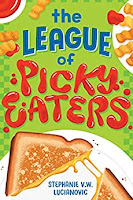
I'm mentioning this here, because Lucianovic now writes children's books, and next month she has one coming out called The League of Picky Eaters. I don't think I've ever seen this subject in a children's book, though there may be some out there. This one sounds very clever. I've sent a request to NetGalley, though I'm behind on posting about other NetGalley books, so I don't know how this will turn out.

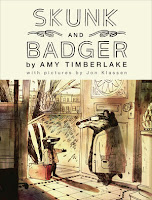
Skunk and Badger by Amy Timberlake with illustrations by Jon Klassen. This is an example of social media marketing working. Amy Timberlake ended up in my September Virtual Opportunities post, because she has a new Skunk and Badger book out right now, Egg Marks the Spot. While scrolling through available e-books from my library, I recognized her name on the first Skunk and Badger book and borrowed it. So the author and her book series got a reader, because of social media marketing, and now it is getting more social media marketing by way of this blog. 

Somehow I got the impression Skunk and Badger was going to be like Frog and Toad. I wouldn't make the comparison, myself, because I think it's for a much older age group, and is much more sophisticated. Which is not a bad thing. Not bad at all. 

Skunk and Badger are two loners who definitely need each other, though they're not at all alike. The reclusive and studious Badger struggles with coming to grips with the much more outgoing and somewhat chaotic Skunk. They inhabit a world with a village populated by other animals, and they have mail! Also, there are lots of chickens. 

A really lovely book.

Saturday, October 31, 2020

"Dragons Love Tacos" Is Talk Of The Town


A couple of days ago, someone on my town's Facebook page was looking for a copy of Dragons Love Tacos by Adam Rubin with illustrations by Daniel Salmieri. Her daughter had made a costume based on one of the characters and the mother just realized the girl needed to bring a copy of the book to school as well as the costume. 

Well, I had never heard of Dragons Love Tacos, though it appears to be kind of a big deal, but other people on that Facebook page had. Not only are there several copies in town for the original poster to borrow, someone has two.

I don't think I've ever seen any book talk at all on our town page, so congrats for attracting such attention, Dragons Love Tacos, an eight-year-old picture book that is still generating buzz in central Connecticut.

Friday, November 08, 2019

This Will Make You Think Twice About Going To The Mall. If You Aren't Already.

I've seen No Safety in Numbers by Dayna Lorentz described as The Hunger Games in a Mall, which I don't think is very accurate. No one is being entertained by what is going on. I've slaso seen it described as "apocalyptic." Nope. The best description I've come across is from the publisher. "A suspenseful survival story and modern day Lord of the Flies set in a mall that looks like yours."

Yeah.

A number of high school students, the same borderline cliche types you might see in a book with a high school setting, happen to go to the mall on the same day, at the same time. Unfortunately, it's a day and a time when a biological weapon is activated there. One of those kinds of biological weapons we hear about that causes people to get sick fast. The place is locked down. Use your imagination.

This is a good mash-up of traditional YA novel and adult thriller. There is no reason why this situation screams for YA characters. They could just as easily be adults. However, these teenagers really are teenagers, not adult characters passing as teenagers as I sometimes see in YA and adult thriller crossovers. Meaning this really is a YA book.

Though this is a first in a trilogy, I didn't feel I was being led on and teased with a nonending. The book was satisfying. Also, the book is from 2012. The rest of the series has been published, so you can binge.

A good example of why you should keep your eye out for older books you missed when they were shiny and new.


Friday, December 21, 2018

A Terrific Granny Book

I picked up Hubble Bubble Granny Trouble by Tracey Corderoy with illustrations by Joe Berger because the grandmother on the cover looked like fun. It turns out, she is.

Hubble Bubble is a good example of a picture book in which the text works very well with the illustrations. The word witch is never used. We get that totally from the illustrations, where it is obvious that Granny is a witch.

More importantly, though, she is a vigorous, healthy, even kind of hip grandmother witch. No sign of creaking joints. No hints of cognitive loss. No aging jokes. No aging sadness.

She's pretty unique, and not just because she's a witch.

Friday, June 16, 2017

Gauthier Reading

Here in the Gauthier family, we have a young relative who is fond of a particular kind of book, and I've got him pegged. I always have some specially selected library books here for him.

Now, he always rejects them in favor of books he brought with him, books which lean toward being about trains and trucks. Not that there's anything wrong with that, but, come on. Trains. Trucks.

Needless to say, I don't get him those things. I can't read train and truck books. Yikes. No, I get him what he really wants to read.

Hidden-Picture Picture Books


His favorite books, though he may not know it, but lucky for him, I do, are hidden picture books. The last time I had one for him, he kept insisting he didn't want to read it because he had five train books lined up for reading. Then I waved a page in front of him and finally caught his attention.

And once we were reading Where Did They Go? A Spotting Book by Emily Bornoff, he forgot about trains and trucks. For a while, anyway. Every two-page spread involves repetition of some natural element, and hidden among them is an animal described in a short text. Sooo much better than trucks, and better, even, than trains.


Where Oh Where Is My Underwear


We've all been in poor Polar Bear's position, hunting madly for underwear. In Polar Bear's Underwear by Tupera Tupera, readers get to look for his underwear, by which, of course, I mean underpants, too. This is one of those deals where you find underwear for everyone but the polar bear whose underwear you want. You go through a lot of underwear in this book.

These two books made for some great reading. Then I had to go back to trains and trucks.


Wednesday, January 25, 2017

A Book Of Colors For People Like Me

When my children were little, I really, really didn't enjoy those books with just a word here or there. Those Richard Scarry books with pictures of thing, thing, thing, for instance. By the time I'd point to "table," "chair," "cupboard" and read the words under them, I was done. And then there were books of shape, shape, shape. And, of course, books of color, color, color. When my oldest son was in kindergarten and his brother was in preschool, I started reading them novels, because I was that close to losing my mind.

How much I would have enjoyed reading them Golden Domes and Silver Lanterns by Hena Kahn with illustrations by Mehrdokht Amini.  "Blue is the hijab/Mom likes to wear./It's a scarf she uses to cover her hair." Real sentences! A beautiful two-page spread with something happening in it instead of a blue circle or square. Oh, my gosh. And eleven more colors are covered, including...get this...silver. Seriously, when do you see silver in a kids' book about colors?

I know picture books are for children, but adults have to read them, too. And that's why a beautiful book like Golden Domes and Silver Lanterns is such a treat. The biggest draw here is described in the book's subtitle, A Muslim Book of Colors. For nonMuslim readers like myself, the content of this book is unique. "Purple is an Eid gift/just for me./I open it up/and love what I see." I'd never heard of Eid before. It involves presents!

Golden Domes and Silver Lanterns is an example of why diverse books can be a pleasure. Sometimes it's just such a relief to read something new.

Friday, September 09, 2016

The Benefits Of A Binge Read

I'm always saying how much I wish I'd read a series in a binge, after several books had been published, instead slowly as they were published. Well, I stumbled upon the Zita the Spacegirl series by Ben Hatke at a local library and thought, Gail, here is your chance.

This was a great experience. Because when I read the first book, Zita the Spacegirl, I thought, That was okay. But as I read the others, Legends of Zita the Spacegirl and The Return of Zita the Spacegirl, I got more and more into this world and this girl's adventures. Seriously, I would have read another book.

These are well done graphic novels in that I don't think there is any narrative text at all. The entire story is told with dialogue and image. Readers have that marvelous experience of sucking in a story fast. I have to say that I sometimes found too much going on in some of the panels, but it didn't slow me down.

There are two things about Zita, herself, that are particularly terrific. One, she always comes up with a solution. And, two, though she is definitely a girl, she transcends gender. This is no pink and green princess story. This is a girl fighting her way across space. Any child can read this.

If you can get them all, read them one after another.

Friday, October 16, 2015

A Vacation Zombie Story

I had a little trouble sticking to A Girl of the Limberlost while I was on vacation, because I was also reading Dust & Decay by Jonathan Maberry. It's the second book in his Rot & Ruin series. I liked the first book, Rot & Ruin, for its western genre overtones and because it's one of the few apocalyptic novels I've read in which a second generation is fed up with the status quo and wants to move on.

While Rot & Ruin was a Wild West story with a lone lawman character, Dust & Decay is more of a lost in the Badlands tale. And, once again, the zombies are not the worst things main character Benny and his crowd have to contend with.

Thoughts on structure: Lots of point-of-view switches. As I've said before, I'm often bothered by point-of-view switches. They slow down narrative drive for me. That was not the case here. I noticed that many chapters were short, only a scene. I thought, Gee. Is this something I should try?

I got so into this book that while we were walking across the desert-like terrain of Dune National Lakeshore in Michigan, I kept wondering how the ol' zoms would fare there. Would that be a relatively safe place for humans? If the humans could stand it?

I was quite unhappy with how things turned out for one particular character who shall remain nameless. Yet, as a writer, a writer of books for young people, I think it was a very wise thing to have done.

So that was some good vacation reading. Good enough that when I got home, I picked up Flesh & Bone, Book 3. Now, Flesh & Bone would probably be considered a journey story, except that Benny and his guys are stopped dead in their tracks by post-apocalyptic religious creepies who are fighting among themselves. Our heroes are facing one disaster after another, all in the course of a day.

Interesting points: Fascinating thing the author did with that situation I was unhappy about in Book 2. Plus, Mayberry does a very good job with creating characters who are different from one another. Lilah and Riot, for instance. They could easily have ended up being mirror images. I realized while reading that Chong is truly different from Benny. All this is probably important to me because I just read a recent adult novel with a lot of buzz in which the three narrators sounded so much alike that I thought I was going to find out that they were all the same person.

Rot & Ruin is an excellent series for older, sophisticated teen readers. I say that not just because the books are grim, though they are, and I mean that in a positive way. They also don't deal with black-and-white situations. As I've mentioned elsewhere, the zombies are often not the worst things that have to be dealt with in this world. They're deadly, but in a benign way. The relationships between male and female characters aren't your traditional teen boy meets teen girl romances, either. These are people who are badly scarred by their experiences and have life-and-death issues they care about beyond who is going to end up with whom.

There appears to be only one more book in this series. I will, of course, be reading it.

Thursday, June 11, 2015

The Environmental Book Club

I had an interesting experience reading What Happens to Our Trash? by D. J. Ward with illustrations by Paul Meisel. I read parts of it aloud at dinner, which I was eating with a civil engineer. He approved the descriptions of the clay and plastic layers in the landfill. When I read, "The trash gets covered with dirt each day," he called out, "Daily cover!" When I read, "When a landfill becomes full, workers carefully cover it," he exclaimed, "Final cover!" (Those terms may date him. It's been a while since he's done design work for a landfill.) The book discusses landfills at some length.

In our part of New England, they're uncommon. We had them, and they ran out of space, just as Ward describes. And, yes, they're often turned into parks after they're closed, again as Ward says. Though we think the solar farm we saw along a bike trail last month may have started out as a landfill. It was peppered with pipes like the one to your left, that may have been there to deal with the methane Ward tells his readers about.

Believe it or not, two adults discussed this picture book over dinner. For instance, in other parts of the country, we theorized, where there is more open land, there are probably far more landfills, whereas we've had to move on to incinerators. And guess what? Ward writes about incinerators, too.

I think What Happens to Our Trash? would work well as a read-aloud with kids, so they can discuss how the book relates to their lives the way we did. Though maybe their read-aloud shouldn't be done at meal time.

Wednesday, June 10, 2015

A Little Darling Of A Book

I've read a few hunting-for-grandparent books over the years, beginning with Brendan Buckley's Universe and Everything in It by Sundee Frazier. I believe Penelope Crumb by Shawn K. Stout is the fourth. Years ago, some blogging buddy made a joke about three books meaning you had a new genre on your hands.

The other three books all involved children of mixed race, and the search for a grandparent involved identity. Penelope Crumb is a white child, and her search for her grandfather involves identity, too. Her father died before her birth, and she's never known his father. She becomes interested when she notices something about her appearance. She has a big nose. When her mother tells her she looks like the grandfather she's never known, she decides to hunt him down.

Penelope has a strong, well-defined personality. The book is written with subtlety and wit, particularly when you consider that it is marketed to students in the lower grades. Subtlety and wit are not often seen in books written for those kids. What do I mean by subtlety? Penelope is a first-person narrator who has a host of complaints about her older brother. Even so, we readers can see that the Alien has moments of almost caring for his little sister.

Three particularly interesting points about this story:

  • The nose. Penelope actually has a big nose, it's not just something she's concerned about as happens in many children's books. She's reasonably concerned about it, but at the same time, takes it in stride. Of course, she's in fourth grade, not eighth.
  • Graveyard Dead. Penelope often refers to people who are "Graveyard Dead" versus, say, people you might think are dead (like her grandfather) but aren't. Her father, for instance, is Graveyard Dead. Her father being Graveyard Dead doesn't distress her. It's more a fact of life.
  • Little Darling. Penelope is a well-loved child. Nonetheless, she has fantasies of loved ones saying things to her like, "Oh, little darling. Oh, my heart."  It's a fantasy that comes true.

Definitely my favorite hunting-for-grandparent book.

With illustrations by Valeria Docampo


Wednesday, March 18, 2015

But, Then, I Like Art Museums

Meet Me at the Art Museum by David Goldin is one of the easiest to take instructive picture books I can recall reading in quite some time. It uses the old night-at-the-museum situation with a docent's name tag giving a ticket stub an after-hours tour.

This thing gets really simplistic, going so far as to explain what a coat check room is and that there are signs all over the place telling you what to do. But, you know, it's a picture book. It's for kids who presumably have never been into a museum. When I go to a museum, I like to go to the coat check first thing.

What a curator does, what a conservator does, what an archivist does, what a historical artifact is...I love this stuff. I also loved the reproductions of artwork sprinkled throughout the book. On page 14 you'll see A Sunday Afternoon on the Island of La Grand Jatte by Georges-Pierre Seurat or, as one of my kids once told me, A Picture of a Woman Walking Her Monkey. I don't know why I'm so fond of that work.

Meet Me at the Art Museum would be a fine addition for libraries, schools...and museum bookstores!

Monday, March 09, 2015

More Royal Binge Reading Material

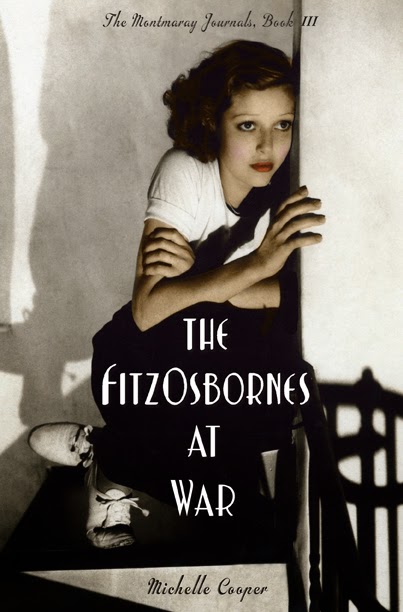
I've just completed reading the Montmaray Journals by Michelle Cooper, an account of the lives of an impoverished royal family from pre-World War II into the very early 1950s. I began the series back in 2012 with A Brief History of Montmaray, a strange, otherworldly story that I definitely enjoyed. I read Book Two, The FitzOsbornes in Exile, right after reading Book One. I don't know why I waited so long to get to The FitzOsbornes at War, but I didn't forget about it.

In the early pages of FitzOsbornes at War, I was definitely sorry I hadn't binge read these books. I was having trouble getting up to speed with the characters. But I did. I won't go so far as to say I couldn't put this final book down, but I was anxious to get back to it.

I thought The FitzOsbornes in Exile was probably a formulaic England-under-the-cloud-of-coming-war story. The FitzOsbornes at War is probably a formulaic London-during-the-Blitz story. It's just a really good one. Or maybe I just really like that formula.

With the first two books, I felt that the change to the characters' lives that gets their stories started didn't really start into well into the book. The change to the characters' world in FitzOsbornes at War is World War II, of course. Things got underway pretty early on this time. I did wonder, though, whose story this is. Sophie, who maintains these journals, is the least out-there of the royal FitzOsbornes. She's not as dramatic and charming as her brother, the king/pilot and younger sister (oh, Henry, Henry, I was in the Laundromat when I read...well, let's not go there), nor as brilliant and beautiful as her cousin. Her war experience is far more limited than the other FitzOsbornes. Her function is to record what happens to them. Is this her story of telling their stories or the family's story?

In one of the earlier books, HRH King Tobias' personal life is revealed but barely mentioned again in this final book. In the last pages of the book, which cover what happened to the family immediately after the war and includes a genealogical chart, those of us in the know can pick up a little something that might relate to it. I found what these royals ended up doing immediately after the war very interesting.

I have to wonder if this last book is actually Young Adult. Sophie, our main character, is nineteen when the war begins at the beginning of the book, meaning she is twenty-four by the end. The war experiences aren't anything that relate specifically to adolescence.

I don't find this to be a problem. The idea of a YA trilogy transitioning to adult is interesting.

Check out this post from author Michelle Cooper's blog in which she discusses some historical events she considered including in the Monmaray Journals and had to let go. Cooper's blog also indicates she's been doing research on the 1950s and '60s. What is coming up?

And, finally, this trilogy is completed so you can binge read. Don't wait for the last book the way I did.


Wednesday, February 25, 2015

Princely Binge Reading Material

My niece and I started a new series, beginning with The False Prince by Jennifer A. Nielsen. It appears to be a trilogy, not a marathon like the last series we read. I thought it dragged just a liiiittllllle bit, but I definitely like a well done unreliable narrator. The best part? Books 2 and 3 have been published. I can whip through these things the way I like to.

Oh, wait. The best part, really? My niece compared Sage in The False Prince to another character in a book I gave her three years ago. I can't tell you who or what or you will figure out an important, neat thing about The False Prince. I figured it out about two-thirds of the way through the book but it was one of those figure-something-out-in-a-cool way not a oh-my-gawd-why-didn't-she-just-put-up-a-road-sign? way. But my point is, Becki made that connection between those two characters, which I, of course, had already done. She wasn't telling me anything.

But she saw the connection between two characters from two books that I had given her. My work as an aunt is done.

And I will be reading the sequels to The False Prince.

Wednesday, January 28, 2015

If This Had Happened This Week, We Wouldn't Have Been Dancing In The Road

John Rocco has a picture book out called Blizzard that's been getting a lot of attention the last couple of months. It would have been terrific if I read that this past week and could write about it now after the events of the last couple of days here in New England. Yeah, well, that didn't happen.

I did pick up Rocco's earlier book, Blackout, from the library a while back. It would have been terrific if we'd had a power outage this week, a threat that was hanging over our heads this past weekend, and could write about it after reading Blackout. Yeah, well, that didn't happen, either.

But I'm still going to tell you about Blackout because it is beautiful. I am not the only person who thinks so, because it was a Caldecott Honor Book in 2012. It is beautiful looking with a lovely, simple story of people having a great time when the lights go out. That simple story is told without a lot of text, something that doesn't happen as often as you'd think with picture books.

By the way, Rocco also illustrated How to Train a Train by Jason Carter Eaton, which happens to be a big hit with a member of my family.

Thursday, December 11, 2014

The Environmental Book Club

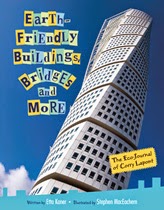
Not every page of Earth-friendly Buildings, Bridges and More by Etta Kaner with illustrations by Stephen MacEachern contains Earth-friendly content. Nonetheless, this is quite a marvelous book about the work that goes into building a variety of structures and how many of them are being built greener.

Though this is a nonfiction work, the basic premise is that an imaginary girl has been traveling with her engineer parents, and we are reading her scrapbook. She is one enthusiastic kid. Among the things I liked about Earth-friendly B, B and M:
  • While there is certainly content related to large buildings being made more green, there's also material about designing buildings to withstand earthquakes and storms. It's as if technology is working with Earth, not against it.
  • It gives readers a good idea of the number of people, the variety of engineers, for instance, necessary just for the planning of a big construction project. This is important because it helps to explain why building takes so long and is so expensive.
  • Technology has had a bad rap for many years now. The 1950's were filled with movies about science gone amock. I've read that The China Syndrome was a turning point in how science was perceived by the public in the '70s, that technology would lead to very bad things. First some guy is messing around with creating life, and the next thing you know, dinosaurs are coming back and eating people. But in Earth-friendly Buildings, Bridges and More, technology is portrayed as a good thing. Mom, Dad, an uncle, and a cousin are all engineers, all involved in creating or fixing things. Even if you're not a fan of tech, this is different.
The stereotype about environmental living involves natural fibers, whole grains, and funny light bulbs. But it takes technology to make real environmental progress, to find ways to heat and cool enormous buildings, for instance. Earth-friendly Buildings, Bridges and More can help young people recognize that.


Monday, August 04, 2014

Diana Wynne Jones, My Spiritual Sister

Last week during my tai chi class, I trained with a more experienced student. At the end of the class, my instructor informed me that I should tell my classmate, "Thank you, older sister" (in Chinese), not because Susan is older than I am, but because she's more experienced. I will spare you the details of how meaningful I find this in terms of the distinction between taekwondo and tai chi culture. I'm just mentioning it to explain why I was dwelling on the sister issue while reading Reflections on the Magic of Writing by Diana Wynne Jones this past week.

Reflections is a collection of  Jones' short nonfiction pieces written for magazines, speeches, and professional groups over several decades. She collected them herself a few months before she died, meaning these articles were ones she felt had particular significance. One of the things I like about this collection is that because it isn't written and edited all in one piece, there is repetition here. The repetition creates recurring themes related to Jones' attitudes about her work.

But I really like about this collection is that so many of Jones' attitudes are ones I share. She talks about creating experiences with her writing. I've thought of writing as creating worlds. She objects to writing that is supposed to instruct. Dear heavens, how I hate that. Over and over again I'm finding things in this book that make me feel that I've found some kind of soulmate.

Oh, and though there are a couple of chapters here on heroes, if Jones even mentions The Hero's Journey, I missed it.

And, finally, the book concludes with an address one of her son's gave at her funeral in which he talks about the tweets they'd seen recently about his mother's books being comfort books for this one or that one. Jones' Chrestomanci novels are my Number One comfort books.

There's just been an amazing amount for me, personally, in this book, making me feel an incredible connection to this woman I will never know.

August 16, 2014: Diana Wynne Jones should be referred to as "Jones," as corrected above, and not as "Wynne Jones."

Thursday, July 24, 2014

Environmental Book Club

The Plant Hunters by Anita Silvey turned out to be as marvelous as I thought when I started it last week.

The Plant Hunters deals with the naturalists who went all over the world hunting for new plants. While Silvey brings her book up to the present day, for the most part, she's dealing with seekers from the past, particularly the nineteenth century, a period when the search for new knowledge sent lots of people out into the unknown.

What Silvey does here that's so terrific is that she doesn't just write bio per chapter after bio per chapter. I thought that might be the case, after reading Chapter One, which is about Alexander von Humboldt. Instead, she organizes her chapters around topics. Say, Chapter 2 Why Did They Do It? While explaining why these people faced danger and made tremendous efforts to bring huge numbers of plants over long distances, she uses real people to illustrate her points. Every chapter is like that. They each are on a subject and the people involved get pulled in that way.

And the nineteenth century illustrations and the black and white photographs are so perfect.

The Author's Note has a great bit on how Silvey got the idea for this book while reading The Orchard Thief by Susan Orlean.

There's also a chapter on thieving westerners robbing other cultures of the crops they depended on. Well, no, that's not how Silvey put it. That's me. Those nineteenth century scholar/adventurers had a dark side, in my humble opinion.

This is a terrific book for older grade school students. It could even function as a quick introduction to this subject for much older readers. It might encourage a few plant hunters

Thursday, July 17, 2014

Environmental Book Club

Add caption
I've only read the intro and first chapter of The Plant Hunters by Anita Silvey, but I have great hopes for it. I found myself getting excited while still on the first paragraph:

"One got eaten by tigers in the Philippines; one died of fever in Ecuador; one drowned in the Orinoco River; one fell to his death in Sierra Leone. Another survived rheumatism, pleurisy, and dysentery while sailing the Yangtze River in China, only to be murdered later. A few ended their days in lunatic asylums; many simply vanished into thin air."

Silvey isn't talking about the work of some kind of curse. She's talking about the consequences of  amateur scholars following their passion for...plants. The nineteenth century appears to have been full of these kinds of people. Paleontologists. Egyptologists. And now botanists. I love them all. Well, not those guys who took boat loads of men to their deaths hunting for a pole. Trying to get some place doesn't grab me. Trying to acquire knowledge about the world most definitely does.

I'll keep you informed on this selection as I make my way through it.

Thursday, June 05, 2014

Environmental Book Club


I found another good book for our club.

I didn't expect to like Rachel Carson and Her Book That Changed the World by Laurie Lawlor with illustrations by Laura Beingessner as much as I did. Picture book bios are often problematic to me. They sometimes seem too old for picture book folks, too young for older ones, so who are they for? This one, not so much. Definitely for mid-grade school readers. Maybe third or fourth grade.

The first thing that struck me about this book is that very early on we hear that Rachel as a child explored the outdoors by herself and had a mother who had an interest in nature. This child got her start without any formal environmental instruction, such as we would want for children these days, and, yet, she turned into Rachel Carson.

Another thing I liked about this book, and, yes, this is just me, is that it describes a woman's story. Carson as a young woman had needy family to deal with. As often happens with achieving women of her era, she had help. In her case, her mother hustled to pull together money for school. She was encouraged by a female college professor. A male superior at the Bureau of Fisheries advised her to submit work to The Atlantic. She was a professional woman without a personal family. If you read the Epilogue, you'll find that after Silent Spring was published critics referred to her as "an hysterical woman." Someone asked "why a spinster with no children was so concerned about genetics."

Okay, so maybe I got into this story because of the feminist angle I read into it. But, really, the part in the beginning about simply growing up enjoying the outdoors was very significant, too.

Love the period illustrations, too.