Sunday, September 09, 2007

An Appropriate Post For A Sunday


I began my career as a Sunday school teacher in the preschool. You didn't have to know anything to teach the littlies. You prepared a craft and a snack, sang some songs, and spent three years memorizing The Lord's Prayer with them. Some years the curriculum wasn't even particularly Biblical. Entire lessons might be developed around thanking God for your various body parts.

Nonetheless, we covered the story of Noah's Ark plenty of times. It's a story that's associated with little kids. There's kiddie Noah music, books, puzzles, puppets, jewelry, book marks, and probably lots of stuff I can't recall. I know that on at least two occasions I provided snacks in the form of a Noah's Ark made out of graham crackers stuck together with icing. Animal cracker critters were stuck into icing, too.

I feel uncomfortable about having done that now that I've read Geraldine McCaughrean's Not the End of the World. Whatever made me (or anyone else) think the story of the destruction of mankind was a fun tale for the kiddies?

In McCaughrean's take on Noah, Timna, his daughter, who knows she doesn't matter and won't be remembered (explaining why she isn't mentioned in the Old Testament), tells the first-person story of the days preceding and following The Wave. Their neighbors thought Noah and his sons were mad for building that giant boat until the water came. Then they begged to be saved--and were rebuffed. Those two older boys, Shem and Ham, were the muscle enforcing what they believed to be God's will. God was intent on destroying all mankind, and the boys believed their function was to help him.

This is a grim, apocalyptic tale that kept reminding me of Life As We Knew It. In addition to the horrific events surrounding The Wave--bodies floating in the water, people being murdered by Shem and Ham--life on the ark with limited food and dampness spoiling what they have is ugly. Not the End of the World definitely works as a disaster story.

In addition, poor Timna is both a doubter and someone desperately trying to believe. The book is being marketed to twelve year olds and up. Though McCaughrean is able to reconcile the brutality of Noah and his sons with a more loving God by the end of the story, it's going to take a mature, sophisticated reader to handle this material.

As an added benefit, you can do a feminist reading of this book. For instance, Timna is fourteen, her younger brother, Japheth (one of the three sons of Noah named in the Bible--I read the appropriate verses today) is twelve. The night before The Wave comes, Japheth's older brothers go out and kidnap a girl for him to marry down the road, since those three boys are going to have to do some serious repopulating when this thing is over. Does anyone think about a future mate for Timna?

This is definitely a good book. I did have some problems with the structure, though. Occasionally the first-person narrator switches from Timna to other family members. I didn't think that worked particularly well, especially with Timna's sisters-in-law. They both came off sounding like the lesser members of a teen bitch posse. One of them even kept saying "you know." Their voices didn't sound all that different, either. By the end of the book, these young women are well-defined, but because of what Timna says about them, not because of anything they say about themselves.

What I did like was when some of the animals did first-person narration.

I'd been wanting to read more by McCaughrean ever since I read Peter Pan in Scarlet. As it turns out, I read her A Pack of Lies a number of years ago. Even when I've been dissatisfied with certain aspects of her books--the narrator switches in Not the End of the World, the ending of A Pack of Lies--I've been very impressed with her work.
Another One For My Collection

A Girl, a Boy, and a Monster Cat was recently reviewed at Big A, little a. I was very pleased with how that one turned out.

Friday, September 07, 2007

Madeleine L'Engle

I didn't have the kind of experience with Madeleine L'Engle's books that many of her fans recalled today when news of her death broke. I didn't read any of her work until I was an adult, and it didn't do for me what it clearly did for many others.

However, somewhere around nine to twelve years ago, I drove about an hour to hear her speak. I only went because the rest of the family was away for the weekend, and I wanted to do something different and writer-like with my found time. So I saw my chance to go hear a famous writer speak, and I grabbed it. I went by myself, and while sitting alone in a group of strangers, I felt my enthusiasm draining away. I wished I'd done something else with my free Saturday.

Then L'Engle was introduced and began to speak. I can't recall now what she said, just how I felt when I left there. Inspired and excited. I don't know how long that lasted, but it's good to come upon someone who can make you feel that way even if it's only for a while.

Magic Along The River


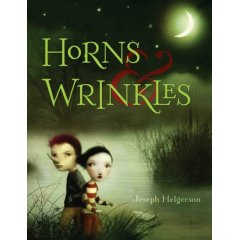
If you can believe there are trolls living in the Mississippi (never having been near the place, I can), you'll enjoy the charming Horns & Wrinkles by Joseph Helgerson.

Everyone in young Claire's family takes the magic associated with their part of the Mississippi for granted. So when her cousin the bully grows a horn in place of his nose, no one's happy about it, but no one is all that surprised, either. Even when his parents are turned to stone by trolls, the relatives know there's precedent for it.

Cousin Duke falls in with a bad crowd, as bullies often do, and Claire takes after him, hoping to find the key to turning the stone family members back to flesh. One thing leads to another, and she just keeps getting in deeper and deeper and deeper.

Horns & Wrinkles is a clever, well-written book with a spunky (but not cloyingly so) protagonist and amusing antagonists. Its author does interesting things with bullies and those traditional fairies who normally annoy me so. It's an attractive looking book, too, with a couple of surprises.

Thursday, September 06, 2007

Short Bits

I've droned on and on here recently, so today I'll give everyone a break and just do some short bits.

I'm sure others have already posted about this, but it's only recently stuck in my mind that the SciFi Channel is doing a mini-series in December called Tin Man. Guess what that's about. I think I've read that the Tin Man is a former cop in this version. I will watch.

I'd never heard of the Mythopoeic Society before yesterday. It's a "non-profit international literary and educational organization for the study, discussion, and enjoyment of fantastic and mythic literature." It recently gave its award for children's literature to Catherine Fisher for Corbenic, one of my favorites from last year.

Heather Smith did a very interesting article for her Judging a Book by its Cover series at Bookslut on the new covers created by David Wiesner for The Chronicles of Narnia. (You've heard of Wiesner. He won the Caldecott Medal for Flotsam.) I enjoyed the article, and I don't even like The Chronicles of Narnia. Couldn't get past the first book.

Bookseller Chick has a discussion going on whether or not writers build readership with blogs.

Mitali Perkins is back from vacation. Two months in an RV. Woman, are you mad?

Wednesday, September 05, 2007

A Little Good News If You Have The Endurance To Look For It

If you decide to read Goodbye to All That by Steve Wasserman in the Columbia Journalism Review you can just skim a big portion of the first part because it's just a rundown on all the newspapers that have been cutting back on or doing away with their book review sections, which you probably already know about. In the rest of the piece you will learn that: 1. book review sections have been losing money for a long time; 2. Margaret Fuller was the first full-time book reviewer in the U.S.*; 3. literary critics think rather a lot of themselves and of serious readers; 4. traditional newspaper people don't think much of book reviewers; 5. the contemporary reading situation may not be all that bad.

I suspect I'm one of those hairy-chested populists (metaphorically speaking, please) Wasserman quotes Richard Schickel as referring to. After offering up that warning, I will say that I thought there was a lot of interesting material in this article, but I also thought it rambled a bit; it was difficult to determine if there was one overall point the author was trying to make or a number of them. A lot of us who are not New York Review of Books types will probably drift off before we get to the end. But that may be okay with the author. He may not have been writing for us, anyway.

ArtsJournal.com provided the link.

*Important if you studied her in your feminist history college course.

Next Day Update: Critical Mass has a post describing this article, too. Check it out for a more detailed account of what's covered in Wasserman's essay.

Tuesday, September 04, 2007

I Come To Praise Book Awards, Not Bury Them. I Promise.

I don't do a lot of announcing of traditional book award winners here because I have my doubts about whether there is any such thing as a best book. Each year there's a pool of really superior books in any particular field, and I wonder if one should be elevated above the rest. What do the awards mean? The criteria remain the same from year to year, but the judges change so those criteria aren't necessarily applied exactly the same way each year. On top of all that, some contests require an entry fee. The National Book Award, for instance, has a $125 entry fee. How many books will a publisher submit at $125 a pop? I learned this past year of a publisher that has a policy of not submitting books for awards with entry fees. (I wanted to ask if that included the National Book Award, but given the particular circumstances it might have been considered argumentative.) What if the best book of the year for a particular award was never even considered because it wasn't entered?

So, you see, I take the whole winning-book thing with a grain of salt.

However, I do like book awards that include a list of announced finalists because that means some of those books from that pool of superior books I was talking about earlier are brought to the public's attention. This is why I was so enthusiastic about the Cybils, by the way. While committee members creating the shortlist read nominated books, they could blog about them, promoting many titles.


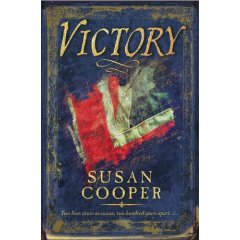
This is all the lead in for how I came to finally read a book by Susan Cooper. You know, The Dark Is Rising Susan Cooper? Never read a word she'd written until her most recent book Victory was named a finalist for this year's Connecticut Book Award for Children's Author. I was writing a short overview of the finalists for a Connecticut publication, so I finally had to read a Cooper book.

I'm so glad I did.

The basic story behind Victory will be familiar to many adult readers. A contemporary person feels a strong personal connection to someone who lived long in the past. Cooper just does a great job with her version.

In this case, young Molly is an English girl who has moved to Connecticut with her mother who has married an American. This is no tale of a disfunctional family. Molly's stepfather is great. Her stepbrother is great. Her mother has a new baby who is great. Everyone loves Molly and wants the best for her. Nonetheless, she is suffering from the relocation. She just wants to go home.

She buys an old book on Lord Horatio Nelson who, evidently, to this day is a major hero/symbol in Billy Shakespeare country. And that is how she forms a connection with a boy who served on HMS Victory, Admiral Lord Nelson's flagship, the very one upon which he died during the Battle of Trafalgar.

These two children's stories are told in alternating chapters. Molly's is told in the present tense, which is nifty since it's taking place in the present. Sam's is told in the past, which is nifty for a similar reason. Molly's story is elegant. Sam's is richly detailed. I'm not much of an ocean-going sort, myself. When I visit Mystic Seaport (which plays a part in this book), those old boats seem like nothing so much as floating coffins to me. So little wonder I at first preferred Molly's story to Sam's as I read Victory. But about halfway through the book that changed. Cooper won me over, and I couldn't wait to get back to Sam.

As I was reading Victory, I wondered if it was a book for history geeks like myself who have either had our own experiences connecting with figures from the past or desperately want one. I don't think so.

If reading Victory makes you a bit of a Nelson groupy and you'd like to read a fine adult novel in which he plays a part, try Losing Nelson by Barry Unsworth.

Monday, September 03, 2007

Under The Radar

Oh, golly. My mind is just like my desk. Littered with things I can't find or have forgotten about.

I meant to comment on the Recommendations From Under the Radar program at the end of the week, but forgot about it until after this next one got started. I'll comment anyway, even though it's now old news, because I think that bloggers, going our own way and following our own schedules, are in the perfect position to keep reminding people about older titles. It's a bit of a mission as far as I'm concerned.

So here are a few things I noticed while trying to keep up with the Under the Radar schedule:

Leila at bookshelves of doom did a post on the Olivia Kidney series by Ellen Potter. I read the first book during the first 48 Hour Book Challenge. I liked it, though I didn't have much to say at the time. Leila described the book as hard to classify. It was recommended to me as an example of magical realism, whether that explains anything or muddies the waters still further.

Kelly at Big A, little a wrote about The Ingo series by Ellen Dunmore. I happen to own the second book, The Tide Knot. I don't like to read a lot about a book before I actually read it myself, so I've only read Kelly's description of the first book in the series.

Betsy at A Fuse #8 Production recommended The Noisy Counting Book. I know nothing about this book. However, the author and illustrator, Susan Schade and Jon Buller, wrote and illustrated Travels of Thelonious, a favorite of mine from last year.

And finally TadMack at Finding Wonderland did a post on something called The Avion My Uncle Flew that sounds just marvelous.

So you're hearing about these four titles one more time. Remember them when they turn up some day on your own personal radar.

What Happened With Butch And Spike?

Remember last week's drawing for A Year With Butch And Spike? A copy has been inscribed for three brothers from Indiana and is going into the mail tomorrow.

If I don't forget, I'll do another giveaway at Halloween because Butch and Spike has a Halloween chapter. Club Earth has a Thanksgiving chapter, so I'll give away copy of that at the end of November. Then in December I'll be giving away a copy of My Life Among the Aliens because--you guessed it--that has a Christmas chapter.

So you can get freebies here for the next quarter year.

Tomorrow I'm also going to be sending out an arc for A Girl, a Boy, and a Monster Cat. I have two more left. Contact me through my web page if you'd like one.

Sunday, September 02, 2007

I Was Put Off My Dinner

My responses to the things that happen to me often seem to relate to my work or the way I work. For instance, last night we went out to a friend's house for dinner. I caught sight of her office. It's half the size of mine and immaculate. It looks like something from HGTV.

Mine, on the other hand, looks as if it's the home of a very unhealthy mind. Last summer I cleaned it and managed to keep it clean for months. It's just been falling apart all year. If I could find my digital camera and figure out how to upload pictures from it, I'd show you.

If you were to see my office on TV, it would probably be on an episode of SVU. It would belong to a perpetrator, and, remember, the perps on SVU are guilty of especially heinous crimes. Benson would take one look at it and make a disparaging comment about the kind of person who could live like this. Stabler would start putting on his gloves. They'd be turning the case over to the assistant district attorney right after the commercial because it went without saying that the evidence they needed was somewhere right in front of them.

Well, I could worry about this. Come down to the office in the night and try to clean. Seek help. But I think this is another one of those situations where you have to take a Zen-like approach and remember that envying others their tidy offices and healthy minds will lead to nothing but unhappiness.