Here is my total knowledge of the subjunctive, such as it is:
Verbs are moody. They have three moods. One mood is the indicative, which is a statement or a question. One mood is the imperative, which is a command or an order. And one mood is the subjunctive, which is...ah...not used much any more, thank goodness.
You use the subjunctive when you want to set up a situation that doesn't actually exist but could if things were different. I'm aware of it most often with the verb "to be." Normally, the first-person past tense of the verb "to be" is I was. But with the subjunctive, the first-person past tense of the verb "to be" is I were. Thus, you would say "If I were taller, I would look thinner" and not "If I was taller, I would look thinner."
If I have this all wrong, feel free to comment.
Now, I almost got through life without knowing the first thing about the subjunctive. (And even now I probably know only the first thing about it.) However, when I was in college my boyfriend invited me to his home to meet his family. Before the big day, said boyfriend became all apologetic and said something like, "I've got to warn you about my father."
I'm thinking, What? Does the guy walk around in his boxers? Chew tobacco and spit? What?
No. "My father knows you're an English major, and he's sure to ask you about the subjunctive. He's got a thing about the subjunctive."
Now, keep in mind that my boyfriend didn't actually know what the subjunctive was, himself. In fact, he was an engineering student and his father was an engineering professor. Why did any of them ever talk about the subjunctive at all?
So I had to hit the books in order to meet my boyfriend's father.
Even so, I did not have a good grip on the subject. And, sure enough, it did come up. I don't recall how, but my boyfriend's father did start talking about it, and he ended the subjunctive conversation with, "It is my favorite mood."
These kinds of things used to happen to me quite often. People would say things to me like, "Hey, you were an English major, right? So what's the difference between a clause and a phrase?"
You know how anyone with any kind of medical training at all will have people ask her to look at their moles? Well, I used to get the same thing, only about grammar and usage.
I probably would do better looking at moles.
Not everyone suffers from grammar and usage anxiety the way I do. We will cover that in Grammar and Usage, Part III.
Monday, July 31, 2006
Neighborhood News
I have been vaguely aware that J. K. Rowling is going to be reading somewhere with two other authors. I wasn't paying much attention until about fifteen minutes ago. I was going for a walk on my street when Kate the nursing student who lives next door to me drove by and stopped to tell me that she is so incredibly excited because she's going to New York City tomorrow! To Radio City Music Hall! To hear J. K. Rowling read!
This nineteen-year-old young woman was delighted at the prospect of listening to an author read from her work. Kate had been trying to get affordable tickets and had given up. Then a friend, who was supposed to go with his mother, ended up having an extra ticket because mom had very poorly-timed back surgery.
So Kate's making a trip into the city. To hear an author.
Now, I'm not the world's biggest Harry Potter fan. But I have to say that it did my jaded old heart a world of good to see Harry and Rowling bringing so much excitement and happiness to someone.
Rowling is going to be reading with Stephen King and John Irving. As I was finishing my walk, I was thinking that it was a great idea to bring these three very different authors together. Each author will bring her or his fans to the event, and those fans will then be exposed to the other authors' work.
As if Rowling, Irving, and King need more exposure. But, still, it's a good idea.
By the way, Katie O. in My Life Among the Aliens and Club Earth was named for the Kate who lives next door to me and is going to Radio City Music Hall tomorrow.
This nineteen-year-old young woman was delighted at the prospect of listening to an author read from her work. Kate had been trying to get affordable tickets and had given up. Then a friend, who was supposed to go with his mother, ended up having an extra ticket because mom had very poorly-timed back surgery.
So Kate's making a trip into the city. To hear an author.
Now, I'm not the world's biggest Harry Potter fan. But I have to say that it did my jaded old heart a world of good to see Harry and Rowling bringing so much excitement and happiness to someone.
Rowling is going to be reading with Stephen King and John Irving. As I was finishing my walk, I was thinking that it was a great idea to bring these three very different authors together. Each author will bring her or his fans to the event, and those fans will then be exposed to the other authors' work.
As if Rowling, Irving, and King need more exposure. But, still, it's a good idea.
By the way, Katie O. in My Life Among the Aliens and Club Earth was named for the Kate who lives next door to me and is going to Radio City Music Hall tomorrow.
Sunday, July 30, 2006
Grammar and Usage and Stuff Part I
I've been reading Word Court by Barbara Wallraff. I found the book on my To Be Read shelf, where it has lived, neglected and unread, for years.
Word Court's cover has a "design element" that includes the line "Wherein verbal virtue is rewarded, crimes against the language are punished, and poetic justice is done." So I thought it would be a light, easy way to learn something about grammar and/or usage, which is the only way I'm ever going to learn anything about grammar and/or usage.
Every now and then I buy and try to read books of this type. I have The Transitive Vampire, A Handbook of Grammar for the Innocent, the Eager, and the Doomed and The Well-tempered Sentence, A Punctuation Handbook for the Innocent, the Eager, and the Doomed both by Karen Elizabeth Gordon. Neither of them did me much good. I have marked them up nicely, but I can't remember why.
I am definitely not one of those word and grammar people who worries about the state of the language and gleefully pounces on errors in newspaper headlines. An error in a newspaper headline has to be really bad before I'll even notice it.
I'm interested in grammar and usage because
1. I believe writing is all about communication. I think an understanding of grammar and language means we can all communicate better, whether we initiate a communication by writing it or we receive a communication by reading it.
2. I don't want to look as if I don't know what I'm doing. I don't want to look like a fool. I don't mean that anyone who makes grammatical errors looks like a fool. But I'm a writer. If I make obvious errors, I'm afraid editors, reviewers, librarians, booksellers, readers, and students in AP English won't take me seriously.
I have it on good authority that the copy editors at Putnam get together and talk about the way I use commas. I've also heard there's been some talk around the water cooler about whether I the use of the subjunctive.
I do, as a matter of fact. I don't use it a lot because I don't think any self-respecting child would use it.
This leads to my subjunctive story. I recalled the subjunctive story recently because I'm reading Word Court, as I mentioned earlier. Because of Word Court, I am dwelling on all kinds of things grammatical and...wordie. I'm talking about such things at the dinner table.
I'm going to be writing about such things here.
You can look forward to reading my subjunctive story in Grammar and Usage and Stuff Part II.
Word Court's cover has a "design element" that includes the line "Wherein verbal virtue is rewarded, crimes against the language are punished, and poetic justice is done." So I thought it would be a light, easy way to learn something about grammar and/or usage, which is the only way I'm ever going to learn anything about grammar and/or usage.
Every now and then I buy and try to read books of this type. I have The Transitive Vampire, A Handbook of Grammar for the Innocent, the Eager, and the Doomed and The Well-tempered Sentence, A Punctuation Handbook for the Innocent, the Eager, and the Doomed both by Karen Elizabeth Gordon. Neither of them did me much good. I have marked them up nicely, but I can't remember why.
I am definitely not one of those word and grammar people who worries about the state of the language and gleefully pounces on errors in newspaper headlines. An error in a newspaper headline has to be really bad before I'll even notice it.
I'm interested in grammar and usage because
1. I believe writing is all about communication. I think an understanding of grammar and language means we can all communicate better, whether we initiate a communication by writing it or we receive a communication by reading it.
2. I don't want to look as if I don't know what I'm doing. I don't want to look like a fool. I don't mean that anyone who makes grammatical errors looks like a fool. But I'm a writer. If I make obvious errors, I'm afraid editors, reviewers, librarians, booksellers, readers, and students in AP English won't take me seriously.
I have it on good authority that the copy editors at Putnam get together and talk about the way I use commas. I've also heard there's been some talk around the water cooler about whether I the use of the subjunctive.
I do, as a matter of fact. I don't use it a lot because I don't think any self-respecting child would use it.
This leads to my subjunctive story. I recalled the subjunctive story recently because I'm reading Word Court, as I mentioned earlier. Because of Word Court, I am dwelling on all kinds of things grammatical and...wordie. I'm talking about such things at the dinner table.
I'm going to be writing about such things here.
You can look forward to reading my subjunctive story in Grammar and Usage and Stuff Part II.
Saturday, July 29, 2006
This Is Sad
Paul Acampora discovered that the author of the Wall Street Journal essay that shook the Internet is an intern.
Good journalism on Paul's part. The intern...well, here's hoping he lives and learns.
As far as I'm concerned, he didn't do anything wrong by writing an essay that so many people, myself included, disagree with. No, what he did wrong, in my humble opinion, was select a cliched angle for his essay. Trashing kidlit has been done to death. He didn't have anything new to say on the subject.
What if he was told he had to write an essay disparaging summer reading lists? He should have come up with a new angle. He could have suggested, for instance, that summer reading lists shouldn't exist at all. That would have been different. Or he could have written about schools that require students to read a certain number of books each summer off a list and what students have to do to prove they've read them. I have young family members whose first English assignment of the school year related to their summer reading. This meant, of course, that they read a book off the list the weekend before school started.
It's sad to think of this poor young intern just rehashing what older writers have already written. Shouldn't his summer writing experience amounted to something more?
NOTE: This post was revised. I'm not at all certain if a blogger should revise a post, but I was unhappy with one of the paragraphs. And once I start revising, I find it hard to limit myself to one paragraph.
Good journalism on Paul's part. The intern...well, here's hoping he lives and learns.
As far as I'm concerned, he didn't do anything wrong by writing an essay that so many people, myself included, disagree with. No, what he did wrong, in my humble opinion, was select a cliched angle for his essay. Trashing kidlit has been done to death. He didn't have anything new to say on the subject.
What if he was told he had to write an essay disparaging summer reading lists? He should have come up with a new angle. He could have suggested, for instance, that summer reading lists shouldn't exist at all. That would have been different. Or he could have written about schools that require students to read a certain number of books each summer off a list and what students have to do to prove they've read them. I have young family members whose first English assignment of the school year related to their summer reading. This meant, of course, that they read a book off the list the weekend before school started.
It's sad to think of this poor young intern just rehashing what older writers have already written. Shouldn't his summer writing experience amounted to something more?
NOTE: This post was revised. I'm not at all certain if a blogger should revise a post, but I was unhappy with one of the paragraphs. And once I start revising, I find it hard to limit myself to one paragraph.
A Favorite Gaiman Children's Book
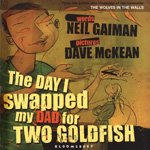
My feelings about Neal Gaiman's books are all over the place. I'm a big fan of American Gods and Good Omens (written with Terry Pratchett). I thought Anansi Boys was clever and amusing enough. I thought Stardust was kind of run-of-the-mill. I didn't get The Sandman Nocturnes and Preludes, though I'd be willing to try it again. I didn't care for his children's books, Coraline and Wolves in the Walls.
But last night I read The Day I Swapped My Dad for Two Goldfish. I loved it. The narrator of this picture book swaps his dad, who is intently reading the newspaper, for two goldfish. His mother insists he get his dad back, and he and his sister then have to follow their dad's trail--because he's been traded over and over again.
What's so terrific about this story is the total acceptance of this improbable premise.
My copy of the book--new to my library--appears to be a 2001 re-release. The book was originally published in 1997, before Coraline and Wolves. My copy included a CD at the back on which Gaiman reads the story. So serious Gaiman fans can hear his voice.
Thursday, July 27, 2006
This Is Why I Don't Have Anything To Do With Summer Reading Lists
The kidlit blogosphere is absolutely burning up today over what appears to be an opinion piece in The Wall Street Journal. Literary Losers is another rant--though a blessedly short one--on the sorry state of children's literature. This one focuses on summer reading lists, which are called uninspiring and said to be filled with formula fiction.
First, off, I'd just like to say that I believe attacking children's and YA literature has become a cheap and easy way for publications and/or freelance writers to create a little controversy. Personally, I'm getting bored with it.
In the second place, I can't stand people telling me what I should be reading, and I can't see why children should feel any differently.
In the third place, come on, are The Secret Garden and The Wind in the Willows, two so-called classics The Wall Street Journal would like to see on summer reading lists, seriously important works that children will find all that inspiring? They sure didn't do anything for me.
There may well be a lot of fluffy light-weight titles on summer reading lists. (I can't say for sure, because I try to avoid them.) However, hasn't The Wall Street Journal also gone the tired and worn-out route with its suggestions?
As other bloggers have noted, there's not much going on in the kidlit world right now. Believe me, if there were, I wouldn't be bothering with this.
First, off, I'd just like to say that I believe attacking children's and YA literature has become a cheap and easy way for publications and/or freelance writers to create a little controversy. Personally, I'm getting bored with it.
In the second place, I can't stand people telling me what I should be reading, and I can't see why children should feel any differently.
In the third place, come on, are The Secret Garden and The Wind in the Willows, two so-called classics The Wall Street Journal would like to see on summer reading lists, seriously important works that children will find all that inspiring? They sure didn't do anything for me.
There may well be a lot of fluffy light-weight titles on summer reading lists. (I can't say for sure, because I try to avoid them.) However, hasn't The Wall Street Journal also gone the tired and worn-out route with its suggestions?
As other bloggers have noted, there's not much going on in the kidlit world right now. Believe me, if there were, I wouldn't be bothering with this.
Wednesday, July 26, 2006
Happy Gail!
I learned yesterday that Happy Kid! received a good review in the July issue of School Library Journal. It's already up at Amazon.
I also found out a couple of days ago that my alumni magazine gave Happy Kid! a nice paragraph in its sidebar to its book column. This was particularly gratifying because I'd sent the editor a press packet back before Christmas as part of my big marketing plan. When nothing appeared in the spring issue, I thought I wasn't going to get any coverage.
And, finally, I'm happy, happy, happy because I'm just a few pages away from finishing the first draft of the second Brandon and Hannah book. I'm hoping to have it in the mail on Monday. And then it's fun time for August! I'm going to:
work on short-term projects like essays and short stories
update my website
catch up on A Novel In A Year
clean my desk
read a lot more at the Storyglossia weblog
paint my bedroom
maybe buy a new car
I am so excited.
I also found out a couple of days ago that my alumni magazine gave Happy Kid! a nice paragraph in its sidebar to its book column. This was particularly gratifying because I'd sent the editor a press packet back before Christmas as part of my big marketing plan. When nothing appeared in the spring issue, I thought I wasn't going to get any coverage.
And, finally, I'm happy, happy, happy because I'm just a few pages away from finishing the first draft of the second Brandon and Hannah book. I'm hoping to have it in the mail on Monday. And then it's fun time for August! I'm going to:
work on short-term projects like essays and short stories
update my website
catch up on A Novel In A Year
clean my desk
read a lot more at the Storyglossia weblog
paint my bedroom
maybe buy a new car
I am so excited.
Tuesday, July 25, 2006
Maurice Gee
Someone at child_lit let the rest of us know that Maurice Gee has won a major award in his native country, New Zealand.
I am a big fan of one of Gee's earlier books, The Fat Man. It's a Depression-era story that came out a few years before Out of the Dust, which I didn't care for nearly as much.
Evidently The Fat Man was controversial at the time of its publication. The controversy seemed to focus on whether the book should be classified as children's or YA. (One of my favorite questions, right!?) It was classified in the Junior Fiction category for judging purposes for the New Zealand children's book awards and won in that category as well as their Supreme catgory even though one critic said "that at a stroke the judges had deprived children of their innocence; the book 'neatly equated' evil with physical imperfection; moreover, it would disturb or even damage nine to 12-year-olds."
Well, I loved the book. The child main character was a little flawed, the bad guy had some legitimate complaints, the book made readers feel the desperation that I assume people felt during that period, and the ending...Well, let's just say the ending was thought provoking.
At Amazon you'll find some unflattering reader reviews for The Fat Man from what appear to be child readers. In an attempt at fair play, I feel I have to acknowledge them. There are only a few of them--there are only a few reader reviews, period. Do they mean anything? As usual, I just don't know.
Monday, July 24, 2006
I Am Overwhelmed--Yeah, Again
Kelly is hosting what I think is the largest Carnival of Children's Literature yet over at Big A little a. I found an enormous list of new-to-me blogs there. I couldn't get through them all this evening, and just trying meant I had to pass on reading my usual evening blogs.
It is a huge carnival.
It is a huge carnival.
"A Gloriously Fearless Heroine"
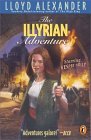 Last week, I was looking for a kids' quest story. What I found was The Illyrian Adventure by Lloyd Alexander. I've certainly heard of Alexander, but I'd never read anything by him.
Well, now I have.
On the backflap to the 1986 hardcover of this book, Alexander says, "The Illyrian Adventure was intended as an entertainment, with a gloriously fearless heroine, legendary heroes, inscrutable mysteries, and fiendish villains." I don't know how inscrutable the mystery was and the villain was a garden-variety fiend. But the heroine, Vesper Holly, was gloriously fearless.
The Illyrian Adventure reminded me of the historical novels I enjoyed when I was a teenager--a strong, outside-the-box heroine in a historical setting. The book is actually narrated by the orphaned Vesper's guardian, a somewhat inept, Watson-type figure who is constantly referring to her as "dear girl."
I've known of mothers looking for books with strong girl characters for their young daughters. The Illyrian Adventure would be a good suggestion. It's the first in a series of Vesper Holly books that girls in, say, fourth through seventh grade could really enjoy.
One objection--I read a book from the 1980s with a cover fitting with the historical period (1872) in which the story takes place. The new covers on the current paperbacks look as if Vesper is a cross between a camp counselor and Indiana Jones (who I've never cared for, by the way). I'm not certain, but I don't think her hair is even the right color, forget about being a style that would fit her time period.
The Vesper on the cover definitely clashes with the Vesper in the book.
Subscribe to:
Posts (Atom)