Shannon Hale has a post up on tumbler today called Writing and Mother: How I (Sort of) Do Both, in which she lays down a few hard truths about working and parenting. She uses the term "care giver" several times, and if she had used it in the title of her piece, it would have made it more universal, capable of covering more of human experience. The experience of elder care, for instance, which is remarkably like child care in terms of the time and effort and degree of intensity involved.
Hale says, "I need help." Yes, care givers do. After years of working to keep one elder in her apartment, her condition deteriorated to the point that she needed placement in a skilled nursing facility. For the other elder, we have given up trying to maintain her home ourselves. Landscapers do her lawn and driveway. We hire contractors for house maintenance. We're going to be looking for contractors to do some work in our own yard. But even the search for the help seems to be too time consuming.
Hale says, "The balance is insane." To which I have to say, "What balance?" There's nothing even remotely like balance here.
Hale says, "I can write. I can mother. And that’s it." Yes, I can sort of write. I can sort of take care of a variety of family problems. I can barely manage my own life maintenance. (We haven't had much time to eat particularly well these last two years, which may have been a factor in my illness last month.) And that's it. All the things Hale talks about giving up are gone for me, too.
Hale says, "I take a day of rest." She's right. She should. I should. The family problems and commitments don't take weekends off. Not even Sundays.
Hale says, "Writing is not a hobby." I fear nearly every day that I will get to the point when I am only writing when I have absolutely nothing else to do. And then I will have to accept that I am not a writer any more.
Hale: "I know it’s the right thing for me." Gauthier: "It's pretty much the only thing for me. I've kind of worked myself into a box here."
Hale ends her post by pointing out that not everyone has to write, that it's possible to be happy doing other things while raising children. I'll end mine by pointing out that writers aren't the only people struggling with work and care giving. We just are so very aware of it because we have so little in the way of boundaries between our professional and personal lives.
Showing posts with label Shannon Hale. Show all posts
Showing posts with label Shannon Hale. Show all posts
Monday, June 17, 2013
Wednesday, January 30, 2013
Austenland Coming To The Big Screen
I read Austenland by Shannon Hale a few years ago and thought it an interesting work. I have to say, though, for me the big draw for the movie is Jennifer Coolidge. However, Jane Seymour looks pretty commanding in the one trailer I've been able to find.
Thursday, January 22, 2009
Vacation Reading: Book Three, Another Kind Of Fantasy
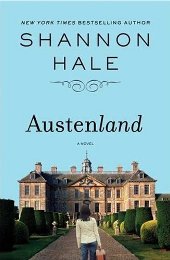
While I've done my fair share of reading of Jane Austen, favoring Pride and Prejudice like so many other readers, I can't say I get the love for Mr. Darcy that I'm always hearing about. Sure, I enjoy the I hate you, I hate you, I love you relationship between the P&P male and female leads, a formula that Austen may have created. But, seriously, Darcy doesn't sound like a whole lot of fun to live with to me, I don't care how many wet shirt scenes actors do while playing him. (Did anyone else think Pandering to the audience while watching that? Did anyone else think about how exploitative that scene--which does not appear in the book--would have been if it had involved a woman instead of a man? Nah, I guess not.)
I'm not all that interested in the romances Jane Austen wrote about. They're sort of beside the point to me. I'm interested in her. I like the sharpness of her observations, and the world she creates in her books. I like the way she makes me feel that there have always been women who stepped to another drummer.
All this build-up is to explain why I felt some reservations about sitting down to read Austenland by Shannon Hale, as my third vacation book. I've liked some of Hale's work, but other things I found "girly". Fairy-tale-like fantasies seem to be her turf, and though she often gave them a bit of a feminist, "girl-power" spin, they still seemed very "girly" for my taste.
But my attitude toward her work changed after reading Austenland, her adult novel about thirty-something Jane, a Pride and Prejudice junky who can't find happiness in love because of her obsession with Mr. Darcy. Now I see Hale as someone who is, indeed, attracted to what might be called fairy tale fantasies but who also looks at them and goes, "Oh, come on!"
For instance, Jane in Austenland inherits a week at what might be described as a very high class Jane Austen theme park--Austenland. Well-heeled women with Austen fantasies dress up in early nineteenth century fashions and live with Austen re-enactors, a number of whom are handsome men who develop Austen-like romantic relationships with the often middle aged clientele.
But unless this feminist of a certain age was reading too much into this tale, Hale doesn't just lay out a light-hearted romantic comedy here. She also raises the question of whether or not fictional romances have left many women readers disappointed in real men. (I know--there's a joke in here somewhere about real men actually being disappointing.) Her main character certainly comes to recognize the flaws in a real-life Mr. Darcy. Hale also points out how mind numbing life must have been for upper class women in Austen's world. All the early nineteenth century stock romantic novel characters end up disappointing. In fact, the guy who is playing Mr. Darcy only becomes interesting when he's not playing him, anymore.
I found the weakest part of this book to be the main character, Jane. She seemed wishy washy, always changing her mind about what she hoped to get from her Austenland experience, and never being very clear about any of her thinking. But she didn't matter to me, anyway. What I liked about Austenland was the sharpness of the observations and the world within the world. It was an interesting book from someone I now consider to be an interesting writer.
Saturday, April 14, 2007
Earth, Wind, And Fire. Wait...And Water
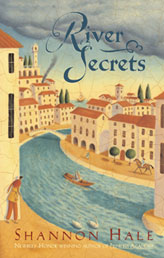
Shannon Hale has a new book coming out soon for adults. So I decided it was time for me to read her most recent book for young people, River Secrets.
River Secrets is described as a companion book to two earlier Hale works, The Goose Girl and Enna Burning. I liked The Goose Girl enough that I actually went out and tried to read some fairy tales since it was based on one I wasn't familiar with. I skipped Enna Burning but had no trouble coming up to speed with River Secrets.
Hale's books exist within an imaginary universe that seems somewhat similar to a late medieval world. There are princes and princesses, transportation is primarily by horse, and guns don't appear to exist. There are soldiers rather than knights, though. And within this universe there are people who can control the elements. Sometimes it's wind, sometimes it's fire, sometimes it's water. (In The Princess Academy , which I've also read, some young women can communicate somehow with rocks. I don't remember the exact details.)
This power is random and democratic. A princess or a young noblewoman might have it but so might a working stiff. Though in these books women seem to have it more often than men.
River Secrets, however, centers on Razo, a powerless character who appears in earlier books. He's a poor, young soldier, a very charming Everyman who isn't all that adept at even run-of-the-mill soldiering, forget about having a grasp on anything supernatural.
So Hale has a well-developed setting, good characters, and some elegant writing--particularly at the beginning of chapters. What's she's not quite so good at in River Secrets is plot. (Hey, plot is hard. Believe me.)
In an earlier book Bayern (Razo's homeland) fought a war with Tira that Bayern won because Enna, of Enna Burning, has power over fire. She used it to assist her people but at a heavy cost to the Tirans, who are still bitter. A Bayern ambassador with a military escort (and Enna as a waiting lady) goes into Tira to try to make nice. But burned bodies keep turning up, the implication being that someone is trying to sabotage the Bayern mission by framing them for these murders.
So the book seems to be a mystery. I like cross-genrization, myself, and this idea definitely worked for me. However, the elements of the plot don't necessarily lead from one to another, there's often long gaps in the action, and big questions are never dealt with. For instance, who the heck are these dead people? We find out at the end, but, logically, wouldn't someone have missed them and raised questions? The Tirans have no organization in place to investigate crimes and stop criminals? One character tries to kill Razo, he knows who does it, but nothing happens to her. Why not? He didn't tell anyone? And, if so, again, why not? And, finally, the ultimate antagonist isn't very well-integrated into the story.
Then there are romantic elements that are not unattractive, by any means, but because those aspects of the book are better done than the mystery, they tend to make the mystery's failings stick out even more.
My concerns don't seem to be shared by others. The book received at least two starred reviews, and bloggers turned cartwheels over it. This is one case where I can understand the response. I think that Hale, like Megan Whalen Turner, is a very decent writer who has created a universe her fans like so much that they're willing to turn a blind eye to any missteps in order to enter it once again.
Subscribe to:
Posts (Atom)