Showing posts with label essentialism. Show all posts

Tuesday, July 26, 2022

Time Management Tuesday: Essentialism And Set-Aside Times

Here we go with the fourth and final portion of our discussion of how we writers can apply Essentialism: The Disciplined Pursuit of Less by Greg McKeown to our lives. Today we’re talking about one of my favorite time management techniques, what I call set aside times. (Sometimes I've hyphenated it, sometimes I haven't. I accept that.) I'm talking a chunk of time--a weekend, a week, a month, or even more-- that we have set aside to do one thing. You can think of it as binging. Binge writing, binge editing, binge submitting.

Binging whatever you think is essential.

Life is chaos, as I've mentioned here a number of times over the last couple of years. Planning to work in blocks of time that we've committed to specific things helps to control that chaos, at least for a little while. To quote myself,  "Looking forward to our future, which we, of course, expect to go on forever, it's hard to get a handle on controlling things, because will power and self-discipline are finite." With shorter periods of time, it is possible to get some control. Additionally, if we try to manage our time around what is essential to us, that's not going to work long-term, either, because, as I said in an earlier post in this arc, that keeps changing. So we can't rely on just defining what is essential to us to help contain chaos for a lifetime.

But we should be able to use it to contain the chaos for a weekend, a week, or a month. Maybe even a semester, if we've decided a class is essential right now.

Planning

In his book, McKeown speaks briefly about extreme preparation. Preparation is going to be a big help in working with set-aside times. In the lead up to any kind of set-aside time, we'll want to plan: 

  • To get other small work jobs out of the way before we start so they won't divert us from the essential task 
  • To get as much pre-writing work done as possible
  • To decide what pre-writing work we want to do, if that's what the set-aside time is for
  • To coordinate the set-aside time with our day jobs so that we aren't trying to work intently on something essential to our writing at the same time we know we'll have extra work for the day job
  • To get as much personal life work out of the way or under control, meaning we don't plan trips or guests during the set-aside time, and to try to find a way to bring family obligations down to a minimum for that period.  

A Perfect Example

A perfect example of applying essentialism to writers lives in a set-aside time is National Novel Writers' Month. That has helped many writers jump starting new projects or completing first drafts. They had one essential thing they were doing for one month--writing 50,000 words.

You can find a multitude of information on-line about preparing for National Novel Writing Month, much of it involving plotting and working on character development or settings before November 1, NaNoWriMo's starting date. Additional planning could involve keeping your November weekends clear of commitments, finding help with the kids, getting meals made ahead of time. (That may only be important to me.)


The more plans you can get in place before NaNoWriMo or any set-aside time begins, the better your chances of being successful with it. 


Round-up Of Original Content's Essentialism Posts


Tuesday, July 12, 2022

Time Management Tuesday: Situational Essentialism

Part III in our discussion of  how we writers can apply Essentialism: The Disciplined Pursuit of Less by Greg McKeown to our lives. 

While I find this book directed primarily to business executives (not that there's anything wrong with that), there are some ways that we can apply some of what McKeown writes about to the writing life.  One of them is to connect essentialism to the concept of Situational Time Management.

No one time management process is ever going to work for us throughout our lives. Life is chaos. We can't expect to come up with what is essential to our lives or work and expect it to hold true forever. What is essential to us right out of school is going to be different from what is essential to us ten or fifteen years later or essential to us another decade on. Or maybe even next year. Or  a few months from now. We have to keep evolving with the situations we find ourselves in. Accepting that and working with it is what I refer to as situational time management.

For writers, there's another whole level of situation that's going to keep changing, though in a pretty predictable way. 

Finding What Is Essential At Different Points In A Writing Life

One of the important points McKeown makes early in his book is that essentialists accept that we can't do everything. Thus, it's important that we prioritize what is essential to us so we can let other things go. Writers can do that in very situational ways.

  • The Acquiring Craft Skills Situation--Actually learning to write is a first step that many writers undervalue. If you read on Medium, check out the many--many, many--articles on writing for Medium that focus on creating lots of content to become successful. There's not a lot on holding back and studying, practicing, or working with critique groups. There aren't a lot of professions where you can hang out a shingle or throw work out before the public with no training or experience. I'm going to go out on a limb here and say that early in their careers, it's essential for writers to learn to write, whether we do it in traditional college courses, or in  workshops or by reading or some other way. While in this situation, we really don't need to be spending valuable, limited time on reading about and attending workshops on how to submit to agents or promoting and marketing books, because we don't have anything to submit or promote and market. The one essential is to learn how to do what we want to do.
  • The Writing Situation--Again, until the project we're interested in is done, writing is our priority. Years ago I attended a writers group with a writer who had barely started a fantasy novel. She clearly was struggling with basics. But she was spending time and energy on promotional ideas. Much more recently I heard about a flash fiction writer who was also a college professor. She wrote in the summer. Writing was what was essential for her during that particular situation, when she had more time to give it. She made submitting essential the rest of the year, because submitting doesn't take the same level of time and involvement. It most definitely takes time, but not the kind of time that writing does. We're talking two different situations.
  • The Submission Situation--The book/short story/essay is finished. Now we're in the submission situation when the search for agents and publications that might be interested in our work takes place. This is way more time consuming than it sounds. In addition to finding people who might be interested in what we have to offer, there is the issue of how to submit--How many pages or chapters does each agent want? Who requires a synopsis? Do all the publications we think might be interested in our short form work accept submissions by email or do some of them use Submittable? Trying to prioritize both submitting and writing at the same time can drain time and energy from both.
  • The Marketing and Promotion Situation--It turns out every damn piece of published writing needs to be at least promoted (seeking attention for it, usually without money being involved) if not actually marketed (more traditional advertising that involves money). This becomes essential once something has been published. But not before. Again, prioritizing marketing and promotion at the same time that we're prioritizing submission or writing can mean that we're not doing any one of those things well.   
Overlap among these situations may occur, particularly for writers who are publishing regularly. Those of us who do that may still be in the Promoting Situation for Book B while we're in the Writing Situation for Book C. And writers who work primarily in short form writing may spend a lot of our reading time when we are in the Writing Situation with journals and other kinds of publications, which will give us a background knowledge in who is publishing the kind of work we do. That would give us a leg up when we get to the Submission Situation.

But overall determining the essential task for any particular situation can mean getting more done.

Tuesday, July 05, 2022

Time Management Tuesday: Essentialism And Choice--For Writers

I was very enthusiastic about Essentialism: The Disciplined Pursuit of Less by Greg McKeown when I began reading it, because I was connecting it to minimalism, a philosophy I am fond of and committed to. Now that I have  finished the book, I've found it to be less about helping to define what the few essentials in our work should be and how to stick with them and more about time management. That's fine if you haven't done a lot of reading on time management already.  And as so often happens with time management writing, it is addressed to people in work situations that provide some privilege that most writers don't have. In fact, the one appendix in the book is directed to people in leadership positions. 

The first section of this book Essence will probably be the most helpful to those  writers struggling with a variety of time issues who hope to find a way to do less but better as McKeown writes. Over the coming weeks, I'll pull out of the rest of the book those things I think we writers can use and how we can use them.

Right now my plan is to address:

Choosing What Is Essential


McKeown suggests that before we choose what is essential to us, we first explore. We can do that through:
  • escaping (making ourselves unavailable), 
  • looking (to see what really matters), 
  • playing (embracing our inner child), 
  • sleeping (because rest is important), 
  • and selecting (after creating high criteria). 
This section, as do all the sections, uses a lot of case studies involving real life people who are almost to a person executives often in higher positions that give them power and privilege. One in this section was particularly noteworthy, because he was able to take a couple of years off from work to recover from what overwork had done to him physically. He and the family spent one of those years in France.

 McKeown says that our best asset is ourselves, but I write for people whose best asset is their time. We don't have much of it. 

People who are working full time jobs, maybe driving delivery trucks or running cash registers or standing in front of a classroom or answering phones or having toddlers screaming "I want Daddy" at them most of the day and have families and have extended families and have to deal with basic life needs like laundry and meals and then are writing just do not have the luxury to explore to determine what is essential to them. Just when is that supposed to happen?

Exploring Your Experience To Determine What Is Essential


Instead of taking new time to explore by way of escaping from others and embracing our inner children (who are very, very overrated, imho), we can try exploring our experience, time we've already used, to make choices about what is essential to us.

  • In looking at writing we've already done (completed or not), are we aware of specific problems we should be working on? Have we had feedback from writers' groups or workshops that suggest we should be choosing improving some particular aspect of our writing as essential?
  • If we're published, have we been more successful with one kind of writing than another? Should we be making that more essential? On the Medium platform, for instance, I do much better with humor pieces about children/parents than humor pieces about lifestyle. I'm considering making child/parent humor more essential in the future. 
  • McKeown writes about normative conformity, doing what a group expects of us. Ten or fifteen years ago, many writers felt pressure to start blogs. A lot of writers don't enjoy this kind of short, nonfiction writing and had a trouble maintaining the blogs they started. Eventually there were more writer blogs than there were readers for them, and between lack of readership, the dislike of writing posts in the first place, and time pressures, we eventually started seeing a lot of abandoned blogs. The attempt to conform to a norm became a negative in a very visible way. Look at what you're doing for social media and try to determine how much of it you feel forced to do and how much is actually working for you. The good can become essential, and you can let the rest go.
  • Normative conformity is also a factor in networking. How many writing-related events do you attend because you feel you should because other writers say you will make work connections there? How often has that actually happened for you? If it has happened a lot, then going to conferences is probably essential to you. If it hasn't, you can consider being a lot more selective about which ones you attend. Does the conference you're considering right now include workshop content that addresses what you actually do for writing? Who is teaching the workshops you're thinking about attending? Are you talking a conference close enough that you can just go for a day, so you don't have to spend enormous amounts of time planning for what a family is going to do while you're gone longer or take a lot of time off from a day job? 

You can see how thoughtfully choosing what is essential can both free up time and make better use of the time we do have.

Tuesday, June 28, 2022

Time Management Tuesday: Essentialism And Work Clutter


In my first post on  Essentialism: The Disciplined Pursuit of Less by Greg McKeown I said that I was finding essentialism to be like minimalism but for work and life activities rather than things. Early on McKeon says "our lives get cluttered as well-intended commitments and activities we've said yes to pile up."

Clutter in Writers' Lives

It's easy to see how life clutter accumulates in our private lives. We have family responsibilities and
jump at every volunteer and social opportunity and collect new interests like sports cards. But what about clutter in writers' work lives? Can that even happen?

Yeah, it can. How often do we want to:

  • Attend every nearby and sometimes not nearby writers' conference?
  • Attend every writer gathering?
  • Accept every request to read and blurb books? 
  • Get on every new social media platform?
  • Join still another writers' Facebook group? 
  • Read every new book on writing?
Notice that none of those things I listed above actually involve writing. Many relate to networking, a big, and not necessarily beneficial, drain on writing time.

McKeown says "A Nonessentialist thinks almost everything is essential. An Essentialist thinks almost everything is nonessential."

He also writes that Nonessentialists feel they have to do all the things they're trying to do while Essentialists choose what they're going to do.

They choose to do fewer things and they go big on the things they do do.

Next week: The Essentialist's first step in making those choices.


Tuesday, June 21, 2022

Time Management Tuesday: A Summer Reading Arc On Essentialism

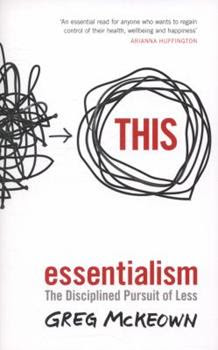
Here comes one of our periodic time management book discussions. Last week I started reading Essentialism: The Disciplined Pursuit of Less by Greg McKeown. While I wish I could recall how I learned of this book, I cannot.

In the past, I have written here about trying to find ways to do more by slowing down. I'm hopeful that McKeown's argument that we can do less, but better will help with that. I'm finding the book well written, well organized, and well researched. This isn't just some guy's quickie throw down of his thoughts.

If I understand essentialism, it's sort of like minimalism but for work and life activities. While minimalism is about how your surroundings impact you and your time, essentialism appears to be about how your choices impact you and your time. I am, you know, a big fan of minimalism, and right now I am very open to essentialism.

More to come in the next few weeks.