Friday, February 10, 2006

A Very Good Point


In a TimesOnline article entitled Why I'm one of the great unread Carol Sarler responds to the Brit writers who were so keen on kids reading classics. And really dull ones at that. Though Sarler claims to have been at the top of the class in English during her school days, she also claims she doesn't read now. This is due, she feels, to the reading she did as a student.

"...we read the books, we were tested on them and we passed or failed accordingly. Reading books was, therefore, the stuff of school in exactly the same way as was trigonometry or chucking a javelin — and since leaving my esteemed seat of learning, I am as likely to curl up with Jane Austen for the fun of it as I am to flirt with a cosine or risk the wrong end of a spear."

I'm not sure if she's suggesting that she (a mother of a grown daughter now) rejected reading as teenage rebellion and never got over it, and, if so, if she rejected everything she else studied in school, too. Or, if so, how that's working for her.

Later in her commentary, however, she makes a very interesting point:

"...her [Saler's daughter] coming late to the books she loves highlights that which Mr Motion [who is famous round the world for suggesting school children read Paradise Lost and The Wasteland] failed to recognise: that the eminent works he so sternly recommended were written by adults, for adults — further, that to press them upon children in an environment in which they are used for the testing, marking and assessment of those children might, in the end, do a lifetime’s disservice."

I'm not touching the part about testing. But her comment that many books we consider classics were written for adults is an excellent point. Now we could argue forever about what is an adult and when is one mature enough to really, really enjoy Paradise Lost. But, how much can we expect kids to connect with books that were never meant for them in the first place? And, since I believe all reading is about the reader connecting with the writer...Well, you can see why I think book selection for English classes is delicate work.

I just love the way British papers show so much interest in children's literature. Either I'm reading the wrong American publications or this kind of thing just doesn't happen here.

Thanks to ArtsJournal.com for the link.

Speaking Of Classics I Haven't Read


I'm not reading Bleak House by Charles Dickens. My exposure to that worthy gentleman's work has been somewhat limited.

No, I am watching Bleak House on PBS. And liking it rather a lot.

I'm afraid this is a case of someone using technology to get her dose of literature in a different format. (As we were discussing yesterday. Though I think the writer who suggested different formats for books didn't have Dickens in mind.)

Happenings In Kidblogosphere


Here in the Bonny Glen is having a carnival this coming Monday! A blog carnival of Children's Literature. Tomorrow is the deadline for submitting a post in order to be part of the carnival. (A sideshow?)

I know exactly what I'm going to submit. I'm a writer. That's what I do. I submit things. Everywhere. All the time.

Thanks to Chicken Spaghetti for the link.
Thursday, February 09, 2006

Something Different On An Old Subject


"But maybe this will at least mean that publishers might start cutting back on their fiction lists, which have become completely out of control."

That was how Roger Sutton ended his Feb. 7 post at Read Roger.

It caught my eye because I've been reading about too many books being published for quite some time. The argument goes something like this:

1. Publishers don't want to let nonblockbusters build an audience because they don't want to pay property tax on the books while they are sitting in their warehouses.

2. So books get only a few months before they are last seasons news and, before long, sent off to be remaindered or, worse yet, pulped.

3. Then the publishers have nothing to sell so they have to rapidly buy more manuscripts to turn into books, which

4. They won't let build an audience because they don't want to pay property tax on them and so on and so forth.

It's a cycle, folks.

Plus, somehow there are a lot of books being published, period. Everyone wants to write a book. Or write several.

So I am constantly reading, "Too many books are being published! That's what's wrong with publishing today! We must publish fewer books! That would fix everything!"

That argument goes that if fewer books were being published, there would be fewer books and authors competing for review space and shelf space in stores and libraries, and the finite number of readers wouldn't be spread so thin over the infinite number of books.

However, never have I seen anyone make any suggestions about which books shouldn't be published. When I see authors make these kind of comments never does one of them volunteer to fall on his or her sword for the sake of the publishing industry and give up writing. (Don't look at me.) The pundits all know what should be done, but no one has any ideas about how to do it.

Until now.

Jeanette Winterson in an article called Her Word on The Times Online makes what might be called a modest proposal.

"Too much is being published. It is time to use new technology to slim the bloat," she says. "It is no shame to find other formats for publications that should not be books at all."

Now, her essay was a little rambly, and she did put me off at first with this: "First, we stop publishing books that needn’t be books. People who don’t really read don’t really need books — so let them have Jordan and Becks in lots of other ways. Audio, animated-audio, that is, audio with pictures — is just about right for most celebrity publications."

That sounded just a little bit witchy and nondemocractic in the small "d" sense of the word for my taste. But then I recalled going to the bookstore last summer to look for a book on writing short stories. I found one. And a couple of shelves of books on screenwriting. And more and more I'm seeing writers conferences, like the one I mentioned yesterday, including screenwriting in their panels and workshops.

And then I recalled the animation I see on-line.

What she's talking about is already happening. Writers are already trying their hands at nontraditional forms.

So, the point I'm laboriously drawing near here, is that maybe not everybody has to write a book. Maybe all the creative effort that's going into novels and nonfiction could go into other things--movies and television and videogames and animation and things I don't know about. The creative desire can be nurtured, it just doesn't have to produce a book.

Am I suggesting a dumbing down of culture, mass illiteracy? Not at all. Though I'm obsessed with reading,myself, I am not so arrogant as to believe that everyone should hold it in as high regard as I do. We readers do tend to be an elitist bunch. Again, to quote Winterson: "Remember that mass literacy wasn’t even discussed until the 19th century — reading the way we read now has not been around for long and may not be the way forward."

I am a student of history. Nothing stays the same. Cultures evolve. If we evolve toward a culture that accepts "other formats" as Winterspoon puts it, we can trim the book publishing bloat without cutting people out of the creative process.

Hey, at least it's a step beyond "There are too many books being published!!"

Thanks to ArtsJournal.comfor the link.

Wednesday, February 08, 2006

Boy, Did I Need This


I woke up this morning to find an e-mail from VerbSap accepting an essay of mine for publication. The essay was one of those I worked on during National Novel Writing Month last November. It's also one of the few nonpromotional things I've been able to work on since November. It's a great load off my mind to feel I've actually written something. And what's more, it's something someone wants to publish.

When the essay is up at the site, I will post a link.

Local News


Ah, it's late winter, early spring and time for writers' conferences again. Graduate and undergraduate creative writing students from the four Connecticut State University campuses, along with outstanding student writers from the state's high schools, are invited to the Fourth Annual State-wide Writing Conference at Western Connecticut State University on Saturday May 6. On Sunday May 7, writing workshops will be open to the public.

Where were the student writers' conferences when I was a student?

Tuesday, February 07, 2006

My Mind Is Turning To Comfort


I am still a woman on the verge of a nervous breakdown. If you think I was whining yesterday, let me just say that today was quite a waste so do not get me started.

However, I have been thinking about comfort books. Comfort books for children, in particular, because this past weekend I read Sam Pig and the Dragon by Alison Uttley.

A few years ago, a friend of mine kept asking me if I'd heard of Sam Pig. It was a book she had read with her children, and she seemed quite taken with it. She finally brought the book over--months and months ago--and suggested I read it to see what I thought.

Well, I think that Sam Pig is one of those English country stories that are charming and restful and comforting. My family had one called The Teddy Bear Gardener. The Teddy Bear Gardener worked in his garden, ate some biscuits (cookies), and, if I remember correctly, went to bed. That was it.

We wore that book out.

Adult comfort books are all over the place. Mystery, romance, fantasy, spirituality, nineteenth century novels and anything else a particular reader finds...well, comforting. But I think children stick to mundane things that reinforce the comfort of their routines.

And that's why many children--and their adults--become so attached to these older English stories in which animals play people doing every day things. We liked Beatrix Potter, who was from an earlier period than Alison Uttley, who started publishing in the 1930s. My personal Potter favorite was that hedgehog who did laundry. Can you guess why?

Sam Pig and the Dragon is interesting because it breaks out of the mundane mold a bit. Sam Pig and the other pigs do run-of-the-mill things like picking berries and playing the fiddle. And they live in a little house. But in this particular book (part of The Adventures of Sam Pig series) Sam accidentally wakens a dragon who went into hibernation around the year 100 because the Roman's were annoying him. He was supposed to sleep for 2000 years, figuring, correctly, that the Romans would be gone by then.

Sam overcomes his fear, and the dragon becomes part of his family's domestic arrangements. Ann Pig stretches a clothes line over him and hangs her laundry on it so it can dry in the heat from his breath. (A clothes dryer!) And their woodland friends play on the dragon's back.

If the dragon hadn't started eating cows, they could have gone on like that forever.

What could have turned into a horror story, goes quite the other way. Sam takes the dragon back to the forest, plays a lullaby on his fiddle, and the dragon goes back to sleep. "Not till the year two thousand or thereabouts would the Dragon waken again."

Yikes!

But in the meantime, Sam Pig has taken care of the problem and life goes back the way it was.

In a BBC Radio production, Uttley's biographer, Denis Judd said her books remain attractive to readers because they involve "another sort of world," "a reassuring world," where there is always a "friendly paw to take the child to safety."

I think the same could be said of all these late nineteenth and early twentieth century stories of animals who wear clothes and eat biscuits.

Monday, February 06, 2006

Perhaps I'm Just In A Bad Mood


Last year I began planning to get more involved with marketing my book, Happy Kid!, which is coming out in May. (That's not a plug. It's totally pertinent. Really.) So I read a book on book marketing, and I made a marketing plan the way the book told me to. I started looking for ways to get my name out more. I sent the marketing plan to my editor, along with some little gifts to distribute to the people at the launch meeting. (I should be able to explain what a launch meeting is because I read that marketing book,but I must be repressing it or something.) I sent the gifts because I'd read somewhere that that kind of thing will make the people at your publisher remember you. Now I feel very manipulative and embarrassed about doing that. Sleazy, in fact.

I wrote a press release back before Christmas and started sending out arcs and photos with the release. (Oh! I started working on the photos last spring! And they still stink!) This last month I've been contacting bookstores and continuing to look for places where I might be able to get Happy Kid! reviewed or get some press for myself. And I've been working on a forty-five minute talk I'll be giving at a writer's retreat later in the month. I also have to work on another hour presentation (different topic) for next month. (Oops. I still have to make a motel reservation for that one.)

I'll be paid for these speeches, but they are still part of the publicity push I'm doing for this new book. I feel I need to push harder for this book because the last one didn't sell all that well, so I'm trying to help the next one along so publishers will consider me a desirable author.

I am a publicity whore, and I am sick to death of it. I am tired of calling bookstores, having people act all excited to hear from me, and then never contact me again. I am tired of doing Internet searches for newspaper addresses. I am tired of looking for schools to contact in selected areas. I am tired of reading about how other authors who are nervier and cooler than I am did it. I am tired of the whole thing.

I want to go back to work. I want to get started on a bunch of new projects. Dear God, I want to do research.

So imagine how thrilled I was to read The Case of the Mystery Writer's Brand, which is about James Patterson. It's not about James Patterson the writer, it's about James Patterson the "brand."

Law professor John Deighton, who has written a "case" called Marketing James Patterson, says, "I see his success as a sublime integration of operations and marketing. Patterson understands that if you want shelf space you need to publish a lot of books; that you need a production system with more than one author; and that you need to mind the brand."

What? I'm confused. Are we talking about something like The Stratemeyer Syndicate? Because I don't think I'm physically up for that.

It may just be the wrong moment for me to be reading this kind of thing. I'm definitely at the point where I'm beginning to feel that we care more about selling books than we do about writing them in the first place. A few years ago, I met a woman who was trying to write her first book. She had a long way to go. A long way. And yet, I heard she had marketing gimmicks planned to submit to publishers with the book that hadn't been finished.

I know it's naive to think a good book will sell itself or find an audience. And, truly, I don't believe I'm above hustling my own books. I'm not very good at it, but I'm definitely not above it. I just feel that we've got our priorities wrong. We should be spending more time on how to create our products than how to marketing them. We're not just putting the horse before the cart now. We're putting all our effort into building carts and not giving nearly as much thought to the horses that are going to pull them.

You'll have to excuse me. I've got to go tell my computer guy that he needs to make me some new postcards to send to Audubon Centers. I'm planning to try to convince them that they really need my last book,Saving the Planet & Stuff, for Earth Day.

Sunday, February 05, 2006

A Kidlit Connection to World Events


The turmoil in the middle east over cartoons published in Danish and European newspapers has a very definite kidlit connection.

According to The Sydney Morning Herald (and a couple of blogs my computer guy, who has very little to do, found), the Danish newspaper Jyllands-Posten published the cartoons we've all been hearing about after learning that a children's book author was unable to find an illustrator for his new book about the life of the Prophet Muhammad.

The illustrators were concerned that Muslims would take offense if they created images of the prophet. The 2004 murder of the Dutch filmmaker Theo van Gogh by someone who claimed to be acting out of religious conviction after van Gogh made a movie on women in Muslim society was weighing on the mind of at least one of the artists.

After learning of the children's author's problem, people at the newspaper Jyllands-Posten and some other Danish publications began to consider "How far should Denmark go down the road of self-censorship?" Jyllands-Posten published the cartoons we've all been hearing about, and the rest is rapidly becoming history with a capital H.

Saturday, February 04, 2006


A Struggle To Be Open-Minded


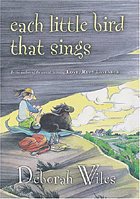
Deborah Wiles won me over with her book Each Little Bird That Sings, but it was a close call. Wiles' book is serious Southern eccentric, and I find Southern eccentric a stereotype that I grew tired of a long time ago.

I realize my response to this kind of thing may be due to the fact that I am a cold-hearted New Englander. Or the south may just be too far away from my reality for me to accept.

True, I do have a cousin named Junior, one of my aunts was once married to a man named Stubb, and I'm told I used to have a Great-uncle Boy. But as a general rule, we in the frozen north don't saddle our off-spring with names like Edisto and Florentine, Comfort, Tidings, and Declaration. (Comfort and Tidings are siblings in Each Little Bird, off-spring of Joy.) We prefer names like "Blackie" and "Brownie" for our dogs to names like "Dismay." The New England child has not been born who would describe a closet as smelling "like opportunity" the way Comfort does in Each Little Bird. And though we love our mothers, we don't go rattling on and on about it, even in our own thoughts. Though I've heard that grown men call their mothers "Mama" in the south, here in New England, no mother would allow her child to use the word past the age of, say, eighteen months.

I know that southern novels are written by southern writers, and I assume they know whereof they speak. I just can't take it. So, really, there was a lot to annoy me in Each Little Bird That Sings.

What I liked, though, was the main character, Comfort's, despair, not over the deaths of her elderly relatives, but over the erosion of her friendship with Declaration. Comfort's family had been running a funeral home for generations, and she could accept death and she could accept that you have to grieve over the lost of a loved one. Betrayal and rejection are another thing. Though I may be reading a little into the book, it seemed to me that Declaration was moving away from Comfort toward other girls (stereotypical "mean" girls, to be honest) because she just couldn't accept who Comfort was any longer. She couldn't accept that Comfort was part of a family business that worked with the dead and grieving. To be rejected because of who you are...man, that's rough.

I also liked Comfort's poor cousin, Peach. (There's another one of those names.) Peach is a heart-breaking character, one of those misfit children who really do show up in real life, even here in New England. In appearance, behavior, and temperament, they just can't fit in. Other children and sometimes even adults are put off by them. I've known kids like Peach. Everyone has known kids like Peach.

I very much appreciate that Comfort was filled with anger and bitterness, and she didn't just roll over and forgive. I appreciate that Wiles goes for a realistic ending instead of an easy, heart-warming happy one--which she could have done.

I think this book probably gets a lot of attention because it deals with death. And it does that well. But for me what raised this book up over my personal objections to it was not the lesson on death but the portrayal of the children's struggles with living.

Friday, February 03, 2006

Gleaning


I found this article on short stories through Metaxu Cafe, a litblog network I joined after I saw all my kidlit friends were joining it. I'm not a hundred percent sure how Metaxu works. I found the short story article (originally published in The Guardian) through a post from a literary magazine called The Angler, which appears to have launched almost minutes ago. However, the post in The Angler seems to have originally been posted at something called Catch and Release. Get it? The Angler? Catch and Release?

So, when you include Metaxu, this short story article by William Boyd, who I had never heard of before, went through four steps to get to me.
I have not read it yet, but who knows? It could be just the thing I've been looking for to make me a short story writer.

And it took four steps to get to me on the Internet. Makes you think.

If you go to the Feb. 1 post for Young Adult Writers Who Blog, you will note that Robyn Schneider will be "teaching an online course on how to write the edgy YA novel."

I found two particularly interesting things about the course description:

One--They are going to read two edgy YA novels from the following list: The Perks of Being a Wallflower, It Girl #1, Looking For Alaska, Be More Chill, Gossip Girl # 1, Gingerbread, Empress of the World. The two books from that list that I've read--The Perks of Being a Wallflower and Looking for Alaska--I found predictable. Though I guess you could say they were predictable in an edgy sort of way, if by edgy you mean sex and drugs.

Two--The students will be "working on or about to start a novel for 15-and-up." I found this really interesting because I've read elsewhere that some publishers are interested in raising the definition of YA into the early twenties. I can understand wanting to address books to college-age and just-out-of-college people. I don't know that there are a lot of books out there that deal with their interests and age groups. But I don't know if expanding YA so it encompasses kids twelve or thirteen up through early twenties is the way to go.

The interests of a twelve year old are dramatically different from those of a twenty-one year old. Especially since publishers, librarians, and booksellers already are not on the same page with their YA definitions. Everyone seems pretty comfortable classifying books anyway they see fit so that Sea of Trolls, with its twelve-year-old main character on a journey can be considered a "teen read" just like Looking for Alaska, with its somewhat older characters enjoying an adolescent sex and smoking fantasy.

Thanks to Child_Lit for that link.

And thank you, Child_Lit, for this link, too. Now I've discovered still more kidlit blogs, to say nothing of all those kidlit authors. I could make a career of reading these things.

Thursday, February 02, 2006

January Books


teenreads.com has its Cool New Books for January page up. Blackthorn Winter by Kathryn Reiss jumped out at me because it is so the kind of book I would have read when I was a teenager. Yeah, I was definitely drawn to murder back then.

What's A Reader To Do?


Speaking of murder, I just finished reading an adult murder mystery that was just terrible. Terrible I tell you. It got a good review in the local paper. When will I learn not to fall for those things?

What made the book so awful was the point-of-view. It was all over the place. Sometimes you were reading a first-person hard-boiled detective story, then you'd shift to a third person who was clearly a bad guy, though was he the bad guy? Then sometimes you'd jump to the mind of a female cop. And sometimes you'd go back in time to the third person point-of-view of the hard-boiled detective when he was a kid.

The point-of-view shifts were so awkward and clunky that the author sometimes used italics to signal them and sometimes actually announced a new point-of-view with the name of the new character.

Oddly enough, the plot wasn't half bad. This could have been a good book.

Why didn't I just quit reading it since I have other books piled up all over the house waiting for my attention? Like so many readers, I find it hard to give up on a book, hard to admit I've wasted my time. I've managed to cut my losses on a few books recently, but I wasn't able to this time.

Reading this book, though, made me think of Louise Doughty's Novel in a Year column. In Week Two she said to read and analyze bad writing so you could avoid it yourself. In that case, the book I read was a textbook.

Speaking of A Novel In A Year


In her fourth week's column, Louise Doughty says, "But in the meantime, I want you to continue to write freely and enthusiastically. Some of you are carrying on with the “day after my eighth birthday…” story, which is terrific. Others are pursuing different ideas."

Ah...does that sound to anyone else as if I should have continued writing past the first few sentences I wrote in Week One? I thought I was supposed to wait for...something...I don't know what.

But after reading Week Four's column I actually started a new file for this project on my hard drive and wrote another couple of sentences. I guess that's sort of like writing "freely and enthusiastically."

Oh, That Curious Little Monkey!


Opinion Journal (from The Wall Street Journal has an intriguing article on Curious George. The movie will be out soon, and this article reminded me of the kinds of things we were seeing in the press before The Lion, The Witch and the Wardrobe movie was released.

Anyway, the author, John J. Miller, says, "Earnest literary types have interpreted the first book as a barely disguised slave narrative. Have you considered that the man's weird outfit could be a send-up of a colonial officer's uniform? Or that George is brown and lacks a tail? (Lots of monkeys are brown and most species have visible tails.) Or that he is abducted against his will from Africa and brought across the sea to a foreign land where he engages in high jinks when the master is away?"

Actually, no, I never considered any of that. But thanks for bringing it up.

And thanks to Book Moot for the link. Book Moot has become a favorite kidlit blog and will be joining my links on my sidebar when I get around to telling my computer guy to do it.

Wednesday, February 01, 2006

Maybe This Wasn't Such a Good Idea After All


I hate to pull an Oprah, but I'm having second thoughts about the "Books Every Child Should Read Before She Leaves Secondary School" list I started yesterday. Not the books on the list, just the fact of a list itself.

Philip Pullman said that we can learn all kinds of things from fiction, and I agree with him. But you have to seek this stuff out for yourself. Reading is a form of communication. Only you can decide who you need to communicate with. The prospect of imposing a list on anyone...

Nonetheless, one should finish what one starts. So here are a few more titles.

Little House on the Prairie by Laura Ingalls Wilder because it's about the pioneer experience and the whole pioneer thing has had an impact on the American psyche.

Lonesome Dove by Larry McMurtry because the cowboy and cattle drive era--though in reality it didn't last all that long--has become part of the American identity. I chose Lonesome Dove because it's the only western novel I've read, and it did win the Pulitzer Prize. But, by all means, choose another.

Something by Raymond Chandler. His outsider heroes with personal codes of honor--very iconic. I found Fell by M.E. Kerr very Chandleresc, and I have a young relative who liked the whole series so much that he would snatch them out of the library basket on his way out the door to catch the school bus.

To Kill a Mockingbird by Harper Lee. I thought several times before including this. I loved this book when I was a teenager, but I've read that African-Americans are not as entranced by it. They see it as a feel-good book for whites because the white family tries to help the African-American in the story but fails. The family then gets to feel virtuous for trying. When I reread the book as an adult, I didn't think it was so much about race as it was about daddy-worship. Not that there's anything wrong with a girl loving her father. The book is still a good one, it's about the American south, and God knows, like Catcher in the Rye, it has spawned a host of imitators. Why not read the first and the best?

Roll of Thunder, Hear My Cry by Mildred Taylor. A story of the American south from African-Americans' experience and a Depression-era story. And just a really good book.

A Native American book. I have to admit that I'm not terribly familiar with Native American writers. I liked Green Grass, Running Water by Thomas King, but it's been a while. Plus, he's Canadian, which is like Native American Continent rather than Native American. Joseph Bruchac has a Native American background and is a well-known writer for young people, though I haven't read any of his books. I've heard him speak though. Very good.

So, altogether, I have more than 10 books. You can live a very fine life without reading any of these titles. But I think these books will give readers an inkling of how we came to be the way we are. And, more importantly, I don't think they will drive anyone away from reading. My hope is that instead of making readers feel "I've read Paradise Lost. Thank God that's over," they will encourage readers to look for more of the same.