Monday, July 30, 2007

Searching For Mysteries


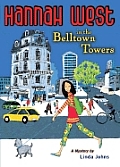
I picked up a couple of mysteries for middle-grade readers about a month ago. One of them, Hannah West in the Belltown Towers by Linda Johns got a little buzz when it was published because the main character is homeless.

Well, that's true. But she's homeless in a very high-class way. She's the daughter of a single mom who loses her job and can't find a comparable one. Mom can't keep their home on her new income as a part-time waitress/freelance writer, so she hooks into her network of well-to-do friends and she and Hannah become housesitters. In The Belltown Towers they have a six-week stint in a classy highrise. This is the beginning of a series and, presumably, Hannah will have an adventure each time she moves.

I actually think this is a promising premise--a young person who has to keep moving and encountering new people. But the circumstances around the homelessness are not very well-developed here. Hannah's living situation is very quickly sketched, and the problems someone without a permanent address must face are only touched on. What's more, Hannah's encounters are going to involve mysteries.The mystery in Belltown Towers is very weak, and the bad guy is extremely obvious. Though I did have trouble at the end figuring out why the bad guy was stealing what she was stealing. But I have to admit that by that point I was only skimming.

However, I wasn't even able to get past the eighth page of the second middle-grade mystery I tried reading. It was also the first in a series.

Writers of mystery serials for kids face a major problem. They are writing about amateur detectives, so to some degree or another their plots are going to be forced and unnatural. Even adult amateur detectives require some suspension of disbelief on a reader's part, and with kid amateurs, the need to suspend is far greater.

I think this is why during the twentieth century, when everyone became interested in specialization and professionalism, anyway, the police procedural became so popular. We can believe a cop is going to run into any number of murderers and worse. But while your average person on the street might stumble into one mysterious situation in a lifetime, it's hard to swallow him or her doing it over and over again. And, as I said, with a child it's even harder to come up with something believable that can happen again and again.

The kid sleuths can't drive to get places. What adult is going to take a child detective seriously? How do these kids get their information? Since they are children, how much background knowledge do they have about anything in order to have a jumping off point for their investigations?

We're talking some big obstacles here.

Sunday, July 29, 2007

What's Happening To Me?

I gave up reading The New York Times Book Review several years ago when a family member gave up reading The Sunday New York Times and passing the Book Review on to me. I wasn't too cheap to buy the paper. Honestly. But the odds of my being able to read two Sunday newspapers were very, very low. I would fall months behind just reading the Book Review. In fact, I bought the Sunday Times, myself, back in May and just found the half-read Book Review in my laundry room. I can't begin to guess what it was doing there. Besides not being read, of course.

The end result of my not reading the Book Review is that I no longer have a very good grasp of what is going on in adult fiction. I find myself standing in front of the new fiction shelves at libraries going What do I do? What do I do? So many books. Which ones should I take off the shelves and look at?

This, people, is why we need book reviews--so that people like myself won't be overwhelmed in libraries and bookstores.

Anyway, I was in I'm a Reading Fool's library yesterday freaking out in front of its sizable new fiction section when I decided to go look at the new nonfiction. I went right to the essay shelf and thought, Why, that looks good and that looks good and that looks good. I took a number of things off the shelf and gave them the once over.

And what did I find but Anne Fadiman's At Large and At Small, which I actually knew about because of a post at Chasing Ray.

How weird is that?

So even though I now have a stack of books next to my bed that is nearly a foot high, I read one of Fadiman's essays last night. I was afraid The Unfuzzy Lamb was going to be about nature or agriculture because the first essay in the collection appeared to be about collecting butterfies, which led me to skip it. But, no, The Unfuzzy Lamb is about Charles Lamb.

Now, I actually have a modest interest in Lamb. He was one of the more accessible writers in my Romantic Period class as an undergraduate. (Though I found myself strangely attracted to Thomas DeQuincey's Confessions of an English Opium Eater, too.) I have a vague recollection of beginning some kind of contemporary version of Lamb's Dream Children many years ago. God only knows what happened to that.

Anyway, Fadiman's essay on Lamb was very readable and interesting. But what I kept thinking as I read it was, Where do you publish an essay on Charles Lamb? And who the Hell is going to read it? Besides me, of course. It turns out Fadiman published her Lamb essay in The American Scholar, not a publication that I have a lot of familiarity with. Or, to be honest, had even heard of before last night. It may publish essays about Lamb all the time, and I'd never know.

I've read Fadiman's Ex Libris, though I can't say it made much of an impression on me. I know it is somewhere in this house, and I can even pinpoint the room. Beyond that, it will probably be a major effort to find it. But it might be worth taking another look.

Anyway, my post title is What's Happening To Me? so I should get around to saying something about that. What I'll say is I went into a library, was flummoxed in front of the fiction and happy in front of the essays. That's a shift, people. I'm shifting. That's what's happening to me.

Friday, July 27, 2007

Don't Kids Say The Darndest Things?

Since I've been reading and blogging about books for younger readers this summer, I've been interested in all the Internet responses to Is Junie B. Jones Talking Trash?.

I've only read a couple of the Junie B. books, and one of them actually made a good impression on me. My own complaint about them is not Junie's poor grasp of grammar but that her poor grasp of grammar makes her sound like an adult's idea of how little kids speak. The humor in the books I read seemed to be around the exasperating things children say and do. Isn't that Junie B. a little dickens?

Back in 2005, though, I thought Junie B. was "so much better than almost anyone else out there" for that age group. I'm still not finding a lot of good stuff out there for younger readers. So while I'd prefer not to read her, myself, I certainly don't object to anyone else doing so.

Well, Yes, A Lot Of Them Were Depressing

I read many of the essays in The Best American Essays 2006 and liked what I read. Lauren Slater was the guest editor who had the task of making the final cut from around one hundred essays that had been screened for her. She admits she was dwelling on death a bit, and a lot of the essays at least flirted with that subject. One of my favorites, Grammar Lessons by Michele Morano, deals with a depressing romance, which isn't death but still a downer. (The author now has a book of essays out called Grammar Lessons.)

Oddly enough, I happen to own a copy of The Best American Essays of 1996, which I never read much of because I didn't care for it. I'm going to take another look. Perhaps my tastes have matured in the last ten years. Or at least changed.

Thursday, July 26, 2007

M.T. Anderson Month, Part II


As a result of the Adbooks discussion of M. T. Anderson this month, I finally read The Astonishing Life of Octavian Nothing, Traitor to the Nation. I am going to have to struggle to control myself, because I'm afraid I'm going to start gushing. The book, itself, is pretty astonishing.

Octavian Nothing is the son of an African princess who is being educated by a group of American Enlightenment philosophers who might be described as having gone slightly round the bend. Octavian and his mother live among them, and he is being given a classical education. As a child, he is totally unaware that he is part of an Enlightenment research project. He is totally unaware that he is, in fact, a slave.

But he becomes enlightened on those points.

The book is written in the style of an eighteenth century collection of memoirs and letters. Three portions of the book are told in Octavian's first person voice, from his "Manuscript Testimony." He appears to be recalling his childhood and adolescence from an adult (though not aged) viewpoint. (I was under the impression that this was the mark of an adult book rather than YA, but that's just a trivial point.) One part is told from the viewpoint of a young New Hampshire soldier through his letters to his sister. (Though this young man is charming and I did enjoy this portion of the book, I wonder whether or not it was necessary to switch points of view. Once again, this is a trivial point.)

The writing style is demanding, but the character is so engaging and the story so compelling that I got used to it. Fast. In fact, I read books of this type as a teenager because I was a teenager so very long ago that there weren't a lot of YA books around. So I did dip into older books. It doesn't seem alien to me for teenagers to be reading something this outside their world. I'm sure that many are reading things just as demanding in their English classes, especially if they're doing Advanced Placement.

Perhaps I took to the book because I've done some research on the period and am still psyched about the Enlightenment and smallpox, for instance. Octavian Nothing makes clear that the American Revolution was a revolution that wasn't for everybody. It certainly wasn't for the American slaves, but it also wasn't for many small farmers living in wilderness areas. The Revolutionary Generation was very much into the status quo. They just wanted their status quo to be American, not British.

Excuse me for getting all rebellious, but as I've said before, I suspect I had ancestors running through the streets of Paris in the 1790s screaming "Off with their heads" in some kind of farm French. (Coupez les tetes?)

Anyway, loved this book. It's described as Volume 1, and Anderson is working on a sequel. Just before reading it I was thinking about the whole series/serial thing that is so popular now, and wondering if it appeared anywhere but in fantasy. Well, here we have at least a two-part series in a historical novel. We'll have to see how far it goes. Though, really, in a way the ending to the first volume is satisfying.

I hope my local bookstore has an Octavian party when the next book comes out. I'd go.

If you read the book and are curious about pox parties, read more. Thanks to Adbooks for the link. Also, M.T. Anderson was interviewed on NPR back in January. Listen for the interviewer's question about whether teen readers will be enlightened or frightened by the book. I thought that question suggested a lack of knowledge of YA, myself.

Wednesday, July 25, 2007

M. T. Anderson Month, Part I


The Adbooks listserv is discussing M.T. Anderson this month, which is how I came to discover his lovely picture book, Me, All Alone, at the End of the World (illustrated by Kevin Hawkes). Me, All Alone is beautiful looking and elegant sounding, but probably falls into that category that I think of as picture books for adults.

On a superficial level, there's a lot of text in this picture book, and some lengthy sentences. "I liked to lie cozy near the brass-bellied stove, and hear the rain and the thunder fall, and the chuckling beasts with long tails or five legs or big kissing mouths squirm over the edge to go snapping at lightning." That's quite a mouthful for a preschooler or early reader, who might also want to know what "chuckling beasts?" Even a short sentence like "I ate hardtack and gristle" includes some vocabulary that the average kid probably isn't familiar with.

On a less superficial level, while I liked the book very much, I'm an adult that didn't quite get it. I thought it was kind of an anti-development story about an idyllic spot that became a tourist attraction. Sort of like Niagara Falls. It was only through the listserv discussion and after reading reviews that I realized that a more accurate reading relates to the attractions of solitude versus the attractions of, say, the developed Niagara Falls.

I liked that, once I got it. While I have no problem accepting that there are probably grade schoolers out there who would get this book faster than I did, I'd still suggest reading it with children to help them out.

Or just read it yourself.

A Great Interview You May Have Missed

I did. I didn't know who Alan Gratz was back in January, so I skipped this truly excellent interview with him at The Edge of the Forest. He had lots of interesting things to say about writing process and blogging. Believe me, I couldn't have come up with half that stuff after publishing my first book.

The interview was both inspiring and made me feel inadequate at the same time.

By the way, Gratz talks about how only friends and relatives were reading his blog in the past. My relatives and carbon-based friends are the people who don't read mine.

Tuesday, July 24, 2007

A Kind Word For Editors

Somewhere this summer I saw a blog post about writers' reactions to editorial comments. (I thought it was at A Fuse #8 Production, but I can't find it now so I may be wrong.) It was an amusing account of over-the-top editorial responses.

Funny though it was, I felt, gee, should I put in a good word for editors? Nah, I guess not.

Fortunately, Gary Kamiya decided to do it with Let Us Now Praise Unsung Editors at Salon.

It's very difficult to describe the editor/author relationship. It can be very intense, "an intimate and gratifying experience," as Kamiya says in his article. I think many nonwriters assume it is adversarial. I once read an interview with a self-published writer who said she went the self-publishing route because she didn't want anyone changing her writing. Personally, I would never want to work without an editor.

Once I started publishing books, I worked with the same editor for eight or nine years. At one point, I was considering donating my "papers" (meaning the foot or two of drafts that accumulate for each of my books) to a library. The main reason for doing so, would be to get all that crap out of my house. But to do so would mean that I was deciding to donate Kathy's work, too--her sticky notes, her pages of suggestions, her letters. It didn't seem right to expose her to strangers like that. I wouldn't do that to a family member, and I wouldn't do it to my editor.

When I heard she was leaving Putnam, I didn't sleep for a couple of nights. What did it all mean? What should I do? Losing your editor is serious. Serious. I may have mentioned this when it happened a couple of years ago. I apologize if I'm repeating myself. But though I'm happy with my new editor, I still haven't gotten over the shock of losing the old one. That's how big a deal an editor is.

So, yeah, I like to hear a kind word for editors.

Monday, July 23, 2007

My Potter Weekend

My theory that everyone would be home this weekend reading the latest Harry Potter was disproved by the time we reached the Massachusetts Turnpike. I followed a family into the first rest area and heard the son telling his father that he had read over 400 pages of 700 some odd. Of course, he was talking about Harry P. His mom told me they'd bought the book at 12:01 that morning. Our next coffee stop was off the highway. A woman was sitting out in front of a store with the book. After dinner that night, I saw a copy of the new book at the checkout counter at a giftshop. The young woman reading it also worked at a library and had been part of a reading party that had begun at midnight and gone on until 7 Saturday morning.

I belong to The Association of Booksellers for Children listserv and have been reading accounts of some incredible bookstore events here in New England. Of course, the closest store event I heard of before I left town was at a Stop & Shop.

So it sounds as if it was a great weekend for you Potterites. I'm curious now to see if the world shifts in some way now that there are no more books to wait for.

An Addition: Justine Larbalestier and Scott Westerfeld have some footage of the scene in New York City on Potter release night at Writer in Residence/Inside A Dog. Which isn't my Potter Weekend, of course, but interesting (though dark) nonetheless. Because I find that sometimes things that aren't related to me are interesting. Who knew?

Friday, July 20, 2007

A Positive Potter Post

It really wears a woman down to have written nearly 40,000 words on a book and realize she's going to have to do some revising before she moves on. The Durand Cousins came to a screeching halt over a week ago, and while I have some work in mind for it, I haven't been able bring myself to do much beyond opening a new file and starting a new spreadsheet.

I'm going to have to go away for a few days to get over this.

Actually, the trip was already planned. Serendipitously, as it turns out, since I'm feeling frazzled and this is Harry Potter Weekend and probably a good time to travel. It's probably a good time to go to the movies and the mall, too. Millions of people are going to be indoors reading.

In honor of the event, I'm going to say something good about Harry. Okay. Here goes.

A couple of weeks ago, a bookseller at one of my listservs told a story about a woman who came into his store looking for a book for her 6- or 7-year-old grandchild. When he brought her a book appropriate for that age, the woman said, oh, no, that wouldn't do. Too many pictures. Her grandchild was reading Harry Potter. By herself. She needed something like that. And thus this child was being hurried out of the early reading experience. It wasn't a real positive story.

Here's the thing, though. Adults were hurrying kids out of the early reading experience long before Harry Potter was even a gleam in J.K. Rowling's eye. Back when the Gauthier boys were little darlings, it wasn't uncommon for the mothers of their classmates to talk about their second grade child who was reading Jurassic Park or to explain that their gifted one (meoooow) didn't read children's books. I knew one kid back then who started reading Star Trek novels when he was in second grade. It was cool to have a fifth or sixth grade child who read John Grisham.

I have no problem with any of those books or authors. And I am aware that children are supposed to grow up and into adult books. But, as I keep saying, I believe very strongly that we all read looking for communion or connection with others, particularly with others like ourselves. When young children are hurried out of children's books, they miss out on reading about people their age who face experiences they, themselves, face, in order to read adult books about grown-ups who face experiences the child reader won't be encountering for years. (Or maybe ever in the case of Star Trek novels.) I'm not suggesting kids should never read an adult book. I just think kids' books are important for kids. It's good for them to read them.

Which brings us to Harry P. Because adults read Harry Potter, because adults like him and approve of him, they think it's just fine for their kids and grandkids to read him and other kids' books like his.

To make a long story short (yeah, I know, it's too late for that), Harry Potter has made it okay for kids to read kids' books.

And now I must go pack for my trip. Happy reading, everybody.