Showing posts with label mystery. Show all posts

Monday, May 22, 2023

Notes On Why I Read "Notes On An Execution"

I read Notes On An Execution by Danya Kukafka, because I am interested in the author's agent. And that is why I am mentioning this book here. It's part of my shifting my world view from children's writing to adult writing. 

Also, a couple of interesting things happened while I was reading it.

First, Notes On An Execution involves a number of women over a long period of time who are all connected to a murderer. Their stories are interspersed with the events of the murderer's execution day. I don't think I'm giving anything away here. It's all in the title.

Well, I started reading the book, and I found a section related to a mother of sons just too painful. I decided I wasn't going to read the book, which I had borrowed through an e-book service, and I returned it.

The very next day I saw on Twitter that Danya Kukafka had won the Edgar Allen Poe Award for Notes On An Execution. The award was announced the night before. She won this award at around the same time I was returning her book to the library.

Book awards often aren't that big a draw for me. However, the timing of this one was so uncanny that I decided to borrow the e-book again. I'm very glad I did, because this is an exceptional book. 

However, I was reading it in bed one night, hit another mother/son section and was up until around 4 AM unable to sleep. To be honest, I had also started an antibiotic that had insomnia as a side effect, so it could have been that. But I would advise any mothers of sons to not read this before going to bed.

Earlier this month, I attended a presentation by two agents who talked about some different categories of fiction. As a result, I'm going to suggest that Notes On An Execution is not a traditional genre work, meaning, in this case, mystery, but a genre work that leans literary or high concept. The book is not, after all, a who done it, since, again, it's in the title, but a why done it. It's literary because of the significance of character development. It's high concept in that the story keeps coming back to the murderer's execution day, and there is a great deal of compassion for every character.

It really is an impressive work. But moms with boys, remember not to read it before going to bed.


Thursday, July 28, 2022

A Marvelous YA Mystery

I found Cold by Mariko Tamaki through a review in The Horn Book. I was a few issues behind, so I was able to find this book at a nearby library. I'm interested in YA mysteries and thrillers right now, so there was my attraction.

It's a terrific book about a dead teenage boy and a live teenage girl. And that's as far as I'm going with the plot description. Oh, except Tamaki does something terrific with the mean girl clique cliche. I am not a fan of alternating points of view, but this worked great. The female lead is my favorite Georgia since Georgia Nicholson. It's not that outrageous a comparison because these two Georgias have voice.

This could be described as a queer mystery. What is particularly interesting is that it is slowly revealed just how much that thread has to do with what is happening. 

Mariko Tamaki is the author of the graphic novel Emiko Superstar  (art by Steve Rolston), which won a Cybil in 2009

Monday, October 04, 2021

A Book That Tears Up Some YA Cliches

Last Friday, October 1, I began a new writing group program with a Facebook group I've belonged to for a couple of years. We create a couple of temporal landmarks a year by setting aside a month for a specific writing project.  This month I'll be working on that mysterious YA mystery I keep talking about here. And today I'm posting about a mysterious YA book I recently read.

A number of books have covered people unaware of the world they're living in or unaware that they are being used for the entertainment of others  (notice how I'm not telling you much here?), but This is Not the Jess Show by Anna Carey does it particularly well. Even if you end up hearing some of what this book is about before reading it (it has been out since February), there's a genre-bending twist, and a bit of a surprise in the ending. 

A real ending, people. As I was getting closer and closer to the end of the book, my anxiety level was going up and up, because I was so sure this was going to be the first in a serial. What a delight to get to that last screen (I read an e-book) and get a satisfying resolution. I think there may be an opening for a sequel, but not in a serial, you've-got-to-read-another book sort of way. 

This Is Not The Jess Show starts out with a very traditional teen girl craving romance. She is a traditional teen girl with two best friends. She has a traditional family tragedy looming over her. I will be honest and say those are not my favorite things to read about. But then author Carey blows all of those out of the water. A really impressive job.

There's also some well done, subtle, commentary relating to technology and society going on here, a la Black Mirror. In fact, I believe there are some scenes similar to a Black Mirror episode. Which is not a complaint. Just saying, if you like Black Mirror, consider reading This Is Not The Jess Show. And if you like This Is Not The Jess Show, consider catching some episodes of Black Mirror.

I would also like to say that I think Carey makes the situation in her book believable with that genre twist I mentioned above. Well done. 

Here's a question you might be left with after reading this book: Why does our culture find death and grieving entertaining?

Wednesday, September 30, 2020

An Inspiring Mystery


Tomorrow my May Days Facebook writing...I guess we could say binge group...begins its annual October effort. October May Days, if you will. After spending the summer on flash writing and the last four weeks or so on submissions, I plan to spend OctoMay Days on my YA mystery. Then keep going on to a NaNoWriMo-ish four weeks on the same project.

So it makes a world of sense that I would write today about One of Us is Lying by Karen M. McManus, because when I read the first chapter this summer, I said to myself, "Self, you've got to change the first chapter of your mystery. Get right to the point, Gail, like Karen does."

My many, many blog readers know that I am not a fan of alternating points of view and romance in genre. The first slows down the narrative drive, and the second is usually a distraction. It rarely supports the main story. This book had both these things. And, yet, I liked it.

In addition to liking the basic story, I thought McManus did some interesting things with some stock YA characters. One of Us is Lying is a book that received a lot of attention and deservedly so.

Saturday, August 29, 2020

You Can Binge Read The "Truly Devious" Trilogy Now


I was definitely a fan of the first two books in the Truly Devious trilogy by Maureen Johnson, Truly Devious and The Vanishing Stair. I liked the two mysteries, one set it in the 1930s, the other in the present. I liked the Vermont and school setting.

The finale, The Hand on the Wall, is well reviewed, but not my favorite of the books. The reasons:

  • Romance. I liked the mystery. I wanted mystery, and I wanted everything in the book to serve the mystery. I know there is a feeling among some YA people that YA books must have a romance. But with a lot of mysteries, both YA and adult, I find romance a tack-on. It distracts from what is, to me, the real story. In The Hand on the Wall there is one plot point that the romance supports. Maybe there are more points in the first two books that I don't remember. The romance wasn't a great element for me.
  • Politics. These books include a political element that involves a cliched bad-guy politician. In the second and third books, the politician does support a plot point. But we have to put up with a lot of him for him to do that. 
  • Serial, not series. The Truly Devious trilogy is definitely a serial, not a series. I had read and, remember, liked the first two books and still found it difficult to recall material that needed to be recalled to make the last book really work for me.

But that third problem can be by-passed now, because all three books have been published. Read them one after another. Maybe my romance and political issues would be resolved with a binge read, too.

Friday, April 03, 2020

YA Historical Thriller...Ah...Mystery

The Girl is Murder by Kathryn Miller Haines was one of my thriller/mystery reads. Reading it met an objective for one of my 2020 goals. 

The Girl is Murder, published in 2011, reads like the set-up to a series, and a second book about its main character, Iris Anderson, was published in 2012. Iris and her father have hit a bad patch financially. Mom killed herself, and we're not sure what that was about. Pop lost a leg at Pearl Harbor and while the war continues, he is trying to make a go of it as a private detective. Things are not going well with that, and he and Iris have had to board with a nice landlady in a lesser part of town. Iris has also had to leave her private school to attend a public one. She wants to help with the family business. Dad says no. When a hot classmate turns up missing, Iris starts a hunt, anyway.

I didn't find the mystery here that compelling or interesting, particularly since Iris, herself, didn't solve it. And it was kind of anti-climatic.

The historical setting was pretty amazing, though. Haines, who writes adult mysteries as well as the two Iris Anderson volumes for YAs, appears to specialize in the World War II era. Not having been there, myself, I can't say that she's got that period down pat, but she sure creates an impressive world, right down to voice.

I believe that as far as world-building is concerned, historical fiction rivals science fiction. The Girl is Murder proves my point.

When I've been writing here about mysteries and thrillers, I've been using the term interchangeably. Mystery, Thriller, or Suspense: Does the Label Matter? by Stacy Woodson at DIY MFA suggests I shouldn't.


Monday, September 05, 2016

Sophisticated YA Mystery

First off, I'd like to say that how I came to read The Mystery of Hollow Places is an example of marketing working. Its author, Rebecca Podos, made some appearances in Connecticut over the last few months, so I saw her name turning up on the Connecticut Children's Literature Calendar. I noted what her book was about while reading about her. She's also an agent whose name I've seen connected with SCBWI events. So, for me, she had a bit of name recognition. When her book turned up in front of me on the new book shelf at one of the libraries I frequent, my mind was ready to accept it. A job well done, Rebecca.

The Mystery of Hollow Places is a literary stand alone mystery. That makes me happy. Our teen narrator/detective is hunting for her father who appears to have taken off for parts unknown. He's a mystery writer and his girl, Imogene, has made a study of his work. She believes she can use what she's learned from reading his books to find him.

This book has a great deal to recommend it:

A legitimate, realistic mystery that is also realistically solved by a teenager.
A wealthy, popular teen girl sidekick for our detective protagonist.
A nonevil stepmother.
A side trip to Willimantic, Connecticut, which isn't that far from where I'm sitting right now and where I have been many times. Which, of course, is only a recommendation to those of us who know the place.

I just suggested The Mystery of Hollow Places to a friend who's writing a mystery. I thought she'd be interested in the way health information is slowly revealed and that great sidekick.

Monday, May 16, 2016

Sherlock Holmes: Nineteenth Century Superhero

Like many young people, I read Sherlock Holmes as a teenager. I struggled to learn the difference between inductive and deductive reasoning. (Yeah. I never worked that out.)  I wanted to be Holmes.

As an adult, though, I've wondered why I see so very many children's and YA books relating to Sherlock Holmes.The original Sherlock is not a fun guy. He's kind of stodgy. I can't recall any young people in the original stories. Thematically, the original stories are not about place in family or separating from family or finding a place in the world, which is what child and YA books traditionally are about.

But I recently read two Sherlock-related stories, one after the other, that suggested something new to me. Sherlock Holmes was an early superhero. His superpower? His intelligence.

A Study in Charlotte


In the YA Sherlock update A Study in Charlotte by Brittany Cavallaro Holmes, Watson, and Moriarty were all real people, not characters in books, and their descendants walk among us. (Hmm. That's sort of like The DaVinci Code.) The present Holmes and Watson representatives are teenagers Charlotte Holmes and Jamie Watson. Their families no longer have contact with one another, so what a coincidence that they should land at the same private boarding school in Connecticut. Jamie's kind of a regular guy. He is, after all, just the descendant of a writer. Charlotte, however, is something else. Holmeses have been Holmeses for generations. She is a chippy off the ol' Sherlock block, brilliant, intense, a bit haughty, and fond of drugs. She's been known to help out at Scotland Yard. So, of course when someone starts framing her and Watson for murder, she doesn't just sit back and let the local police take care of things. No one can handle the case as well as she can. Because, you know, she's got that super intelligence superhero thing going on. And now with Jaimie, she's got a sidekick, too.

This book's neat stuff:
  • The members of the Holmes and Watson families are not a hundred percent terrific people. The members of the Moriarty family are not a hundred percent awful. 
  • Though Holmes and Watson are drawn to each other, I didn't read this as a romance. (Though I may be mistaken.) It's more like Holmes and Watson are more together than they are apart.
  • I've read YA books that were essentially adult thrillers in which the main character had been replaced by a teenager, a teenager who was very adultish, we were all just saying s/he was YA. That could have easily happened here, since the source material is adult fiction. But it doesn't. Charlotte, for all her Holmes-behavior, is also very young. She actually gets along with her boarding school roommate. She may have actually wanted to go to that dance. She's a victim of...well, I won't give that away.
  • Like Marvel superheroes, Charlotte suffers.
  • A couple of YA thrillers I've read recently are very unrealistic in their portrayal of adults. In order for the YA characters to have control of the action, the authors don't deal with the fact that, realistically, some adults somewhere would have been wondering what was going on and trying to protect their kids. Here the adults are present and trying to do what they can for young Holmes and Watson.
A Study in Charlotte trailer: Though this is twice as long as I thought book trailers are supposed to be, if you've read the book, it's like watching a mini-movie adaptation! I hope this is Emma Pfaeffle's audition for the real movie adaptation.

Powerless


In the middle grade Powerless by Matthew Cody, Holmes and Watson were characters in books. In this book, main character Michael just admires Holmes and studies him. It's a good thing he does, because he moves into a new town, a new town with kids who have secret superpowers. Real ones like flying and super strength. While Michael seems powerless in comparison, being merely smart and heavy on acquired Holmes knowledge, when these superkids are having their superpowers stolen from them, they don't need another guy with superpowers to lose.

This book's neat stuff: 
  • These kids are losing their powers on their thirteenth birthdays. Some kind of comment here about puberty destroying childhood? Because adolescence is a freaking train that knocks you right off the tracks? 
  • Is Michael an everyman character?  A regular person who readers can identify with because there's nothing special about him? And then he saves the day, just as we like to feel we would if were in that situation? Or...
  • Is Michael a superhero in his own right, his intelligence making him the equal of the super kids?
Well, you know what side I come down on in that discussion. Obviously, he is a Holmesian superhero.

Why Child Readers--And All Readers--Like Sherlock Superhero


My theory now is that child and YA readers are not attracted to the man Sherlock Holmes, who only only comes out of his apartment to work and who only has one friend. What they're interested in is what I was interested in as a child reader of Sherlock Holmes--his ability to right wrongs and serve justice simply with his mind. His super intelligence didn't come to him because he is an alien or was exposed to some kind of chemical that changed him. It's something he just had or developed on his own.

Therefore, Holmes is a hopeful hero for us, because while we learn pretty young that exposure to chemicals and radiation leads to some grim things and not spidie sense and that nothing alien has ever arrived on our planet that looked like Superman, intelligence is another thing. Maybe we have super intelligence like Sherlock Holmes and don't know it, or maybe we can develop it somehow.

There's a chance we can become like Sherlock Holmes. And that's why there continues to be a child audience for Holmes-related stories.


Sunday, June 28, 2015

The Weekend Writer: Writing Genre For Children

Have we discussed genre? Focusing your writing on a specific type of writing?

One of the interesting things about writing children's literature is that you can end up writing genre within genre. Children's fiction is a specific type of writing, a genre. Then within children's fiction you can have still other genres, mystery, science fiction, fantasy, historical fiction, maybe humor, maybe problem novels. I've read jokes about three books on a new subject is the start of a genre, raising the question of whether autism books became a genre a few years ago. Oh. Wait. Are they just a sub-category of problem novels?

Writing Genre For Children Can Be Tricky


For new writers the big issue with writing children's literature is that it must involve a child main character and be written from a child's point of view, whether you're talking using a first- or third-person narrator. This seems obvious, but some writers struggle with slipping in an adult character to fix things or teach. And it can become very tricky with writing genre. In mysteries, how do child main characters get around to investigate when they can't drive, may not live in an area with public transit, and may have limited financial resources to pay for transportation? In historical fiction, how can writers connect children to specific events they want to write about? How much knowledge do we have about children's experience during various historical periods?

All these thoughts of mine were inspired when I stumbled upon Must-visit Sci-Fi Websites at Now Novel's blog. It relates, of course, to the science fiction genre. It has sites to visit for research and even for research about space-based or robot stories. Science fiction writers for children may find help there for the science fiction aspect of what they're doing. The children's writing portion of the job is another story.


Wednesday, November 05, 2014

A Mystery With Romance

I definitely liked All The Truth That's In Me by Julie Berry, which I'm going to describe as a literary mystery. (Though, wait, it's also a romance.) I liked it enough that I tried to find time during the day to sneak in some reading. I liked it even though there were some odd little quirks that would normally bother me.
  • It took me a few pages to grasp the book's episodic nature, even though the episodes, often quite short, were clearly defined by Roman numerals. The episodes were usually in the main character, Judith's, present, when she is living in a socially rigid village where she has returned after having been kidnapped around the same time that one of her friends was murdered. But sometimes the episodes were in her past when she was kept captive by a dangerous man who released her after maiming her so she couldn't speak.
  • I was a little put off by the lack of definition as far as the setting was concerned. It seemed to be a Puritan world to me, but the text never makes that clear and an attack from the homeland is not consistent with the Puritan era, at least to my knowledge.
  • On a superficial level, Judith seems to be like Belle in the Twilight series. Men are mysteriously attracted to her. However, though the author doesn't clearly state it, I was able to see the logic of what was happening. In one case, Judith was not actually an object of desire, she was merely available. In another she is being pursued by someone hoping to take advantage of her. Only with the third man is there a real relationship. I can believe one.
Among the many things I liked about this book:
  • It doesn't scream "I'm a mystery!" Though the book is supposed to have received a lot of attention last year when it was published, I didn't know anything about it. The fact that this is a mystery was sort of slowly revealed as I was reading it.
  • There's a big battle scene early in the book. It was what would have been THE big climactic scene for many writers, but it came early. I definitely was wondering what was going to follow that.
  • A secondary young woman character could have been a stereotypical twenty-first century teen bitch placed in a Puritan village. But she's not.
  • Judith's slow understanding of what happened to friend Lottie, as well as of things she saw while a captive, and her slow reveal of what she knows, make sense.
I think an argument could be made that some scenes border on melodrama, what with one character throwing herself upon her injured beloved, another throwing himself off a cliff, and still another stripping naked to ford a river. Evidently I like a little melodrama.

Monday, July 28, 2014

Maybe Too Much Going On?

I like books that stay on task, as I always put it. It may be that as a reader I get distracted if there are too many different things going on. I found the cookery part of Getting the Girl, A Guide to Private Investigation, Surveillance, and Cookery by Susan Juby distracting.

Sherman Mack is a wonderful character, like a younger, less raunchy, undamaged Seth from Home to Woefield. The mystery he's investigating, who singles out girls to be turned on by the general population, is a serious one, if maybe a little over the top. Sherm's interest in cooking ties in to the mystery by the end, but it seems unconnected until then. Same with his out-there Mom and the neighbor guy who serves as a father figure for Sherm.

Juby does a couple of interesting things here. First, she does a neat twist on the cliched mean girls stereotype. She also has created a world in which every popular kid in school, whether they earned their popularity with their looks, their athletic prowess, or something else, isn't hateful. They certainly aren't heroic or particularly positive in their behavior, but, again, they aren't the evil stereotype we're used to seeing.

I have another one of Juby's books here that I hope to get to in the next few weeks. 


Tuesday, August 16, 2011

So Much To Think About


The Romeo and Juliet Code by Phoebe Stone was getting lots of buzz earlier this year, and I'm happy to keep the noise going.

Quick and Dirty synopsis: An eleven-year-old English girl is moved out of London to stay with relatives in Maine in 1941 to keep her safe while her home city is under attack from the Nazis. Why did her parents dump her with her grandmother, uncle, and aunt, family members she has never known?

There's a lot of interesting things going on in this book.

Personally, I think there's a bit of a gothic novel vibe. A young woman journeys to a large old house on the seacoast, where she is unknown and knows no one. There is a tall, handsome stranger. In this case, they're both eleven years old.

The evacuation of British children during World War II to rural parts of the country or even to North America had a big impact on that generation. There's practically a genre of children's books about the subject, and The Romeo and Juliet Code is certainly a legitimate addition.

Our main character, Felicity, is eleven years old, a common age for children's book protagonists. I think the age is chosen because it's on the high end of childhood, just before the kids get to their teenage years, and it's a writer's best chance at creating a character who is mature enough to believably do things. The interesting thing about Felecity is that she's so immature. She carries a teddy bear that she talks to and interacts with, and there's no doubt that it's not appropriate for her to be doing this. It's a nice little change in children's books.

Felicity's voice seems to be both foreign (as in English) and from another time (mid-twentieth century). In American children's literature there's a lot of talk about authentic child voices (more so in YA, perhaps), and I find that this means that a lot of first-person child and YA narrators sound alike. Felicity's voice is ever so different. She sometimes got on my nerves, but I definitely respect what Stone was doing with voice here, particularly after seeing True Grit this weekend, in which the attempt to duplicate the sound of another era is extremely important--and a bit demanding of viewers.

The research Stone describes at the end of the book involves characters who barely appear in the story, which is fascinating. It's as if there's an alternative novel somewhere, a traditional World War II thriller for adults, that accompanies The Romeo and Juliet Code.

There is a mystery going on in this book, and the solution was satisfying in the sense that I only saw it coming shortly before it was revealed. What was very disturbing about the reveal was that Felicity embraced it. What she learned was something that in real life has been known to knock people on their backsides. Adults are shaken by this kind of knowledge. What was unbelievable to me wasn't what happened, but Felicity's response to it.

But The Romeo and Juliet Code is one of those old-fashioned children's stories in which a child character enters a family and fixes everyone's problems. Everyone's life is improved because of her presence. (Felicity is a fan of Frances Hodgson Burnett's--Isn't that what happened in her book The Secret Garden?) Felicity's own life is on an improving arc, too, and in order to give her as happy an ending as possible, she has to let the solution to the mystery roll off her back.

It was jarring for me, but it is only one aspect of a book with so many fascinating facets.

Thursday, July 14, 2011

Mystery For Child Readers


I heard through one of my favorite bookstores that Elise Broach has a new book out, Missing on Superstition Mountain. Now, I heard Elise Broach speak a little over a year ago, so the next time I went to the library, I picked up one of her earlier books, Shakespeare's Secret.

And that, folks, is one of the wonders of marketing. No purchase was actually made, but a promotional e-mail led me to mention Elise Broach's new book to all of you, and one of her older ones, as well.

Shakespeare's Secret involves a young girl trying to find a jewel that appears to have belonged to a long-dead queen of England and been passed down to a contemporary person through a family member with connections to Shakespeare. Personally, I felt the various plot threads didn't tie together very well. However, I definitely liked the historical aspects of the book, which is why I was so very vague about describing them just now. I didn't want to give away the best stuff.

There are two big difficulties when writing mystery for children, and I think Broach does manage both of them here. The first difficulty is that kids are kids and can't go far or do much on their own. Thus it's hard for them to investigate things. That problem is addressed in Shakespeare's Secret by making the mystery very close to home. The second difficulty is that in the twenty-first century we expect parents to keep an eye on their kids and not let them wander off investigating things. That's why in so many child mysteries, the parents are distracted by work, a bad marriage, or finanical woes. The kids suffer from benign neglect and are thus able to go off sleuthing. Branch handles that issue, again, by keeping the action close to home.

Another thing she does is give the child some traditional child problems--new kid in school and trouble making friends. In The Fletcher Farm Body I didn't actually give the main character a child problem, but there is something youthful going on with him and his friends.

Now I'm thinking...why? Is it because we writers of child mysteries want to give them a real child feel/setting? Is giving the child detective some kind of child personal life the equivalent of giving an adult detective a job and maybe a love interest? (I hate love interests in mysteries. Just thought I'd mention that.)

By the way, my library still stamps books with due dates so readers can tell how often a book has been taken from the library. Shakespeare's Secret has been stamped a lot.

Tuesday, June 07, 2011

And Now For Something Different


I've got to stop ranting for a while and do some Reader Responses. So here goes.

It seems as if I've been reading a lot of YA lately. My own local library purchases a lot of series books for younger readers, which don't attract me particularly, though I will have a post on a couple sometime in the future. So I've had to branch out a little in my book foraging. I found The Secret Life of Ms. Finkleman by Ben H. Winters at another library I've started hitting occasionally. What caught my eye is that it's a contemporary, school-based book. No paranormal elements. Not a serial. No obvious signs of a sequel.

Really, it's a unique offering in today's children's literature climate.

The Secret Life of Ms. Finkleman involves some kids discovering a fascinating secret about their very dull music teacher, Ms. Finkleman, and what that knowledge, once it gets around, leads to. The book uses a third-person narrator without a point of view character--the point of view shifts among characters. This is most unusual in children's literature today. The first-person dominates, and when the third person is used, only one charcter's inner workings is usually featured. That character is on stage all the time. The author manages his shifting point of view just fine, and it will be a bit of an eye opener for a lot of child readers.

Another interesting aspect regarding Ms. Finkleman: It's a book with rock elements, but those elements work much better here than I've seen them in other children's/YA books. I've read a number of YA books in which a character has some rock music obsession that sounds totally unrealistic, particularly if the obsession is with rock music from a decade or two before the kid was born. (Oddly enough, the music was probably from an era when the author would have been listening to it. Hmmm.)

With The Secret Life of Ms. Finkleman, however, punk rock is far more organic to the story/plot. It also isn't used to simply define a character. As in, oh, that's the outsider kid who listens to rock. There is one of those, but he's significant to the story, a story that has to do with punk. He's more than just a few characteristics.

I do think the adult characters are a little over the top. They're cartoonish, while the child characters are far more rounded and realistic. The assistant principal, for instance, is a whipping boy for the dragon lady principal, and one dad makes a rare appearance to encourage his daughter to blackmail a teacher. I think, myself, that this is an illustration of how going for humor can sometimes undermine a story element.

Nonetheless, The Secret Life of Ms. Finkleman is a good read, and a definite relief from the relentless parade of fantasy and girl group stories. For kids who particularly like realistic fiction, it will be a joy.

Though I didn't mention it, Ms. Finkleman has some mystery going on, enough so it was nominated for an Edgar Award. So was Griff Carver by the way.

Thursday, February 24, 2011

I've Mentioned How Much I Like Noir, Haven't I?


Griff Carver, Highway Patrol by Jim Krieg is not the first book to bring a hard-boiled noir hero into a middle school. (See The Big Splash, which was published in 2008.) But it's an excellent offering in what might be called a child noir genre.

Griff Carver isn't a private eye, like Matt Stevens in The Big Splash and some of the classic mid-twentieth century adult noir books. Instead, he's a hallway patrol officer, what you might call a noir cop. He was a hallway patrol officer at his old school, where he did something, we're not sure what, that has made him legendary but also meant he needed to change schools. His mother (known quaintly as "the Old Lady") believes he's going to stay away from the law in his new stomping ground, but he can't give up another chance to wear the badge and joins the patrol on his very first day.

In the middle school world Griff inhabits, we find a head cop, a tough female reporter, and a crooked politician. There's also what sounds like a Chucky Cheese takeoff where a grieving lawman can drown his sorrows in way too many caffeinated soft drinks.

And, finally, there is Tommy, who I guess is the by-the-book officer every tough cop dreads being paired up with. Tommy is terrific.

Griff Carver is told through different points of view, by way of incident reports from Tommy to the head of the hallway patrol, the reporter's reluctantly maintained journal, and the transcripts of Griff's meetings with a guidance counselor. These devices work far better than many point-of-view switches do.

The library where I found this book and Amazon both classify it as YA. I'm not sure what that's about. Perhaps the noir style is considered too sophisticated for middle grade readers? The dark underside of the school is too scary?

Plot Project:The plot here is a traditional noir plot retrofitted for a kids' book. And that's good.

Tuesday, January 25, 2011

We Might Call It A Sophisticated Mystery


I am not fond of traditional problem books, which I see as validating themselves because they are about something really, really important. A problem. I particularly dislike those books that pile on problem after problem to make sure we all get the point about how serious they are. Jellico Road by Melina Marchetta involves a lot of problems. To make matters worse, when a librarian friend saw me leaving with the book, she told me she'd cried over the ending. That is not my idea of a recommendation.

I didn't cry over the ending of this marvelous book, but I came damn close.

The many problems the many charcters in Jellicoe Road suffer through are not there to instruct us on how people should deal with their trials. Instead, they are there to support character and plot. They explain why characters behave the way they do, and each ordeal is literally part of the plot in this story of a tough, witty, capable seventeen-year-old girl who appears to be alone in the world but most definitely is not. Taylor appears to be caught in an age-old battle among three groups of teenagers--the private school students like herself, the Townies, and the Cadets who are just in the neighborhood for a few weeks. Really, she is in paradise, a pardise that is slowly revealed to her along with the story of another group of students, Townies, and Cadets who had lived in that very spot nearly eighteen years earlier.

This is a demanding book. The story of the earlier kids is told by means of a manuscript that Taylor has been reading out of order. It takes time to work out those kids' relationship to each other. We have to also work out what they have to do with Taylor, something that I was sometimes able to figure out before she did--but in the most satisfying way.

There are also multiple mysteries here. In addition to Taylor's personal mysteries and the mystery surrounding the earlier teenagers, there is a serial killer at work here, maybe some arsonists, and a tunnel keeps coming up. Everything is resolved, nothing is forgotten.

How good is this book? It's good enough that its weaknesses don't stop the narrative drive. Why don't the adults in the book tell Taylor more about her life? Everybody seems to know and to be keeping things from her. Isn't the manuscript a little contrived? Isn't the crisis at the dorm at the end of the book a little over the top? Hey, let it all go, and enjoy the ride.

Jellico Road might be a great crossover book between traditional mysteries and mainstream literature. The mystery will engage mystery-loving teen readers, and the quality of the writing will make them want more of the same.

Plot Project: Several times in the book, Taylor talks about what she wants. More. More from everybody. Is this a case where the author gave her character something to want and then came up with a plot by throwing in stumbling blocks to getting it? I don't think so. Come on. More? Plus there are too many threads here for something so simplistic as roadblocks to happiness to have kept things running. My guess is that this is a book that started with a situation. You've got this group of kids involved in this elaborate war that in reality is a game that enables them all to interact together, and they start learning about another group of kids who were doing the same kinds of things twenty years before. From there the plot is all about revelation. One revelation leads to another revelation and then another.

Saturday, November 06, 2010

Excellent Kiddie Noir


For a long time I've been interested in writing what I think of as kiddie noir--a kid-level version of the dark, hardboiled, mystery stories made popular in the 1930s by Dashiell Hammett and Raymond Chandler. Well, I don't need to feel any rush to do that because Jack D. Ferraiolo has done it with The Big Splash.

Matt Stevens is most definitely the classic, outsider noir hero with a personal code that he must adhere to. In the slightly twisted middle school world in which he lives, a young crime boss rules the cafeteria and hallways, aided by his personal bodyguards. He controls the sale of sweets in school, as well as the sale of test answers and fake hall passes. There is law at Franklin Middle School. It takes the form of hall monitors, led by one tough customer named Katie Condor. What is Matt's place in this scheme of things? He is neither criminal nor lawman, but something separate, a private detective who students hire for various tasks.

The adults at the school are pretty much invisible. The student subculture is the one kids really live in. Unless, of course, they are humiliated by being shot in the crotch with water pistols usually filled with cat urine. No one survives that. The humiliated spend the rest of their student lives in the Outs. Moving on to high school is no escape. Once in the Outs, always in the Outs.

Yes, it's an over-the-top premise but it's laid out on the page as given by first-person narrator Matt who speaks in classic noir simili. Of Joey Renoni, also known as the Hyena, Matt says on the very first two pages, "He scanned the crowd constantly as we walked, his head swiveling back and forth in a herky-jerky motion, like a lawn sprinker with the hiccups." Just a few pages later, he says of himself, "Apparently, I wore my thoughts like makeup on a little girl: all over my face." The noir style is so well done that it would be very difficult not to accept the world it describes.

The Big Splash is filled with goons and heavies and femme fatales and damselles in distress. The young women in this book are fantastic. They may wear ponytails and, in at least one case, carry binders with horse stickers pasted all over them, but they are tough and powerful. And while all the characters are clever takeoffs on their adult counterparts in adult noir stories, many of them also have some serious depth going for them, too. Nikki Fingers--there's a heart-breaking bad girl.

This is a two-year-old book that seems to have been well-reviewed when it was published, but I missed it until a local librarian bought it a few months ago. It really deserves a wide readership.

Plot Project: This is an idea/concept plot rather than a give-a-character-something-to-want-and-keep-it-from-him plot. The Big Sleep clearly provided some inspiration for The Big Splash, though it's been years since I've read it so I don't know if the plots are at all similar.

Monday, July 12, 2010

Was Totally Into It, But Then...


I read The Wild Boy of Aveyron by Jean-Marc Gaspard Itard when I was a teenager. (Where did I find the stuff I read back then?) Nowadays students of his case lean toward the theory that young Victor was born with his disabilities and abandoned by his family and not raised by wolves at all, but adolescent Gail was fascinated by the possibility of a feral child and pained by the fact that Victor was never able to live a normal life. I have read many an account of wolf childen since then.

The Incorrigible Children of Ashton Place: The Mysterious Howling by Maryrose Wood had me from the cover.

This is an elegantly written and clever book that I definitely enjoyed. I don't usually care for an omniscient narrator who talks to me, but the one used in this book is just fine. Do you have to have spent your adolescence reading historical novels about governesses and young wives of twitty English aristocrats to enjoy The Incorrigible Children? Do you have to love feral children? I suspect not. But if you do have the right reading background, I think you'll get extra pleasure from The Incorrigible Children.

My only objection to this book came a few pages from the end when I realized this is not the first book in a series but the first book in a serial, meaning this book really doesn't have much in the way of an ending. Nothing is resolved. The favorable review in the May/June edition of The Horn Book Magazine described this first installment in the serial as being "practically all setup," and I agree.

It is a mystery to me why kids don't find this kind of thing frustrating, but publishers, at least, believe they don't. Myself, I can't tell you how despondent I get when I reach that point in a book when I realize that I'm not reading a book at all, but an installment in a serial.

But except for that The Incorrigible Children of Ashton Place: The Mysterious Howling is a lovely piece of work.

Friday, October 31, 2008

A First Creepy Doll Story


As luck would have it, I just finished reading a book appropriate for Halloween posting.

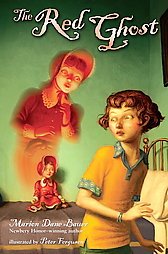
The Red Ghost by Marion Dane Bauer is a Stepping Stones Book. "Build the bridge to chapter books...," the publisher says. So we're talking a book for young 'uns here.

Earlier this week, anonymous and I were talking about whether or not books for children and YA readers need truly new and unique story lines because much is new to less experienced readers, anyway. I understand that everything's new when you're too young to vote, but I find it difficult to judge how good a book for a younger audience is when its plot and/or characters and/or setting have been done to death.

The Red Ghost is an example of a book that is using a story line that's been done many times before but doesn't come across as the same old, same old. The Red Ghost is a creepy doll story, and, yes, indeed, a lot of us older folks have seen it before. But Dane Bauer manages to create a real sense of tension here that I don't usually see in books for kids this young. This is a short, complete mystery that the kid characters manage on their own. You've got what is really a simple plot, a limited number of characters, and a setting that is rooted in one place, all necessities, I think, for a book for kids in the lower grades.

Many books for this age group are just silly and pointless. The good ones tend to be very realistic, sometimes with adult characters helping child protagonists learn feel-good lessons. The Red Ghost is a genre novel for the very young. I don't think I've seen many of those, and I was quite taken with the novelty of it.

Like many early chapter books, this one has a number of illustrations. Peter Ferguson's black and white drawings definitely show the feelings of the characters portrayed. He created a great-looking main character, a neighbor who is a dignified, contemporary older woman, and a doll that looks as if she's got something on her mind.

Sunday, September 14, 2008

Maybe You Can Be Too Ambitious


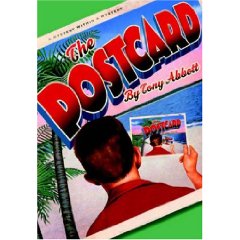
The Postcard by Tony Abbott includes a couple of elements I find very interesting. Jason, our main character, ends up searching for his dead grandmother's history. I'm definitely into the whole personal past thing. Jason stumbles upon excerpts of a '40s and '50s era noir mystery that may or may not include an account of events in his grandmother's life. I like a little noir every now and then, so I was attracted to that.

I didn't feel that all the elements in this book were well connected, though. Abbott is the author of Firegirl, a book that stayed focused on one situation and delved into the intense suffering of the characters dealing with it. The Postcard covers too many situations. Mom and Dad's marriage is in trouble. Dad has personal problems that may relate to his childhood and his own mother. The search for Jason's grandmother didn't need any of that. It was interesting enough all by itself. It did, though, become extremely complicated given that a lot of it is told through the chapters of a mystery novel that may be totally fabricated or may not. Jason ends up jumping through hoops following clues that I know I would have totally missed. We find out that there was a mind at work behind the mystery, though I was never certain why he didn't just come forward.

In an interview regarding The Postcard at cynsations, Tony Abbott called the book a "magical realist noir crime comedy mystery." I wonder if that's just too much to try to do in one book.

The Postcard did make me want to go to Florida, though.