Showing posts with label 2008. Show all posts

Thursday, May 12, 2016

Picture Book Research

I'm making an attempt to write a picture book manuscript, something I've tried before without success. While at the NESCBWI Conference at the end of April I came up with an idea with something else to do with my material. Nonetheless, I'm going to slog through trying to complete a draft.

I decided to do a little picture book research while working on this project. I'm particularly looking for humorous picture books. I'm finding them harder to find than I expected. For one thing, there doesn't seem to be a spot in the library for "Gut Busting Picture Books." Also, I may not understand picture book humor. One of the local librarians picked out some picture books for me that she found funny. Er...ah...uh.

Keep in mind, just because we were looking for humorous picture books, it doesn't necessarily follow that these books are meant to be funny. That may very well have not been the authors' intent.

I'm finding picture books to be a bit of a mystery.

Grumpy Bird Jeremy Tankard. This has a subtle story. The humor is also subtle. Kids who understand grumpiness will enjoy this more than kids who haven't had their own or others' grumpiness pointed out to them yet. The book also has an intriguing ending that I didn't notice the first time I read it. Overall, a nice work.

Little Owl Lost Chris Haughton. Love the artwork here. This is the story of an owl who falls out of his nest and is helped to get back to his mom by a squirrel. The squirrel keeps finding the wrong mom. Child readers might find the mistakes humorous and enjoy taking Little Owl's part and setting squirrel straight over and over again. That's an interesting idea. The reader brings the humor to the story. Again, a nice work overall, but this one I didn't find that funny. I think the librarian gave it to me.

Let's Sing a Lullaby with the Brave Cowboy Jan Thomas. I'm really liking bold, not particularly representational, art in these books. This is another one. This is a bedtime book, and as bedtime books go, this one is probably pretty funny. The humor here is around the fact that the cowboy isn't brave. I definitely find incongruity humorous. I wonder at what point kids get that?

Bug in a Vacuum  Melanie Watt. Okay, this definitely isn't meant to be funny. A fly experiences a crisis and then goes through Elizabeth Kubler-Ross's five stages of grief. It was published as a children's book, aimed toward the lower grades of elementary school. Perhaps as instructional? If you are an adult with a dark sense of humor, you'll find a lot of jokes here. I don't think it's going to help me as a model/mentor text for preschool picture book humor.

There Are Monsters Everywhere Mercer Mayer. Don't know why I thought this would be funny. Good story about a kid overcoming monsters that may or may not be everywhere. But not much in the way of humor.

The Pout-Pout Fish Deborah Diesen. This is another book that I think readers bring the humor to. The pout-pout fish's face lends itself to spreading the dreary-wearies. That is, until someone changes his mind by.... I don't want to spoil the story. I can imagine a child listener and adult reader having a good time with "glub-glubs" and kisses. But this isn't the kind of humor I'm thinking of.

Twelve Terrible Things Marty Kelley. This isn't actually a story. It's more like the picture book equivalent of a listicle. Very realistic art illustrates twelve terrible things that happen to many kids: gravy day at the school cafeteria and elderly ladies looming in for a cheek pinch. This is clever and witty and probably for grade school age readers who will have experienced these "terrible things" and recognize that "terrible" is being used loosely here.

Monster Trouble Lane Fredrickson with art by Michael Robertson. Okay. This one has both the story and humor I'm interested in, for the age group I'm interested in.

Pete the Cat and His Four Groovy Buttons Eric Litwin with art by James Dean. I am sure I picked this book up because it had "groovy" in the title. It is a groovy book about...math! Again, it has the story and humor I'm looking for. Also, I know someone who would love this.

The Hueys in the New Sweater and The Hueys in It Wasn't Me Oliver Jeffers. The thing about the Hueys is they're thumb people. Come on. No one notices that? Or maybe they're bean people. But for such unsophisticated bodies, they have sophisticated issues related to uniformity and getting along. There is some humor here, but the books are also thinkers. I like It Wasn't Me because of the randomness of the climax.
 

Thursday, April 09, 2015

The Environmental Book Club

I have finally found an environmental book for older readers, and it is terrific.

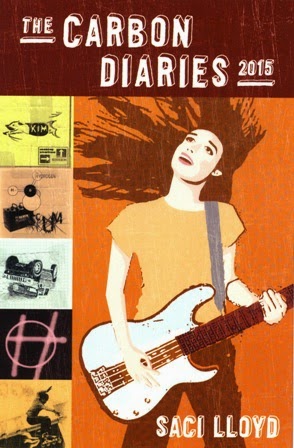
Sixteen-year-old Laura, the journal keeping main character in The Carbon Diaries 2015 by Saci Lloyd, is a member of a punk band. She has an appalling older sister, and her parents are falling apart. Sounds pretty generic YA, doesn't it? What makes this book riveting is its setting and its main character.

Are Good Environmental Books All About Setting?


The 2015 Britain of The Carbon Diaries is one suffering from energy shortages and horrific climate problems, as is the rest of the world. Britain, however, is the first country to start carbon rationing. The book is Laura's account of her family and neighbors dealing with limited access to energy while suffering through an extreme winter, a drought, and torrential rain. Her older sister is appalling because she is bitter and angry about her gap year in America being cancelled. Her parents are falling apart because they're having trouble coping with the social change they're being hammered with. Dad, for instance, is the head of a travel and tourism school. With carbon restrictions, people can't travel. That pretty much puts an end to the tourist industry in Britain, and he loses his job.

The book isn't a cautionary tale, in my humble opinion. It's much more of a thriller. What's going to happen next and how will the characters survive it? Though Laura comments on the selfishness of others a couple of times and wants very much for the rest of the world to get on board with carbon rationing, this is not a "Let's save the planet!" story. There is no instructive message.

I'm sure many reviewers probably write about The Carbon Diaries' environmental themes. I always have trouble determining what an environmental theme would be. I've seen some writers calls The Carbon Diaries' theme "climate change." That seems more like a subject to me. I would say the theme of The Carbon Diaries involves a teenager struggling to find her place as an older person in her family and her place in society, one that is dramatically changing. Those are traditional YA themes, not environmental ones. It's the environmental setting that makes those traditional YA themes interesting and makes this book environmental.

Isn't climate fiction, fiction dealing with climate change, all about setting?

A Good Character Always Does Wonders For A Book


Laura is like an edgier, smarter Georgia Nicholson. The format of the book is even similar to the Georgia Nicholson books. It's a journal, of course, and there are several pages at the end translating British terms for American readers, which you find in Georgia's books. This is not a complaint. I like Georgia. I like Laura.

A Good Book Doesn't Have To Teach You Anything

Though The Carbon Diaries doesn't insist that readers do anything, the characters' struggle was so intense that it has an impact. I hadn't read much before I started obsessing about whether or not I'd turned the heat down at night. I freaked out a bit over that power outage in Washington earlier this week. And, yikes! They're rationing water in California!! 

Very few people like to be preached at or taught. If a piece of fiction is well done, it creates a response in readers without doing either of those things.

Monday, July 28, 2014

Maybe Too Much Going On?

I like books that stay on task, as I always put it. It may be that as a reader I get distracted if there are too many different things going on. I found the cookery part of Getting the Girl, A Guide to Private Investigation, Surveillance, and Cookery by Susan Juby distracting.

Sherman Mack is a wonderful character, like a younger, less raunchy, undamaged Seth from Home to Woefield. The mystery he's investigating, who singles out girls to be turned on by the general population, is a serious one, if maybe a little over the top. Sherm's interest in cooking ties in to the mystery by the end, but it seems unconnected until then. Same with his out-there Mom and the neighbor guy who serves as a father figure for Sherm.

Juby does a couple of interesting things here. First, she does a neat twist on the cliched mean girls stereotype. She also has created a world in which every popular kid in school, whether they earned their popularity with their looks, their athletic prowess, or something else, isn't hateful. They certainly aren't heroic or particularly positive in their behavior, but, again, they aren't the evil stereotype we're used to seeing.

I have another one of Juby's books here that I hope to get to in the next few weeks. 


Wednesday, July 11, 2012

Bradburyesque

I have finally read some Shaun Tan, and I do like his work. Tales From Outer Suburbia, in particular, reminded me of the Ray Bradbury short stories I read in my early teen years. My uncle Mickey, a college graduate who married into the Gauthier family, had an enormous trunk filled with paperback books. Once when my parents, sisters, and I were visiting him and my aunt in the old house their were living in up in the mountains, he opened that treasure chest and pulled out a couple of Bradbury books to give me. They, along with To Kill a Mockingbird, were among the first adult books I read.


My recollection of the Bradbury short stories, and his book Dandelion Wine, a particular favorite of young Gail's, is that they were small town stories about things that just weren't quite every day. And that's how I read Tales From Outer Suburbia and Lost & Found, too, though in this day the action shifts to suburban towns rather than whatever small towns used to be back when Bradbury was writing.

Tan tells his tales in part with visuals, making his books picture books and seemingly for the very young. I see them more for older readers, older children, as I was when I first read Ray Bradbury, and adults.

Check out Shaun Tan's essay PICTURE BOOKS: Who Are They For?, in which he addresses the question "Who do you write and illustrate for?" Among the things he has to say while trying to come up with an answer: "I suspect that much art in any medium is produced without a primary concern for how it will be received, or by whom. It often doesn’t set out to appeal to a predefined audience but rather build one for itself. The artists’ responsibility lies first and foremost with the work itself, trusting that it will invite the attention of others by the force of its conviction." He also says, "What makes art and literature so interesting is that it presents us with unusual things that encourage us to ask questions about what we already know. It’s about returning us, especially we older readers, to a state of unfamiliarity, offering an opportunity to rediscover some new insight through things we don’t quite recognise (as it was for all of us in the very beginning)."

I think that's a very good explanation for why adults like picture books, in general, and Tan's books, in particular. The strangeness of both Tales From Outer Suburbia and Lost & Found do make the familiar unfamiliar, much as Ray Bradbury's short stories did years ago. 


Thursday, February 23, 2012

The Irish Troubles Are More Interesting Than Iron Age Speculation


Fergus McCann should be having a great summer. He's on study leave to prepare for his A-level exams. If he can pull off three B's, there will be a place for him in a medical school, which is his get-out-of-town plan. His uncle is teaching him to drive. He finds a two-thousand-year-old body in a bog. He gets to hang out with an archaeologist who arrives to study the body, and he gets to make out with the archaeologist's hot daughter.

Bog Child by Siobhan Dowd could have easily been a book about one of those magical teen summers. But Fergus McCann's magical teen summer is pretty much wrecked by the fact that he's living in Northern Ireland in 1981, and his older brother Joey is on a hunger strike in Maze Prison. Ten men died during the hunger strikes at Maze in 1981, so Joey's family is painfully aware that his decision to stop eating could very well be a death sentence.

The magical realism aspect of the book, in which the Iron Age girl's story is told through Fergus's dreams, didn't work for me. Her fate and the one Joey has chosen for himself parallel in that both the dead girl and Joey are willing to sacrifice themselves for the culture they live in. Over all, though, I didn't find the bog child all that interesting.

Fergus and his struggles are. Bog Child is a historical novel, something we were talking about here recently. It's a good one in that the historical setting doesn't become instructive or overwhelm the proceedings and Fergus actually does have an interesting story, historical or not. Can he save his brother? Will he destroy his future trying?

Though I am not a big fan of all things Irish, I found myself greatly attracted to this book because its setting in time isn't one I know a great deal about. It was such a relief to be reading something that wasn't a paranormal romance, a mean girl story, a school based outsider tale, or anything that I've read before. Dowd, who also wrote The London Eye Mystery, really was a fine writer. This book was one I wanted to keep reading.

A question I was left with: The hunger strikers were seeking political prisoner status. However, in Bog Child we never find out what Joey McCann did to get sentenced to prison in the first place. Though there's much talk of Bobby Sands, we don't hear what he did, either. Can you be a political prisoner if you committed a real crime?

Sad to say, this book has been in my local library since November, 2009. I am only the second person to have checked it out.

Thursday, December 23, 2010

New Work From Pamela F. Service


Stinker From Space by Pamela F. Service (who really ought to consider getting herself a website) is remembered fondly here at Chez Gauthier. More recently Service has been writing a series called Alien Agent. I found one of the latest volumes on the new book shelf at one of my local libraries and sought out the first book in the series, My Cousin the Alien.

My Cousin the Alien is about a young boy whose cousin believes he's been placed on this planet by aliens. It sort of plays with the old situation of children who can't believe they're actually a true member of the family they find themselves in. (I used to fantasize about being, in reality, a Mafia princess.) Because of a parallel storyline involving a definite alien, we know that there is, indeed, an alien placed in a family on Earth and that he is in danger.

Some of the writing here is a little awkward, and the parents are definitely cliches. I figured out the twist in this story early on, but in this case, that's not necessarily a bad thing. Readers can enjoy feeling they know something the characters don't. This book (and presumably the series) is marketed toward middle grade readers, but I think it is most appropriate for kids on the young end of that range. It's well done for that age group because it has a real story line and doesn't lean on pointless, silly jokes. I'm surprised I haven't heard more about it.

Plot Project: I wouldn't say that this plot is built around giving its protagonist something to want and then throwing in obstacles to his getting it. It's more likely that the author had an end point in mind--the big reveal, say--and created what might be called some flashpoint scenes for the characters to experience before getting to it. That's all speculation, of course.

Saturday, November 06, 2010

Excellent Kiddie Noir


For a long time I've been interested in writing what I think of as kiddie noir--a kid-level version of the dark, hardboiled, mystery stories made popular in the 1930s by Dashiell Hammett and Raymond Chandler. Well, I don't need to feel any rush to do that because Jack D. Ferraiolo has done it with The Big Splash.

Matt Stevens is most definitely the classic, outsider noir hero with a personal code that he must adhere to. In the slightly twisted middle school world in which he lives, a young crime boss rules the cafeteria and hallways, aided by his personal bodyguards. He controls the sale of sweets in school, as well as the sale of test answers and fake hall passes. There is law at Franklin Middle School. It takes the form of hall monitors, led by one tough customer named Katie Condor. What is Matt's place in this scheme of things? He is neither criminal nor lawman, but something separate, a private detective who students hire for various tasks.

The adults at the school are pretty much invisible. The student subculture is the one kids really live in. Unless, of course, they are humiliated by being shot in the crotch with water pistols usually filled with cat urine. No one survives that. The humiliated spend the rest of their student lives in the Outs. Moving on to high school is no escape. Once in the Outs, always in the Outs.

Yes, it's an over-the-top premise but it's laid out on the page as given by first-person narrator Matt who speaks in classic noir simili. Of Joey Renoni, also known as the Hyena, Matt says on the very first two pages, "He scanned the crowd constantly as we walked, his head swiveling back and forth in a herky-jerky motion, like a lawn sprinker with the hiccups." Just a few pages later, he says of himself, "Apparently, I wore my thoughts like makeup on a little girl: all over my face." The noir style is so well done that it would be very difficult not to accept the world it describes.

The Big Splash is filled with goons and heavies and femme fatales and damselles in distress. The young women in this book are fantastic. They may wear ponytails and, in at least one case, carry binders with horse stickers pasted all over them, but they are tough and powerful. And while all the characters are clever takeoffs on their adult counterparts in adult noir stories, many of them also have some serious depth going for them, too. Nikki Fingers--there's a heart-breaking bad girl.

This is a two-year-old book that seems to have been well-reviewed when it was published, but I missed it until a local librarian bought it a few months ago. It really deserves a wide readership.

Plot Project: This is an idea/concept plot rather than a give-a-character-something-to-want-and-keep-it-from-him plot. The Big Sleep clearly provided some inspiration for The Big Splash, though it's been years since I've read it so I don't know if the plots are at all similar.