Showing posts with label 2015. Show all posts

Tuesday, April 11, 2023

Getting Serious About Humor: More Memoir

The World's Largest Man  by Harrison Scott Key is another genuinely funny memoir. In many places, we're talking about humor in nearly every paragraph. A good work that won the Thurber Prize in 2016.

Now a big reason for my Getting Serious About Humor feature here at Original Content is to provide me with opportunities to study humor writing. So here are some thoughts:

  • The World's Largest Man reminded me of Priestdaddy, another Thurber winner, by Patricia Lockwood, in that they are both about a specific growing up experience with a specific, out-sized, over-the-top father.  Lockwood's father is a Catholic priest (yeah, read the book to see how that happened) while Key's father was a rural southern salesman. We're talking about people who are writing about the uniqueness of their young life. Arguably a lot of readers won't relate to the situation...except they are talking about fathers, and a lot of us had one whether they provided us with an unusual upbringing or not. 
  • While reading The World's Largest Man, I also thought a great deal about I'm Wearing Tunics Now by Wendi Aarons, the last book I wrote about in this series. Now, Wearing Tunics, also funny, also a memoir, seems more essay-like than Largest Man.  It also seems more outer directed than Largest Man, as if the author is reaching out to the readers who will identify with her experiences. I'm thinking of Largest Man as inner directed, as if the author is pulling readers in to his experience.

Two Different Ways A Humor Writer Could Go

So these books illustrate, I think, two different ways a humor writer could go:

  1. A book-length memoir about a specific, unusual experience/relationship. The uniqueness of the experience/relationship being the reason for the writing.
  2. A memoir made up of essays that deal with how the writer's experiences represent what was going on with other people at the time they were living them. The relatability of the experiences being the reason for the writing. 
I didn't realize I'd be doing so much reading of and thinking about memoir when I started this. But that is the humor reading that's turned up for me.


Friday, September 04, 2020

A Mini-Binge Possibility For Regency-Era Comedies of Manners

I recently wrote about a binge-worthy trilogy, Truly Devious. Now I have a two-volume binge suggestion, this one dealing with the Regency-era-women-looking-for-husbands.


I am a fan of Patrice Kindl's Keeping the Castle, a book I thought had the Regency romance set up with a modern twist, because the young woman main character was...

"...all business, not romance. She's out to use her beauty, which she knows won't last long, to score a wealthy husband who will save her family's dilapidated castle home, thus providing for her mother and very young brother, as well as all the people who work for the family. A lot is riding on her. She's a lot like the female lead in a contemporary YA novel who is intent on going into a profession. The outsider male in this case isn't a rogue, as you find in the old-time romances. He's an outsider because he can actually do something. In this aristocratic world, doing nothing because you've inherited wealth is held in higher regard than being smart enough to make a buck."

Kindl did a second book set in the same world and described as a "companion volume to Keeping the Castle." A School for Brides involves a girls' boarding school where the students are being educated to become wives, though the area is woefully short on husband material. 

I found this book a little heavy on characters and their story lines. I would have been happy if some of those characters had carried their own books. However, as I got closer to the end, the skulduggery and romance provided a lot more narrative drive.

It's been so many years since I've read Keeping the Castle that I didn't realize A School for Brides included some characters from the first book until I was reading up on it in order to write this post. Read the books one after the other, so you don't miss anything the way I did. 

By the way, I also liked Patrice Kindl's Owl in Love, which is very different from Castle and School.

Saturday, August 01, 2020

What I Didn't Know About 20th Century Russian History Filled A Book

My faithful followers may have been wondering if I am ever going to read another book, or at least write about one here. Put your minds at rest. I recently finished Symphony for the City of the Dead: Dmitri Shostakovich and the Siege of Leningrad by M. T. Anderson. This is a historical work, not historical fiction. I am going to be upfront here and say:
  • I think it should have been called Dmitri Shostakovich and An Introduction to Communist Russia, since the actual siege doesn't come until well into the book.
  • Also, I found this a little long, probably because there was such a long wait for the siege I'd been promised in the title.
  • And then there's the issue that I am an old fart who will never give up wanting footnotes sprinkled through a historical text that I'm reading so that I can be assured that there is documentation for this point or that point, and I don't have to go hunting through the end notes to see if it exists. Yeah, I'm never going to see that again.
I'm also going to be upfront and tell you that Symphony for the City of the Dead was on the longlist for the National Book Award for Young People's Literature in 2015. (The winner that year was Challenger Deep by Neal Shusterman.)

Thoughts


  • Anderson uses Shostakovich as an entry point to discuss the period he lived in. That's not unusual. In fact, most works on historical figures need to include information on the world that formed them.
  • I am truly embarrassed that I knew so little about the Siege of Leningrad before reading this book. I was aware that the Soviet Union suffered huge losses during World War II, but I didn't know anything specifically about Leningrad. I had heard and read plenty about London during the Blitz. Why has Leningrad's suffering and survival not been more prominent? My high school history courses often didn't get all the way to World War II. I wasn't that interested in twentieth century history when I was in college. So this could be on me. And, yet, as I said, I know about the Blitz.
  • Am I the only person who thinks M.T. Anderson and Dmitri Shostakovich look alike? Come on.
  • I spent a lot of time bitching about Joseph Stalin while I was reading this.
  • Yes, I've been listening to a little Shostakovich recently.
Symphony for the City of the Dead is one of three nonfiction books I can think of off the top of my head that I didn't totally embrace while reading but that shifted, or at least enhanced, my world view.

Wednesday, December 04, 2019

Humor AND Story

I am certain I've complained pointed out here before that I find that a lot of so-called humorous children's books just aren't. They are written as if kids are from another culture and this is their humor. Of course, it's not actually going to be anything adult culture would recognize as funny. The jokes are forced. They aren't integrated into the story. Sometimes there isn't much of a story to begin with.

In I'm An Alien and I Want to Go Home Jo Franklin does a much better job with both humor and humor that's integrated into story. This is one of those  child outsider stories, in this case taken to an extreme. And, yet, for an "alien" story, it is very grounded in reality. The resolution here is one that makes sense and is reached in a logical way.

The book has many illustrations by Marty Kelley. With both subject matter, humor, and packaging, this could be a fun read for younger children.

 I saw Marty Kelly at a NESCBWI event a number of years ago, about, I believe, author appearances at schools. He does a lot of those.

Interesting factoid. Kelley is an American writer located here in New England. Franklin is British. I had a British cover artist for the hardcover edition of one of my books, so I shouldn't be all "They're from different countries!" about that situation. Nonetheless, I am.

Children's publishing is probably a small world. 

Monday, May 21, 2018

Worth The Wait

I liked what I heard about Nimona by Noelle Stevenson when it was published in 2015. I finally got hold of a copy a couple of weeks ago, and this National Book Award Finalist did not disappoint.

Nimona is a graphic novel about a joyful young female shape shifter who is game for, and good at, any kind of violence. She throws her lot in with a supervillain, one with a backstory that involves injury and disappointment. Morally, he's a little horrified by Nimona, though he definitely becomes attached to her.

There's what was for me a surprising and subtle love interest. I'm not going to say much about it and ruin anyone else's reading experience.

The world these people live in is an interesting one. It's your traditional high fantasy setting with knights and medieval-looking people, but one to which science and modernish weapons have been added.

Great-looking art. Also, this is my favorite kind of graphic novel, one in which the story is showed totally through the images and dialogue, no narrative boxes telling us things.

Lots to enjoy here and not much to complain about.

Monday, May 14, 2018

For Alcott Fans, Women's History Fans, Women's Lit Fans, Art Fans...You Name It

My faithful readers are aware that I can be a bit obsessive about Louisa May Alcott. I've gone on and on here about Little Men, which I reread last year. I went on and on about An Old Fashioned Girl back in 2010. Honest to God, I've read Little Women and Werewolves. I've been to Alcott's house. I've been to her grave. I've been to Fruitlands. In truth, all this activity was spread over many years. We're not talking an Alcott scholar here.

But I'm going on and on like this to explain why I was attracted to the adult book Little Woman in Blue: A Novel of May Alcott by Jeannine Atkins.

 May Alcott was Louisa May's youngest sister, the inspiration for Amy in Little Women, Little Men, and Jo's Boys. This novel about her adult life is impressive in the way it uses what I, at least, know of the Alcotts' lives. There are lots of small details, like the reference to Louisa's childhood birthday party at which she had to give away all the little cakes to her guests and didn't get one herself, that I'd heard of. Or recognized from Louisa's books, which, remember, had some connection to her life. There's also playing off the books. May in Little Woman in Blue is unhappy with how she is portrayed in Little Women. And, when you think about it, who wouldn't be?

This book is a marvelous mind game for readers who have knowledge of the source material.

But it's more than that. In Little Woman in Blue May Alcott is a single woman who is overwhelmed by her family. I will hazard a guess that this is a classic theme in women's literature. In this case, the needy parents and the needy married sister and her family don't seem to even realize what they're doing or that there's anything unusual in draining their family members. I say "members" because it's not just May they're doing this to. Louisa bears the financial burden for all the Alcotts, as she did in real life. Louisa and May could be described as draining each other, too.

This book also shows the life of "single working women" in the 1860s and '70s. It sounds very much like a section in Louisa Alcott's An Old Fashioned Girl. And then there's all the talk of art and specifically art in nineteenth century Paris at the beginning of the Impressionist movement. (Read Sacre Bleu by Christopher Moore, covering the same period? I have.)

So there's something here for several different types of historical fiction readers. And good somethings.

UPDATE: Reading this book motivated me to record Little Women on PBS last night, which I would probably have passed on.


FTD Stuff: Jeannine Atkins is a Facebook friend, one I actually interact with. I purchased an eBook edition of this book during a sale period.

Wednesday, January 03, 2018

My First Read Of 2018

I've finished reading my first book of the year.

The War that Saved My Life by Kimberly Brubaker Bradley is a fine addition to the pool of juvenile books about the evacuation of children from London during World War II. My sons and I read a number of these when they were young, and the subject has become of such interest to me that it was the inspiration for an adult scifi book I've completed. I found the beginning and ending that framed the Saved My Life story a little melodramatic, myself. It could have come down a couple of notches. But that doesn't wreck the reading experience by a long shot. I'm interested in this subject, anyway, and like twentieth century small-town British stories on top of that. I knocked off the first half of this book while I was up in the night with an attack of insomnia.

Some of the things I particularly liked about The War That Saved My Life:

  • Susan, the woman who takes Ada and her brother in after they leave London, appears to suffer from depression. But the author doesn't use it as some kind of teachable moment. It's merely a way of defining Susan.
  • Perhaps I'm ready too much into this, but I also suspect Susan is a lesbian mourning the loss of her companion. Again, there is no big neon sign or any kind of lesson on acceptance here. This is just Susan.
  • There's an interesting spin on the "miracle of Dunkirk," which usually, in my experience, focuses on the boats. In The War that Saved My Life, the focus shifts to what happens to the men after the boat lift.
A follow-up book was published last year, The War I Finally Won.


Saturday, June 24, 2017

Like "American Gods," But Lighter

Okay. Found that journal. The following reader response was written in a waiting room at one of those surgical satellite facilities where a family member was having his shoulder torn apart.

Author Matthew Laurence calls his first book, Freya (I don't recall the "and the Myth Machine" part that I'm seeing on the book I read), an urban fantasy, which, in my experience, usually means contemporary, real world. It is my favorite kind of fantasy and Freya was a treat to read.

The basic premise here is that the gods of myth and legend are real. They were created and maintained by human belief, and now that few people believe in them, they don't have much of a presence. (This sounds similar to my recollection of Neil Gaiman's American Gods, not that I mind.) Take the attractive, voluptuous (meaning "not tiny") main character in Freya. She has been living in a mental hospital in Orlando for years with no one noticing. That's because she's the Norse goddess, Freya, who still has just enough power to pull off the hide-in-plain sight trick.

Freya's settled, if not particularly dynamic, life blows up in her face when a representative of an organization "collecting" gods shows up and tries to collect her. She takes off with a new psych aid and ends up with a job at DisneyWorld before she is, indeed, caught. But the goddess of beauty and war has a plan.

Freya is a clever and witty narrator, and this was a fun read. Additionally, though, the book addresses what belief in a god does for people. It even mentions Christ, in passing, something I haven't seen in other YA and children's books about gods in contemporary times.

This is the first in a trilogy. It could very well end up as present for a Gauthier relative. Maybe two of them.

Tuesday, February 14, 2017

And The Cybils Winner For YA Speculative Fiction Is...

Illuminae by Amie Kaufman and Jay Kristoff.

Illuminae brings the science fiction thriller to a YA audience. I'm not aware of a lot of real science fiction being written for young readers. Note that all the other Speculative Fiction nominees were fantasy. Illuminae also has an interesting format. Like World War Z (the book, not the abysmal movie), it's an account of a disaster that is already over. The basic premise is that a tech group has collected information about the aftermath of an attack on an illegal mining colony and the ordeal the survivors suffered after they are evacuated . We don't know who is doing the collecting or who the information was collected for. So the story is told with documents--various types of reports, communications, transcripts of videos, etc., and a little commentary from the mystery technician. This can be risky, in my opinion. There's always the possibility that all the shifts will slow down narrative drive. And thrillers are all about narrative drive. No problem here. Drive, drive, drive.

Oh, and there's a plague. That's always good. And some neat plot twists at the end. And I haven't even started on the clever main characters and the little role reversal thing they've got going on, with Kady being the heroic nerd going all out to save Ezra, her guy in distress. Plus there's a sequel, Gemina, which offers a different setting and some new characters. I would read that.

Check out the YA Speculative Fiction Committee's write-up on Illuminae, as all as all the other Cybils winners.


Monday, January 16, 2017

Picture Books For Retreat Reading

My Reading Done Pile
While I was on retreat last week, I did a lot of reading. Cybils spec fiction. A Poets & Writers.  Some Yoga Journals. A couple of Vermont Lifes. The most recent issue of 7 Days. Half a Carve Magazine. Got started on The Man in the High Castle, which I got at my retreat week indie bookstore.

But today's post is about a couple of picture books I brought with me, primarily because we had a four-year-old family member with us. I have a long history of "shopping" for books for family members. Over the years, I've registered a lot of hits. I'm thinking all those YA humor books for one YA. The adult mystery series for another. The hip books of essays for a daughter-in-law.

So what about the books I brought on retreat last week for a family member?

The Little Snowplow by Lora Koehler with illustrations by Jake Parker. I picked this book because our four-year-old is into things like trucks, race cars, and trains. This isn't the first truck book I've latched on to these last few years, which I want credit for. I may have mentioned here before that I don't get the truck, race car, and train thing. Dinosaurs, I get. Curious George, I get.

This is not a gender issue, by the way. I don't get princesses, either. Princesses actually annoy me. At least trucks, race cars, and trains are not annoying. They're just mystifying.

The little snowplow, of course, isn't a truck. It's a little snowplow in a world of big trucks. The Little Snowplow is a classic story of a little guy who trains and prepares and comes through in a pinch, in large part because he is little. Lovely story with a Beep, Beep for little ones to...beep.

I picked up Spot, the Cat by Henry Cole because I'd heard that our picture book reader is into those "hunt for things in pictures" books. Yeah, that's another thing I don't really understand. In fact, after looking at the first few pages of this thing, I thought, I hope he can spot the cat from this point on, because I sure can't.

Well, he could. Pretty soon, so could I. In large because this isn't a random Where's Waldo type of book. There is a narrative here that's told totally in pictures. A boy's cat goes out the window, has adventures while the boy looks for him, and eventually comes back home.

"Found That Cat."
We developed a "Found that cat!" sing-song as we thumbed through this, and before long our guy was "reading" the book by himself, including the wordless story about the cat's boy. One morning I stayed in bed and could hear him in the living room, going "Found that cat! Found that cat! Boy sad. Boy makes signs. Found that cat. Cat comes home." 

When it comes to picking out books for others, I've still got it. Not that I'm bragging or anything.

Well, of course, I am.


Wednesday, January 04, 2017

A Middle Grade Thriller


I think of Gordon Korman as being a writer of realistic middle grade fiction, with humor. His Masterminds is different. It’s a thriller. Think Wayward Pines without the creepy devolved beings and the futuristic setting. And the violence. And the adult point of view. Well, okay, it’s only like Wayward Pines in that it takes place in a community cut off from the rest of the world to such an extent that residents, or in this case the child residents, don’t know what’s out there.

The kids believe they’re living in a perfect place. Eventually, readers realize that indeed they are. They’re living in a perfect place that’s been created for them. The question then becomes why?

While I was reading Masterminds, I wondered why utopias always seem to have something about them that’s not so utopian.  

This book is written from differing points of view, switching among a number of the kids. This is something I don’t usually care for. In fact, I had just finished reading an adult book written with point of view switches. Masterminds worked better.

This thriller keeps a reader coming back for more. My major complaint is that it’s the first in a serial. The ending was better than it could have been. But, still, I would have loved to see a complete story.

Monday, November 14, 2016

A Little Time Spent With Picture Books

A Poet Kids May Want To Know About


I can't claim to be at all knowledgeable about poet e.e. cummings, though I've certainly heard of him. I didn't have to know much about him to find Enormous Smallness: A Story of E.E. Cummings by Matthew Burgess fascinating.

The book spends a lot of time on Cummings' youth (He sounds like the rare artist/bio subject who had a happy childhood.), a great idea for a children's book. Then it makes a smooth transition to his adult life.

The book makes an interesting connection between Cummings and artists working in other artistic fields, such as Gertrude Stein, Paul Cezanne, and Igor Stravinsky. They "were challenging the way we think and see. In all of the arts, people were in pursuit of the new and Estlin wanted to make his mark, too."  Last month, The Millions carried an essay related to Impressionism's influence on Virginia Woolf's To The Lighthouse. The idea that all sorts of artists in a particular period are connected is new to me.

This is a beautiful looking book, too.

The MacDonalds And Their Farm 


It's a rare child who hasn't heard of Old MacDonald Had a Farm, and that's what makes Old MacDonald Had a Truck by Steve Goetz with illustrations by Eda Kabanwork work. Old MacDonald
isn't supposed to have trucks...front loaders...bulldozers...on his farm. He's supposed to have animals. Incongruity. That's funny. In fact, yesterday I read this book to a four-year-old who said, "That's crazy" when he heard the title.

One of the many neat things about this book is all the face time Ms. MacDonald the farm wife gets.

Personally, I don't get children's fascination with heavy equipment. However, I heard someone on NPR suggest a few weeks ago that it has something to do with powerless children associating themselves with the powerful equipment. No idea how accurate that is.

I think this book is a example of what Pegi Deitz Shea was talking about at the Publishing Children's Books panel discussion earlier this month. Old MacDonald stories are concept books in that they teach children about farm animal sounds. Pegi said that if writers can "provide a twist to a concept," they have a totally new book. Old MacDonald Had a Truck is a definite twist.

Wednesday, August 17, 2016

Diva Could Be Renee's Dog

The Story of Diva and Flea by Mo Willems with illustrations by Tony DiTerlizzi is about a French dog with a home and not much sense of adventure and a French cat, Flea, who lives on the street and is very into adventure. And they become friends and have a positive impact on each other, and that's all very meaningful and nice.

Here's the reason I'm taken with this book. Diva belongs to a gardienne, Eva, who takes care of a building. Towards the end of the book, we see Eva's feet as she sweeps a floor. I thought, Sacre Bleu! That could be the concierge in The Elegance of the Hedgehog!!!

The Elegance of the Hedgehog by Muriel Barbery was an odd (the in the best sense of the word) 
international bestseller from France around eight years ago. It had two main characters, a twelve-year-old girl who lived in an upscale building and Renee, the upscale building's concierge. Renee is quite fantastic, a nobody building maintenance worker who is also a French intellectual. Though no one knows it. Like Diva, she becomes friendly with someone quite different from herself. Or is he?

I must say, The Elegance of the Hedgehog includes an event that left some readers shaken. (I'm looking at you Sally Allen.) Still The Story of Diva and Flea and The Elegance of the Hedgehog could be companion books. Young readers could read Diva and Flea preparing themselves for the philosophy and shock of Hedgehog.

Yes, I recall that Renee was a cat person. But look at the cover of Diva and Flea. Diva is one of those fluffy little dogs that could pass for a cat.

My Goodreads post about Hedgehog from 2012.


Thursday, August 11, 2016

An End To "The Lunar Chronicles"

I enjoyed The Lunar Chronicles by Marissa Meyer so much that I bought several of the books for my niece. I even liked Fairest: Levana's Story. And nobody likes Levana.

The last book in the series, Winter, is not my favorite. That would be Cinder, followed by Cress. Winter reminded me of Dreams of Gods & Monsters by Laini Taylor. Both books were the finales of fantasy war romances. Or war romance fantasies. Or... you get my drift. Both of those final books ended up dwelling on getting those romances resolved. And in Winter there were a number of romances to resolve. There was lots about whether A has told B he loves her. Will C get back together with D. You get my drift. All that will be a treat for big F fans. I am a little f fan. I'm not that keen on stopping to talk about feelings.  (Yikes. I sound like a family member who used to complain that Star Trek: Deep Space Nine was the "feelings Star Trek." "More battles! More explosions!")

Oh, my gosh! We're not really done with The Lunar Chronicles! Stars Above is a collection of short story prequels to the Lunar Chronicle books. If you are what's known in book collecting and reading circles as a completist, you will probably have trouble resisting that.

Thursday, August 04, 2016

A Few Picture Books From Last Winter's Reading

I read these three titles before I started my humorous picture book research. What I had in mind while I was reading these was the 3-year-old family member I often read picture books with. My experience reading with him twists my perception of these kinds of stories now. I'm always thinking in terms of what would he like, what would he be able to take in and appreciate?


The Red Hat by David Teague with illustrations by Antoinette Portis. This has striking illustrations in red, white, black, and lots of blue. The story has a little magical realism thing going. The wind keeps two children apart, making one of them work so they can meet. It's a good story, but is it a really young children's story?

Check out Elizabeth Bird on spot gloss, something I'd never heard of, and its use in this book. Now that I know about the spot gloss in these illustrations, that might be the catch for my young reader, if we were reading this together. I don't know if the story of two kids struggling to meet would grab him on its own.

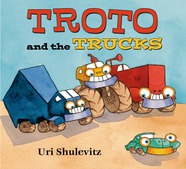
Troto and the Trucks by Uri Shulevitz would be a hit with my picture book reader, simply because of the trucks. And while the story doesn't make a lot of sense to me, the little car overcoming all those trucks might work very well with him.

Last Stop on Market Street by Matt de la Pena with illustrations by Christian Robinson. This one I picked up because I read an article about de la Pena that interested me. This is a story about a boy going somewhere with his grandmother after church and not feeling very enthusiastic about it. The elegance of the writing may be over my little reader's head. Though I have read that this book is for grade school age children, not three-year-olds. It's not meant for my guy, who likes looking at pictures of trucks. Though he prefers trains, to be honest.

Picture books cover such an array of age groups. Someone must be writing about that, right?

Last Stop on Market Street was this year's Newbery winner, by the way. I told you it was elegant.

Also, Market Street's illustrator, Christian Robinson, also illustrated Gaston and Josephine.

Monday, July 04, 2016

Some Light Election Year Reading


I picked up Red Girl, Blue Boy by Lauren Baratz-Logsted because I'm acquainted with the author, I'm tired of reading so much fantasy, and...it's an election year! Red Girl, Blue Boy is a light romance about a teenage girl from a Republican family and a teenage boy from a Democratic family who...

Oh, my gosh. This is Romeo and Juliette, isn't it? Without the playing dead business.

The basic set-up here is that Katie's father is the Republican Presidential candidate and Drew's mother is the Democratic candidate. Katie is totally into politics and has often had a part in her father's campaigns. Drew has never been interested. In fact, his mother's political aspirations are a bit of a trial. Needless to say, these two get together.

Now the politics-makes-strange-bedfellows/Mary-Matalin-and-James-Carville storyline has been done before. But maybe not for teens. And what really makes this particular version a fun read is one character, Katie. Her political interests make her an over-the-top, abnormal teen. While Drew is "nice," as Katie describes him, she's a happy misfit. She's too much a part of the adult political world for her to fit in at her private school, even though she is wealthy and connected to power. (Hmm. Maybe those things don't matter in high school.) She's never had a boyfriend, she doesn't have friends, and she does not care. No "woe is me" teen angst for this girl. She's got a campaign to run! 

Katie reminded me of Alison on Orphan Black, except for, you know, the drugs, alcohol, and being a clone. Who doesn't love Alison?

The course of true love can't run smooth and  misunderstandings drive Katie and Drew apart. Oh, my gosh. Am I getting a Pride and Prejudice vibe here? As an adult, I think Drew was way out of line, and Katie should move on. But that's years of experience talking.

I hope this book is finding an audience this summer. And oh, how I wish the cover showed Katie in one of her red Nancy Reagan suits.

Red Girl, Blue Boy is part of  the What If romance series published by Bloomsbury. While the books are standalones, they are linked thematically. The books are supposed to provide a "What If" situation (What if both presidential candidates had teenage children and they started dating?), contain humor to some degree, and be appropriate for readers as young as twelve.

FTC Info: As I said earlier, I do know this author. However, I got this book at a local library.

Monday, June 27, 2016

The Penderwicks Came Back

I was a big fan of the original Penderwicks  by Jeanne Birdsall. I still liked the second book, The Penderwicks on Gardam Street, though I thought it had the potential to be "sweeter than yuck."  The Penderwicks at Point Mouette, the third book, I thought rambled, without a tight story line. That's how I felt about the most recent Penderwick offering, The Penderwicks in Spring, too.


The story was pretty much Batty Penderwick's. She's the musical Penderwick who discovers she's even more musical than she thought. But Penderwickish distractions are going on around her. And Penderwickish distractions tend to teeter on the brink of being "sweeter than yuck," as I said above. Even a bad college boyfriend is bad in a safe way.

This particular book did have what seemed to me to be a particularly dark episode, not sweet at all, with Batty experiencing what sounds like a depressive episode or something similar. Her family took it very seriously, and she recovered with just their assistance. Which was nice, but I don't know how often a child is able to come back from something like that without a little professional help.

Yet with all the sweetness and improbable goodness, I still snatched time here and there from my work days to read it. What is the attraction these books have, at least for adults? I know I will probably read the next one.

Monday, June 20, 2016

An Excellent Reading Experience

We're having a little trouble with Interlibrary Loan here in central Connecticut, so I haven't been using it lately. Instead, I've been browsing the "new books" shelves at three area libraries. This means I'm stumbling upon things I might have overlooked, if I was just ordering books I'd seen reviewed somewhere.

John Stone And His Many Lives


The Many Lives of John Stone by Linda Buckley-Archer is one of those books that leaves you feeling you've read something unique. In large part, that's because it doesn't fit neatly into the YA mold. For one thing, the John Stone of the title is an adult, not a teenager. For another, though it could be argued that Spark, a teenage girl who is sought out by John Stone, is the main character, this book is really about Stone, not Spark. It's his story. She's part of his story.

On the other hand, though this book is about an adult, there's a great deal of focus on his teenage years. So we're brought again to the YA world.

Oh, but this is one of those situations in which you wish you had a third hand, because there is still another aspect of this story you'd like to consider. The aspect I'm talking about is Spark's age. She's just finishing up what we'd call high school (the book is set in England) and waiting to see what she'll do about college. She's old on the YA continuum. She's teetering into adulthood.

Years ago, when I first heard about the possibility of a new category of books, something that would fall between YA and traditional adult publishing, John Stone was the kind of story I thought would fit into that category. I thought we were talking about books about a slightly different period in young people's lives. The literary equivalent of a gap year. Then New Adult came along. Usually when I read of bloggers and writers talking about New Adult, sex and romance is a factor. There's nothing wrong with sex and romance, but what about all the other experiences people have between leaving high school and becoming full acclimated adults, say mid-twenties or so?

Well, New Adult or not, this book is a mash-up of historical fiction and scifi with a little Gothic business going on about a young woman called to an old house by a mysterious older man. A sophisticated work for an older audience by the author of Gideon the Cutpurse.

Thanks For The Trouble. Really.


I read Thanks For The Trouble by Tommy Wallach right after I finished The Many Lives of John Stone. Another elegant piece of writing with some strange stuff going on.

This is one of those stories in which two characters meet cute (main character Parker robs a young woman named Zelda) and develop an intense, emotional connection that's played out over a short period of time.Think Nick & Norah's Infinite Playlist without the rock and obscenities. It was a magnetic read, though I did think it romanticized death a bit.

However, for me, the ending fixes that. I liked the ending in this case, even though I'm sure some would argue that it gave the story a frame that older readers--really older, like me--will recognize. But it also gives readers a choice, one that I appreciated.

Is There Something You're Not Telling Us, Gail?


Well, yes, there is. I'm not telling you the essential situation, set-up, what these books are actually about. I'm not putting that on the table to protect your reading experience.

I picked these things up off a library shelf with only a vague idea of what they were about. They sat around my house for a while before I got around to reading them. I no longer remembered why I was interested in them. What a great time reading that first book was. Then the second book was just as good.

And about something very similar.

I love it when this kind of thing happens. I don't want to ruin the reading experience for anyone else.