Showing posts with label memoir. Show all posts

Wednesday, July 30, 2025

The Heritage Month Project: "Blind Man's Bluff" by James Tate Hill

While Disability Pride Month (July) is recognized by a number of groups, it doesn't appear to have ever been observed by the U.S. government as a heritage month. Nonetheless, July was kind of free as heritage month reading goes, and what you might call disability literature isn't something I think I've ever sought out, so I decided to go for it.

You can find lists of books featuring disability. I was attracted to Mystery – The Disability Book Archive,  but then was thrown because it included a book about vampires, who I don't think of as disabled. (This led me to much speculating about what, exactly,  disability is, which I will spare you. You're welcome.) I wish now that I'd spent more time going through The Disability Book Archive's other genre offerings.  I did look at Book Riot'20 Must-Read Fiction and Nonfiction Books About the Disability Experience, though. It had a lot of memoir, and I was hoping for fiction at that point.

Yes, I am so freaking picky.


One way or another, it's the end of July, and I've only read one disability-related book, the memoir Blind Man's Bluff by James Tate Hill. I ran into Hill on BlueSky, where he comes across as being very congenial. (The first thing I look for in a writer, I guess.) His memoir describes his efforts to hide his blindness, something he had a shot at doing, because he became legally blind in his mid-teens, being left with some modest vision. (I think the cover of his book is an attempt at replicating what he can see.) The book is also described as humorous, which is always a draw for me.

So here was an intriguing situation, with humor. I was in. 

First, Hill does have a dry, self-deprecating sense of humor that I definitely appreciate. 

Second, what most intrigued me about this book was not the disability/blindness. What intrigued me was the way it was about transitioning from high school to college and from college to the work world and from single life to married life. Yes, Hill had to do all these things I recognize while working out how he would get his college reading done, how he would mentally map out how he'd get to classes, how he would find the men's room in restaurants and bars, and how he would, as a college instructor, deal with the issue of students raising their hands to speak, since he couldn't see them. Also, he risked his life every time he crossed a road. But there was still much that he was living through that many seeing people live through, also.

I don't want to downplay the significance of the blindness Hill deals with. But what struck me about this book was not how different he is, but how much he is the same. He just can't see.

The "Bluff" Aspect of This Book

The young Hill didn't like to address his vision with new people. He didn't like to talk about what he couldn't do. When he did feel he had to deal with it, with new people he expected to have to interact with in the future, for instance, he would say something about having blindspots that made it too hard to do something. "Too hard. Never impossible. Not once had I ever said I can't drive; it was always I don't drive, which wasn't a lie. I didn't drive. If that particular verb left room for one to infer choice, so be it."

That idea of choice seems significant to me. When he lost his sight at sixteen due to Leber's hereditary optic neuropathy, Hill didn't just lose his vision. He lost the choice to do so many things, choices that sighted people have. And that may be a big factor in why he tried to keep his blindness to himself as much as he could. He didn't want to make his lack of choice obvious to the world.

At one point, though, he says, "I had accomplished less than many blind people who acknowledged their disability."

He was still young, though. He had time.

The Writer Aspect of This Book

I'm not sure if I've read other writer memoirs. I can recall reading my-mother-was-horrible memoirs and my-oddball-dad memoirs and collections of essays about aging women or young humor writers. I can't believe I've never read a writer memoir, but I have to say that Hill as a young writer seemed familiar to me not because I'd read about writers, but because I am one.

He writes about how he became a reader after he lost his sight, through audio books. He writes about editing his work. He quotes F. Scott Fitzgerald. He gets an agent!

This, to me, illustrated that a disability isn't everything a person is. This person was a writer like me. In fact, one who right now is doing more than I am professionally.

I am still here, though. I have time, too.

The Memoirist Now

I don't want to say. I don't want to take another writer's story. Read his book. Oh, wait! I will share that there was a section of this book, which was probably the most painful, and that was only marginally involved with his blindness. Unless, of course, I've got that wrong and it was intricately involved with his blindness. Anyway, that was a part that really kept drawing me in in a when-is-what-I-am-damn-sure-is-going-to-happen going to happen? way.

A Couple of Other Options

While going over disability reading lists, I did find a couple of novels I'd read. And written about here!

Tru Biz by Sarah Novic, an adult book that deals with a deaf school that both my sister (for what that's worth) and I liked. It also won the Alex Award.

The War That Saved My Life , a middle grade book by Kimberly Brubaker Bradley, turned up somewhere on a disability reading list. This is a book I liked, and I liked the sequel even more. These are books that fall into the World War II British child evacuation genre. I'm assuming there's a genre, because there are so many of them. Not complaining about that. I have enjoyed a lot of those books. In this one, main character Ada has a clubfoot that was ignored by her abusive mother. 

If you followed my link to my post on the subject, you saw that I didn't even mention Ada's disability. I had trouble recalling it until I read a review of the book at a site that focuses on disability. What was my thinking about that? Can't even begin to guess.

I do think that the reading I've done this month, limited as it was, will change my perception of how disability is portrayed in the future.

I don't have any Heritage Month reading planned for August. I hope I can use that time to read ahead for September.

Friday, February 21, 2025

The Heritage Month Project: "Pearl's Secret, A Black Man's Search For His White Family" by Neil Henry

Pearl's Secret by Neil Henry is an older book, published in 2001. It's been on my To Be Read Shelf for a number of years. I probably bought it because of the genealogy and history aspect. I didn't know much about it beyond that.

By the time I finally started reading Pearl's Secret, I thought it was going to be a Finding Your Roots thing. That worried me since I stopped watching that show, because I find it so formulaic. ("Your ancestors suffered horribly. How does that make you feel?") Then I thought the book was going to be a memoir of Henry's experience hunting for his white family members, maybe some nerdy stuff about hunting high and low. You do get a little of that. Genealogical research was much more of a chore before the Internet, even if today sites like Ancestry.com are only as accurate as the strangers who are doing the posting there.

But what the book really is is a family history as it relates to race, first through the Black side and then the white side of Henry's family, once he connects with them. I personally think family histories relate to the greater histories families lived through, and Henry's story supports that.

Henry describes his childhood in Seattle as the youngest son of a surgeon and a librarian as being Leave it to Beaverish. It was an idyllic suburban life interrupted by episodes of racism. He's invited by a couple of little white girls in his neighborhood to come over and play only to be chased down the street by their grandfather when he goes to the door. Not at all surprised he remembered that years later. In his family there is talk of the value of having light skin and good hair while at the same time feeling great respect for their Black history and culture. Believe me, no one was talking about French Canadian achievements and listening to French Canadian music when I was growing up. My mother's side of the family didn't know they had any kind of achievements or music, which I suppose can easily happen when your name is Adams.  

Henry's own story of being adrift while attending Princeton and working for Ben Bradlee at The Washington Post tended to drag for me, because I've read about guys going to private schools and having good jobs in journalism before. His grandparents are nice people, but he doesn't talk that much about them. The relatives who are the stars of his family show are his parents, who experienced life under Jim Crow and survived and overcame it. Their stories are riveting, shocking. Seriously, I am shocked by how little I, who have taken a history course or two and read a few history books, have known about the Jim Crow era until recently. I kept talking about these people at the dinner table while I was reading about them. 

Netflix! Where are you? I would watch this mini-series.  

I don't want to say too much about the Beaumonts, Henry's white family, because there's sort of a creative nonfiction thing going on here, with a narrative climax that I don't want to give away. Though I will just say, "boll weevil." Yes, I had heard the name, just as I had heard "Jim Crow." I had no idea the significance, though.

Regarding Peal's secret, itself--That's a bit of a surprise, too. It's not that she was a Black woman hiding her white background or a Black woman passing as white, because she was neither of those things. Her secret is something else. 

Pearl's Secret is a great example of how reading about people you are less familiar with opens up opportunities to see something different, to add to your personal knowledge base. My feelings about this book reminded me of reading Don't Hold Me Back, a picture book memoir written and illustrated by the late artist, Winfred Rembert. Rembert was a few years older than me, but not a lot, and I actually met him. In his book, he writes about growing up in the south at the end of the Jim Crow era. I found it disturbing that someone nearly my contemporary had to pick cotton as a child and saw the bodies of lynched Black men hanging from trees. Now I realize that growing up poorish in rural Vermont when I did, without weekly news magazines or a daily paper coming into the house, was probably a great protector for little Gail in terms of what was going on in the rest of the world.

James Marriott, a columnist with The Times (London), wrote a few days ago that "Our society has been peaceful and healthy for so long that for many people serious disaster has become inconceivable."  It's also inconceivable if we never knew it happened.


Wednesday, October 16, 2024

Another Story Behind A Story

Farr House as it still looked when I ate dinner there.
The Memoirist, a Medium publication that is new to me, just published my memoir Eating at Shirley
Farr's House
in which I write about very much enjoying a restaurant in a mansion I later learned was once owned by someone who might not have been happy about me being there.

Once again, there is an interesting story beyond the story in the story.

In the Beginning


This memoir began as an essay for the one graduate course I took more than twenty years ago, an essay writing course at the University of Connecticut taught by Sam Pickering. Now, Pickering is the author of a few books of essays, but you can't find much about him on-line. Given the little I know of him from that class, I am not surprised. He did not seem to be an Internet-embracing kind of guy. At that point, none of the historical material was in the essay. The essay was about a local rube (me) who managed to get into a wealthy person's house by way of the restaurant someone had opened in it after her death, enjoy the place, and then it became even more of a wealthy person's place, ruining my bliss.

The History Involved


To make a long story short(er), the history involved in this story relates to the eugenics movement in the early twentieth century. There were eugenics fans all over the U.S, and the world, since some draw a line between American eugenics and the Nazis. You don't need to know much to think, Gee whiz, don't these things sound kind of similar? The Nazi connection may be why I never heard of eugenics while I was in high school or college, where I was a history minor. Even though I was in Vermont, which definitely was definitely up to its neck in eugenics. Who wants to have been involved with something with possible Holocaust connections?

What Does Eugenics Have to Do with Me Eating Sticky Buns in a Mansion Turned Restaurant?


Well, it turns out the Shirley Farr of My Dinner at Shirley Farr's was active in Vermont's eugenics movement. How active, you ask? Go ahead, ask. She funded what was known as the Vermont Eugenics Survey for eleven years. She spent between fifty and sixty thousand dollars on it back in the nineteen twenties and thirties when fifty to sixty thousand dollars was real money. 

This survey studied a number of generations of families someone had identified as having issues a society didn't want to encourage, issues eugenicists believed were genetic and could be stopped  immediately if these people weren't allowed to reproduce. A number of these families happened to be poor, happened to be Abenakis, or happened to be French Canadian. 

Because, you know, nothing goes wrong in white anglo saxon Protestant families. Absolutely nothing.

Now, I didn't learn anything about the eugenics movement and Shirley Farr until I decided to look her up on-line either while I was writing the original essay or thereafter. And even then, it took a while for me, a second-generation American on my father's French-Canadian side to go, "Wait. Gail. Isn't it odd you were eating dinner in that woman's house? And you took your kids there?"

Still More to the Story!!!


So that was going on in my head, off and on, over the last twenty years. But I did nothing with it because I had books to write that wouldn't sell and humor writing to get started on.

Then earlier this year I decided to start cleaning my massive professional files. My plan was to save anything I thought I could still do something with and toss the rest. I didn't get far, because I found some undergraduate writing that I used for a humor piece and this graduate material about Shirley Farr.

And the rest was doing research to get specific info on Farr, revising to create a little bit of a braided format, and finding an appropriate illustration.

Now I'm done.

The University of Vermont has a great deal of information about the eugenics movement in Vermont. A great deal. So much


Thursday, March 14, 2024

I've Written A Doughnut Essay

My second publication of the year, Confessions Of A Doughnut Eater, is what I call an eating essay. My eating essays tend to be memoirish. We could call it a doughnut memoir, inspired by my children who were both burning up our family text one weekend with news about their doughnut excursions. They inspired some of my earliest work and continue to do so. 

Interested in literature? This piece has a couple of references for you. There's one to Jane Eyre, and the title is a shoutout to Thomas de Quincey's 1821 classic Confessions of an English Opium-Eater. Everyone loves Thomas de Quincey, right?

Wednesday, August 30, 2023

Don't Ever Throw Away Your Writing

I've said it before, and I'll say it again--Don't ever throw away your writing, whether it's a full draft or something you just started or something you completed and nobody wanted. You never know when you'll be able to do something new with it. Throw away all your other stuff, but not your writing.

Remember last Friday when I announced I'd had two rejections the same day? Well, it's five days later, and Ellemeno, a new, for me, publication on the Medium platform, has published Their Times and Ours. This is a memoirish piece, not humor. 

Ellemeno is interested in articles that are about writers, not about writing craft. I like that, because absolutely everyone, whether knowledgeable about the subject or not, writes about craft. Whereas what goes on in writers' lives has the potential to be...well, not another rant about whether or not writers should write what they know, at least.


This Writer's Life With Their Times and Ours


According to my excellent filing/submission system:
  • I submitted an earlier version of Their Times and Ours to someone in 2015, about a half a year after I visited The Thurber House in Columbus, Ohio. (I love traveling in the Midwest.) At that point, it only dealt with James Thurber...and me. 
  • A year later, it was still about James Thurber and me when I submitted it somewhere again.
  • Between 2016 and 2019, I took a nature writing workshop and met the man I describe in the essay, which is how Charles Dickens came into the picture. (I feel it goes without saying that the man was not Charles Dickens.) I added the workshop guy and Dickens to broaden the essay. 
  • Between 2019 and 2023, the pandemic came to visit, and I added a sentence about that, both to bring the essay up to date and to deal with the issue of change, which has a big part in the essay.


Two Reasons To Hold On To Your Writing


Two things happened with Their Times and Ours over the years:
  • I kept finding and adding new material
  • I found new places to submit it

Of course, I must also add that being able to rework old projects and hunt for new markets for them involves...time. Yes, a totally different subject.

Friday, August 18, 2023

Time To Push Some Old Essay/Memoirs Onto The Reading Public

Yes, I'm in this picture
While on X/Twitter today, I noticed that it is now Bread Loaf Writers' Conference time. What a great excuse to remind the world about my old memoirish essay My Bread Loaf published long ago at The
Millions
. It's about my even longer ago experience at the Bread Loaf Writers' Conference where I...worked in the kitchen for three summers! At the time I wrote it, I thought my Bread Loaf experience was so unique and unusual because, as a general rule, when you hear about someone going there, they go on about how meaningful and literary and artie their experience there was. There are often pictures of the beautiful mountain scenery. I thought my kitchen pictures and experience were fascinating because they were so different.

I am alone in that, by the way. This memoir doesn't get a lot of attention when I toss it out into the world again.

These days, the incongruity factor of my Bread Loaf experience doesn't interest me as much as it used to. Now that I'm interested in writing about eating, the kitchen is far more meaningful to me. I was the pastry assistant to Aggie, the chain-smoking baker, and it was with her I learned about oatmeal bread. That was way too exotic for my family.

By the way, I'm working on a bread baking essay.


I used my Bread Loaf experience in another memoirish essay, not about bread baking, called Blackened Pans, published at The Bigger Picture. My time in the Bread Loaf kitchen has had a bigger impact on my writing than anything else I saw or did there.


Tuesday, April 11, 2023

Getting Serious About Humor: More Memoir

The World's Largest Man  by Harrison Scott Key is another genuinely funny memoir. In many places, we're talking about humor in nearly every paragraph. A good work that won the Thurber Prize in 2016.

Now a big reason for my Getting Serious About Humor feature here at Original Content is to provide me with opportunities to study humor writing. So here are some thoughts:

  • The World's Largest Man reminded me of Priestdaddy, another Thurber winner, by Patricia Lockwood, in that they are both about a specific growing up experience with a specific, out-sized, over-the-top father.  Lockwood's father is a Catholic priest (yeah, read the book to see how that happened) while Key's father was a rural southern salesman. We're talking about people who are writing about the uniqueness of their young life. Arguably a lot of readers won't relate to the situation...except they are talking about fathers, and a lot of us had one whether they provided us with an unusual upbringing or not. 
  • While reading The World's Largest Man, I also thought a great deal about I'm Wearing Tunics Now by Wendi Aarons, the last book I wrote about in this series. Now, Wearing Tunics, also funny, also a memoir, seems more essay-like than Largest Man.  It also seems more outer directed than Largest Man, as if the author is reaching out to the readers who will identify with her experiences. I'm thinking of Largest Man as inner directed, as if the author is pulling readers in to his experience.

Two Different Ways A Humor Writer Could Go

So these books illustrate, I think, two different ways a humor writer could go:

  1. A book-length memoir about a specific, unusual experience/relationship. The uniqueness of the experience/relationship being the reason for the writing.
  2. A memoir made up of essays that deal with how the writer's experiences represent what was going on with other people at the time they were living them. The relatability of the experiences being the reason for the writing. 
I didn't realize I'd be doing so much reading of and thinking about memoir when I started this. But that is the humor reading that's turned up for me.


Thursday, March 09, 2023

While You're Waiting For Me To Write Something Substantive

I have more Getting Serious About Humor posts to do, but they require a little more thought and effort than I have in me right now, because I am within weeks of finishing the first draft of a book I've been working on for four years. I truly know what that saying about horses picking up the pace when they're within sight of their barn means. It's all I want to put time and work into right now.

In the meantime, I can tell you that I've been reading Julia Child's memoir, My
Life in France 
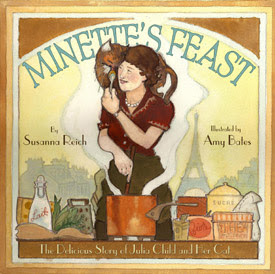
. When I started it, I wondered when Julia would mention her cat, Minette, who got her own book in 2012 with Susanna Reich's Minette's Feast. (What happened to my copy? Je ne sais pas!) She mentioned her very early on, and Minette keeps coming up.


On a kind of related note, I've been becoming friendly on Facebook with one of my second cousins in Ottawa. I've known her mother, my first cousin once removed, I believe, for years. Yesterday she mentioned Frenglish, in which she says her family is fluent. As in she can toujour  tell when sa mere is speaking to sa tante sur le telephone, because she never uses a complete sentence dan either langue. My French est plus mauvais, so maintenant I'm thinking peut-etre Frenglish should be my goal.

However, there is something else called Franglais, and if you scroll down on this article, you'll see it's not the same as what is spoken in Canada, presumably the Frenglish of which ma cousine spoke.

I may be becoming more confused. I should just go back to working on that livre.


Thursday, February 23, 2023

Getting Serious About Humor: "I'm Wearing Tunics Now" Is Funny And Thought Provoking

I stumbled upon author Wendi Aarons at McSweeney's where an excerpt from her book I'm Wearing Tunics Now was published last fall. I enjoyed the excerpt so much that I sought out the book. (Lesson learned--excerpts work.) I'm Wearing Tunics Now is what might be called a women's memoir, about middle class women's life stages. Aarons is genuinely funny and has quite a bit of experience writing humor. (Lesson learned--experience is good.) I often think of her reference to her primary care physician, google.com, because I, myself, keep Dr. Google on retainer.

She has a terrific chapter on blogging in the '00s, an experience I recognize and the only thing I've read that describes it. Aarons is far more extroverted than I am, however, and has actually met blogging buddies in the flesh and is friends friends with them. But otherwise we both enjoyed that period in a similar way.

While Aarons is funny, I do feel that her material may be a little traditional. She writes about PTO Moms and women of a certain age feeling they're invisible, for instance. Among many other woman subjects. This may be a perceptual thing on my part, because I'm a little older than she is (I could be her mother's really cool younger sister) so I've heard about these subjects before. For women Aarons' age and younger, however, her material is new and relevant to their lives.

While reading I'm Wearing Tunics Now, I kept thinking of my friend, Ellie, my neighbor's mother and thus a generation older than me. She would hear us younger women at book club going on and on and on about our kids and what was going on at the school, because it was the most important freaking thing in the world, and she'd say, "We did all that. I was PTO president. I was a room mother." I would think, You can't possibly know what you're talking about, Ellie. But she did. We were probably boring her to death. Nothing is more important than an experience while we're living it. Then we move on to things like going to vineyards with our adult children and posting George Santos memes on Facebook. Or, in Ellie's case, getting a graduate degree. In, I believe, theology.

I'm Wearing Tunics Now left me thinking about what my own humor writing material will be. Because I really need to be considering whether things like meditation and FrancoAmerican holidays are the endless source of laughs I think they are. I've been mulling over trying my own PTO piece. I was the PTO Science Fair mom, you know. And head room mother at least once. I say "at least," because like childbirth and the first 5- to 10-years of motherhood, school volunteer work ends up being run together, if not actually suppressed.

Wendi Aarons speaks about and teaches humor writing. You can learn more about her at the Freelance Writing Direct podcast Humor Writing and Wearing Tunics with Wendi Aarons.

And, yes, Aarons has a middle grade book out, Ginger Mancino, Kid Comedian, that I hope to get to in the next couple of months.


Friday, May 20, 2022

A Personal Essay With A Childlit Connection From Yours Truly

My most recent short form publication is Blackened Pans, published at The Bigger Picture on the Medium platform. This is not humor but a light, memoirish personal essay. To some extent it deals with
food and eating, something I would like to write more about. And it has a connection to some classic children's books.

Over the two years or so that I've been publishing at Medium, I've tried doing different things there. Self-publishing humor directly myself. Writing about Medium, which often goes over well there. Reworking material from this blog's Time Management Tuesday feature. Publishing a review of a time management book I discussed extensively here last year. 

With Blackened Pans what I did differently was add a bio at the end of the essay with a link to Saving the Planet & Stuff.  

I have another piece out for consideration at a Medium humor publication and will be probably submitting to another later today.

And then some work on the never ending YA novel. Because it's not all short form work here all the time. 


Monday, June 13, 2016

More Picture Book Research

Tonight is my writers' group meeting, and I'll be bringing my picture book manuscript. Again. Yes, you may well wonder how long it takes to write a picture book. It takes me a while.

At any rate, today I'm offering you some more humor picture books from my research on same. I'm talking just two authors.

Mo Willems


I've certainly heard plenty about Mo Williams over the years, but when I read one of his books years ago, I was impressed by the illustrations but not so much the text. Now that I've read his Pigeon books, though, I totally get him.

Don't Let the Pigeon Drive the Bus! and Don't Let the Pigeon Stay Up Late! are funny in concept and in incredibly simple execution. On top of that, I think few children will be able to resist interacting with the adult reading these to them.

I want to read these to somebody!

William Joyce


William Joyce is an author I've liked for a long time.  The retro, intensely representative art work...the slightly twisted narratives... Love it all.

Billy's Booger, A Memoir is a very clever, funny-in-a-subtle-way, picture book for older kids, older kids who have experienced writing stories for school. The story involves a fourth-grade boy writing a kids' book for a contest. His entry, Billy's Booger, The memoir of a little green nose buddy, appears in the center of the book on smaller, colored pages, with its text looking as if handwritten, its illustrations appearing as if done by a gradeschooler.  You get a real book within a book.

Memoir seems like a neat genre to discuss with and teach young kids, since it would help them understand how their lives can become material for their writing.

I had suggestions for humor picture books from a couple of people the last time I posted about them. I haven't forgotten. At some point, I'll be taking a look at those titles.


Saturday, June 07, 2014

Book 2. "Persepolis" by Marjane Satrapi

Oh, my gosh. How could I have waited so long to read Persepolis by Marjane Satrapi? How soon can I get hold of the second volume?

I probably would have been even more blown away by this memoir of living through the fall of the Shah of Iran, the fundamentalist takeover of that country, and its war with Iraq if I hadn't read Reading Lolita in Tehran, which deals with some of the same period but from an adult's experience.  What's amazing in both cases is the way people living under those conditions tried to maintain normality, continuing with their social gatherings in secret, collecting western pop culture trinkets. Oh, my gosh.

No wonder I see this book on my local schools' summer reading lists so often. But this isn't instructive, you-ought-to-learn-about-this-culture stuff. This is simply little Marjane's life, and she has quite a character. She's a very little revolutionary at first, but when the revolution leads to a fundamentalist takeover, she doesn't buckle under to that.

I wasn't expecting to like this as much as I did. Very pleased. Maybe a gift for my brother-in-law, who likes history but probably has never read a graphic novel.

My only complaint--the print seemed small at first. But once I was into the book, I no longer noticed.

Wednesday, November 28, 2012

Two Different Views Of The Bread Loaf Writers' Conference

At the end of August, The Millions published Michael Bourne's essay, Keeping the Faith: Ten Days at Bread Loaf, about his experience at the Bread Loaf Writers' Conference. In August, 2011, The Millions published my essay on the same subject, My Bread Loaf. Compare and contrast, people.

I would just like to point out that while I didn't do any professional networking while I was at Bread Loaf and it pretty much ruined writers' conferences for me, I was paid to be there.

Sunday, February 19, 2012

I Wish I'd Had A Sensei. Is It Too Late For Me To Get One Now?


Drawing From Memory by Allen Say is a marvelous memoir, a highly illustrated work based on Say's auto-biographical novel The Ink-Keeper's Apprentice. The publisher describes it as being of interest for grades 5 through 8, but adults can enjoy it because the material is novel but, for us, a quick read.

The period of time Say writes about has a lot going for it. His parents divorced in post-World War II Japan, and he ended up living with a grandmother. That wasn't going well for either one of them, and she and his mother allowed him to live independently from the ages of twelve to fifteen. This is an unusual situation to twenty-first century middle Amercians, but not a tragic one. Say was supported by his mother and lived in a one-room apartment while attending school.

So that's pretty eye catching.

On top of that, though, Say, who wanted to become a cartoonist, managed to become an apprentice to Noro Shinpei, who was, at that time, a well-known cartoonist in Japan. (I'm unable to find anything about him on-line that doesn't relate to Drawing From Memory.) So we also learn a great deal about Say's training as an artist, the work he did with Shinpei, with whom he had a student/teacher relationship, and his study of Greek and Roman sculpture and life drawing.

One of the most interesting aspects I found about the book is that nowhere does Say talk about submitting his own art to any kind of publication at that point in his life. He's always studying or training with his sensei (teacher), Noro Shinpei. It is, I think, a different model then the one I often hear about with young people (and often their parents) believing they should be publishing their writing now, that there are short cuts or that talent trumps actually knowing how to do things.

It is, in fact, different from what I thought I should be doing when I was a teenager and college student. I barely worked/trained at all and would send out any piece of crap I managed to approach finishing. If only I'd had a sensei.

Monday, August 08, 2011

A New Publication For Gail

The essay I wrote about last week has been published. You can read My Bread Loaf, a short memoir about my nontraditional working experience at the Bread Loaf Writers' Conference, at The Millions.

I originally wrote this essay a number of years ago when the Writers' Conference was celebrating some anniversary. I'd say eleven years ago when it was celebrating its seventy-fifth anniversary, but come on. It can't be that long. At the time, I tried to publish it in local Vermont publications where Bread Loaf is a big deal because that's where the Conference is held, in Ripton, Vermont. No takers. I thought, Well, this is a case of no one wanting to think of Bread Loaf in any way but as a highbrow literary gathering.

When I decided to take a look at the essay again and submit it to The Millions in time for this year's Conference, which starts on Wednesday, I realized that though it may very well be that there are people who only want to think of the Bread Loaf Writers' Conference as a highbrow literary gathering, it was also true that my essay rambled and was unfocused. If I'd found someone to publish it as it was originally written, I would probably be quite embarrassed about it now.

I cut it down a lot before submitting and was careful about transitional material between paragraphs, which helps to keep an essay on topic. If you can't create a transition between one thought and the next, it's probably because the thoughts aren't similar enough to do so and something should be cut. The editor's response to that submission was that he liked it but that he thought it could be tighter and more focused and gave me a suggestion for the opening. Clearly I was on the right track, even if I was not moving along it very rapidly.

Here is the big thing I learned while working on this essay over the past month--with memoir, and probably with all kinds of essays, it's important to leave things out. I don't mean that you have to leave out anything that could get you into legal problems. I mean you have to leave out good bits because too much detail can actually overwhelm and confuse readers. With a personal essay or memoir you have to have the equivalent of a thesis statement/topic just as you would with a formal essay, even if you don't formally state it the way you would, say, in an argumentive article on why the U.S. economy is in the toilet. And then you have to stay with that topic. It may be a little harder to stay with it with a less formal essay because without a hardcore, clearly stated thesis statement at the beginning of the work, it's hard to create topic sentences that loop back to said statement. You have to be aware, yourself, what you are doing with each paragraph even if there isn't a formal thesis statement for you to direct readers back to. That means that good thoughts, anecdotes, and funny lines that don't relate specifically to your topic cannot be included.

I didn't formally state that this flash essay was going to be about the writing of My Bread Loaf. But that's what my intention was. Oh, and look--the paragraph above takes the essay from the particular--My Bread Loaf--to the general--writing personal essays/memoirs. I am pleased with how that worked out, cause I had forgotten to try to do that.

Maybe I'm developing a little muscle memory for essay writing.

Tuesday, August 02, 2011

Now That Was Writing In Flow

Years back, I read a book called Writing in Flow by Susan K. Perry. It made me a believer in writing in flow states, probably because I'd done it a few times, but I can't say I did a good job of learning how to do it whenever I wanted. However, writing in flow is something I aspire to.

Well, yesterday it happened.

I had received an essay back from an editor last Wednesday with his suggestions for changes, and I'd been working on it ever since. Yesterday morning I got up and went to the computer in my nightclothes. I changed into workout clothes, as I do every morning that I'm not training in the dojang, but I got distracted...by work...and went back to the computer. Around mid-day I considered cleaning up and getting dressed, but I remembered that I hadn't worked out yet. So I put in a load of wash, fixed something to eat, and took it back to the computer. The essay was in good shape around 2:30, so I got on the treadmill for a while. Then I got off and went back to the computer. Around 4 o'clock, I finished working out, finally took a bath, and got dressed. After dinner I went back to the computer for an hour and a half or so, just to tweek the essay and do things like spellcheck, then I submitted it. I never combed my hair, though I did brush my teeth. I think.

The day of work felt great. If the editor is no longer interested in the essay, it doesn't matter because the writing experience was so terrific, and I learned so much about writing memoir while working on this piece.

How did this flow state come about when it so rarely happens for me?

I think it was the amount of time I put into the essay before Monday, the flow state day. I worked on this thing for a couple of hours Thursday morning and all day Friday. It was not going well. I tried this and I tried that, I moved things here and there. Saturday morning I woke up around 3:30 and was still up at 4:30. So I got up and worked on the essay for 2 hours until going back to bed for a few hours. I think I worked on it some more Saturday afternoon or evening. I definitely worked on it off and on Sunday. I felt I was making progress, and Sunday night just before I went to bed I made a page and a half of freewriting notes in my hardcopy journal for use the next day.

Then I had my flow experience on Monday.

I think to finally get into a flow state you have to achieve a certain level of concentration before getting into the flow. (It's the same thing you need to do to trigger a breakout experience, though in that case you back off for a while after you've been working.) My present schedule of working only Monday, Wednesday, and Friday means that I'm not staying at work long enough to get to that level of concentration and stay there. I remember talking to Computer Guy about the whole flow thing years ago when he was writing code for games he was creating. He said he'd read that the reason you used to hear these stories of people who write code regularly living on caffeine and staying up all night was that they wanted to stay in some kind of work groove once they'd achieved it. That sounds like flow.

A few months ago I started trying to work for a half hour or so every weekday morning, even on the elder care days. It didn't lead to anything like the flow state I experienced yesterday, but it helped. Yesterday's experience confirms my impression that I need to find a way to work more.

Tuesday, May 24, 2011

A Book For That Worrisome Teenager You Want To Scare Straight


When I heard a few years back that Jack Gantos had written a memoir about his imprisonment for drug running when he was twenty, I thought, Gee, you'd think there'd be some parent or adult group somewhere having a hissy fit about a childen's writer with a background like this. Not that I thought someone should have a hissy fit about it. It just seems like the kind of thing someone always is having a hissy fit about.

Hole in My Life is probably a book that every teenager ought to be forced to read. Holy Moses. Talk about a cautionary tale. And I don't think Gantos was trying to do the instructional thing. His writing style is very plain, but the story is an eye popper.

Seriously, even before he gets to the crime he talks about getting so drunk he was vomiting caustic substances. That sure makes being blind drunk look attractive. And before he got caught he had to worry about one of his co-conspirators killing him. Wouldn't a lot of young minds read this kind of thing and think, Nah, I'll just get a job at Target, after all?

Interesting note: Hole in My Life also deals with Gantos's evolution as a young writer, and his movement toward becoming a children's writer. While in prison, he enjoyed recalling his childhood and thinking of childhood events in terms of stories. Some of his short stories do have a very autobiographical feel to them.

Jack Gantos is the author of books of short stories and the Joey Pigza books.

Monday, November 02, 2009

More Graphic Novels


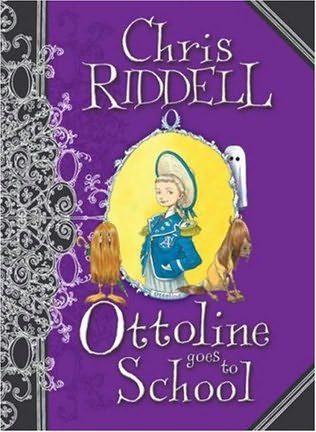
I was in my favorite library last week, and what do I see on their new book shelf, but another Ottoline. I thought, What the heck, Gail. Give the series another shot. And that's how I came to read Ottoline Goes to School by Chris Riddell. I liked this Ottoline better than the first. It has a little more substance, what with Ottoline being attracted to a new friend and Mr. Munroe (whatever he is) feeling left out. The new friend is interesting because she is both upper class snotty and sympathetic at the same time.

The Ottoline books, this one in particular, use a lot of oddball names and situations, which always annoy me in a children's book. This one is so lovely looking, though, and the basic story good enough, that I was able to turn a blind eye toward all the Orvillises and Wilburtas. Plus, Riddell is British, and I should try to show compassion toward the British because no doubt they are still suffering from all those years of Monty Python's influence. That can't be a good thing.


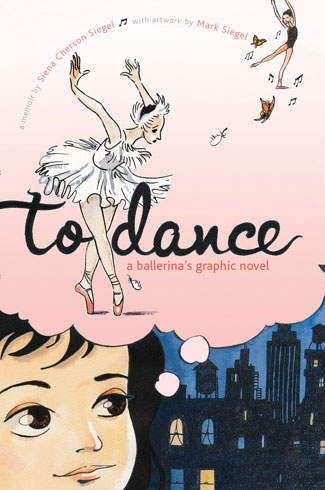
I've also just read To Dance: A Ballerina's Graphic Novel, which is not a novel at all but a memoir by Siena Cherson Siegel, illustrated by Mark Siegel. Because To Dance is a graphic...I hate to say "novel" when it so clearly isn't...written for young readers, I was able to read it quickly. And reading it quickly made me feel immersed in Cherson Siegel's young life as a ballet student. It definitely made me feel that having such a strong vocation so young must be very special. Maybe it's not, of course. Maybe a lot of kids lose their youths to studying for a vocation. But that's not the feeling I came away with from To Dance.

Cherson Siegel writes about reading A Very Young Dancer by Jill Krementz. I wondered if her own book would end up being another generation's A Very Young Dancer?

I have only one reservation about this book. Though not a ballet fan, by any means, I recognize many of the dance names of the period when Cherson Siegel was studying ballet--Balanchine, Baryshnikov, Suzanne Farrell, etc. I think it's unlikely child readers will know those names, and I'm not sure how that will affect their enjoyment of the book. On the other hand, the fact that dance is visual and this memoir is written in a graphic format may mean that child readers can see who these people were and having previous knowledge of them won't matter.

Friday, July 10, 2009

Modeling Writing


In my former life as a professional mom, I was often perplexed by how little nonfiction of the essay and memoir variety my kids read in elementary school. This was a big problem in my mind because they were frequently asked to write essays and sometimes even about themselves. Yet as far as I could tell, they had nothing to model their writing upon. Connecticut had standardized testing before anyone had ever heard of No Child Left Behind, and the writing portion of those tests didn't involve novels, it involved multiple paragraph essays. The Gauthier kids' teachers scrambled to provide instruction, but how much easier it would have been for them "to get it" if they ever read examples of what it was they were supposed "to get."

I used to spend my time hunting for essays for my kids to read. By the time they were in sixth grade, I was passing them some of Joel Stein's Time Magazine essays. You know, his "self-focused humor column". Come on. He used thesis statements and topic sentences.

What I really wanted was Jon Scieszka's Knucklehead. But it wasn't available then. Scieszka's memoir of "Growing Up Scieszka" is filled with short, readable chapters about his life as a child. (I'm not going to make much of the fact that he was a boy child, because I think girls will enjoy this book, too.) And while I didn't notice much in the way of thesis statements and topic sentences, I did see a lot of material that could make child readers think, "Hey! I could do this! I could write about the strange books I have to read at school. I could write about my grandparents. I could write about Halloween, my siblings' injuries, things I've bought, games I've played" and about thirty-one other subjects since Scieszka includes thirty-eight chapters.

Coming up with material is hard for a lot of kids. Knucklehead could provide inspiration for some of them. After all, learning to write will come a whole lot easier if you have something to write about.

Training Report: You haven't seen one of these in a long time, have you? At the beginning of the week I found a journal to which I could submit the essay I spent so much time on this summer. And I submitted it.

Essays, which we were discussing in this post, anyway, are kind of problematic. You feel this overwhelming need to express yourself about something that has happened to you that you think has some connection to the greater world, to humankind, and then what do you do with it? It's not easy to find potential markets for some of these personal essays. For instance, earlier this week I did a rough draft of what might be called a flash essay about washing windows. What am I going to do with that?

A writer could, of course, write essays that publications are actually looking for. I just read today that Drunken Boat is looking for 1000 word or less "nonfiction perspectives from around the world on the effect of the global economic crisis." The writing prompt becomes more specific, and I'm sure someone could do a personal essay with it. But the phrase "global economic crisis" is freaking me out.