Showing posts with label The Heritage Month Project. Show all posts

Sunday, January 25, 2026

The Story Behind the Story: My First Publication of 2026 is...

 "I Educate Myself, Therefore I Act:" My Top 7 Heritage Month Reads in 2025! Published in Books Are Our Superpower. 

Getting this published was important to me, because my Heritage Month reading last year ended up being...ah, well, a little profound, is probably too highfalutin' a way of thinking of it. It was meaningful. I read some good stuff. I read a couple of authors I'd heard of but never read, and they were terrific. I read some authors I'd never heard of, and they were terrific, too. I read a genre I didn't foresee myself reading for this project, and it was terrific, too. I got to read a few books I'd had on my TBR shelf/iPad for a while, and that was was...you guessed it...terrific.

It was also eye-opening. I'm saying "eye-opening," but I could say "humbling." I saw myself as advocating for groups who are not part of mainstream white Anglo-saxon Protestant America by reading these authors from nonmainstream white Anglo-saxon Protestant America and writing about them. But these authors didn't need Gail advocating for them. They were already well-regarded, well-read, even award-winning writers. Who did I think I was?

At least, I ended up being a reader who enjoyed their work and told other readers they could enjoy it, too. A good use of time, and a great reading year.

What Am I Reading This Year?

I was also happy to get this essay published, because it wrapped up last year's reading. It was a conclusion, before getting started on something new.

The something new I'm getting started on is reading history. This year's reading project is, indeed, called Reading History. In fact, on this blizzardy Sunday afternoon, I'm going to go move my history books to a lower shelf so I can get to them easily and spend some time on the first history book I've been reading this year. 

More to come. 


Thursday, December 11, 2025

The Heritage Month Project: Literary Horror by Stephen Graham Jones

I thought I had reached the end of my Heritage Month Reading related to the Heritage Months the U.S. used to recognize (that's archived material I just linked to) but dropped earlier this year. (Black History Month is all that's left. I can't tell you why, 'cause I don't know.) But last year's Native American Heritage Month inspired the Heritage Month Project for me. So, of course, I was going to observe it in November with some reading even though, according to my research at the Department of State's website, which used to post info about heritage months, it was never observed by the U.S.

Well, folks, I was cruising around the Internet last month when what do I find? Not only did the U.S. recognize November as National Native American Heritage Month in the past, it continues to do so! We just don't do it through the Department of State. We do it through the Department of the Interior, which includes the Bureau of Indian Affairs.

What does this mean? 

  • The Department of the Interior treats Native Americans differently than the Department of State treats absolutely everyone else?
  • One hand in Washington doesn't know what the other hand is doing, and the people who went after the other Heritage Months were unaware that National Native American Heritage Month is living at the Department of the Interior?
  • The Secretary of State was using "we were here first" as an argument to nix all the other Heritage Months and decided that that wouldn't work with Native American Heritage Month?
I don't care! I just think Native American Heritage Month managing to stay on its feet during the white washing is subversive as hell. I mean that in the most positive way.

So Let's Talk Some Native American Literary Horror. My Search for Something Different


Whatever possessed you to read horror, Gail? Well, truthfully, it's not something I read a lot of, unless you include Shirley Jackson and the occasionally zombie book. After last month's reading, I think horror may have specific genre requirements that I don't understand, so are Jackson and zombies horror? Perhaps someday I will know.

But to be specific about this fall's horror reading: I was looking for Native American fiction writers to read and came upon Stephen Graham Jones. I see that he writes horror. Literary horror. And I think, Well, that would be something different for me to read this year. Then I see that he wrote a book called I Was A Teenage Slasher , and I was all in. I was aware Jones has written quite a few books, so once I started this one, I thought, Gail, why don't you read another of his books, as if you were making a study of him? That would be different, too.

I Was A Teenage Slasher 


The Native American connection in I Was A Teenage Slasher involves a secondary character who is very important, but readers won't get a feeling of being steeped in Native American culture. Unless there was something going on here that I wasn't knowledgeable enough to get. 

What I did feel steeped in was slasher culture, if such a thing exists. The basic premise here is that this is the first-person account of poor adolescent Tolly who finds himself unwillingly pulled into a classic slasher story, as the slasher. I was about to say as the main character, but are slashers the main character in slasher stories? He realizes that he is in a slasher story with specific tropes he can't control or avoid, because his Native American best friend/nearly girlfriend is a fan of the genre and recognizes what's happening. 

This is kind of a heart-breaking story, folks, something I didn't expect from a slasher tale.

Having been a childlit person in the past, I've read a YA book or two. Whenever I read an adult book with a YA main character, I have to wonder, Why is this adult and not YA? It's an easy question to answer here. Tolly is now an adult recalling his teenage slasher experience, making him, in reality, an adult character able to assess events from an adult perspective. YA books take place in the moment as it's being lived. All their responses are, or should be, YA responses.

I Was A Teenage Slasher was an Alex Award winner this year, an award given to ten adult books with appeal for young adults. It may be my favorite book award.

The Only Good Indians


The second Jones book I read was actually one of his earlier ones, The Only Good Indians. This has been widely reviewed and has won an award or three, which were pretty well deserved I'd say. 

This book is horror within a Native American culture. Four youngish Native American men go hunting in an area where they were not supposed to be hunting. They kill quite a number of elk, including a pregnant female who does not experience a quick and easy death. 

Ten years later they, and some of the people around them, pay a price for what they did.

What I'm going to say now is going to seem to come out of left field, but there is a lot of basketball in this book. For those of us who consider basketball to be another one of those run-back-and-forth with a ball sports, this could seem...odd. Mystery solved. Basketball is part of Native American culture.

There's some moving around in points of view here, so expect to do a little work while reading this, which just enhances the whole experience.

The Horror Genre


Here is what I've learned from reading these two books:

  • Horror may deal with specific themes around guilt and revenge. Who is most at fault? Those who have done something for which they feel, or should feel, guilt or those the guilty wronged?
  • The final girl. This is a quite marvelous literary figure in horror, one I'd never heard of until reading I Was A Teenage Slasher, in which she is explained. She also appears in The Only Good Indians. I will not spoil either of those books by explaining her, but I love her.

I can't claim that my latest exposure to horror has made me a fan of the genre. However, I expect I'll be reading more of Stephen Graham Jones in the future.


Thursday, September 25, 2025

The Heritage Month Project: "Night at the Fiestas: Stories" by Kirstin Valdez Quade

Last week I discussed Junot Diaz's The Brief Wonderous Life of Oscar Wao as part of my Hispanic Heritage Month observance. I feel I should point out that I am aware that seven years ago he was the focus of claims regarding inappropriate behavior toward several women writers. As a result of that issue at that time, writer and critic Monica Castillo tweeted "Because I need/want to deal with this Junot Diaz news in another way, can we signal boost some Latina authors out there?" And that led PBS to run the article Sexual misconduct claims against Junot Diaz have sparked support for Latina writers. Here’s who you should be reading now. 

That is how I came to find Night at the Fiestas: Stories by Kirstin Valdez Quade, a book of very fine short stories. They are all set in the southwest, many around Santa Fe, with Hispanic families/culture often part of that setting. This raises a question for a lifelong New Englander: Am I being exposed to a world I know nothing about? Or do I know so little I can't recognize whether or not I'm being exposed to a world I know nothing about?

But I obsess.

I will admit that though I found these stories highly readable, I often wasn't clear about the endings. Now this is an issue for me when reading short stories, anyway. Endings are a factor for me when writing short stories, too. Could my lack of ending knowledge be keeping me from finding publication homes for more of my short stories?

I continue to obsess.

Let's Talk About Some of These Stories

When I looked over these stories a second time in preparation for writing this post, I noticed a couple  things that I wasn't aware of during the first read.

  • Religion plays a part in a number of them. In Nemecia, the main character has an opportunity to lead the procession at the annual Corpus Christi festival, an opportunity her creepy cousin Nemecia snatches from her. In The Five Wounds a pretty poor excuse for a father is playing Christ in a local Passion Play. In Family Reunion, an atheist child wants to convert to the Mormon faith. In Ordinary Sins, a young, single woman pregnant with twins works at a local Catholic church office.
  • Family trauma turns up in many of them. In Nemecia, Nemecia is living with the main character's family because of something that happened in Nemecia's past, something the narrator only knows about through what creepy Nemecia tells her. In that one, childhood trauma spreads. In The Five Wounds the poor excuse for a father is seeking redemption for forsaking his child, realizing that the child his daughter is carrying is going to suffer pain from that, too. The Guesthouse is your classic family trauma instigated by a death. And in Family Reunion that atheist child I mentioned is the daughter of an alcoholic father and thus recognizes that something is wrong with the Mormon family she has become attached to.
Family trauma isn't something I'm usually a fan of in my reading, but, as I said, I did like these stories.

Other Favorites

  • Mojave Rats. A woman is trapped in trailer park with her children while the furnace is broken. She insists to herself that they aren't like the other people there. They will be leaving. Readers may have their doubts.
  • Night at the Fiestas. This story is clearly set in the fifties or sixties, which I found novel. I also liked it because I found the main character unlikable. Writing workshops/how-tos often insist that main characters must be likable, because readers won't relate to them otherwise. I've never agreed with that, and I found this story particularly memorable because of this main character who wants to escape her world and doesn't mind a little theft to help her do it.
  • Jubilee. The daughter of a Hispanic man wants to hate his Anglo employers, the Lowells, which is an old New England upper class family name, in case I am the only person who noticed.  Do they deserve it? Another main character who's not all that likable. 
  • Canute Commands the Tides. A New England artist moves to Santa Fe, with little understanding of what's there or what she's doing there. Her move has a bad impact on the painting she's working on "Canute Commands the Tides." Should we stay in the culture that made us? I particularly liked this story because the artist moving west is from my part of the world. I can see this woman. Also, I was familiar with the Canute Commands the Tides story, though with a different spin than the narrator of the story gives it. Canute was not a foolish old man. He was making a point to his followers who had been sucking up to him. No, he could not command the tides. If I had all the time in the world, I would read this story again to work out Canute's place in it. Also, there are two women here with adult children, something I should probably think about more. 

Another Interesting Work from Quade


The Five Wounds is Kirstin Valdez Quade's first novel and picks up on the characters and world she introduced in her short story The Five Wounds. I love when this kind of thing happens.


Monday, September 15, 2025

The Heritage Month Project: "The Brief Wondrous Life of Oscar Wao" by Junot Diaz

Hispanic Heritage Month, one of the heritage months recognized by the U.S. State Department prior to 2025, runs from September 15 to October 15. For those of us very focused on traditional classifications/designations of time, mid-month to mid-month seems...wrong. However, a number of Latin American countries observe their independence days on September 15 or soon thereafter, so think outside the box, Gail.

I must admit upfront that in the past I associated Hispanic American literature with my back-in-the-day book discussion group. The books by Hispanic authors I read for book group I found difficult. Deep. Maybe stylistically outside my experience. Very literary? The Mambo Kings Play Songs of Love by Oscar Hijuelos--There were only a couple of sentences in that book that registered with me, and they both dealt with Desi Arnez, who I had some previous knowledge of. Even the movie was lost on me. In the Time of the Butterflies by Julia Alvarez--that's pretty dramatic original material and all I could tell you about it is that everyone...... Well, that would be telling you the ending, so I won't. I think we read some magical realism, which is a big deal in Latin American literature and after that I avoided that genre. Even if you take the attitude that magical realism can exist in writing from nonLatin American writers, and I've heard that some people don't, I tend to avoid it now. Be magic...be real...be one or the other. 

In short, I wasn't looking forward to my Hispanic Heritage Month reading. But things have gone really well.

I Found Oscar

I cannot recall what led me to look into author Junot Diaz's work, other than I'd heard his name. I often say I can't recall why I read this or that, and it isn't because of some kind of mental lapse. Though would I recall it, if it were? No, it's because I juggle reading a great many things, as well as thinking about them. 

Pardon me for obsessing.

I became aware that Diaz has published in The New Yorker, and flash fiction, too! I could get a short sample, and I did with the lovely The Books of Losing You.

And so I went on to The Brief Wondrous Life of Oscar Wao, which I think I chose because it was available at a library I was in. Yes, I have crap reasons for reading the things I read. I shouldn't even mention them.

This is not one of the Hispanic-related books I was used to, even though it has markers of what some people would think of as a "literary" book. The story moves around a number of twentieth century periods, and a number of points of view. Much of the book has a narrator who remains unknown for a while. (He's Oscar's college roommate and his sister's sometime boyfriend.) There are footnotes. There's a lot of Spanish. There's what might be a curse.

On the other hand, though, there is Oscar, a sad, Dominican-American nerd who might be living under that family curse and who wants love so badly. His story is extremely engaging. Of course, everyone who has watched an episode of The Big Bang Theory thinks they know nerd culture. Oscar Wao reads as if author Junot Diaz really knew it back in 2007 when his book was published. Or I should say, knew it in the '90s, the period when Oscar was living. Who doesn't love a nerd, wherever he comes from?

A Little Bit of What We're Dealing With Here

A lot of footnotes. Footnotes were a thing in fiction for a while. I have a family member who intensely dislikes them used that way, but I enjoy them. I liked what Diaz did with them here. He uses them to explain the Dominican Republic world that earlier generations of Oscar's family lived in under the Trujillo regime there. I had actually heard of Trujillo, probably because I'd read In the Time of the Butterflies, which Diaz mentions. Meaning I got something out of that book. I realized he was bad news, but I couldn't have told you what country in which he was bad news. Meaning I didn't get very much out of that book. Diaz places the bulk of his Trujillo history in footnotes, but he handles that history with wit. Could readers skip the footnotes, which is probably what many readers of nonfiction do with footnotes there, and still get a story in Oscar Wao? Probably, but the footnotes are fantastic. It's hard not to compare our own times to the Trujillo era, which most readers probably weren't doing in 2007 when this book was published. As grim as things are now, they are not Trujillo grim.

A lot of Spanish. I've read that there are some objections to the amount of Spanish in this book. I don't feel you had to understand it to follow the story. What's more, this is a story about Spanish speaking people. Wouldn't a book about Spanish-speaking people with little or no Spanish be a book about Spanish-speaking people for nonSpanish people? What am I trying to say here? Would it be a book about Spanish-speaking people that English-speaking people would be comfortable with? I read a book about Spanish-speaking people but they weren't Spanish enough to speak Spanish? 

I have to admit, though, that I did wish the Spanish was French. Because I study French, de temp en temp, and I would have looked up what I didn't know, and my French would have improved so much! So I was patient with the Spanish. Someone's Spanish probably improved as a result of reading this book.

The curse. I am not a fan of curses, but this one provided a connection between characters. It was a sort of storyline. A recurring theme, perhaps.

In short, there is a great deal to like about this book.

Has Oscar Influenced Another Book?


Earlier this year, I read The Savage, Noble Death of Babs Dionne by Ron Currie. The Brief Wonderous Life of Oscar Wao brought it back to mind. The books' titles are similar, both in terms of how they're structured and in terms of them tipping readers off to the fates of the main characters. Both books deal with an ethnic group in America, Dominican Americans in one case, Franco-Americans in the other. Both make use of a language other than English in the text, Spanish for Oscar Wao and French for Babs Dionne. (There's far more Spanish in Oscar Wao than there is French in Babs Dionne. I'm going to make a wild guess here that Diaz is more fluent in Spanish than Currie is in French, but that may just be me overidentifying with another Franco-American author.) In Oscar Wao we have the nightmarish Trujillo back in the Dominican Republic. In Babs Dionne we have a pretty terrifying criminal back in Canada. Both books also have a touch of the supernatural. In Oscar Wao there is that curse. In Babs Dionne there is a character who suffers from hallucinations in which she communicates with the dead.

I should be writing an undergraduate paper, shouldn't I? 

Yes, my Hispanic Heritage Month reading is off to a good start.


Wednesday, July 30, 2025

The Heritage Month Project: "Blind Man's Bluff" by James Tate Hill

While Disability Pride Month (July) is recognized by a number of groups, it doesn't appear to have ever been observed by the U.S. government as a heritage month. Nonetheless, July was kind of free as heritage month reading goes, and what you might call disability literature isn't something I think I've ever sought out, so I decided to go for it.

You can find lists of books featuring disability. I was attracted to Mystery – The Disability Book Archive,  but then was thrown because it included a book about vampires, who I don't think of as disabled. (This led me to much speculating about what, exactly,  disability is, which I will spare you. You're welcome.) I wish now that I'd spent more time going through The Disability Book Archive's other genre offerings.  I did look at Book Riot's 20 Must-Read Fiction and Nonfiction Books About the Disability Experience, though. It had a lot of memoir, and I was hoping for fiction at that point.

Yes, I am so freaking picky.


One way or another, it's the end of July, and I've only read one disability-related book, the memoir Blind Man's Bluff by James Tate Hill. I ran into Hill on BlueSky, where he comes across as being very congenial. (The first thing I look for in a writer, I guess.) His memoir describes his efforts to hide his blindness, something he had a shot at doing, because he became legally blind in his mid-teens, being left with some modest vision. (I think the cover of his book is an attempt at replicating what he can see.) The book is also described as humorous, which is always a draw for me.

So here was an intriguing situation, with humor. I was in. 

First, Hill does have a dry, self-deprecating sense of humor that I definitely appreciate. 

Second, what most intrigued me about this book was not the disability/blindness. What intrigued me was the way it was about transitioning from high school to college and from college to the work world and from single life to married life. Yes, Hill had to do all these things I recognize while working out how he would get his college reading done, how he would mentally map out how he'd get to classes, how he would find the men's room in restaurants and bars, and how he would, as a college instructor, deal with the issue of students raising their hands to speak, since he couldn't see them. Also, he risked his life every time he crossed a road. But there was still much that he was living through that many seeing people live through, also.

I don't want to downplay the significance of the blindness Hill deals with. But what struck me about this book was not how different he is, but how much he is the same. He just can't see.

The "Bluff" Aspect of This Book

The young Hill didn't like to address his vision with new people. He didn't like to talk about what he couldn't do. When he did feel he had to deal with it, with new people he expected to have to interact with in the future, for instance, he would say something about having blindspots that made it too hard to do something. "Too hard. Never impossible. Not once had I ever said I can't drive; it was always I don't drive, which wasn't a lie. I didn't drive. If that particular verb left room for one to infer choice, so be it."

That idea of choice seems significant to me. When he lost his sight at sixteen due to Leber's hereditary optic neuropathy, Hill didn't just lose his vision. He lost the choice to do so many things, choices that sighted people have. And that may be a big factor in why he tried to keep his blindness to himself as much as he could. He didn't want to make his lack of choice obvious to the world.

At one point, though, he says, "I had accomplished less than many blind people who acknowledged their disability."

He was still young, though. He had time.

The Writer Aspect of This Book

I'm not sure if I've read other writer memoirs. I can recall reading my-mother-was-horrible memoirs and my-oddball-dad memoirs and collections of essays about aging women or young humor writers. I can't believe I've never read a writer memoir, but I have to say that Hill as a young writer seemed familiar to me not because I'd read about writers, but because I am one.

He writes about how he became a reader after he lost his sight, through audio books. He writes about editing his work. He quotes F. Scott Fitzgerald. He gets an agent!

This, to me, illustrated that a disability isn't everything a person is. This person was a writer like me. In fact, one who right now is doing more than I am professionally.

I am still here, though. I have time, too.

The Memoirist Now

I don't want to say. I don't want to take another writer's story. Read his book. Oh, wait! I will share that there was a section of this book, which was probably the most painful, and that was only marginally involved with his blindness. Unless, of course, I've got that wrong and it was intricately involved with his blindness. Anyway, that was a part that really kept drawing me in in a when-is-what-I-am-damn-sure-is-going-to-happen going to happen? way.

A Couple of Other Options

While going over disability reading lists, I did find a couple of novels I'd read. And written about here!

Tru Biz by Sarah Novic, an adult book that deals with a deaf school that both my sister (for what that's worth) and I liked. It also won the Alex Award.

The War That Saved My Life , a middle grade book by Kimberly Brubaker Bradley, turned up somewhere on a disability reading list. This is a book I liked, and I liked the sequel even more. These are books that fall into the World War II British child evacuation genre. I'm assuming there's a genre, because there are so many of them. Not complaining about that. I have enjoyed a lot of those books. In this one, main character Ada has a clubfoot that was ignored by her abusive mother. 

If you followed my link to my post on the subject, you saw that I didn't even mention Ada's disability. I had trouble recalling it until I read a review of the book at a site that focuses on disability. What was my thinking about that? Can't even begin to guess.

I do think that the reading I've done this month, limited as it was, will change my perception of how disability is portrayed in the future.

I don't have any Heritage Month reading planned for August. I hope I can use that time to read ahead for September.

Wednesday, June 25, 2025

The Heritage Month Project: "A Distinct Alien Race" and Eugenics

This is it, folks. My last reading post for National Immigrant Heritage Month  related to Franco- Americans and the very fine A Distinct Alien Race by David Vermette.

I have no recollection of ever hearing about the eugenics movement in school, though I was a history minor in college.  In the early twentieth century eugenics, the belief that humanity could be improved through selective breeding, became popular enough in the United States that in 1927 the Supreme Court in Buck v Bell found that "The Virginia statute providing for the sexual sterilization of inmates of institutions supported by the State who shall be found to be afflicted with an hereditary form of insanity or imbecility, is within the power of the State under the Fourteenth Amendment."

Eugenics was a national and international movement, culminating in the Holocaust. 

It wasn't until around 25 years ago while I was taking my one graduate course, which was on essay writing (I aced it, since I know you're all wondering), that I stumbled upon eugenics. I was working on an essay for that class that would one day become Dinner at Shirley Farr's House. At that point, the essay was about a local rube (me) who managed to get into a wealthy person's house by way of the restaurant someone had opened in it after her death, enjoyed the place, and then it became even more of a wealthy person's place, ruining her bliss. I decided I should see if I could find anything about Shirl on-line. The woman definitely used her wealth to help her community. She also used it to support something called The Eugenics Survey of Vermont. and did so for ten years. The survey involved research on families as part of the Vermont Eugenics Project, and it would eventually lead to Vermont's own sterilization law in 1931. (It was one of 30 states to have one.) The goal was to reduce the "population of Vermont's "social problem group."

And What Does This Have to do With Franco-Americans, Gail?

Well, it has plenty to do with them, as Vermette says in his chapter on eugenics in A Distinct Alien Race. He refers to a writer named Madison Grant who believed that the U.S. needed to "prevent an infusion of so-called inferior breeding stock to maintain its racial purity." There's lots of quotes  concerned about who was--and was not--fit to reproduce. 

Various groups tended to turn up as targets for eugenicists and French Canadians were among them. (You see them mentioned in writing about Vermont's eugenics survey.) Grant said of them "The Quebec Frenchmen will succeed in seriously impeding the progress of Canada and will succeed even better in keeping themselves a poor and ignorant community of little more importance to the world at large than are the Negroes in the South." (Hitting two groups at once!) Vermette says that Grant classified Canadiens as "the lowest form of whiteness in his racial scheme."

During this period, the issue of whether or not French Canadians are mixed race came up again. Vermette says that genealogists today are divided on how much early French and Native American marriage actually occurred, but it was a common believe in the U.S. in the late nineteenth and early twentieth century, and that was a reason for considering Franco-Americans nonwhite and thus inferior. (Another case of hitting two groups at once.)

Vermette gives the Vermont Eugenics Project its own section in his eugenics chapter. He quotes a letter to Dr. Henry F. Perkins, the head of the Vermont project, from Charles Benedict Davenport the creator of the Eugenics Record Office. "Did you know, that in the study of defects found in drafted men, Vermont stood at or near the top of the list...? This result I ascribe to the French Canadian constituents of the population which, I had other reasons for believing, to contain an undue proportion of defectives."

One of the interesting aspects, yes, there is more than one, of the eugenics movement is that terms like "defective" do not appear to have ever been defined. Another interesting aspect? It was a Progressive reform.

Vermont's Eugenics Project particularly targeted the poor, the disabled, French Canadians, and Native Americans. Two hundred and fifty-three sterilizations were performed there between 1931 and 1957.  You can also find a breakdown of sterilizations due to eugenics by state.

Eugenics Today? Positive vs Negative Eugenics


Now, there were two aspects to the eugenics movement:

The one sometimes referred to as negative, involved forced sterilizations of people considered unfit to reproduce. Negative eugenics gets a lot of attention for very obvious reasons. In addition to the unpleasantness going on in this country, books on eugenics by American writers were cited by Hitler and his buddies as influences. (Vermette and others.) Hitler...his buddies...the Holocaust.

This past spring, the word "eugenics" turned up in the press in response to some comments from a government leader on the topic of neurodivergence. 

But while the positive aspect of eugenics isn't, shall we say, as dark, it is...impactful. Positive eugenics encourages the improvement of humanity through selective breeding by actually encouraging breeding, but of the right sort of people. We're talking white, Anglo-Saxon Protestant, or at least western European. In A Distinct Alien Race, Vermette quotes someone who made a distinction between European French and French Canadian, for instance. No one was encouraging French Canadians to reproduce. The French they were more open to. 

An argument can be made that today's pronatalist (probirth movement) may have a positive eugenics tone to it, one involving large white families. Some pronatalists also have a goal of producing lots of children with high IQ. I say may, because it's difficult to speculate about how wide-spread a goal is when the same couple is featured in articles about it.

To Recap


A Distinct Alien Race is an excellent, well-documented history of a group that has seemed invisible to me most of my life, even though I'm a member of it. At one point the author, David Vermette, describes Franco-Americans as "a mostly forgotten, white-identified ethnic enclave in New England." 

It seems bizarre to me that that could happen to a people who were despised as much as Franco-Americans were one hundred plus years ago. However, history tells us that there are far worse things that can happen to a culture.

Comptez votre bénédictions.


Friday, June 20, 2025

The Heritage Month Project: "A Distinct Alien Race" and the Ku Klux Klan

My reading for National Immigrant Heritage Month continues.

I grew up in central Vermont and graduated from the state's university. While there, I had a suitemate (later one of my bridesmaids) who grew up in the northern part of the state. One day she casually mentioned that her grandfather had been active in the Ku Klux Klan in Vermont. (No recollection how the conversation came about.)

I was ignorant back then and not shy about showing it. Everybody knew that the Klan was anti-Black, right? And back then Vermont was not known for its extensive Black population. So, I laughed and said, "Who were they against?"

"French Canadians."

Ayeah, I stopped laughing.

And that, mesdames et monsieurs, is why Klan activity in relation to Franco-Americans is something I was aware of a little earlier in life than I was, say, Little Canadas.

David Vermette has a fascinating chapter on the the KKK and its activities in relation to Franco-Americans in A Distinct Alien Race.

The Klan in the Early Twentieth Century

As Vermette tells it, in the early twentieth century, the Klan became very business-like.  The Ku Klux Klan Corporation was formed in 1915. In 1920, its Imperial Wizard (a former minister) hired a public relations firm. There were members who functioned as traveling salesmen, going into new towns to drum up new members. They ran ads in newspapers and offered special promotions. Protestant ministers, for instance, could join for free. New members paid a membership fee, and bits and pieces of that fee were doled out to various people in the Klan hierarchy. Members bought their hoods and robes from the Klan, and that fee was spread out amongst higher ups, too. It sounds very much like a pyramid scheme.

As with all kinds of businesses, the Klan wanted to grow, and it did. It had quite an impressive membership by the 1920s and was pulling in real bucks. To continue growing, it had to branch out to other parts of the country, such as New England. I was right. Back in my day, there was not a large Black population in New England, and the same was true in the '20s. (Before my day!) But as Vermette says in his book, "Since, in most cases, New Englanders had little occasion to interact with non-whites, distinctions of language and faith served as the practical basis for othering minorities."

In other words, New England had a lot of French-speaking Catholics. According to Vermette, in the early part of the twentieth century it also had a lot of Klan members.

The Klan and Franco-Americans

The Klan response to Franco-Americans was "logical" to the extent that Franco-Americans were both Catholic and foreign. Foreign-ish, even if they were born in the United States, because they maintained their language. The fear that Franco-Americans were too close to their homeland and would thus be able to join with French Canadians in some kind of French Catholic takeover was renewed during this period. To deal with that the Klan encouraged the passage of laws that would enforce English-only instruction in schools, and they were successful with that in some New England states. Dealing with Catholicism was harder. In the South, the Klan worked through the Democratic Party, but in the north Democrats tended to be working class and...Catholic.

And recall that French Canadians and Franco-Americans were sometimes considered mixed race because of the possibility of intermarriage between early French settlers and native people. In addition to being Catholic and French speaking, for the Klan Franco-Americans were not truly white the way European immigrants were. 

Vermette's chapter on the Klan in New England is fantastic in terms of both explaining the Klan's response to Franco-Americans there (conflicts between pro- and anti-Klan groups, bombings, and the burning of a Franco-American parish school, for instance) and in terms of Klan history, itself. It left me wondering why, given the times we live in, we're not hearing about a resurgence of Klan activity.

Perhaps, given the times we live in, those who might otherwise be interested don't feel there's a need for it.

Next time: Franco-Americans and the eugenics movement. 

Wednesday, June 11, 2025

The Heritage Month Project: "A Distinct Alien Race" and Little Canadas

My Reading for National Immigrant Heritage Month Continues


One of the many things author David Vermette writes about in  A Distinct Alien Race: The Untold Story of Franco-Americans  that I knew nothing about growing up is Little Canadas. I mean I didn't hear about them until the last ten years or so. I had some knowledge of Little Italies, Chinatowns,  Little Polands, and Little Swedens. But I'd never heard of Little Canadas, even though there was supposed to have been one in the early twentieth century in Winooski, Vermont where I was a student teacher in the middle school years later. I now also wonder if the extremely small  town in which my father was born and grew up would qualify as a Little Canada, but one that grew up around farming, not mills. My Gauthier grandfather was 
The Gauthier family on their Vermont farm. 
from eastern Ontario and came here with his wife and older children after WWI, making him and other French Canadians like him different from the French Canadians who came to the U.S. from Quebec in the nineteenth century to find work in mills. My American-born father, who as an adult lived in a neighboring, very nonFrench town, spoke his native language with nearby people he'd grown up with right up until his death. (He didn't speak it in his own adult home, of course, since his wife and daughters didn't understand a word of it.)

Otherwise, Petite Canadas were neighborhoods that developed around mills and Catholic churches, primarily in the nineteenth century. People shopped in French-run stores, attended French-speaking schools, and may have been able to read locally published French newspapers and go to French doctors. I'd say they could attend French churches, but the Mass was in Latin in the old days, so that wouldn't have mattered as much, though French-speaking priests did appear to be common in them.

According to Vermette, it may have been possible for many French-Canadian immigrants to not have to speak English if they lived in a Little Canada.

What Happened to Little Canadas?


Why do other areas associated with the ethnic identities of immigrant groups still exist, but we find so little left of Little Canadas? Even Chinatowns, which experienced serious racism in the late nineteenth century, are still around and attract visitors. Many of the other ethnic "towns" may have grown up around mills or some other work situation, as Little Canadas did. But when the mills closed down, the big factor in the end of Little Canadas, some aspect of Italian, Polish, Swedish, etc. culture remained. 

Why were Little Canadas different?

My own speculation:
  1. Vermette says in A Distinct Alien Race that there was incredible poverty in Little Canadas, at least in those in New England. He talks of housing built for Franco-American workers by the Cabot Company, which owned a number of mills in the area that employed them. Typhoid and diphtheria were an issue in the 1880s. He has quotes from a newspaper editor and doctors from the same time period complaining of the sanitary conditions.  Vermette also has statistics suggesting that education levels stayed low among Franco-Americans into the twentieth century. Among my father's siblings, only one of the eight finished high school. For all I know, she was the only one of the eight to even attempt going to high school. My point being, if the living conditions were not as bad in other ethnic communities and if the groups living in them were able to improve their personal situations with education faster, that would explain why they stayed in them while Franco-Americans got out of Little Canadas, many of which were then just absorbed into the English-speaking world. Lowell, Massachusetts' Little Canada, for instance, was demolished as part of an urban renewal project.
  2. Because the French-Canadian immigrants came from a country that bordered the U.S., their need for an ethnic community where they could speak their own language and practice their own faith may not have been as great as it was for people who came from Europe and Asia. People arriving from Italy, Poland, and China in the nineteenth century, for instance, probably had no expectation of ever being able to go home again. But the French Canadians, the only immigrants arriving in this country by train, could "go home again." In fact, there was a great belief at that time that they were here just to make money, and when they'd made enough, they'd go back to Canada with it. (I don't know how many of the French Canadians knew that, since so many of them stayed here.) My husband's family has heartbreaking nineteenth-century letters from Irish parents writing to their children in America, asking them when they're coming home. My father's family, who arrived here in the twentieth century, went back to Canada for funerals and events and had family members coming down here to visit them, which explains why I know some of my father's cousins. That kind of familial interaction may have been enough to satisfy the cultural needs ethnic communities filled for other groups.

Some Fiction Related to this Subject


Last week I happened to stumble upon and start reading The Savage, Noble Death of Babs Dionne by Ron Currie. It's primarily set in 2016 in what's left of a Little Canada in Maine, where the number of remaining French-speaking residents can fit around a kitchen table. So far, it's terrific

Next Time: Franco-Americans and the Ku Klux Klan.

Wednesday, June 04, 2025

The Heritage Month Project: "A Distinct Alien Race"

As Heritage Months go, June is primarily known as Pride Month. But it is also National Immigrant Heritage Month. (Once again, I want to point out that those links are to archived material from former administrations. It appears that the present one doesn't observe them.) I hope to get to Pride Month in a few weeks. (I have a book!) But I'm beginning June with the first of four posts on my own favorite immigrant group, French-Canadians, and a fine book about their immigration to New England in the nineteenth century, A Distinct Alien Race: The Untold Story of Franco-Americans by David Vermette.  

What's that you say? You weren't aware that Franco-Americans, Americans of French-Canadian descent, even were an immigrant group? Not a real immigrant group? That may be because though the term Franco-American isn't new according to Vermette, it is more common in New England than in other parts of the country. Like him, I never heard the word Franco-American until I was an adult, though I grew up in New England and even around French speaking family and neighbors. (I had only a few American-born French-speaking cousins. By our generation, the language was pretty much gone, but my American-born father didn't learn to speak English until he went to school.) The lack of a well-known unifying name may help explain why we are a very low-profile group. That's in spite of the fact that in early days the French were all over North America. It's also in spite of the fact that, as Vermette explains, in the United States in the late nineteenth and even early twentieth centuries, French Canadian immigrants were...maybe reviled is too strong a word. Something like reviled.

How the Press Treated Franco-Americans in the Nineteenth Century

The press in the nineteenth century had a great deal to say about the French-Canadians moving into the United States according to Vermette. He quotes British-American Citizen from 1889:

"The French number more than a million in the United States...The number of their children is unimaginable for Americans...They are kept a distinct alien race subject to the Pope in matters of religion and politics. Soon, with the Irish, they will govern you, Americans."

Well, the British have always had a thin about the French, haven't they? Should we expect them to feel any differently about French-Canadians?

The New York Times also had things to say about French-Canadian immigrants in the late nineteenth century.

May 1, 1881. "They are, for the most part, ignorant and unenterprising, subservient to the most bigoted class of Catholic priests in the world...They care nothing for our free institutions, have no desire for civil or religious liberty or the benefits of education.,,[T]he feeling which they excite...is not fear or jealousy, but a sort of contempt."

French-Canadian immigrants were believed to be temporary here. They'd only come to the U.S. to make some money and go home with it. The New York Times, 1885, Canadians in New England:

"In such towns as Fall River and Holyoke the French Canadians have nearly shouldered out the native American operatives, who a generation ago impressed foreign observers by their superiority to any persons engaged in similar occupations elsewhere...he [French Canadians] cannot be brought to take any interest in the life around him of a community in which he regards himself as merely a sojourner. He maintains his own churches and no schools. Add to this feeling of alienism that he is absolutely unenterprising, and it becomes evident that he must be a troublesome element in the population."

Notice the term "native American" in the above quote. Vermette says that the descendants of English Protestant settlers in the United States managed to establish themselves as the native, original people here, even though the French had been on the North American continent as long as they had and the original native people had been here for thousands of years. 

Going back to 1878, Vermette quotes another New York Times article:

"...beyond dispute that there is hardly a French Canadian family...that does not inherit strongly-marked traces of Indian blood."

This is a reference to a belief, which Vermette discusses, that French Canadians were mixed race because of intermarriage with native people in earlier years. While I had not actually heard that, I wasn't surprised. Years ago, I'd read that the French settlers in Canada were far less brutal towards the native people there than the English settlers were toward them in the United States. Certainly, there was violence there. But, as I heard it, the French were often more interested in trapping than farming, which meant they didn't feel a need to take as much land, and sometimes married native women. It never occurred to me that that would have some kind of impact generations later. It would come into play during the twentieth century eugenics movement. But that is another blog post.

One attitude toward Franco-Americans in the nineteenth century is particularly interesting for us today. At the end of that century, there was a fear that French Canadians wanted to take New England to create a French Catholic country. The New York Times was on this in January, 1889:

"The tradition is that within a period not included within the present century there will be a country in North America called New France. It is to be constituted of Quebec, Ontario as far as Hamilton, such portions of the maritime provinces as may be deemed worth taking, the New England states, and a slice of New York. No effort is to be made to realize this tradition until the French race in America reach a certain number."

This appears to have been quite a widespread belief, and you can read more about it in an article by Vermette in Smithsonian Magazine, When an Influx of French-Canadian Immigrants Struck Fear Into Americans. 

Vermette says that in a region/culture where there aren't clear physical differences between people, language and religion become far more important in classifying others. You can see that with almost all immigrant groups, but it seems to have been happening in spades with Franco-Americans in the nineteenth century. The attitudes toward Franco-Americans in the past that Vermette reports are so extreme that it's amazing to me that now we are pretty much invisible. 

Given the fear of a French-Canadian plot to take over a section of the United States a hundred and fifty years ago, more or less, it is jaw-dropping to me that there are U.S. folk (at least one, anyway) who now want to push the issue of making Canada a fifty-first state. The reversal is just amazing. 

Coming up next: Little Canadas


Friday, May 30, 2025

The Heritage Month Project: "Hula" by Jasmine Iolani Hakes

For those of us who observe Heritage Months, it is still just barely May and thus Asian American, Native Hawaiian, and Pacific Islander Month. I'll remind you that the link I just used  takes you to U.S. State Department archived material on the subject. Otherwise, the State Department Heritage Month Page disappeared earlier this year. But look! It's back with one entry for Black History Month from January of this year, in which the current administration recognized February as Black History Month.

I'm not touching what's going on with that, except to say huzzah for Black History.

Now, on to the Native Hawaiian portion of my reading this month. Which was Hula by Jasmine Iolani Hakes. Of all the books I've read for heritage months this year to date, this is the one that has made me the most aware of my ignorance of other groups. I had vague knowledge that historically U.S. involvement with Hawaii was not our finest hour. But for the most part, I just thought of Hawaii as a vacation destination. I didn't even know about the 1993 Apology Resolution, in which the U.S. government recognized its part in overthrowing the Hawaiian government in 1893.  

Hawai'i is spelled Hawai'i, but because it was spelled Hawaii in the act making it a state, Hawaii has to be used in many situations. I mention that, because I have a thing about how groups lose their language after becoming part of the United States. 

My last Heritage Month book, The Buddha in the Attic by Julie Otsaka, used a collective narrator/first-person-plural point of view/narrator. Lo and behold, Hula does, too! At least some of the time. 

There are two things going on in this book. In part it is the story of three-generations of women in a Hawaiian family in which the question of what does it mean to be Hawaiian is very important. In part it is the story of Hawaiian culture. When the book is focusing on Hawaiian culture, the collective narrator is used. That narrator pretty much disappears when the second and third generation women take center stage.

Though not humorous, Hula reminds me of the fantastic new Netflix sitcom North of North in which a woman leaves her husband and is starting a new life. Seen it before, yeah? The big draw here is the woman is Inuit, and the story is set in her contemporary Inuit village. We're seeing someone else's world. Like North of North, Hula rises above being something we've seen before, another mother/daughter identity drama. In this case, the story is set in late twentieth century Hawaii, where we see another world, and the characters are Hawaiian. 

Or are they?

Hula can be a little demanding to read at times, because the characters use a dialect that will probably be unfamiliar to a lot of mainland readers. But it's worth the effort because of the wealth of knowledge about Americans who we rarely see unless they are the backdrop to a vacation story.

Hula, the dance, by the way, is so much more than a dance. This clip from This Morning covers the Merry Monarch Festival and the hula competition that is part of it, both of which are in Hula. In fact, I kept going on-line to check facts from the book. Everything I looked for was there.


Tuesday, May 13, 2025

The Heritage Month Project: "The Buddha in the Attic" by Julie Otsuka

So many heritages used to be recognized by the U.S. federal government. You can check them out at this archived website from earlier administrations. May covers a number of them. This post deals with Asian American, Native Hawaiian, and Pacific Islander Month. 

The Buddha in the Attic by Julie Otsuka is a lovely and unique piece of writing. It's often described as a novel, though after reading this I feel I don't know enough about novels to be able to comment on that. 

Two Standout Features

The two memorable aspects of The Buddha in the Attic are its subject matter and its point-of-view.

Subject Matter: The book deals with Japanese picture brides, a group I'd known nothing about. (My Heritage Month Project is exposing me to a great deal I didn't know about.) Essentially picture brides were Japanese women who came to the United States in the early part of the twentieth century to marry Japanese men they didn't know, had never even met. The men were already in the U.S. and the couples exchanged pictures. As Otsuka recounts in The Buddha in the Attic, many of the men were less than truthful, using old photographs of themselves so they'd appear younger or borrowing clothes to wear for formal photographs, so they'd appear better off than they were. Many of these women learned after they got here that they were going to work with their new husbands, picking fruit or doing other kinds of field work, and live in tents or barns. "...if our husbands had told us the truth in their letters...we never would have come to America to do the work that no self-respecting American would do." 

Some women turned around and went back to Japan, but a large number of them stuck it out. They worked with these husband strangers, created families, and for their efforts ended up in internment camps during World War II.

(For what it's worth, in the seventeenth century around 700 women went to Canada at the king's expense to provide wives for settlers and soldiers. No photos, of course. Assuming they survived the trip there, les filles du roi, as they were known, would have been part of the mainstream European culture in Canada at the time. The Japanese picture brides were outsiders in the United States. It also sounds as if the French women were in more dire straits in their homeland than the Japanese women were in theirs. The Japanese women had legitimate expectations about what they would find here that often were not met.)

Point-of-view: The Buddha in the Attic uses a first-person plural point-of-view, also sometimes known as a collective narrator. It can be a bit demanding to get used to. However, I recently took a workshop on short stories in which Steve Trumpeter, the workshop leader, said that with every short story you have to teach yourself how to read that particular story. I think that's the case with many books. Once you've taught yourself to read The Buddha in the Attic, it's riveting. The collective narrator works fantastically here, because what we're reading is the shared experience of many people. Occasionally an italicized line appears that is one person's thought that illustrates what the collective had been speaking about. 

Does this book have a plot? Is a group's historical experience a plot? Do life stories have plots? I don't know. At any rate, this is a terrific book about a specific group's experience.


Monday, April 28, 2025

The Heritage Month Project: "Evil Eye" and "Behind You Is the Sea"

While Heritage Months have disappeared from U.S. government websites and some college websites as well, there's no law, yet, against individuals observing them. So I am.

This month is Arab American Heritage Month. As just a general reader, I'm not aware of having run into or read much by Arab American authors. I have no idea why, because there are certainly plenty of them out there. In fact, I can direct you to a couple of lists of books by Arab American authors.

The Brookline Booksmith site says that Arab American Heritage Month has only existed since 2021, which might account for me not being more familiar with these authors. Heritage months truly do provide opportunities to promote groups, and those groups that have had heritage months for a longer time may have a higher profile. 

The two books by Arab American writers that I read this month were selected because 1. the content descriptions interested me in some way, and 2. I could get them. Coincidentally, they are both written by Palestinian American writers and deal with Palestinian American experience. Times being what they are that ended up being a good thing for me. I knew as close to nothing about the Palestinian situation as it's possible to know and still be alive in the twenty-first century. Now I know a little more.

Evil Eye 


Evil Eye by Etaf Rum is a highly regarded book that has received a great deal of positive attention. I mention this to encourage others to read it even though stylistically it was not my favorite kind of book. I found it rather interior directed, a lot of telling. As an older woman reader, I also found it to be a little bit of a "diary of a mad Palestinian American housewife." By which I mean it deals with issues I've seen in books about women in the past. What this may mean is that Rum is writing about problems middle class first-generation American women face now that were new for other middle class American women a generation or two ago.

Main character Yara married to escape her parents' home in Brooklyn. Marrying to escape family is not that unusual in literature and probably not in life. What is unique here is that Yara married a man she barely knew in an arranged marriage. She also suffers from generational trauma. Her grandmother lost her home in Palestine and lived her life in a camp. Her mother came to America with a new husband, expecting a life as a singer, not a life tied to six children and a husband who abused her. 

Otherwise, like many other women, Yara doesn't want to lose her job and only be a housewife. She wants the same freedoms her husband has. She fears being unable to escape her childhood and becoming her mother. She's miserable and struggling to do more than accept she deserves to be miserable. 

As I was reading Evil Eye, my basic feeling was that unhappy marriages transcend culture.

I also tended to feel that Yara's father was too over the top a nasty dad. (Oh, my gosh. Her mother-in-law!) Then I read Behind You Is the Sea by Susan Muaddi Darraj.

Behind You Is the Sea


Behind You Is the Sea
is another highly regarded book. It's described as an episodic novel, but I found it more to be interconnected short stories. Yeah, that's nitpicking. Even though I occasionally didn't see how a story/chapter was connected, it didn't matter, because they were all terrific. 

What's more, there are characters and situations in Behind You Is the Sea that are similar to what we see in Evil Eye--a married couple who reminded me of Yara and her husband, though there's something very different going on with them, as well as an immigrant father similar to Yara's. It's as if both authors are writing about a culture they know, and I don't. 

Yeah, that's what happens when you read books by authors from other cultures.

At the same time, both books involve cultures I am familiar with. The unhappy marriage in Evil Eye. The wedding reception, the mother dealing with a school issue, the teenager involved with theater in Behind You Is the Sea. These are all things I've heard about before, if not actually experienced, but they're different here, too.

And that is the pleasure in reading books from authors who come out of cultures different from one's own. In addition to experiencing something totally different, you sometimes get to experience a new twist on something that isn't different.

Behind You Is the Sea's title is part of a quote attributed to an 8th century Muslim general. "Behind you is the sea. Before you, the enemy." There's more to it you can read for yourself. It was kind of grim for the situation the general was dealing with, but, personally, I find it a profound metaphor for life. In Behind You Is the Sea a character says something about Arabic being poetic, and there is some lovely language in this book, the title being just one example. Lovely language, in my experience, sometimes weighs a narrative down. Not the case here at all. 

All told, my Arab American reading this month was very satisfying. My only regret is that I didn't have time to do more of it. I'm on to May and another heritage month.

UPDATE 5/24/25: I took a workshop this past Thursday on novels-in-stories. I wonder if Behind You Is the Sea would fall under that umbrella.


Saturday, March 29, 2025

The Heritage Month Project: The Lives of Housewives With Shirley Jackson and Erma Bombeck

The Women's History Month portion of my Heritage Month Project has provided me with an opportunity to do some thinking about two women writers who worked in times that were close together in terms of timeline but different in terms of what was going on in society. They also both wrote about the lives of housewives. 

I am talking about my obsession, Shirley Jackson, and Erma Bombeck.

Shirley Jackson

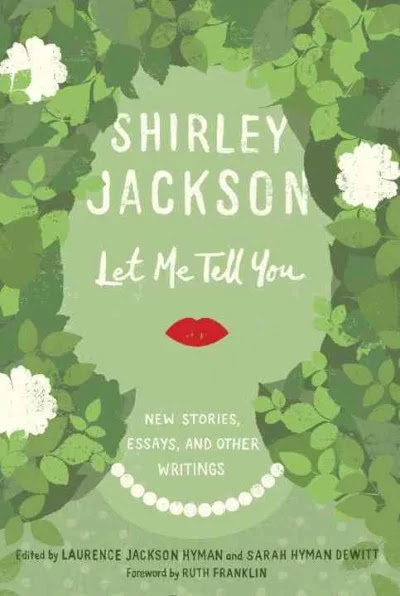
While Shirley Jackson is known today for writing literary horror, during her lifetime she also wrote memoirish essays for women's magazines, work that paid rather well and was well received. She turned out two collections of these things in the early 1950s, Life Among the Savages and Raising Demons. In 2015, fifty years after her death, Let Me Tell You: New Stories, Essays, and Other Writings was released, which included more of her housewife work. It's been fifteen years since I've read the first two books, but at the time I found one of them "just so well done." The same is true of her housewife essays in Let Me Tell You, which I've been reading this past month.

These essays are drole, but they don't focus on being funny. They are not jokie. There is no reaching to get a laugh, because making readers laugh isn't the point. The family members who appear in the essays are well-defined characters. Whether they are true to life or not is another thing, but from essay to essay they stay true to the characters Jackson created. 

Because these essays were written so long ago, some of them seem like historical documents. The one on teenagers' need to conform, for instance. That was an issue in the 1950s? Who knew? Jackson gives the best explanation for the teenage desire to sacrifice individuality for the crowd that I've ever seen. 

What Jackson doesn't do in the housewife essays in Let Me Tell You is complain about doing housework. I kept waiting for that, but it never came. She certainly doesn't glorify it or say anything to suggest it is women's God given role for which they should be grateful. Housework isn't a good thing, it isn't a bad thing. It's just a thing.

Erma Bombeck

Around the same time Jackson was writing for women's magazines, Erma Bombeck, a humorist who wrote specifically about being a housewife and mother, began writing a column for a local newspaper. It wasn't until the mid-sixties, however, that she became a syndicated columnist and the '70s and '80s were her era.

Being old as mud, as I am, I remember Erma Bombeck. It is difficult to exaggerate how successful she was. I remember being surprised to see her as a guest on some evening television special. I was totally blown away when I learned she was pulling down half a million dollars a year, because that was real money back then. I didn't know until recently that she had an eleven-year gig on Good Morning America or that she developed and wrote for a sitcom. It was not a successful sitcom. However, this was before stand-up comics were getting their own shows. To me the failure of the show is far less significant than the fact that a woman got a chance to create one. 

I have huge respect for Bombeck's achievement. I was just never a fan of her writing. It may have been because I was younger and felt the things she wrote about were somewhat dated. I may have found her humor obvious and contrived. I can't even recall. I tried to read one of her books this past month and just couldn't get through it. Bombeck's success must have put her under tremendous pressure to produce content for the columns and appearances she was making, which Jackson probably didn't experience. The "rush to publish" could easily have had an impact on her writing. 

Is Writing About Housewives a Good Career Move?

In the foreword to Let Me Tell You, Jackson's biographer, Ruth Franklin, says that Jackson "considered herself at least a part-time housewife." A lot of the writing she did about that part-time life was done in the early 1950s, a period we think of as the Golden Age of Housewifery, the era I've read that trad wives look back upon with nostalgia. Yet an article in The Guardian from 2016 raises the question of whether critics didn't take her seriously for a long time because of "her busy sideline producing funny tales about life as a housewife and mother for women's magazines."  The era when being a housewife was most highly accepted was also a time when being a housewife marked you as lesser? Twisted much? 

Bombeck, on the other hand, was writing during the second wave of feminism. Women were leaving the house. You'd think that would be a really bad time to be trying to make a career writing about housewives. But, no, Bombeck did fantastically well. Two theories about why, both my own:

  1. While Jackson didn't complain about housework, Bombeck did. She made it okay to complain, and her housewife readers appreciated that. 
  2. Bombeck's housewife humor was nonthreatening. Readers could embrace this housewife stuff at the same time that women were turning their backs on it in order to do other things. Jackson's housewife writing was nonthreatening, too, but there wasn't anything going on culturally at that time that would make people seek it out for comfort the way they might have in the '70s and '80s.

Hey, Maybe Networking Does Help Writers


In Haunted Houses in The New Yorker (2016), author Zoe Heller says that Jackson and her husband were part of a social set that included Ralph Ellison and Bernard Malamud, and I've seen several other references to them knowing those writers. But I don't know what that means. Jackson lived in Bennington, Vermont in the 50s and 60s. (There's not much there even now.) What access did she have to these writer friends? How much did being part of group of writers help her? (Note: I have not read Ruth Franklin's Jackson bio, which might address those questions.) 

However, even I knew Erma Bombeck was friends with Art Buchwald, a high profile humor writer of the period, and I believe there may have been other humor writers she was connected with. All men. In those days, it would have been helpful to be tight with men in your profession. I recently learned she was also friends with Phyllis Diller, a stand-up comic who specialized in housewife humor. These names mean nothing to you now, but these people were a very big deal in Bombeck's day. More so, I'm guessing, than Bernard Malamud was in Jackson's. Coverage in the press of friendships among well known writers/comics could benefit all of them.  

Don't Let Your Mind Wander


Jackson did more than one type of writing. In addition to the housewife memoirs and the literary horror, she wrote short stories. As I said earlier, the question has been raised as to whether or not the housewife work hurt her with critics of her time. But the refusal stay in a lane may not have helped her, either. The literary world does like its labels and pigeonholes. So does the publishing world. There's nothing like a nice clear book category to make marketers happy. Because Jackson did different types of work, it may have been difficult to define her during her lifetime.

Bombeck didn't just stay in her lane, she owned it. She wrote about housewives and mothers. People liked reading about housewives and mothers. People knew what they were getting with her. The publishing world knew how to sell her. Everything fell into place.


Life After Death


I believe Shirley Jackson has always maintained a bit of a reputation, even if it was primarily for her short story, The Lottery. Horror fans have kept up interest in her work as well. Recently, though, she's been experiencing a comeback. Part of that is due to her children's efforts to manage her estate. (Well done, guys.) Part of it may be that she's been dead more than half a century, and the 50-year anniversary might have triggered some attention. Then there was Netflix's beautiful version of The Haunting of Hill House in 2018. That could well have encouraged readers to go back to her books. I think she's doing pretty well right now, though probably not for her housewife writing. 

Erma Bombeck is all housewife writing.  A play about her was being staged a few years ago and the University of Dayton runs a writers' workshop named for her, but it can be difficult to find her books in libraries or places like Libby. She's been dead for just under 30 years, and her time for a revival of interest may still be coming. Also, humor writers may not age well.  A 2022  Guardian article claims that Bombeck's friend, Art Buchwald, who died in 2007, has been forgotten. Finally, humor about women's lives is more common than it was in Bombeck's day, and it's not just about being a housewife or a mother. Readers can find more up-to-date material. 

Housewife Writers


Though both Jackson and Bombeck self-identified as housewives, they were also both writers. The extent of Bombeck's career demands and the money her writing earned her may have meant that there came a point where she was no longer doing housework. I don't know that Jackson ever made enough money to be able to pay for someone to take over housework for her. 

While their lives as housewives had an impact on their writing, it's hard to determine what kind of impact their writing had on their lives as housewives. Did the writing become such a big factor for them that they were no longer living the experience they were writing about?