Showing posts with label Women's History Month. Show all posts

Monday, March 09, 2026

The Reading History Project: "Pedal Pusher" by Mary Boone. Watch Out for Women on Bikes!

Pedal Pusher: How One Woman's Bicycle Adventure Helped Change the World  by Mary Boone with illustrations by Lisa Anchin is a great subject for Women's History Month. For a couple of reasons.

Women on Bikes Were a Big Deal in the Late Nineteenth Century

First off, Pedal Pusher is described as a picture book biography, though it only deals with one period in Annie Cohen Kopchovsky's life. Kopchovsky was the first women to ride a bicycle around the world in 1894-95. Nowadays, this seems like a kind of meaningless stunt. And it may have been a stunt then, too. But bicycling was part of a cultural change for women, giving them more ability to get around and leading to changes in how they dressed, which was far more than just fashion. Kopchovsky represents all that.

I wonder, too, if she represents nineteenth century public relations and self-promotion. Kopchovsky seems to have been very adept at raising money for the trip by signing pictures and giving lectures as she traveled. Boone raises the question of whether or not Kopchovsky was one hundred percent accurate/truthful in her talks. Was she creating an Annie Cohen Kopchovsky for public consumption/sale?  

Which leads me to wonder about another aspect of the Annie Cohen Kopchovsky story. She was a Latvian Jewish immigrant at a time "when prejudice against Jewish people was widespread," as Boone tells readers. Soon after she began her trip, she temporarily changed her name to Londonderry in exchange for a donation from the Londonderry Spring Water Company. She appears as Annie Londonderry in the newspaper quotes Boone provides at the end of the book.

Would public interest have been as great in Kopchovsky if she had used her own name?

Pedal Pusher is a great introduction to its subject. But I want more! I want a movie! I want a Netflix limited series! 

Oh, But There is More


I bought a copy of Pedal Pusher, because I'm interested in the era involved and still have young people around who might read it. But what brought the book to my attention last October was an opinion piece author Mary Boone wrote for The Seattle Times. (I may have stumbled upon it on BlueSky.)

In it, Boone describes how during last year's Women's History Month, the Tacoma Children's Museum invited her to lead two story times about Pedal Pusher. She ran the first program at its downtown location, but the second was going to be held at the museum's site on Joint Base Lewis-McChord. A Federal site. And that one was cancelled four days before the event.

Boone was told "it violated the administration's executive order restricting so-called "radical" Diversity, Equity, and Inclusion programs across federal institutions." 

Hmm. Could that be Executive Order 14253 Restoring Truth and Sanity to American History she's talking about, since that specifically includes federal sites? The one covered here at Original Content back at the beginning of February

I have questions.

  • If the story hour was cancelled because of Executive Order 14253 Restoring Truth and Sanity to American History, is there a claim here that the book isn't true? Annie Cohen Kopchovsky wasn't the first woman to ride a bicycle around the world? I'm not touching the sanity issue. I don't even know what it means in the context of the executive order.
  • Otherwise, what was "radical" about the book? It was about a woman? It was about a Jew? It was about a Jewish woman who did something successfully? 
  • Or I could phrase that a different way: It wasn't about a man? It wasn't about a Christian? It wasn't about a Christian man who did something successfully?
The Power of One Voice


I have a long history of obsessing on the wrong point in a story, and I am probably about to do that right now. In her article about the cancellation of her appearance Boone writes, "Someone complained when they saw my story time being promoted."  "... museum staff later suggested the event might have gone forward if it hadn't been advertised." 

This program was cancelled because one person heard about it and complained? Now, on the one hand, that's a very positive thing, isn't it? It suggests that any one of us can complain and have an impact. We can get the ball rolling to take attention away from books we object to.

But doesn't it also suggest that any one of us can have an impact by speaking out in support of and bringing attention to books we appreciate? Which is what I'm trying to do here.

One voice can make a difference. Imagine the kind of difference many voices could make.

Pardon me while I leave to spread the word about Pedal Pusher on Facebook, BlueSky, and Goodreads. 


Saturday, March 29, 2025

The Heritage Month Project: The Lives of Housewives With Shirley Jackson and Erma Bombeck

The Women's History Month portion of my Heritage Month Project has provided me with an opportunity to do some thinking about two women writers who worked in times that were close together in terms of timeline but different in terms of what was going on in society. They also both wrote about the lives of housewives. 

I am talking about my obsession, Shirley Jackson, and Erma Bombeck.

Shirley Jackson

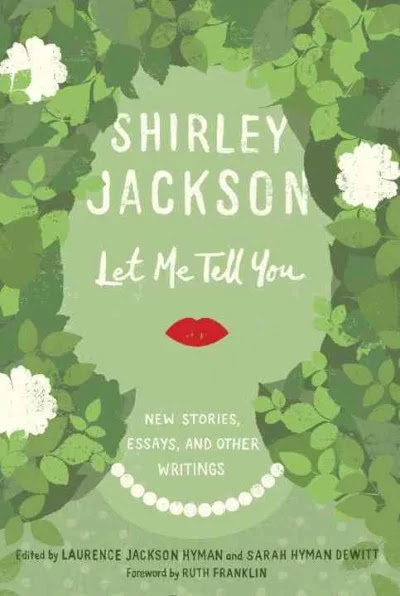
While Shirley Jackson is known today for writing literary horror, during her lifetime she also wrote memoirish essays for women's magazines, work that paid rather well and was well received. She turned out two collections of these things in the early 1950s, Life Among the Savages and Raising Demons. In 2015, fifty years after her death, Let Me Tell You: New Stories, Essays, and Other Writings was released, which included more of her housewife work. It's been fifteen years since I've read the first two books, but at the time I found one of them "just so well done." The same is true of her housewife essays in Let Me Tell You, which I've been reading this past month.

These essays are drole, but they don't focus on being funny. They are not jokie. There is no reaching to get a laugh, because making readers laugh isn't the point. The family members who appear in the essays are well-defined characters. Whether they are true to life or not is another thing, but from essay to essay they stay true to the characters Jackson created. 

Because these essays were written so long ago, some of them seem like historical documents. The one on teenagers' need to conform, for instance. That was an issue in the 1950s? Who knew? Jackson gives the best explanation for the teenage desire to sacrifice individuality for the crowd that I've ever seen. 

What Jackson doesn't do in the housewife essays in Let Me Tell You is complain about doing housework. I kept waiting for that, but it never came. She certainly doesn't glorify it or say anything to suggest it is women's God given role for which they should be grateful. Housework isn't a good thing, it isn't a bad thing. It's just a thing.

Erma Bombeck

Around the same time Jackson was writing for women's magazines, Erma Bombeck, a humorist who wrote specifically about being a housewife and mother, began writing a column for a local newspaper. It wasn't until the mid-sixties, however, that she became a syndicated columnist and the '70s and '80s were her era.

Being old as mud, as I am, I remember Erma Bombeck. It is difficult to exaggerate how successful she was. I remember being surprised to see her as a guest on some evening television special. I was totally blown away when I learned she was pulling down half a million dollars a year, because that was real money back then. I didn't know until recently that she had an eleven-year gig on Good Morning America or that she developed and wrote for a sitcom. It was not a successful sitcom. However, this was before stand-up comics were getting their own shows. To me the failure of the show is far less significant than the fact that a woman got a chance to create one. 

I have huge respect for Bombeck's achievement. I was just never a fan of her writing. It may have been because I was younger and felt the things she wrote about were somewhat dated. I may have found her humor obvious and contrived. I can't even recall. I tried to read one of her books this past month and just couldn't get through it. Bombeck's success must have put her under tremendous pressure to produce content for the columns and appearances she was making, which Jackson probably didn't experience. The "rush to publish" could easily have had an impact on her writing. 

Is Writing About Housewives a Good Career Move?

In the foreword to Let Me Tell You, Jackson's biographer, Ruth Franklin, says that Jackson "considered herself at least a part-time housewife." A lot of the writing she did about that part-time life was done in the early 1950s, a period we think of as the Golden Age of Housewifery, the era I've read that trad wives look back upon with nostalgia. Yet an article in The Guardian from 2016 raises the question of whether critics didn't take her seriously for a long time because of "her busy sideline producing funny tales about life as a housewife and mother for women's magazines."  The era when being a housewife was most highly accepted was also a time when being a housewife marked you as lesser? Twisted much? 

Bombeck, on the other hand, was writing during the second wave of feminism. Women were leaving the house. You'd think that would be a really bad time to be trying to make a career writing about housewives. But, no, Bombeck did fantastically well. Two theories about why, both my own:

  1. While Jackson didn't complain about housework, Bombeck did. She made it okay to complain, and her housewife readers appreciated that. 
  2. Bombeck's housewife humor was nonthreatening. Readers could embrace this housewife stuff at the same time that women were turning their backs on it in order to do other things. Jackson's housewife writing was nonthreatening, too, but there wasn't anything going on culturally at that time that would make people seek it out for comfort the way they might have in the '70s and '80s.

Hey, Maybe Networking Does Help Writers


In Haunted Houses in The New Yorker (2016), author Zoe Heller says that Jackson and her husband were part of a social set that included Ralph Ellison and Bernard Malamud, and I've seen several other references to them knowing those writers. But I don't know what that means. Jackson lived in Bennington, Vermont in the 50s and 60s. (There's not much there even now.) What access did she have to these writer friends? How much did being part of group of writers help her? (Note: I have not read Ruth Franklin's Jackson bio, which might address those questions.) 

However, even I knew Erma Bombeck was friends with Art Buchwald, a high profile humor writer of the period, and I believe there may have been other humor writers she was connected with. All men. In those days, it would have been helpful to be tight with men in your profession. I recently learned she was also friends with Phyllis Diller, a stand-up comic who specialized in housewife humor. These names mean nothing to you now, but these people were a very big deal in Bombeck's day. More so, I'm guessing, than Bernard Malamud was in Jackson's. Coverage in the press of friendships among well known writers/comics could benefit all of them.  

Don't Let Your Mind Wander


Jackson did more than one type of writing. In addition to the housewife memoirs and the literary horror, she wrote short stories. As I said earlier, the question has been raised as to whether or not the housewife work hurt her with critics of her time. But the refusal stay in a lane may not have helped her, either. The literary world does like its labels and pigeonholes. So does the publishing world. There's nothing like a nice clear book category to make marketers happy. Because Jackson did different types of work, it may have been difficult to define her during her lifetime.

Bombeck didn't just stay in her lane, she owned it. She wrote about housewives and mothers. People liked reading about housewives and mothers. People knew what they were getting with her. The publishing world knew how to sell her. Everything fell into place.


Life After Death


I believe Shirley Jackson has always maintained a bit of a reputation, even if it was primarily for her short story, The Lottery. Horror fans have kept up interest in her work as well. Recently, though, she's been experiencing a comeback. Part of that is due to her children's efforts to manage her estate. (Well done, guys.) Part of it may be that she's been dead more than half a century, and the 50-year anniversary might have triggered some attention. Then there was Netflix's beautiful version of The Haunting of Hill House in 2018. That could well have encouraged readers to go back to her books. I think she's doing pretty well right now, though probably not for her housewife writing. 

Erma Bombeck is all housewife writing.  A play about her was being staged a few years ago and the University of Dayton runs a writers' workshop named for her, but it can be difficult to find her books in libraries or places like Libby. She's been dead for just under 30 years, and her time for a revival of interest may still be coming. Also, humor writers may not age well.  A 2022  Guardian article claims that Bombeck's friend, Art Buchwald, who died in 2007, has been forgotten. Finally, humor about women's lives is more common than it was in Bombeck's day, and it's not just about being a housewife or a mother. Readers can find more up-to-date material. 

Housewife Writers


Though both Jackson and Bombeck self-identified as housewives, they were also both writers. The extent of Bombeck's career demands and the money her writing earned her may have meant that there came a point where she was no longer doing housework. I don't know that Jackson ever made enough money to be able to pay for someone to take over housework for her. 

While their lives as housewives had an impact on their writing, it's hard to determine what kind of impact their writing had on their lives as housewives. Did the writing become such a big factor for them that they were no longer living the experience they were writing about? 


Thursday, March 20, 2025

The Heritage Month Project: "Monster, She Wrote" by Lisa Kroger and Melanie R. Anderson

At last, I am writing about Women's History Month reading! I am beginning with Monster, She Wrote: The Women Who Pioneered Horror and Speculative Fiction by Lisa Kroger and Melanie R. Anderson. This is another book from my To Be Read stash on my Kindle app. I'm not much of a fan of horror and only dabble in speculative fiction. However, the women's history aspect grabbed me on this one.

Monster, She Wrote is what might be described as a popular history. There's a section for each author covered, and within that section is an overview/critique, a list of the author's best works, and a list of similar authors. That last section I particularly liked.

The authors begin with women writers of Gothic novels in the eighteenth and nineteenth centuries, since, they say, "There's a strong argument that horror as it exists in the twenty-first century evolved from the Gothic novel..." They cover six women in this section, the two best known (because I've heard of them) being Mary Wollstonecraft Shelley and Ann Radcliffe. Now six is not a statistically significant number. But I was still surprised there were that many, in part because conventional wisdom tells us that women in the past just could not and did not work. 

Later sections of the book tie time periods to subjects such as ghost stories, the occult, pulps, and paperback horror. I was particularly interested in women writing in various fields in the twentieth century. These writers moved around with work, some writing for television as well as paperbacks. Or, like Shirley Jackson, writing horror as well as domestic stories for women's magazines. I like the idea of not allowing yourself to be tied to one thing. 

The last section, The Future of Horror and Speculative Fiction, included interesting people whose work I'm now interested in reading. In fact, I've already read a short story by Helen Oyeyemi.

The Housewife Writer

For some time, I've been interested in women who self-identify as housewife writers. There aren't a lot of them, but I am trying to focus my Women's History Month reading on that. I'm not talking about homemaking as women's God-given role, what they are born to do. I am talking about homemaking as life maintenance, eating and putting clothes on backs and who does that for themselves and others? Why is that not considered as significant as roping a steer or running a store? I have a theory. 

In their section of Monster, She Wrote called Haunting the Home Kroger and Anderson say, "Historically, women have been consigned to the domestic realm, running the household and caring for children." "Many of the women profiled in this book struggled with that dichotomy: the pressure to care for home and family, and the need to tend their writing career. Haunted house fictions play upon the complex fears and concerns about domestic issues that woman have long grappled with."

They include Shirley Jackson in that section. I consider her to be the ultimate housewife writer. More on that before the end of the month.


Tuesday, March 08, 2022

A Repost About Women's Work For Women's History Month


Well, I had hoped to generate some new material for Women's History Month, but that's not going to
to happen. So I decided this is the perfect time to do a little blog anniversary observance and reach into the archives for a post. Turns out, I've only been doing Women's History Month posts since 2017. I particularly like this one, in which I mention a favorite book and go on a favorite rant.

NOTE: The book giveaway mentioned in the original post is long over. I didn't edit out the first reference to it, because I wanted to keep the intro about Fancy Party Gowns and Ann Cole Lowe. 

And, yes, I am aware that today is also International Women's Day.


Wednesday, March 8 2017 Women's Work And A Book, Maybe For You

I have another copy of Fancy Party Gowns by Deborah Blumenthal with illustrations by Laura Freeman to give away, and I'm going to offer it in honor of Women's History MonthFancy Party Gowns is about Ann Cole Lowe, a mid-twentieth century African American dress designer who designed for wealthy white women. She was quite popular with them. Lowe has great significance in the history of her field.

Her field involves sewing, traditional women's work.

During Women's History Month I'm seeing all kinds of terrific material about women in science, the military, and technology. I'm seeing reports on women explorers and inventors.

 Ann Cole Lowe made clothes.

And that's very important in terms of women's history, because Lowe wasn't the only woman who sewed over these last few hundred and maybe thousand years. Yes, she sewed particularly well, but in terms of women's history, as I said, in my mind, she represents something. She represents traditional women's work. In a big, spectacular way.

The Significance of Traditional Women's Work


Women kept humanity going with the traditional work they did to keep families functioning, to keep family members alive. They still do.

When I was in college, I heard about a women's history library at what was then Radcliffe College. (The library is now the Schlesinger Library at the Radcliffe Institute for Advanced Study at Harvard University.) There were thousands of cookbooks there. Twenty thousand, it turns out, a fifth of the collection's 100,000 books. My first response when I learned about this was to get all holier-than-thou college student. Who did those private college people think they were, pigeonholing women as cooks?
From my kitchen bookshelf

But somewhere along the line, I learned that cookbooks in days of old weren't just lists of ingredients and how to mix them together.  The American Frugal Housewife by Mrs. Child, originally published in 1832, describes how to corn meat and includes a section on "remedies." "A rind of pork bound upon a wound," for instance, will prevent the lock-jaw, in case you ever need to know that. Even a twentieth century cookbook like Good Housekeeping's Book of Menus, Recipes, and Household Discoveries, originally published 1922,  includes a year's worth of menus, three per day, and a section of household tips.

Cookbooks used to describe how people lived. They described what women did in particular times. When I realized that, I became more interested in cooking, as women's work, and in women's work, in general.

Yes, historically women have been ignored for their work and contributions to NASA, paleontology, medical research, everything. But they've been ignored and even belittled for the work that was considered "their place," as well. How important was traditional women's work in, say, the American West or any frontier? I've read that the loss of a wife in those areas and times was a greater catastrophe than the loss of a husband. At least a woman with some money could hire a man to help with farm work. And, what's more, many women shared their husband's work on farms/ranches. They could at least milk a cow, take care of chickens and a garden and maybe do much more, if their husbands died.  But where was a man with children to raise, feed, dress, on top of his traditional work going to get help, if his wife died? What was the likelihood that a man could do much of women's work, the way many women could do theirs? We hear about mail-order wives; we don't hear about mail-order husbands.

Saturday, March 14, 2020

Hey, It's Still Women's History Month

The Secret History of Wonder Woman by Jill Lepore is a fantastic Women's History Month read, even if, like myself, you were not a Wonder Woman fan until Gal Gadot started carrying her shield. (I read most of my DC comics at a friend's house whose older brother purchased them. He must not have been a WW fan.) Wonder Woman is the most popular female superhero character and the third most popular superhero character overall, coming in only behind Superman and Batman.

The Secret History of Wonder Woman isn't really about Wonder Woman, though. It appears to be about William Moulton Marston, Wonder Woman's creator. He's one fascinating guy, even though, according to Lepore, he was not nearly as successful as he appears on paper. Instead, he went from one academic job to another, usually in a downward spiral. He went from one project to another, Wonder Woman being one of them. Then there was his unconventional lifestyle. He lived with his wife,  Elizabeth Holloway Marston, a highly-educated woman who wanted both a career and a family. Even in the early part of the twentieth century, how women could do this was an issue under discussion. Elizabeth Holloway Marston managed this by accepting her husband's lover, Olive Byrne, into their home to raise her children with Marston...as well as Byrne and Marston's children...while she worked.

Yeah, that is fascinating.

But what is also fascinating is the way Lepore pulls together the little aspects of Marston's life that turn up in the Wonder Woman story. He was in on the creation of the lie detector, for instance. Wonder Woman carries a lariat that forces people to tell the truth. There are photos of his companion, Olive Byrne, wearing bracelets similar to the ones Wonder Woman wears.

But what is the most fascinating is the way Marston was a sort of magnet for all sorts of pre-WWII feminism. His wife was an early working woman, for instance. His girlfriend was Margaret Sanger's niece.

All these Marton factors, both from his personal life and the feminism he supported, turn up in Wonder Woman in the mid-twentieth century.

Lepore says, "The suffrage campaign, from 1848 to 1920, is often thought of as the "first wave" of the women's movement, and women's liberation, in the 1960s and 1970s, as the "second wave." In between, this thinking goes, the waters were still. But there was plenty of feminist agitation in the 1940s in the pages of Wonder Woman."

I don't know what I was expecting when I bought this book. But I was delighted to be exposed to so much early- to mid-twentieth century women's history.


Sunday, March 31, 2019

An Early Twentieth Century Woman Educator For Women's History Month

It's the last day of Women's History Month, and I just have time to do one more post on the old books piled on the floor in my living room. Well, I'm going to do more than one, but I mean one more about women that fit into a Women's History Month theme.

What I'm telling you about today is The Children's First Reader by Ellen M. Cyr. My edition was published in 1893 by Ginn & Publishers, Boston. You can find a variety of her readers for different levels and in different editions all over the Internet.

In Mysteries Revealed about a Reading Instruction Pioneer in the Winter/Spring 2006 The Jayhawk Educator (page 8) Arlene Barry, Associate Professor at the University of Kansas School of Education, says that Ellen Cyr was "the first woman in America to have a widely sold reading series marketed under her own name." Her books were translated into Spanish, Japanese, and Braille.

Barry provides an analysis of the books and why they were successful. But the First Reader has a note To the Teachers that includes some interesting information about what motivated Cyr to write her books. She said that the reading program for the first year of school was in the first half of the books used for instruction. "...the larger share of the first-year books are too difficult to be completed by the class, and therefore a part of the book is left unread." She writes that children were overwhelmed by the vocabulary in the second half of the books, would start another book and become overwhelmed after the halfway point again.  "...vocabulary is introduced too rapidly for the struggling brain."

"In this series, it has been my purpose to have a complete primary course..."

And she was successful. Her first primer, published by Lothrop, did so well that Ginn & Company offered her a contract. I can't find precise information about how long they remained in print or in use, but books available for sale indicate they were still being published in 1906.

Now, of course, Ellen is gone, another successful woman who became obscure.


Thursday, March 21, 2019

An Obscure Woman Writer For Women's History Month

In my last post, I commented upon writers who ramble and distract from their points with lots of extra words. So I deleted a couple of paras relating to how I came to have two grocery bags full of books from the late nineteenth/early twentieth century, as well as a couple more stacks on the floor. Let's just say, I've got 'em. And in checking them out on-line to see whether or not it's necessary for us to hold on to them, I was struck with how many of them, and their authors, seem...lost. A sobering situation for a writer to learn about.

One of the first books I noticed was a 1900 edition of To Have And To Hold by Mary Johnston. This thing is set in Jamestown during, you know, Jamestown, not one of my favorite time periods. But the story line has features I would have loved as a younger, pre-feminist reader. The lover with a secret identity. How Scarlet Pimpernel! An evil lord. I would probably have eaten that stuff up, though I don't think I was a particular fan of the pirates that also appear here.

What really interests me now is not the book but its author. According to Encyclopedia Virginia, Mary Johnston was the first woman to top best-seller lists in the twentieth century. To Have And To Hold broke publishing records. It's supposed to have been the most popular book between Uncle Tom's Cabin and Gone With the Wind. (Hmm. All three of those books were written by women. What am I to make of that?) It made Johnston rich. She was profiled in the New York Times in 1900, and To Have And To Hold became a movie twice. Okay, they were both silent, but they were movies. (A third version was made in 2015 and never released. Yikes.) And though it was Johnston's most successful book, she wrote and published others. She wasn't a one-hit wonder. She had a career.

And Then...Obscurity


You can find some odd editions of Mary Johnston books here and there, but she's far from a household name. Or a name most of us have heard of. What happened to this bestselling author who wrote the most popular book between Harriet Beecher Stowe's Uncle Tom's Cabin and Margaret Mitchell's Gone With the Wind? We remember Stowe and Mitchell, don't we? Why not Mary Johnston? Come on, Gone With the Wind wasn't that great.

I have a family member who studies and preserves obscure TV at Television Obscurities, so I have given some thought to obscurity. You have your material that is what you might call born obscure because it never made much of an impact when it first appeared. Then you have material that becomes obscure for some reason.

To Have And To Hold certainly wasn't born obscure. But evidently it isn't considered timeless nor some kind of outstanding representative of its era. Or whatever a book has to be to remain in the public memory. And so it became obscure.

Which raises the question, I believe, of which popular books from our period are headed for obscurity?

Feel free to post your answer in a comment.

Wednesday, March 08, 2017

Women's Work And A Book, Maybe For You

I have another copy of Fancy Party Gowns by Deborah Blumenthal with illustrations by Laura Freeman to give away, and I'm going to offer it in honor of Women's History Month. Fancy Party Gowns is about Ann Cole Lowe, a mid-twentieth century African American dress designer who designed for wealthy white women. She was quite popular with them. Lowe has great significance in the history of her field.

Her field involves sewing, traditional women's work.

During Women's History Month I'm seeing all kinds of terrific material about women in science, the military, and technology. I'm seeing reports on women explorers and inventors.

 Ann Cole Lowe made clothes.

And that's very important in terms of women's history, because Lowe wasn't the only woman who sewed over these last few hundred and maybe thousand years. Yes, she sewed particularly well, but in terms of women's history, as I said, in my mind, she represents something. She represents traditional women's work. In a big, spectacular way.

The Significance of Traditional Women's Work


Women kept humanity going with the traditional work they did to keep families functioning, to keep family members alive. They still do.

When I was in college, I heard about a women's history library at what was then Radcliffe College. (The library is now the Schlesinger Library at the Radcliffe Institute for Advanced Study at Harvard University.) There were thousands of cookbooks there. Twenty thousand, it turns out, a fifth of the collection's 100,000 books. My first response when I learned about this was to get all holier-than-thou college student. Who did those private college people think they were, pigeonholing women as cooks?
From my kitchen bookshelf

But somewhere along the line, I learned that cookbooks in days of old weren't just lists of ingredients and how to mix them together.  The American Frugal Housewife by Mrs. Child, originally published in 1832, describes how to corn meat and includes a section on "remedies." "A rind of pork bound upon a wound," for instance, will prevent the lock-jaw, in case you ever need to know that. Even a twentieth century cookbook like Good Housekeeping's Book of Menus, Recipes, and Household Discoveries, originally published 1922,  includes a year's worth of menus, three per day, and a section of household tips.

Cookbooks used to describe how people lived. They described what women did in particular times. When I realized that, I became more interested in cooking, as women's work, and in women's work, in general.

Yes, historically women have been ignored for their work and contributions to NASA, paleontology, medical research, everything. But they've been ignored and even belittled for the work that was considered "their place," as well. How important was traditional women's work in, say, the American West or any frontier? I've read that the loss of a wife in those areas and times was a greater catastrophe than the loss of a husband. At least a woman with some money could hire a man to help with farm work. And, what's more, many women shared their husband's work on farms/ranches. They could at least milk a cow, take care of chickens and a garden and maybe do much more, if their husbands died.  But where was a man with children to raise, feed, dress, on top of his traditional work going to get help, if his wife died? What was the likelihood that a man could do much of women's work, the way many women could do theirs? We hear about mail-order wives; we don't hear about mail-order husbands.

Your Chance To Own "Fancy Party Gowns"


You have a chance to win a copy of a book about a woman who excelled at a particular type of women's work, who, it could be said, raised it to an art form. Comment below, and at the end of the month, I'll draw the name of the person who gets my last copy of Fancy Party Gowns.

Keep in mind, I'll need to get in touch with the winner. If the name next to your comment, doesn't link back to a blog or site so I can find an e-mail, I won't be able to reach you. Therefore, check back here at the beginning of April to see if you've won. Then you can contact me.


,