Showing posts with label picture book biography. Show all posts

Monday, March 09, 2026

The Reading History Project: "Pedal Pusher" by Mary Boone. Watch Out for Women on Bikes!

Pedal Pusher: How One Woman's Bicycle Adventure Helped Change the World  by Mary Boone with illustrations by Lisa Anchin is a great subject for Women's History Month. For a couple of reasons.

Women on Bikes Were a Big Deal in the Late Nineteenth Century

First off, Pedal Pusher is described as a picture book biography, though it only deals with one period in Annie Cohen Kopchovsky's life. Kopchovsky was the first women to ride a bicycle around the world in 1894-95. Nowadays, this seems like a kind of meaningless stunt. And it may have been a stunt then, too. But bicycling was part of a cultural change for women, giving them more ability to get around and leading to changes in how they dressed, which was far more than just fashion. Kopchovsky represents all that.

I wonder, too, if she represents nineteenth century public relations and self-promotion. Kopchovsky seems to have been very adept at raising money for the trip by signing pictures and giving lectures as she traveled. Boone raises the question of whether or not Kopchovsky was one hundred percent accurate/truthful in her talks. Was she creating an Annie Cohen Kopchovsky for public consumption/sale?  

Which leads me to wonder about another aspect of the Annie Cohen Kopchovsky story. She was a Latvian Jewish immigrant at a time "when prejudice against Jewish people was widespread," as Boone tells readers. Soon after she began her trip, she temporarily changed her name to Londonderry in exchange for a donation from the Londonderry Spring Water Company. She appears as Annie Londonderry in the newspaper quotes Boone provides at the end of the book.

Would public interest have been as great in Kopchovsky if she had used her own name?

Pedal Pusher is a great introduction to its subject. But I want more! I want a movie! I want a Netflix limited series! 

Oh, But There is More


I bought a copy of Pedal Pusher, because I'm interested in the era involved and still have young people around who might read it. But what brought the book to my attention last October was an opinion piece author Mary Boone wrote for The Seattle Times. (I may have stumbled upon it on BlueSky.)

In it, Boone describes how during last year's Women's History Month, the Tacoma Children's Museum invited her to lead two story times about Pedal Pusher. She ran the first program at its downtown location, but the second was going to be held at the museum's site on Joint Base Lewis-McChord. A Federal site. And that one was cancelled four days before the event.

Boone was told "it violated the administration's executive order restricting so-called "radical" Diversity, Equity, and Inclusion programs across federal institutions." 

Hmm. Could that be Executive Order 14253 Restoring Truth and Sanity to American History she's talking about, since that specifically includes federal sites? The one covered here at Original Content back at the beginning of February

I have questions.

  • If the story hour was cancelled because of Executive Order 14253 Restoring Truth and Sanity to American History, is there a claim here that the book isn't true? Annie Cohen Kopchovsky wasn't the first woman to ride a bicycle around the world? I'm not touching the sanity issue. I don't even know what it means in the context of the executive order.
  • Otherwise, what was "radical" about the book? It was about a woman? It was about a Jew? It was about a Jewish woman who did something successfully? 
  • Or I could phrase that a different way: It wasn't about a man? It wasn't about a Christian? It wasn't about a Christian man who did something successfully?
The Power of One Voice


I have a long history of obsessing on the wrong point in a story, and I am probably about to do that right now. In her article about the cancellation of her appearance Boone writes, "Someone complained when they saw my story time being promoted."  "... museum staff later suggested the event might have gone forward if it hadn't been advertised." 

This program was cancelled because one person heard about it and complained? Now, on the one hand, that's a very positive thing, isn't it? It suggests that any one of us can complain and have an impact. We can get the ball rolling to take attention away from books we object to.

But doesn't it also suggest that any one of us can have an impact by speaking out in support of and bringing attention to books we appreciate? Which is what I'm trying to do here.

One voice can make a difference. Imagine the kind of difference many voices could make.

Pardon me while I leave to spread the word about Pedal Pusher on Facebook, BlueSky, and Goodreads. 


Tuesday, March 08, 2022

A Repost About Women's Work For Women's History Month


Well, I had hoped to generate some new material for Women's History Month, but that's not going to
to happen. So I decided this is the perfect time to do a little blog anniversary observance and reach into the archives for a post. Turns out, I've only been doing Women's History Month posts since 2017. I particularly like this one, in which I mention a favorite book and go on a favorite rant.

NOTE: The book giveaway mentioned in the original post is long over. I didn't edit out the first reference to it, because I wanted to keep the intro about Fancy Party Gowns and Ann Cole Lowe. 

And, yes, I am aware that today is also International Women's Day.


Wednesday, March 8 2017 Women's Work And A Book, Maybe For You

I have another copy of Fancy Party Gowns by Deborah Blumenthal with illustrations by Laura Freeman to give away, and I'm going to offer it in honor of Women's History MonthFancy Party Gowns is about Ann Cole Lowe, a mid-twentieth century African American dress designer who designed for wealthy white women. She was quite popular with them. Lowe has great significance in the history of her field.

Her field involves sewing, traditional women's work.

During Women's History Month I'm seeing all kinds of terrific material about women in science, the military, and technology. I'm seeing reports on women explorers and inventors.

 Ann Cole Lowe made clothes.

And that's very important in terms of women's history, because Lowe wasn't the only woman who sewed over these last few hundred and maybe thousand years. Yes, she sewed particularly well, but in terms of women's history, as I said, in my mind, she represents something. She represents traditional women's work. In a big, spectacular way.

The Significance of Traditional Women's Work


Women kept humanity going with the traditional work they did to keep families functioning, to keep family members alive. They still do.

When I was in college, I heard about a women's history library at what was then Radcliffe College. (The library is now the Schlesinger Library at the Radcliffe Institute for Advanced Study at Harvard University.) There were thousands of cookbooks there. Twenty thousand, it turns out, a fifth of the collection's 100,000 books. My first response when I learned about this was to get all holier-than-thou college student. Who did those private college people think they were, pigeonholing women as cooks?
From my kitchen bookshelf

But somewhere along the line, I learned that cookbooks in days of old weren't just lists of ingredients and how to mix them together.  The American Frugal Housewife by Mrs. Child, originally published in 1832, describes how to corn meat and includes a section on "remedies." "A rind of pork bound upon a wound," for instance, will prevent the lock-jaw, in case you ever need to know that. Even a twentieth century cookbook like Good Housekeeping's Book of Menus, Recipes, and Household Discoveries, originally published 1922,  includes a year's worth of menus, three per day, and a section of household tips.

Cookbooks used to describe how people lived. They described what women did in particular times. When I realized that, I became more interested in cooking, as women's work, and in women's work, in general.

Yes, historically women have been ignored for their work and contributions to NASA, paleontology, medical research, everything. But they've been ignored and even belittled for the work that was considered "their place," as well. How important was traditional women's work in, say, the American West or any frontier? I've read that the loss of a wife in those areas and times was a greater catastrophe than the loss of a husband. At least a woman with some money could hire a man to help with farm work. And, what's more, many women shared their husband's work on farms/ranches. They could at least milk a cow, take care of chickens and a garden and maybe do much more, if their husbands died.  But where was a man with children to raise, feed, dress, on top of his traditional work going to get help, if his wife died? What was the likelihood that a man could do much of women's work, the way many women could do theirs? We hear about mail-order wives; we don't hear about mail-order husbands.

Thursday, February 17, 2022

A Picture Book Biography For Black History Month

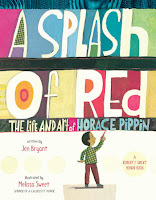
A few weeks ago, I was hunting for art-related picture books, when I came upon A Splash of Red: The Life And Art of Horace Pippin by Jen Bryant with illustrations by Melissa Sweet. It's a lovely picture book biography.

Horace Pippin was an untrained African American folk artist who became successful in his own lifetime. He was born twenty years after the Civil War, but his work became popular in the 1930s, during a period when folk art was of particular interest. According to a write-up at the National Gallery of Art website, among his subjects was African American genre scenes, meaning scenes of everyday African American life.

Both in terms of what he accomplished with his work and what he painted, Horace Pippin seems like a fine subject for Black History Month. A Splash of Red, which gathered a lot of well-deserved attention when it was published in 2013, is a good introduction to him. 

Monday, February 15, 2021

Attending My First Virtual Book Launch Of 2021

On Saturday afternoon I attended a book launch sponsored by The Silver Unicorn Bookstore in Acton, Massachusetts for The Leaf Detective: How Margaret Lowman Uncovered Secrets in the Rainforest by Heather Lang with illustrations by Jana Christy. The event was an example of the things virtual author events can do that in-person ones can't.

  1. The author, the illustrator, and the subject of the book were all in attendance from different locations. Even during normal times, I don't think that kind of thing happens very often at a bookstore. Bookstores provide space and time for author events and take care of ordering and selling books. But they can't pay authors for their time or travel expenses. Unless the people involved all live near one another and have a local bookstore to host them, I think this kind of gathering is rare in the real world.
  2. The Leaf Detective is a picture book and Lang read it, something that often happens at an event for a picture book. But instead of us watching her read and having her hold the book up periodically so an audience can try to see some illustrations, each page was on the screen so we could see the whole thing as she was reading it. This is a huge improvement over a traditional reading.
  3. One hundred people had registered to attend this virtual gathering. Seventy-one had shown up when it began. This is a much larger crowd than I've seen at most of the traditional book launches I've attended. In fact, I think a lot of bookstores wouldn't be able to provide space for this many people. Not every virtual book launch attracts this many people. But the potential is there, because people can watch from everywhere, and not just show up because they're nearby. I, for instance, was almost two hours away.

About The Leaf Detective And The Launch

Margaret Lowman, the subject of The Leaf Detective, is one of the first scientists to study the canopy in the rainforest. Her personal story involves both her work in the rainforest and her life as a woman in a field where there weren't many of them. She also spoke about being shy as a young person, something she has overcome. She's a very engaging speaker. 

Author Heather Lang is a nonfiction writer for children. She talked about how she decided to write The Leaf Detective, which sounds like a method for picking subjects for any nonfiction writer.

Jana Christy did a very good presentation on how she illustrated the book, showing the different types of work she did on one two-page spread.

Remember, I saw all this from my office, after a tiring Saturday of cooking and cleaning. I could not have spent the afternoon driving back and forth to a Massachusetts bookstore. If you have an opportunity to attend a virtual book event, I suggest you grab it.


Sunday, March 15, 2020

Coronavirus Cancellations In Childlit

Over the coming month (or more) I will be covering book launches within the children's literature world and other childlit-related events that are cancelled due to the coronavirus outbreak in this country. You can help out these authors by spreading the word about their new books, following them on social media, recommending their books to your libraries, and, of course, purchasing them when you can.

I'm collecting this information on a catch-as-catch-can basis. Many more authors and illustrators will be affected who you won't see here.

A Whale Of A Mistake


A few days ago, Ioana Hobai announced on Twitter that all her events for A Whale of a Mistake have been cancelled.

A Whale of a Mistake, illustrated by the author and published by Page Street Kids, is about a girl dealing with a big mistake.

Ioanna Hobai has published two other picture books since 2018, one as an illustrator and one as an author and illustrator. She studied art in her native Bucharest.

The Fabled Life Of Aesop


Ian Lendler also announced on Twitter last week that he's had to cancel events for the launch of The Fabled Life of Aesop: The Extraordinary Journey and Collected Tales of the World's Greatest Storyteller.

The Fabled Life of Aesop, illustrated by Pamela Zagarenski (two-time Caldecott Honor winner, by the way) and published by Houghton Mifflin Harcourt, is both a picture book biography of Aesop and an anthology of his work.

Lendler is the author of a number of children's books, as well as adult nonfiction. Interesting mini-fact: He grew up in Wallingford, Connecticut, which isn't that far from me. Not that close, either. Close enough that I may have driven through. Never knew him, though. Not that interesting a mini-fact.

The  Derby Daredevils Book 1


On Wednesday, Kit Rosewater announced that the launch for The Derby Daredevils Book 1 at Book People in Austin, Texas has been cancelled.

The Derby Daredevils, illustrated by Sophie Escabasse and published by Amulet/Abrams, is about two girls trying to pull together a 5-girl roller derby team in one week.

Daredevils is Rosewater's debut book.

Hudson Children's Book Festival


The Hudson Children's Book Festival, scheduled for May 2 in Hudson, New York, has been cancelled. This year's Newbery winner, Jerry Craft, was to have been the featured author. The author/illustrator list included many NESCBWI colleagues. The Book Festival's 2021 date has already been set--May 1.


Thursday, March 12, 2020

Coronavirus Cancellations In Childlit


Over the coming month (or more) I will be covering book launches within the children's literature world and other childlit-related events that are cancelled due to the coronavirus outbreak in this country. You can help out these authors by spreading the word about their new books, following them on social media, recommending their books to your libraries, and, of course, purchasing them when you can.


KidLitCon

The thirteenth annual KidLitCon, which was to have been held on March 26 and 27 in Ann Arbor, Michigan, announced on Twitter yesterday that it has been cancelled. The Ann Arbor District Library, where it was to have been held, has cancelled all its programs and events indefinitely.

KidLitCon is described as a Cybils Award Event, and is connected to the same childlit blogging community. My recollection is that it was originally specifically about blogging and bloggers, though now it is an "...annual gathering of people who care about, and/or blog (or Tweet or Instagram or Facebook or make Videos) about children’s and young adult books..." It involves a wider group these days.

Check out the bloggers and authors who were scheduled to attend.

You're Invited To A Moth Ball


You're Invited to a Moth Ball by Loree Griffin Burns was supposed to launch at the National Science Teaching Association conference in Boston in April. The conference has been cancelled.
Burns said yesterday on Facebook that other spring launch events are up in the air.

You're Invited to a Moth Ball, illustrated by Ellen Harasimowicz and published by Charlesbridge, describes how child readers can observe night time insects at their own homes.

Loree Griffin Burns is the author of numerous nonfiction books for children, some of which have been named ALA Notable Books, Boston Globe-Horn Book Honor Books, and have won IRA Children's Book and Green Earth Book awards.

Numbers in Motion


The book launch for Numbers in Motion: Sophie Kowalevski, Mathematician by Laurie Wallmark, at The Book Garden in Frenchtown, New Jersey on March 15 (this Sunday), has been cancelled.

Numbers in Motion, illustrated by Yevgenia Nayberg and published by Creston Books, deals with Sophie Kowalevski, a nineteenth century Russian mathematician, who was the first woman to receive a doctorate in mathematics that required original research and to hold a university chair in mathematics. (Hmm. A women's history month title, perhaps?)

Laurie Wallmark is the author of three other picture book biographies on women in technology, one of which was named Outstanding Science Trade Book and Cook Prize Honor Book.

Laurie was also scheduled to appear at the National Science Teaching Association conference next month. 

I have at least two more cancellations to cover, and I suspect I'll be hearing about more.

Sunday, March 25, 2018

Reading For Research Month, Day 17

Friday's Reading for Research Month's presenter was teacher and podcast host Colby Sharp. He did a YouTube presentation on picture books that inspire creativity. His talk was primarily, if not totally, about books that inspire creativity in children. As a Reading for Research Month participant, you could take a couple of different things away from this:
  • We could be looking at these mentor texts as examples of creativity-inspiring books we could be writing.
  • We could be looking at these mentor texts for inspiration for ourselves. 
Let's see, how many of the suggested books did Gail manage to find and read? I hope you guessed just one.

Friday's Picture Books


The one book I read is Radiant Child: The Story of Young Artist Jean-Michel Basquiat by Javaka Steptoe, who also illustrated Jimi by Gary Golio, about Jimi Hendrix. Steptoe, who, remember, is both author and illustrator, is clear in a foreward that he has not done any reproductions of Basquiat's work in this book. Readers "will find my original pieces that were inspired by my interpretations of his paintings and designs." An example of an author/artist's creativity being inspired by another's work. (See second bulleted item above.)

 One of the very impressive things about this book is that the illustrations carry the story very well, while at the same time often being very nonrepresentational. On many pages, you have a representational figure, or figures, primarily humans, in a nonrepresentational world.

By the way, Radiant Child won the Caldecott Medal.

Can I use Friday's creativity lesson in my picture book manuscript? Can I rework my text so it encourages creativity in child readers? Can I find something to better inspire my creativity with that book? Or make better use of the work that did inspire it? What would that be? you ask. Die Hard.

ReFoReMo Books Read To Date: 41


Monday, February 26, 2018

Entry Points

I picked up The Shape of the World: A Portrait of Frank Lloyd Wright by K.L. Going with illustrations by Lauren Stringer for me. We visited a Wright house in Grand Rapids, Michigan while we were on vacation a few years ago. Wright's all over the place in the midwest, and we're probably going to visit another house he designed this fall when we're in Illinois and Wisconsin. But my point is, I wasn't interested in readability for children when I brought this home.

Then I found myself with a five-and-a-half-year-old house guest, who is as fond of bedtime reading as I am. I still hadn't read Shape, so I added it to one of our evening bed binges. But I thought, I'll just skim this with him. We won't get into the real techie stuff.

Well, we didn't skim it. The book worked just fine with a littlie. This is what I think did the trick--the shapes. Early on, the author and illustrator introduce the idea of the boy Wright being given gifts: "cubes, spheres, cones, pyramids, cylinders." They appear to be blocks or other kinds of toys. And then they carry the shape idea throughout the book. Kids get shapes, or ours did. Shapes were a way getting into the Frank Lloyd Wright story.

During a trip to the library, our guy picked out Pocket Full of Colors: The Magical World of Mary  Blair, Disney Artist Extraordinaire by Amy Guglielmo and Jacqueline Tourville with illustrations by Brigette Barrager. This book uses a similar device. "Other children collected marbles or dolls, but Mary collected colors of every shade and every hue." And the idea of what Mary Blair did with colors is carried through the whole book.

In both cases, something child readers are familiar with--shapes or color--is used as way of bringing them into a story about adults.

Mentor texts?


Monday, April 10, 2017

Picture Book Giveaway: Pete Seeger And Using Music To Promote Social Justice

The Giveaway


This month I'm giving away a copy of Stand Up and Sing! Pete Seeger, Folk Music, and the Path to Justice by Susanna Reich with illustrations by Adam Gustavson. You'll find instructions on how to enter to win at the end of this post. But first...

The Book


Susannah Reich has written a number of interesting nonfiction picture books that deal with individuals. They're either traditional biographies (Painting the Wild Frontier), creative nonfiction covering a little known aspect of a well-known figure's life (Minette's Feast), and even an account of a group of people in terms of the group members' relationship with one another (Fab Four Friends). This spring's Stand Up and Sing! Pete Seeger, Music, and the Path to Justice tells you exactly what the book is about in its title. It focuses specifically on folk singer Pete Seeger's use of music to bring attention to social problems during his own lifetime. The book covers Seeger's development as a singer and his interests in issues such as improved pay and conditions for workers and civil rights.

This is a picture book that will be of interest to adults as well as older children. Why?

  • Stand Up and Sing! covers some of the movement for social justice in mid-twentieth century America.
  • It also deals with music history. Hey, Seeger was a member of The Weavers. Wimoweh, folks. Who hasn't fantasized about being able to sing the Tokens' version of that song? Who hasn't humiliated themselves trying?  The Weavers' song list.
  • For young writers (or new writers of any age) the book could also serve as a model of a certain type of biography, one that follows a specific thread in the subject's life.

Check out illustrator Adam Gustavson's blog post on illustrating Stand Up and Sing!

And Stand Up and Sing! Could Be Yours


For the rest of the month of April, readers may leave a comment to this post, which will enter them into the random drawing for a copy of Stand Up and Sing! The drawing will take place on Sunday, April 30.

I will need to notify the winner of the book. If the name next to your comment doesn't link back to a blog or site so I can find an e-mail, please either leave a way for me to reach you in your comment or check back here on April 30/May 1 to see the announcement of the winner. And contact me then, of course.

Good luck to everyone.

FTC Transparency Info:  I received a copy of this book from its publisher, Bloomsbury.


Saturday, April 01, 2017

And The Winner Is...

Maria Gianferrari is the winner of Original Content's March Women's History Month book giveaway, Fancy Party Gowns. Thank you to all who entered. There are more giveaways coming up, so...try again.


Later this month, after a week-long elder visit in a far western state, I'll be running a giveaway for Stand Up and Sing! Pete Seeger, Folk Music, and the Path to Justice by Susanna Reich.


Then in May, I'll be offering Strange Fruit: Billie Holiday and the Power of a Protest Song by Gary Golio.

Stay tuned, folks.


Friday, March 24, 2017

One More Week To Take A Chance At Winning "Fancy Party Gowns"

Next Friday I'll be selecting the winner of the Women's History Month giveaway of Fancy Party Gowns by Deborah Blumenthal with illustrations by Laura Freeman. To be considered, enter a comment at this post. (By "this post," I mean the post I link to in that last sentence, not "this post" that you're reading right now.) No, you won't see your comment immediately. I will need to approve it, because the post is old. But I most definitely will approve.

If you happen to have a website or blog and want to leave me a way to reach you there, that would be appreciated. Otherwise, check back at Original Content next weekend. I'll announce the winner, and if I can't contact you, you can then contact me.

More book giveaways coming up in April and May.

Wednesday, March 08, 2017

Women's Work And A Book, Maybe For You

I have another copy of Fancy Party Gowns by Deborah Blumenthal with illustrations by Laura Freeman to give away, and I'm going to offer it in honor of Women's History Month. Fancy Party Gowns is about Ann Cole Lowe, a mid-twentieth century African American dress designer who designed for wealthy white women. She was quite popular with them. Lowe has great significance in the history of her field.

Her field involves sewing, traditional women's work.

During Women's History Month I'm seeing all kinds of terrific material about women in science, the military, and technology. I'm seeing reports on women explorers and inventors.

 Ann Cole Lowe made clothes.

And that's very important in terms of women's history, because Lowe wasn't the only woman who sewed over these last few hundred and maybe thousand years. Yes, she sewed particularly well, but in terms of women's history, as I said, in my mind, she represents something. She represents traditional women's work. In a big, spectacular way.

The Significance of Traditional Women's Work


Women kept humanity going with the traditional work they did to keep families functioning, to keep family members alive. They still do.

When I was in college, I heard about a women's history library at what was then Radcliffe College. (The library is now the Schlesinger Library at the Radcliffe Institute for Advanced Study at Harvard University.) There were thousands of cookbooks there. Twenty thousand, it turns out, a fifth of the collection's 100,000 books. My first response when I learned about this was to get all holier-than-thou college student. Who did those private college people think they were, pigeonholing women as cooks?
From my kitchen bookshelf

But somewhere along the line, I learned that cookbooks in days of old weren't just lists of ingredients and how to mix them together.  The American Frugal Housewife by Mrs. Child, originally published in 1832, describes how to corn meat and includes a section on "remedies." "A rind of pork bound upon a wound," for instance, will prevent the lock-jaw, in case you ever need to know that. Even a twentieth century cookbook like Good Housekeeping's Book of Menus, Recipes, and Household Discoveries, originally published 1922,  includes a year's worth of menus, three per day, and a section of household tips.

Cookbooks used to describe how people lived. They described what women did in particular times. When I realized that, I became more interested in cooking, as women's work, and in women's work, in general.

Yes, historically women have been ignored for their work and contributions to NASA, paleontology, medical research, everything. But they've been ignored and even belittled for the work that was considered "their place," as well. How important was traditional women's work in, say, the American West or any frontier? I've read that the loss of a wife in those areas and times was a greater catastrophe than the loss of a husband. At least a woman with some money could hire a man to help with farm work. And, what's more, many women shared their husband's work on farms/ranches. They could at least milk a cow, take care of chickens and a garden and maybe do much more, if their husbands died.  But where was a man with children to raise, feed, dress, on top of his traditional work going to get help, if his wife died? What was the likelihood that a man could do much of women's work, the way many women could do theirs? We hear about mail-order wives; we don't hear about mail-order husbands.

Your Chance To Own "Fancy Party Gowns"


You have a chance to win a copy of a book about a woman who excelled at a particular type of women's work, who, it could be said, raised it to an art form. Comment below, and at the end of the month, I'll draw the name of the person who gets my last copy of Fancy Party Gowns.

Keep in mind, I'll need to get in touch with the winner. If the name next to your comment, doesn't link back to a blog or site so I can find an e-mail, I won't be able to reach you. Therefore, check back here at the beginning of April to see if you've won. Then you can contact me.


,

Monday, February 06, 2017

Terrific Bio And Giveaway

Authors who write historical nonfiction look for stories from the past that haven't been told. A lot of untold historical stories come out of the experiences of groups whose actions have been ignored. African Americans, for instance. For the general public, that's the case with African American fashion designer Ann Cole Lowe, the subject of Fancy Party Gowns by Deborah Blumenthal with illustrations by Laura Freeman.

Lowe is probably known within her field. She got a New York Times obituary when she died in 1981, and some of the clothes she designed can be found at The Met. She also appears to be experiencing a revival over the last couple of years. She's all over the Internet. (Yeah, you can look.) But she certainly doesn't have the same kind of high profile that designers from the same era whose design houses still exist have. Lowe designed for individuals, not the mass market, which also limited how many people knew about her, either in her lifetime or now.

All of which makes her a great subject for a picture book bio. She's not generally known, but at the same time, there is information about her out there, so that when you want to hunt down more info about her, you can.

Okay, Fancy Party Gowns is the story of an African American woman who was sought out by wealthy white women who wanted her to design and make their clothes for important events at a time when people of her race weren't accepted just anywhere. Like design school, for instance. She got in, but had to study separate from white students. So what we have here is a tale of an outsider who makes the insiders come to her. She had something they wanted. They wanted it bad enough to let her in the front door.

Lowe designed one particular gown for one particular person, an act that ties her to history in a big way. I wasn't aware of this when I read Fancy Party Gowns and getting to this part of the book was an eye popper. Hope other readers will have the same experience.

A note about the illustrations: They are both realistic and bigger than life at the same time. Lowe often appears as some variation of the cover image. In my humble opinion, it gives her power.

Black History Month Giveaway


Little Bee Books, publisher of Fancy Party Gowns, provided me with two copies of Fancy Party Gowns to give away here. I'll give away one copy this month for Black History Month and the other next month for Women's History Month. Leave a comment below. When we reach ten comments, we'll pick one at random to receive this month's copy.

Thursday, February 02, 2017

A Throw Back Thursday Post For Black History Month

Back in 2015 I did a post on Vaunda Micheaux Nelson's Bad News for Outlaws: The Remarkable Life of Bass Reeves, Deputy U.S. Marshall, which was published in 2009. I'm republishing it below as a Black History Month observance.

Bass Reeves
I happened to recall this book recently because last week the television show Timeless featured Reeves in an episode. Timeless is a time travel story, a genre I'm not that fond of as a general rule. In this one, the main characters go to a different time every episode chasing a bad guy who's doing something I don't quite understand and there are some other bad guys I don't get at all. But here's what I do get about Timeless. It's a show for history geeks. It's a show for those of us who sit on our couches watching it and shout, "That's Judith Exner! Judith Exner! That's Kennedy's mistress!" "Oh, you know, there was a serial murderer at the Chicago World's Fair and look how cool Houdini is in this episode." "Bass Reeves? I know him."


Colman Domingo as Bass Reeves
The Bass Reeves' episode was actually called, The Assassination of Jesse James. But the character of Bass Reeves, and the actor who played him, left me thinking, Jesse Who?

Something happens when a genre show aimed at a general audience features lesser known historical figures like Reeves. The show places those figures into popular culture where lots more living people have a chance to hear about them. It takes them out of their niche--Black history, say, or western history--and places them into history with a capital H. It gives them their shot at being remembered for what they did.

We history geeks think that's a good thing, a very good thing.

Throw Back Thursday Post: "Bad News" Is Good News For Readers


I was so taken with Vaunda Micheaux Nelson's article Mind the Gaps in The Horn Book last winter that I went on to read her book Bad News for Outlaws: The Remarkable Life of Bass Reeves, Deputy U.S. Marshal. Like Nelson, I grew up watching westerns, so I had noticed a review for this book when it was released in 2009.

Bad News for Outlaws is a fantastic book. It's marketed to grades 3 to 6, so expect more text than in a traditional picture book. It is fascinating text, well-constructed as Bass Reeves' life story. The Reeves' story is told within the context of his world, as well. Just what was the deal with the so-called Indian Territory, anyway? And what were the deputy marshals vs. any other kind of lawman out in the west? Additionally, Nelson uses some great stories about Reeves' activities as a marshal to illustrate what was so interesting about him. And she subtly throws in language from Reeves' era.

In addition to the great writing, this is a beautiful looking book, illustrated by R. Gregory Christie. The design of many of the pages calls to mind old books or maybe wanted posters. The back material is some of the best and most inviting I can recall seeing.

Because Bass Reeves was an African American, I imagine Bad News for Outlaws being displayed prominently in libraries during Black History Month. But this is a book that could be used for so much more. It could support history units because it is so good on the time period when Reeves' lived. It could be used to support a writing unit with the the stories Nelson uses about Reeves lives illustrating use of detail in writing. Oh, and the book also illustrates using an opening hook.

I learned from this book. I was left wondering about one thing, though. Was poor pretty Jennie Reeves left raising Bass's eleven children on her own while he was off taming the Wild West? But then I wonder about that with many books about men from the past.

______________________________

Historical photo of Bass Reeves from Timeless Wiki.

Photo of Colman Domingo as Bass Reeves from A.V. Club.

Monday, November 14, 2016

A Little Time Spent With Picture Books

A Poet Kids May Want To Know About


I can't claim to be at all knowledgeable about poet e.e. cummings, though I've certainly heard of him. I didn't have to know much about him to find Enormous Smallness: A Story of E.E. Cummings by Matthew Burgess fascinating.

The book spends a lot of time on Cummings' youth (He sounds like the rare artist/bio subject who had a happy childhood.), a great idea for a children's book. Then it makes a smooth transition to his adult life.

The book makes an interesting connection between Cummings and artists working in other artistic fields, such as Gertrude Stein, Paul Cezanne, and Igor Stravinsky. They "were challenging the way we think and see. In all of the arts, people were in pursuit of the new and Estlin wanted to make his mark, too."  Last month, The Millions carried an essay related to Impressionism's influence on Virginia Woolf's To The Lighthouse. The idea that all sorts of artists in a particular period are connected is new to me.

This is a beautiful looking book, too.

The MacDonalds And Their Farm 


It's a rare child who hasn't heard of Old MacDonald Had a Farm, and that's what makes Old MacDonald Had a Truck by Steve Goetz with illustrations by Eda Kabanwork work. Old MacDonald
isn't supposed to have trucks...front loaders...bulldozers...on his farm. He's supposed to have animals. Incongruity. That's funny. In fact, yesterday I read this book to a four-year-old who said, "That's crazy" when he heard the title.

One of the many neat things about this book is all the face time Ms. MacDonald the farm wife gets.

Personally, I don't get children's fascination with heavy equipment. However, I heard someone on NPR suggest a few weeks ago that it has something to do with powerless children associating themselves with the powerful equipment. No idea how accurate that is.

I think this book is a example of what Pegi Deitz Shea was talking about at the Publishing Children's Books panel discussion earlier this month. Old MacDonald stories are concept books in that they teach children about farm animal sounds. Pegi said that if writers can "provide a twist to a concept," they have a totally new book. Old MacDonald Had a Truck is a definite twist.