Showing posts with label art books. Show all posts

Wednesday, March 29, 2023

If Anyone Is Interested In Michelangelo's David

I understand that there's been a brouhaha about Michelangelo's David, an old statue of a rockstar Biblical figure in all his youthful glory, so to speak. I have no dog in this race, no opinion to voice. However, I will take this opportunity to bring a really lovely book to your attention, Stone Giant, Michelangelo's David and How He Came To Be by Jane Sutcliffe with illustrations by John Shelley.  

I had the good fortune to attend a presentation Jane did on this book in 2015 at the Connecticut Children's Book Fair. (The fair hasn't been held since well before the pandemic, and I personally doubt we will ever see it again. Just had to mention that. Sorry.) 

In her presentation, Jane said she had seen David (in Florence, not Venice as I say in my blog post about her talk) and that when she looked into his face, she thought she saw a story. At the time, I thought she wasn't talking just about David, but looking at all art.

The book is lovely, and I've just added it to a wishlist so I can have it for my personal library to share with young family members.

Well, maybe I do have a dog in this race, because I knew Jane Sutcliffe, a lovely woman and very good historical nonfiction writer who died a little over a year ago. I regret not buying this back in 2015 so that I'd now have a signed copy.

This book would be a great addition to school and church libraries, as well as for homes.

Thursday, February 17, 2022

A Picture Book Biography For Black History Month

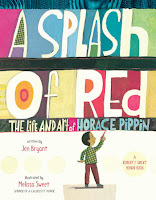
A few weeks ago, I was hunting for art-related picture books, when I came upon A Splash of Red: The Life And Art of Horace Pippin by Jen Bryant with illustrations by Melissa Sweet. It's a lovely picture book biography.

Horace Pippin was an untrained African American folk artist who became successful in his own lifetime. He was born twenty years after the Civil War, but his work became popular in the 1930s, during a period when folk art was of particular interest. According to a write-up at the National Gallery of Art website, among his subjects was African American genre scenes, meaning scenes of everyday African American life.

Both in terms of what he accomplished with his work and what he painted, Horace Pippin seems like a fine subject for Black History Month. A Splash of Red, which gathered a lot of well-deserved attention when it was published in 2013, is a good introduction to him. 

Sunday, March 25, 2018

Reading For Research Month, Day 17

Friday's Reading for Research Month's presenter was teacher and podcast host Colby Sharp. He did a YouTube presentation on picture books that inspire creativity. His talk was primarily, if not totally, about books that inspire creativity in children. As a Reading for Research Month participant, you could take a couple of different things away from this:
  • We could be looking at these mentor texts as examples of creativity-inspiring books we could be writing.
  • We could be looking at these mentor texts for inspiration for ourselves. 
Let's see, how many of the suggested books did Gail manage to find and read? I hope you guessed just one.

Friday's Picture Books


The one book I read is Radiant Child: The Story of Young Artist Jean-Michel Basquiat by Javaka Steptoe, who also illustrated Jimi by Gary Golio, about Jimi Hendrix. Steptoe, who, remember, is both author and illustrator, is clear in a foreward that he has not done any reproductions of Basquiat's work in this book. Readers "will find my original pieces that were inspired by my interpretations of his paintings and designs." An example of an author/artist's creativity being inspired by another's work. (See second bulleted item above.)

 One of the very impressive things about this book is that the illustrations carry the story very well, while at the same time often being very nonrepresentational. On many pages, you have a representational figure, or figures, primarily humans, in a nonrepresentational world.

By the way, Radiant Child won the Caldecott Medal.

Can I use Friday's creativity lesson in my picture book manuscript? Can I rework my text so it encourages creativity in child readers? Can I find something to better inspire my creativity with that book? Or make better use of the work that did inspire it? What would that be? you ask. Die Hard.

ReFoReMo Books Read To Date: 41


Monday, November 07, 2016

But How Does Art Make You Feel?

I pulled Pierre-Auguste Renoir: Paintings That Smile by True Kelley off one of my To Be Read Shelves to take with me on vacation back in September. I have a vague recollection of buying it new somewhere. I often no longer recall how I came to have books on my TBR Shelves. This one was published in 2005, and I'm not sure it's still in print.  (UPDATE: I just did a blog search. I bought this book in 2005. Yikes.)

This book is structured like a child's report on Renoir and makes very good use of page layout--Renoir's artwork, text that is supposed to be the student's text, and her personal comments. While her report tone is enthusiastic, it is pretty much the familiar French Impressionist story. What makes Paintings That Smile unique is those personal comments, in which the narrator often describes her responses to Renoir's art.

For instance, on the cover of her book of piano music is a Renoir portrait of two girls seated at a piano. "They look like they are having such a good time...in lots of his paintings people are smiling and having fun. That's why I picked Renoir for my report. His paintings make me smile."

She likes the dress in one of his paintings, the dog in another. She wonders what a woman is doing with her hands in still another. She has opinions about Renoir's children, who served as models in some of his work. My personal favorite of our young report writer's responses? "Those black eyes look weird to me."

What I think this book does is show people that art can be enjoyed on a very personal level, related only to them. They don't have to be concerned about whether their responses are right or wrong or falling in line with those of anyone else. It's not so much that it shows child readers how to enjoy art. It's more as if it gives them permission to enjoy it.

Sunday, January 03, 2016

My Christmas In Books, Part 2

Christmas is finally over for the Gauthiers, and I can report on the last of the books I gave to family members.

Impressionist Painting for the Landscape by George Gallo & Cindy Salaski and The Hudson River School: Nature and the American Vision by Linda S. Ferber We have a couple of family members who paint, paint well, and study their art. One of them asked for these books. If I had all the time in the world, I'd do some reading on the Hudson River School. Maybe I can find an exhibit somewhere.

Cruel Beauty by Rosamund Hodge and The New Artisan Bread in Fives Minutes a Day by Jeff Hertzberg and Zoe Francois. I've bought my niece nearly 40 books over the years (I kept a list--you have to with that many books or you'll buy duplicates.) Earlier this year, I learned that in addition to reading fantasy, she likes to bake. But she wasn't into baking bread, because it took too long. Well, as my Facebook friends will tell you, I am notori--legendary for baking, including bread. So I fixed Becki up with a bread baking book I've used myself.

The Wright Brothers by David McCullough and The Complete Persepolis by Marjane Satrapi. We have a family member who reads historical nonfiction. When we saw him in October, I learned that he wasn't familiar with graphic nonfiction, believing that all graphic work was fiction for kids. Well, we fixed that!

And what did I get in the way of books, you may ask? Raising Demons by Shirley Jackson, which my loyal followers know I appreciate very much. I also received a hefty Amazon gift card that will cover my eBook purchases for months to come.


Monday, December 28, 2015

My Christmas In Books, Part I

I'm going to have to ease myself back into blogging, so I'm going to start with a simple list of my Christmas book purchases for family members. Because that's fun, for me, anyway. I was excited about a lot of these books, but held off writing about them because I do have a couple of relatives who stop by here occasionally.

So here goes:

Darth Vader and Son by Jeffrey Brown. This was the perfect gift for our young father of a three-
year-old boy. How perfect was it? Someone got it for him for his first Father's Day. It was, however, the only case this Christmas of people receiving a book from me that they already had.

Bossy Pants by Tina Fey. I listened to the audio edition of this book. It's not just show business talk. There's some contemporary life essays here that I thought would go over with one of our young women. She seemed pleased.

Redshirts by John Scalzi. I was really excited about this one. Some low-ranking crew members on a starship realize that a large number of their colleagues are killed while on away missions. It appears to be a parody of that issue on Star Trek. I gave it to a relative who has more than 200 Star Trek novels in our basement. He didn't seem as taken with the whole concept as I was. You know, if you've read 200+ Star Trek novels, you may not be interested in funny ones. I, however, am. I may try to read this thing at some point.

A Beautiful Friendship by David Weber. This went to a fan of the Honor Harrington books who has also become interested in YA. Beautiful Friendship is the first in a series about one of Honor's ancestors, and it's YA. This was another gift that went over well.

The Comedians: Drunks, Thieves, Scoundrels and the History of American Comedy by Kliph Nesteroff. We have a family member who is a TV archivist/historian, and The Comedians includes TV. Our archivist also received Best Television Plays, edited by Gore Vidal, which I picked up in a used bookstore in Michigan this fall. I was happy with how these were received.

The Cuckoo's Calling by Robert Galbraith, who is really J. K. Rowling. Our middle school librarian is a big Harry Potter fan. This seemed like a good match.

In the Garden with Van Gogh by Julie Merberg and Suzanne Bober. I went to a Van Gogh exhibit this summer and got this in the museum gift shop. I gave this to someone who is much more interested in trains than he is in art. So I also gave him a signed copy of Train by Elisha Cooper.

Christmas isn't quite done here. I'll be giving another six books to other relatives next weekend. So My Christmas In Books will continue in about a week.

Monday, May 05, 2014

Catching Up With Winfred Rembert

I'm not sure what led me to take my copy of Don't Hold Me Back by Winfred Rembert off my shelf yesterday to show to a family member. I met Rembert back in 2004 when we were both nominated for the Connecticut Book Award, back when there still was a Connecticut Book Award. (Not to be confused with the Nutmeg Award, folks.) But as a result, I looked up Rembert today.

Wow.

Winfred Rembert is a leather folk artist whose work has gotten around. He's had gallery shows that were reviewed  in the New York Times. He's had other gallery shows.  Oh, look. Another, very recent show. The Huffington Post carried a piece about him. A book has been written about him. And a documentary has been made.

I was going to offer my copy of Don't Hold Me Back to a couple of my family members who are library/reading teacher people. But I love folk art! And Rembert signed it! I think I will make them drag it from my cold, stiff hands. They can look forward to fighting for it.

Here's something I've been thinking about this afternoon. I love a lot of the folk art I've run into over the years. It's not so much the execution, which I'm not qualified to judge, though there are definitely some things I've liked more than others. It's that these people, who have little to no art training, need to create so badly that they won't let the fact that they have only a vague idea what they're doing stop them.

So why don't I feel the same way about work from untrained writers?

And was I the equivalent of a folk writer when I started publishing?


Tuesday, September 17, 2013

Binging On Picture Books

This is Tuesday, so I should be doing a time management post. However, I'm recovering from a minor illness during which I've been working in sprints. I'm still lolling about reading and sleeping and saving my sprinting time for a work in progress. However, Blogger is letting me access it from my desktop today, which it hasn't done for a couple of weeks. That means I can get to my image file and finally upload this picture book post I did several weeks ago and have been saving.

I did a little art picture book binge recently. One book would be classified as an "art book" by just about anyone. The other I'm classifying as an art book because, well, this is my blog. I can classify anything anyway I want here.

Modern Art for Kids. And Me.


I don't know how kids feel about Mousterpiece by Jane Breskin Zalben, but it sure helped me develop a better understanding of modern art. Do kids need to know about modern art? Do they need to know about art at all? Does anyone? Personally, I think art is a form of communication and being able to comprehend and enjoy it is as valuable as being able to comprehend and enjoy any other kind of communication. On top of that, like other types of communication it expresses something about the culture that produces it, so it has a place in the study of history.

Okay, enough pontificating. Mousterpiece is about a mouse name Janson who lives in a museum and stumbles upon the modern art room. She is amazed and inspired and begins painting in the style of the paintings she  sees there. This is a story about appreciation. There is no push to teach artists or styles or names of paintings. All we see are Janson's paintings done in the style of Warhol, Matisse, Picasso and many more. Anyone (probably adults like myself) who wants a very quick and easy lesson on the artists Janson is inspired by can turn to a four-page spread at the back of the book. It's one of the best Notes sections in a picture book that  I've ever seen.

Narrative in Art


A piece of art often expresses a narrative, even when it is abstract rather than representational, which is probably its main attraction for me. Bluebird by Bob Staake is an example of a picture book that's narrative is expressed totally through art. All the illustrations are done in shades of blue and gray and while the work could be called representational, in that it represents what it is and we can recognize it, it's not all realistic. The human figures, for instance, are cartoonish but fit in with the overall settings in which they're placed.

While I'm not particularly fond of the narrative told  in these pictures (I find it a little "important" and even somewhat predictable in the way important children's books can be), it is a really fine example of art communicating story. So much so, in fact, that  in the early pages I found myself  going, "What? What's going on here?" It wasn't until the disturbance came to the main character's world (the bluebird's? the child's?) that I became engaged. Because disturbance is the beginning of story.

By the way, Bluebird is mentioned  in one of those What Makes a Good Picture Book About articles in  the most recent issue of The Horn Book.  Giving you the whole title would be a bit of a spoiler for Bluebird, but the article is on-line, so those of you who don't mind spoilage can follow the link and read it.

Sunday, March 21, 2010

Everyone's Been In Monet's Garden


I stumbled upon The Magical Garden of Claude Monet by Laurence Anholt, a story based on a real incident.

The book made me think of Linnea in Monet's Garden by Christina Bjork. Then I learned that Philippe has been there, too.

Everyone has been in Monet's garden. My sister has been in Monet's garden. That would make a great picture book. Constance in Monet's Garden and Why Gail is Bitter.

Thursday, June 25, 2009

A Lost Week


Because I'm incredibly insensitive, I spent a little time working at home on Monday while a family member was going under the knife. (Come on. It wasn't brain surgery, and one of our nicer relatives was at the hospital with her.) Otherwise, I've been sharing post-surgical elder care this past week, including an overnight last night. I didn't get any other work done, but during those moments when I wasn't becoming incredibly friendly with a large number of residents of a senior housing complex, I did manage to do a little reading.

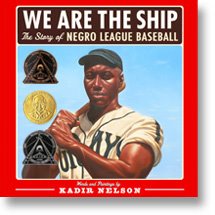
Among the books I completed was this year's Siebert Medal winner, We Are The Ship: The Story of Negro League Baseball, which was written and illustrated by Kadir Nelson. The images are eye-poppingly beautiful, and the unnamed first-person narrator who sounds like a player from the era makes this historical work very readable. And the book uses endnotes! I can never say enough about how much I love nonfiction that includes citations.

I am not a fan of baseball. Reading about it is one hundred percent better, as far as I'm concerned, when there is a historical element.

This book is deserving of every good thing that's been written about it. I do wonder, though, as I always wonder when I read these beautiful nonfiction books published in a picture-book format, who will read them? The text is way too sophisticated and lengthy for traditional picture book readers. We Are The Ship's publisher is marketing it to ages 8 and up, but will, say, intermediate and middle school teachers accept their students reading and reporting on it? Will the adults who might be very taken with it find it in the kids' section of libraries and bookstores?

Do books like this find their readers?

A exhibit of the original art work for We Are The Ship will arrive at the Eric Carle Museum in 2012. I hope I remember.

Sunday, February 01, 2009

Random Reading

The Chronicle Books spring and summer children's catalog arrived last month. I only had time to browse, but Classic Western Stories, compiled by Cooper Edens, caught my eye because I'd recently recommended a western novel for YA readers. Plus, I've wondered in the past if kids would read western.

Chronicle Books publishes a lot of art books, including art board books.

Then back while I was on vacation (can you believe I'm still talking about that?), I bought a copy of that week's Sunday New York Times, a treat that goes back to my college days and one that I rarely have time for. That issue included an article called Hapless Boy Wins Eager Friends, about the popularity of the Wimpy Kid books by Jeff Kinney. I've only just read the article because I was on retreat from all kid reading while I was on vacation.

I have not yet read any of the Wimpy Kid books because they're written in diary format, and I have trouble getting enthused for reading those kinds of books. However, I hear a lot about them when I go into schools. Kids love them. The diary format doesn't bother them one bit.

Thursday, October 30, 2008

Art And History In One Lovely Package


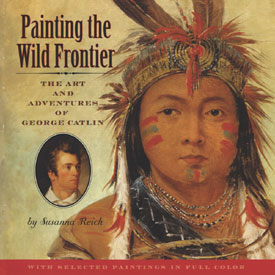
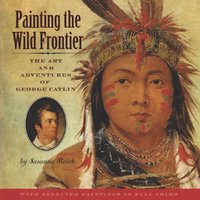
My impression of the nineteenth century is that it was a time when people had a big interest in things outside themselves—natural history, art, and philosophy, for instance. At the same time, you saw some remarkable bigotry. Susanna Reich's biography of George Catlin, Painting the Wild Frontier: The Art and Adventures of George Catlin, confirms my feelings about that incredibly interesting century.

You may not be familiar with George Catlin's name, but you've probably seen his work, particularly The Cutting Scene. Catlin was a nineteenth century artist who made painting American Indians (the term Reich uses) his life's work, both in terms of art and business. Early in Painting the Wild Frontier, Reich says of him, "Would people pay to look at paintings of Indians, he wondered, the way they paid to look at the Greek statues and the paintings of Revolutionary War heroes in Peale's museums?"

He gambled that they would.

The first part of Painting the Wild Frontier deals with Catlin the artist and adventurer. He believed the Plains Indians were still relatively untouched by contact with Europeans and seemed sincerely interested in documenting them and their lives with his art. Except for a few unattractive incidents that indicate that he was, indeed, a nineteenth century man, (the buffalo he shot but didn't kill and allowed to struggle in pain so he could sketch it from better angles, for instance, and his insistence on visiting a quarry considered a sacred site, even going so far as to take a sample of the rock away with him) Catlin comes off well during his productive years.

Making a living from art is almost always a problem, and in Catlin's case, he appears to have been a better painter than businessman. Though he ran successful exhibits in the United States and London, he wasn't able to hold on to money. An argument could be made that he also exploited Indians who appeared in his exhibitions. In his later years, he could have been a model for the artist tragically fallen on hard times.

When literary agent Nathan Bransford described his fantasy MFA Program he said, "Good nonfiction has an underlying arc and a satisfying conclusion." Reich definitely finds an underlying arch in George Catlin's life story, and while its conclusion may not be satisfying in terms of happily ever after, it's satisfying in terms of being a conclusion that fits in with what came before. While I kept hoping he would redeem himself as I read the latter part of the book, I can't say I was surprised when he didn't.

The art of our past is important because before cameras it was the only way to preserve how people and things looked. Archaeologists sometimes use art to help them date items--if a cup is similar to one in a painting from the late eighteenth century, then it, too, may very well come from that period. Thus Catlin's art is important no matter what we may think of him. Painting the Wild Frontier includes enough of it to almost be considered an art book. Some of the illustrations are in black and white, some are in color, and all are beautiful. Captions not only discuss the work, but identify the individuals in the paintings, making them real people who lived on after they were painted, who had families and perhaps descendants walking among us today.

Pay particular attention to the timeline at the back of the book, in which Reich shows us what was going on in the U.S. at various points in Catlin's life. While reading Painting the Wild Frontier, you'll definitely get a feeling for the nineteenth century world, but it's here in the timeline that you really get hit with some of the inconsistencies of the period. In 1838, for instance, while Catlin's Indian Gallery exhibit is a big hit with the citizens of four eastern cities, 4,000 Cherokee Indians die on the Trail of Tears while being forcibly relocated by the federal government.

This is a piece of work that could really get young readers interested not only in the subject covered but in reading history, period.

Painting the Wild Frontier has been nominated for a Cybil.

You can read a lot more about Painting the Wild Frontier next week, when Susanna Reich will be doing a blog tour. She'll be getting started on Monday at Becky's Book Reviews and stopping here on Thursday when we'll be talking history.

Wednesday, January 30, 2008

My First Picture Book Of The Year


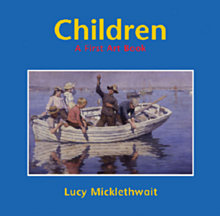
Children: A First Art Book by Lucy Micklethwait is a collection of works of art used to illustrate common childhood activities. I thought it was kind of interesting, a way of introducing children to the idea that looking at traditional art can be a pleasurable experience.

Micklethwait has a series of I Spy books that also serve as introductions to fine art.

Sunday, January 28, 2007

My Interesting Mail

A few weeks ago I received the children's spring/summer 2007 catalog from Chronicle Books. This is the first book catalog I've ever received that wasn't from my own publisher, so, of course, I took a look at it.

I'd never heard of Chronicle, but it publishes the Griffin & Sabine books, which I certainly do know about (and have read). According to its website, it focuses on "illustrated titles" and "visual books." The website also says "the company's philosophy was to publish books that were as affordable as they were beautiful."

Definitely a worthy sentiment.

I noticed that Chronicle was featuring a number of art books. As it turns out, I'm a sucker for kids' art books, probably because my knowledge of art is on a kid level. Among the titles that caught my eye:

Andy Warhol's Colors by Susan Goldman Rubin (a board book)

Charlotte in Giverny by Joan MacPhail Knight; illustrated by Melissa Sweet. This book was originally published in 2000. The paperback comes out in April.

Artist in Overalls by John Duggleby Published in 1996. The Chronicle catalog features it in both hardcover and paperback.

When Pigasso Met Mootisse by Nina Laden. Published in 1998! I read it back in 2005

Notice anything interesting about those books? Many of them are older titles, definitely not new this season. And yet Chronicle is still giving them space in its catalog. That looks like some serious support to me.