Showing posts with label #BlackHistory #BlackHistoryMonth. Show all posts

Thursday, February 17, 2022

A Picture Book Biography For Black History Month

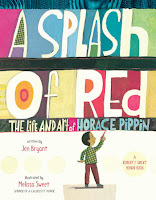
A few weeks ago, I was hunting for art-related picture books, when I came upon A Splash of Red: The Life And Art of Horace Pippin by Jen Bryant with illustrations by Melissa Sweet. It's a lovely picture book biography.

Horace Pippin was an untrained African American folk artist who became successful in his own lifetime. He was born twenty years after the Civil War, but his work became popular in the 1930s, during a period when folk art was of particular interest. According to a write-up at the National Gallery of Art website, among his subjects was African American genre scenes, meaning scenes of everyday African American life.

Both in terms of what he accomplished with his work and what he painted, Horace Pippin seems like a fine subject for Black History Month. A Splash of Red, which gathered a lot of well-deserved attention when it was published in 2013, is a good introduction to him. 

Wednesday, February 03, 2021

How Does A Zombie Story Fit In With Black History Month?

Deathless Divide, the sequel to Dread Nation by Justina Ireland, is a work of alternative history dealing with the rise of the undead after the American Civil War. That's right. It's a zombie story. Why would I consider that an appropriate book to discuss in relation to Black History Month? Because in an Author's Note, Justina Ireland writes that she feels the one goal she is sure she accomplished with this book is putting "Black people back into history."

Ireland loves the western genre but says she felt that while Black people "lived throughout the West, they are rarely the heroes of any popular narratives." Given the author's goal, and the sense that Deathless Divide appears to have been as meticulously researched as a traditional historical novel, and the fact that, as with Dread Nation, Deathless Divide is about race and gender more than it's about zombies, I think it's a good title to bring to readers' attention this month.

The family member who recommended these books to me felt that the sequel wasn't as good as the original. I think Deathless Divide is as good as Dread Nation, but it is different structurally, which some fans of the first book may find disappointing. 

Dread Nation was told from the point of view of Jane McKeene, an outsider antihero type who is engaging the way outsider antiheroes often are. Deathless Divide is told from alternating points of view, moving between Jane and Katherine Deveraux, another excellent character from the first book. Like Jane, Katherine is a powerful young woman, but she manages her power behind a facade of traditional womanhood, while Jane is right out there. For me, alternating points of view often slow down narrative drive, and that may be an issue in the second book for some readers.

People who have read the first book are also probably going to want Jane and Katherine to get back together, which  takes a while. This is more of a journey book, with both Jane and Katherine on separate journeys to arrive at the same place.

I think you could argue that the author took an admirable risk structuring the second book so differently. I think it worked. I definitely felt I was reading a different book, while sequels and, particularly series, are often so similar to the original and each other that it's hard to pinpoint what happened in which book.

Not the case here. I think these will be memorable books. 


Friday, February 07, 2020

Black History Month: 50 Years Of The Coretta Scott King Award

My more rabid followers may recall that last month I took a year's worth of Horn Books with me on retreat, because I had fallen a year behind in my reading. As a result, I've only recently read The Horn Book's special issue from last year on the 50th anniversary of the Coretta Scott King Award.

The Coretta Scott King Award is given each year "to outstanding African American authors and illustrators of books for children and young adults that demonstrate an appreciation of African American culture and universal human values." I think the focus on "appreciation of African American culture and universal human values" gives this award a much different spin than the Newbery Medal, which is "awarded annually to the author of the most distinguished contribution to American literature for children published by an American publisher in the United States in English during the preceding year." Because...what's that?

Which brings us to The Horn Book tribute issue. It covers a number of different aspects of the Coretta Scott King Award.

Rudine Sims Bishop's Let Our Rejoicing Rise: Celebrating Fifty Years of the Coretta Scott King Book Awards is an excellent overview on the subject and gets right to the point in its first sentence. "The Coretta Scott King Book Awards originated as a response to the failure of the children’s literature establishment to acknowledge the talents and contributions of African American writers and illustrators."  A publisher at the 1969 ALA conference overheard two librarians discussing that in the 47 years the Newbery Medal and the 31 years the Caldecott Medal had existed, neither had been awarded to an African American writer or illustrator. The publisher suggested the librarians establish an award that would do just that, so they did.

Editor Roger Sutton's interview with George and Bernette Ford, the winner of the first Coretta Scott King illustrator award and the first African American vice president of a children's publishing, respectively, has a "they-were-there-on-the-barricades" vibe that I always enjoy. George Ford says that pre-CSK, " Publishers did not even think Black people did any reading, so the notion of winning prizes was not on the radar."

In A Vision for the CSK: Past, Present, and Future, Kekla Magoon writes about the types of books that are recognized with the Coretta Scott King Award--a variety of books about young black life and not just stories with obvious racial themes. Nor do the judges limit the award to books that just support a traditional, "approved" narrative about civil-rights history.

"After the initial shock and ebullience of my first award call wore off, I was able to reflect on how remarkable it was for the Coretta Scott King Jury to so open-mindedly embrace a text that expands readers’ understanding of the civil rights era. And how important a statement it was for the jury to emphasize that my voice — as a debut author trying to expand young readers’ understanding of Black history — mattered to the powers-that-be of children’s literature."

Magoon also reminded me that two hits from my reading past are Coretta Scott King books. Mare's War by Tanita Davis is an Honor Book (2010) and Bad News for Outlaws: The Remarkable Life of Bass Reeves, Deputy U.S. Marshall by Vaunda Micheaux Nelson won the award the same year. 

This Horn Book issue is also peppered with marvelous brief personal essays by authors and illustrators who have been CSK winners.

Looking for a copy of this Coretta Scott King Award Horn Book tribute issue would be well worth your time.