Showing posts with label Cybils nominees. Show all posts

Wednesday, October 18, 2017

Your Cybils Reading Lists

Public nominations for the Cybils Awards are closed. Check out the nominees for reading suggestions from this year's books.

It appears that I've read only four books, Freya and Gemina from the YA Speculative Fiction list, The Lost Girl of Astor Street in YA Fiction, and The Nian Monster in Fiction Picture Books/Board Books.

I liked them all, though for some reason I didn't post a response to Lost Girl here or at Goodreads. Little lack of focus there, folks.

Thursday, March 16, 2017

A Post-Apocalyptic Dystopia I Can Actually Enjoy

Here it is, people. My last post on this year's Cybils YA Speculative Fiction finalists. This is definitely a last, but not least, situation. This Savage Song by Victoria Schwab was the first of the finalists I read. It was a good introduction.

One of the things I liked about this fantasy/scifi (what is apocalyptic fiction, anyway?) is that instead of front loading the story with  world building, it begins with a scene that could appear in a nonfantasy book. The scene involved a girl burning down a church at a boarding school, so, sure, it wouldn't appear in just any nonfantasy book. But my point is, the book begins with a realistic (and intriguing) opening that helps pull readers like myself, who don't love fantasy for the sake of fantasy, into the story.

The publisher compares this book to the work of Holly Black, Maggie Stiefvater, and Laini Taylor. But This Savage Song reminded me much more of Jonathan Maberry's Rot and Ruin. Both are post-apocalyptic novels that don't rely on cliched totalitarian political mumbo jumbo. Instead, whatever caused society to fall involves the rising of...creatures...beings. In the case of Rot and Ruin, we're talking zombies. With This Savage Song, we're talking monsters that are "born" from the violent acts that caused human deaths. In these books, the human characters are trying to maintain a normal life with a town in the middle of a zombie frontier or a high school in the middle of a protected city. It's not their political leaders holding them down. It's a real, physical threat from outside. Not that there aren't some human issues. There's the question in both these books of just who is the real monster here?

This Savage Song, like Illuminae, the Cybils winner in this category, has a neat little gender twist. Kate is much more of an anti-hero than August is. He is more of a family person. I've seen a number of YA books over the years with a male protagonist who has father issues. In This Savage Song, it's Kate who has them. Both Kate and August are filling roles traditionally played by members of the opposite sex.

Okay, that's it. My 2017 Cybils experience is over.


Sunday, March 12, 2017

Family Drama With Magical Realism

I'm down to writing about my last two Cybils YA speculative fiction finalists.

Today, lads and lasses, we will discuss Still Life With Tornado by A.S. King.
This was a particularly intriguing work because it wasn't overtly speculative. It was more of a family drama that had some magical realism here and there.

Sixteen-year-old Sarah is struggling. She's not going to school. She's wandering around the city. What's going on? How much does this have to do with an art project that was destroyed? How much with her brother who is estranged from the family? How much with a family vacation in her past?

What about those sightings she keeps having of herself from her past and future? What's that about?

What Little I Know About Magical Realism


The First Thing I Know About Magical Realism, Though I Don't Know If It's True. While reading this very well-written book, I kept thinking of a conversation I had with a bookseller years ago while I was making an appearance in her store. The poor woman didn't make a sale the entire time I was there. I don't mean that she didn't sell one of my books while I was there. She didn't sell any books while I was there. (There's no bookstore in that town anymore, so I guess she didn't do better on other days.) The two of us spent the afternoon sitting in rocking chairs in the middle of all the books that weren't selling, shooting the breeze. Good times, good times.

The one thing I remember us talking about was magical realism. She said that if some sort of bizarre event in a book is due to a character suffering trauma, than it's not magical realism. A delusion that occurs because someone is under mental duress has an explanation. Magical realism cannot be explained. That's why it's magical.

The bookseller who told me this had once been a therapist, which in my mind gave her opinions a lot of validity. No, I don't know why.

For a long time while reading Still Life With Tornado, I kept wondering if what Sara was seeing--her former self, at first--was explainable because of trauma, duress. Maybe I was reading a family drama, not speculative fiction. But eventually others see the various Saras, which meant that this wasn't going on in Sara's mind, something magical was going on.

The Second Thing I Know About Magical Realism, Though I Don't Know How True It Is. In magical realism, the magical events are simply accepted by the characters. Like the roses growing out of the main character's wrist in When the Moon Was Ours.

Eventually that's what happens in Still Life With Tornado.

Still Life With Tornado, in my humble opinion, should have a lot of attraction for adult readers as well as YA. In part that's due to the family drama. There are also a number of chapters from the mother's point of view. Adult point of view in a YA novel isn't something I see a lot of, so it does add something different to this particular piece of work.


Saturday, March 04, 2017

Traditional Fantasy

The Keeper of the Mist by Rachel Neumeier is the fifth of the seven finalists
for the Cybils YA Speculative Fiction Award. This was my idea of serious, traditonal fantasy--imaginary country with a ruling family that's got some magical thing going. At least one member does. The book actually starts out with a Cinderella situation, though Cinderella becomes the prince figure, so to speak, she doesn't marry him. A very neat twist.

While reading this, I felt a bit of a feminist vibe. Main character Keri and her friend are the dominant people here. They are in control. They engage males not so much for help, but to flesh out their plans.

Sunday, February 19, 2017

Some Speculative Fiction For Black History Month

The Door at the Crossroads by Zetta Elliott was one of the Cybils YA Speculative Fiction finalists this year. Though it's technically science fiction/fantasy (not sure where time travel comes down), it's a good read to consider for Black History Month because it's time travel. Its teenage African American and Jamaican main characters are transported back to the American Civil War. Genna ends up in Weeksville, a free black community in Brooklyn. (I'd never heard of Weeksville, but it sounds pretty impressive.) Poor Judah, however, ends up in a nightmarish situation, enslaved in the south.

Genna moves about in time a bit, getting back to 2001-era Brooklyn. But it's the historical work in Door at the Crossroads that's really impressive. Judah's story in the south is gripping, and the material on Weeksville left me wanting to know more. The book is a sequel, and readers might want to read the first book, A Wish After Midnight, before starting on Crossroads. The second book ends with a cliffhanger, suggesting another book is planned.

Author Zetta Elliott was interviewed earlier this month at Cynsations about one of her most recent books, The Ghosts in the Castle, and being a hybrid author, meaning she's book traditionally and self-published. Also check out her lengthy list of essays, many of which are available on-line.

Friday, October 07, 2016

Get Your Cybils Nominations In

Bloggers, you have 9 more days to nominate a 2016 children's or YA book for the Cybils Award. I almost missed the nomination period this year, because they opened October 1 while I was in Pennsylvania. I managed to get 2 nominations in this year, one for Kill the Boy Band and another for Thanks for the Trouble.

Thursday, February 18, 2016

Cybils Middle Grade Finalist: "Listen, Slowly"

Listen, Slowly by Thanhha Lai is a traditional story about an American girl stuck spending part of her summer vacation away from friends and boys and all that is good. It's also a fish-out-of-water story about an American girl stuck spending part of her summer vacation with her Vietnamese family in Vietnam. It's also whatever we call books that fit into the category "diverse books." And it does all those things well.

Mai's parents came to the U.S. from Vietnam when they were young. They are both professionals, so Mai has a comfortable, middle class or better life. Her father arrived in this country with his siblings and his mother after his father disappeared during the Vietnam Conflict. His mother, who never learned to speak English, lives with them. She is, if I recall, pushing eighty, if not older, not in great shape, and she's managed to hire a detective back in the old country to find out what happened to her husband decades ago. She just needs to get back to Vietnam to meet with him.

Mai's father, the doctor, goes back to Vietnam regularly to provide medical assistance in rural areas. But once he's there, he needs to tend to patients off in some remote spot. He can't hang out in the village with Mom and all his relatives. So he and his wife come up with a plan by which he would get twelve-year-old Mai and granny to the family in Vietnam, where  Mai would watch over her grandmother and get to know the folks.

Mai is what I call a "bridge character" like Christopher in The Blackthorn Key. Because she is familiar to us, she acts as a bridge between us and what is, to us, the more unusual world of Vietnam, the way Christopher acts as a bridge between us and what is, to us, the unusual world of England in the sixteen hundreds. Mai feels about the strangeness of the culture there much as we would.

The author does a great job with the Vietnamese world. While the village where Mai's family lives is different from what we're used to--not everyone has showers or Internet access, and what's there isn't state of the art--it's not portrayed as being impoverished, either. There's a young relative with braces on her teeth, after all. And I loved the love triangle in the village, similar to the one Mai kind of thinks she's part of back home. The young guy who has been going to school in Texas, speaks with a Texas accent, and acts as translator for Mai? What a hoot. And a touching character, too.

That translator I just mentioned brings up the issue of language, which Meg Medina discusses in a recent Horn Book article.  She is speaking of Spanish, but she says, "Language is such a dilemma in multicultural families and in the books that represent us. The fact is, some of us speak Spanish, and some of us don't--sometimes all under the same roof." That is definitely the case here. Mai understands some Vietnamese because she's lived with Vietnamese speaking people, though she made the choice to stop speaking herself because it marked her as different when she was in kindergarten. (Shades of Blackbird Fly!) It turns out, her closest contact among her new Vietnamese family members (the girl with braces), can understand some English. The language issue for families with American branches is very real. I think the title, Listen, Slowly, relates to a couple of the characters trying to understand one another.

I believe all the things I said about Listen, Slowly in the first paragraph here are true. But the book does all those things in a very organic way. There's never a feeling that this is a fish-out-of-water or girl-torn-from-her-social-group story with a "diverse" character tacked on. Nothing in this book could happen without Mai being who she is.

A word about grandma and her story--In the best of all possible worlds, Thanhha Lai would have written two books, Listen, Slowly and another about grandma and her experience as a young woman in Vietnam, coming to America and raising those kids, seeking out information about her husband, and then going to Vietnam with her granddaughter to find it. They would have both been published at the same time. And that would have been incredible.


Monday, February 15, 2016

Cybils Middle Grade Finalist: "Blackbird Fly"

I'm covering the Cybils' Middle Grade finalists in alphabetical order, so today you'll hear about Blackbird Fly by Erin Entrada Kelly.

Main character Apple and her mother have moved to Louisiana from the Philippines. Apple is growing up American while at the same time living with Filipino culture at home. The Filipino culture part results in her becoming the target of boy bullies at her school, who use a particularly unpleasant method to attack girls, many of whom are not members of different cultures. They're selected for other reasons.

Initially this book seemed to me to be a bully book. But I think it could also be described as a between cultures story. Though the bullying stuff is going to be what gets most readers' attention. 

Apple wins over the student population with a suddenly discovered, but also long foreshadowed, talent, something I found a little bit of a stretch. I think it could be argued that it's more of a YA story than middle grade, too, both in terms of the characters' ages and the situations they're in. But whatever the age, this is a book that will probably be embraced by any reader who has suffered at school and hoped for a way to overcome it all. Fast.

Check out author Erin Entrada Kelly's extensive list of short fiction publications. At some point, I do hope to hit some of those.

Friday, January 01, 2016

What Does New Year's Day Mean In The Kidlitosphere?

Why, it means the announcement of the Cybils finalists, of course.

Here we are particularly interested in the Middle Grade Fiction Finalists. This year, I am a judge for this round in this category. You will be hearing more from me on the subject next month.

Wednesday, December 31, 2014

The End Of My Cybil Season Reading

I finished the last book I'd taken from the Cybils lists last night, and not a moment too soon. The finalists for the Cybils Award will be announced tomorrow.

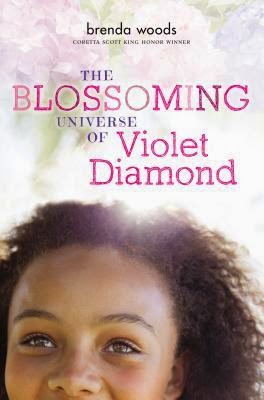
I love the premise for The Blossoming Universe of Violet Diamond by Brenda Woods. Violet Diamond is an eleven-year-old biracial child whose black father died before she was born. She has never met his family because his mother originally objected to her son marrying a white woman and later, we learn, was so devastated by her only child's sudden death in an accident that she couldn't deal with the family he created with his wife. Once she'd recovered, staying away from them had become a habit.

I find that believable, by the way.

Violet's loving maternal family is extremely white,  and she lives in a very white, upper-middle class world. Her mother is a neonatologist, and her late father was a medical doctor as well. Her white grandmother runs some kind of on-line business and her white grandfather is enjoying retirement, cooking and playing golf. Violet wants for nothing, materially or emotionally. Except that half her identity is missing. Just not there.

She is aware that her black grandmother is a well-known artist, and when she finds out that grandmother will be in a neighboring city for an exhibit, she gets her mother to take her to the opening. Violet and grandmother meet, and Violet ends up being exposed to the half of her family history she's never known.

As I said, I love the concept and love the artist grandmother. I felt as if the story of Violet's exposure to her family took a while to get started, though.

For another take on biracial children meeting an unknown grandparent, check out Brendan Buckley's Universe and Everything In It (Hmm, similar title.) by Sundee Frazier.

The Blossoming Universe of Violet Diamond is a Cybils nominee in the middle grade fiction category.

After a couple of months of Cybilizing, I feel more up-to-date on recent children's lit than I have in quite some time.

Monday, December 29, 2014

I Stumbled Upon A Couple Of Charmers

I think these are the only two picture books I read off the Cybils list. (I've read myself into a mild coma, so I can't be sure.) They are both particularly engaging.

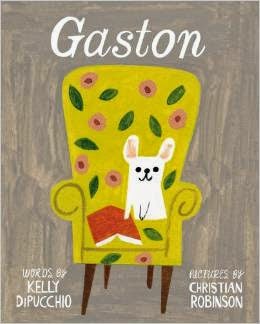
I read Gaston by Kelly DiPucchio with illustrations by Christian Robinson first and was delighted. Gaston does not exactly fit with his teapot poodle siblings, Fi-Fi, Foo-Foo, and Ooh-La-La. Does his mother care?  Not a bit.

One day this family is out at the park where they meet another family of dogs with a member, Antoinette, who doesn't fit in with her siblings, Rocky, Ricky, and Bruno. Quelle horreur! Has a terrible mistake been made?

Gaston is all about feeling right as well as looking right. It's amusing and quick and kind of deep. I did wonder if some kids reading this will learn about the possibility of being switched at birth and be a little shaken. But, hey, literature is dangerous.

Flora and the Penguin by Molly Idle is one of those books in which the pictures tell the tale. There are no words. I can't recall when I've seen a book in which facial expressions and body language--even on the part of the penguin--did such a terrific job of conveying emotion and action.

Gaston and Flora and the Penguin are both Cybils nominees in the fiction picture book category.


Sunday, December 28, 2014

Characters. It's All About The Characters.

A clever, spunky girl who keeps a journal and is dealing with a parent's tragic illness. Doesn't that sound like a stereotypical children's book, the kind adult gatekeeper's just love?

That was my first impression of The Meaning of Maggie by Megan Jean Sovern. In fact, I considered giving up on this one early on. Before long, I was very glad I didn't.

Twelve-year-old Maggie Mayfield is brilliant, knows it, and loves everything that goes along with being smart. She is given a journal in which she begins writing a memoir while sitting in a hospital room with her obviously critically ill father. This is all in the prologue. You can see why I wasn't immediately entranced.

But Maggie has a truly marvelous voice. She reminded me very much of Flavia de Luce, a child character of about the same age in an adult mystery series, not just in her intelligence and enjoyment of same, but in her relationship with her two hot, older sisters. There is antagonism there, but the older sisters also keep an eye out for Maggie, which she may not always recognize. Maggie also sets out at one point to cure her father of multiple sclerosis, just as Flavia sets out to do something miraculous and impossible for a parent in one of her books.

Maggie's memoir deals with the year between her eleventh and twelfth birthdays, the year when her father's illness took a turn for the worse, something her family couldn't protect her from, try as they would. Hmm. My college knowledge of memoir is that it's a recollection of an event the significance of which is not clear until after it happens. That pretty much fits the situation here.

One thing I found odd with this book was it's 1980s setting. Why? I kept wondering. So that dad could be the aging hippy he is here? So that the author can talk about decades old music? So that Maggie wouldn't have the Internet available to her, because the Internet would have made it a lot harder to keep knowledge of her father's illness from her? No, in an author's note at the end of the book we find out that The Meaning of Maggie is autobiographical. I can't believe I've never read an autobiographical children's book before. If so, was it this good?

The Meaning of Maggie is a Cybils nominee in the middle grade fiction category.

Saturday, December 27, 2014

How Will We Live Our Afterlives?

Here's the basic set-up for The Devil's Intern by Donna Hosie: Hell and "Up There" are just places people go to after they die. While there are definitely evil folk in Hell who suffer horribly, some people, like our teenage protagonist Mitchell, seem to end up there for random reasons. For them, Hell is pretty much a really boring, overcrowded place. They hold jobs and can change. Mitchell's good friend, a Viking prince who died in battle at sixteen, has learned to read in Hell.

Mitchell is an intern in the accounting department and through his boss is able to get his hands on a device that will allow him to time travel. His plan is to go back in time with his three best (dead) friends to relive and change their deaths. Mitchell, in particular, wants to get to live the life he missed out on because he was hit by a bus.

There's much that's entertaining and intriguing in this book. There's plenty of narrative drive once the group finally gets on the road. But I had a hard time with the "paradox" business that Mitchell kept talking about. If these dead kids changed their deaths, what does that do to their afterlives where they were best friends and even two couples? The things that happen at each of their deaths that only happen because of something else that happened and could that be changed? Well, I was watching an episode of Dr. Who this afternoon that I couldn't follow, either. The where-are-we-in-time thing is difficult for me.

While I was reading The Devil's Intern, I wondered if it was really YA or was it an adult book with teen characters? One of the big factors in determining YA is supposed to be theme. YA themes often involve young people working out how they're going to live their lives. At first, I thought the characters in The Devil's Intern were coming to terms with how they had lived their lives, which would be adult. However, you could argue that they are working out how they're going to live their afterlives, bringing us around to YA territory again.

Hellbent by Anthony McGowan is another YA book set in Hell. Interesting how totally different they are.

The Devil's Intern is a Cybils nominee in the Young Adult Speculative Fiction category.

Monday, December 15, 2014

Going Out On A High

I have liked some of M.T. Anderson's Thrilling Tales/Pals in Peril books better than others. (I know I'm nitpicking on this, but the name of the series changed for some reason.) I had to be won over by the first book, Whales on Stilts, but the second one, The Clue of of the Linoleum Lederhosen, was a hit. The third one I read (there are supposed to be six; I seem to have missed a couple), Jasper Dash and the Flame-Pits of Delaware wasn't a favorite. But the final book in the series, He Laughed with His Other Mouths, is an absolute gem.

The basic premise for all these books: A Tom Swift-type character named Jaspar Dash and a spunky girl (younger and spunkier than the 1930's era Nancy Drew) existed in their own book worlds that reflected the eras that created them, the 1920s/30s and the 1980s/90s. And yet, at the same time, they are existing in our own twenty-first century where Jaspar, in particular, is both having adventures but out of place.

In He Laughed with His Other Mouths, Jaspar is now that classic/stereotypical character, the young male in search of his father. Jaspar will go to the ends of the universe in search of dear old dad. He will accept some pretty outlandish behavior from his father figure. However, Jaspar is a young hero, and he recognizes evil when he sees it. Maybe he doesn't recognize it right away and maybe he needs a little push from his spunky girl companions, but he does recognize and behave as a hero should.

All of the books that I've read in this series operate on more than one level. You have the basic contemporary adventure. You have characters from an older book world trying to function in a contemporary one. You have the knowledge that children who are now old, if not dead, read the older books back when they were new and shiny.

With He Laughed with His Other Mouths, Anderson does something quite marvelous with footnotes. Using footnotes for witty asides has become a cliche since Terry Pratchett perfected doing that back in the day. But Anderson uses his clever footnotes not to be witty but to tell another story entirely, this one about a kid during World War II who was a Jaspar Dash fan. This is a complete story, a piece of serious historical fiction embedded in a fantasy satire/comedy.

As with all these books that I've read, I wonder how much of this wonderful stuff child readers will understand. Assuming they enjoy the layer with the contemporary adventure, will they get the jokes that are part of it? Will they get the nostalgic elements?

Kid readers aside, for those of us who do get He Laughed with His Other Mouths, it's pretty damn brilliant.

He Laughed with His Other Mouths is a Cybils nominee in the Elementary/Middle Grade Speculative Fiction category.


Monday, December 08, 2014

Wouldn't This Make A Neat Little Sitcom?

When I picked up The Misadventures of the Family Fletcher by Dana Alison Levy from the library, I told the librarian that I'd heard the book was like The Penderwicks but with boys and two gay dads. She said, "Ah, bringing the story into the present." I think that is the case. I liked The Penderwicks very much and found it contemporary, probably compared to/contrasted with Little Women, which it is a spin on. But I also thought "This book, simply by being a throw-back to Little Women and, perhaps, other pre-nineteen-fifties stories, is different." It had a retro thing going for it, it was "a story about sisters who worry about the family's honor and don't even mention a TV."

The Fletcher boys may be viewed as a little innocent and other-worldly not because they're retro in any way but because their stories and lives are very rooted in traditional child issues. This in spite of the fact that they are not genetically related, they are not even all the same ethnic background, and they are all the children of two men who are living and raising a family together. Each boy has his own storyline with his own issue:
  • Boy One is a popular athlete who is considering trying something different 
  • Boy Two is dealing with growing apart from a friend and moving on, as well as trying to interview the crotchety old guy next door for a school project
  • Boy Three is highly intelligent and has begged Dad and Papa to let him go to a school for the gifted
  • Boy Four has the "stereotypical" imaginary friend. Or does he?
You know the one problem none of these kids have? Those gay dads. The men are just there, doing any kind of dad stuff. There's nothing didactic or instructive here about accepting families with nontraditional parents. These guys have had children in the school system for a number of years now. People know they're there. Halloween parties are held. Ice rinks are made. Holidays are celebrated. Life goes on.

This is not to say that no one ever raises an eyebrow over the gay family. When they are attending an open house at a new school, oldest brother Sam feels compelled to address questions. "We were all adopted as babies. Our dads have been together for ages. They got married two years ago"..."Do you have any other questions? Want to know our birthdays? Height and weight?"

That was a neat way to handle back story, by the way. The newspaper article written by an eighth grade student about the Fletchers and their annual Halloween party is also a clever way to get the back story on how the Fletcher kids became brothers.

As I was reading this book, I thought this premise would make a charming sitcom. The various chapters here could be the first season's episodes. Then the story could expand with episodes about the gay dads dealing with their boys going to camp, getting babysitting jobs, heading to high school, getting jobs, dating girls. 

The Misadventures of the Family Fletcher is a Cybils nominee in the Middle Grade Fiction Category.

Wednesday, December 03, 2014

And Now For Something Totally Different

I just finished three fantasy books in a row, mainly because I needed to get them back to the library in a certain order. You'd think fantasy would be different, wouldn't you? As in, it's not real world stuff, so it should be different. But when you read so much of it, there's a certain sameness. And then real world YA is often very similar in its own real world way.

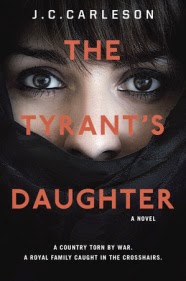
Which is why The Tyrant's Daughter by J. C. Carleson is so exciting. It's real world, but very different YA real world.

Laila is a princess, daughter of the murdered king of an unnamed, presumably Middle Eastern country. Except after she has resettled with her mother and brother in a seriously modest two-bedroom apartment outside Washington, DC she realizes that no, she's not a princess at all. Mainly because her father was never a king. He was a third-generation strongman tyrant and when he wasn't being Dad at the palace, he was behaving in a typical tyrannical way.

Laila has a terrific voice, slightly reserved and stiff as she describes, for instance, her appreciation of her new American friend's kindness even though she can't help noticing that she dresses like a prostitute. She's a kind person, herself, recognizing that a classmate is suffering because her parents are divorcing and becoming attracted to that nice guy who works for the school paper. But  those traditional YA experiences pale compared to those of a fifteen-year-old whose father was gunned down in his home on her uncle's command, who saw her mother covered in her father's blood, whose life was saved by a CIA operative. The Tyrant's Daughter isn't about the world of teens. It's about a teen in the world.

What's missing from this novel is cliched nasty teenagers. There are no mean girls. There are no bullies. There are no jocks trying to force themselves on girls. Adults might find the CIA operative familiar, as well as the brilliant, manipulative widowed tyrant wife. But I don't think they appear often in YA.

So that's just the basic set-up to this thing. As the truth about Laila's family is slowly revealed to her, the fact that this book is a political thriller is slowly revealed to readers. Why is that CIA op hanging around? What's he paying Laila's mother (but not very much) to do? With whom? Why is her mother talking to Laila's uncle, the tyrant who had her tyrant father killed?

And what will Laila's involvement in all this be? She is a tyrant's daughter, after all.

This is a marvelous book, extremely well written. But it's undercut a bit by the essay on women in the Middle East that follows. Even though the essayist ties it to The Tyrant's Daughter by questioning what will become of Laila after the end of the action of the novel, I think most readers are going to wonder why it's there and feel that this great reading experience is being turned into some kind of lesson.

The Tyrant's Daughter is a Cybils nominee in the YA Fiction category.


Wednesday, November 19, 2014

Come On. No One Else Gets A "Jane Eyre" Vibe Here?

When I was a teenager, I was a big fan of historical romance. In college, I would read Georgette Heyer during exam weeks to relax. As an adolescent, I really liked that "I hate you, I hate you, I hate you, Well, maybe you're not so bad" storyline in a historical setting. So I picked Cruel Beauty by Rosamund Hodge off the Cybils Young Adult Speculative Fiction nomination list for one reason and one reason only: The main character has been raised to marry and murder a demon who has had control of her country since before she was born but falls for him before she can complete her task. Okay, it was paranormal and not historical, but I was dealing with a speculative fiction list, after all.

Now, though I seem to read a lot of fantasy, it's mainly because a lot of children's and YA books are fantasy. It's not because I'm so fond of it. I don't get excited about fantasy elements, as a general rule.  I'm not crazy about houses that are always changing, for instance, as the one in Cruel Beauty does. I was kind of mystified about who the Kindly Ones were in this book, especially since there seems to be an alternative Greek mythology thing going on here and where do the Kindly Ones fit in? But that didn't matter because the demon was very witty and clever and our protagonist wasn't a particularly nice person, which I like in a heroine.

Yes, Teen Gail would have loved this thing. Cruel Beauty should be on a list of teen vacation reading that is totally inappropriate for school papers. 

But If You Want To Write A School Paper On It, Try Talking About Jane Eyre


However, if someone really wants to sell this as a subject for a high school paper, I think they might be able to do a Jane Eyre comparison. Cruel Beauty is being marketed as a Beauty and the Beast meets Greek mythology tale, but I kept thinking of Jane Eyre.

Jane Eyre was not assigned reading for me when I was a teenager. I read it on my own, as I read a great many things back then. I did not find it particularly memorable, except for the scene where poor Jane sits on the sidelines during an evening event at Mr. Rochester's house. That probably speaks volumes about my adolescence. I didn't become a fan of Jane's until I re-read it in 2003 after reading The Eyre Affair. The Good Reading Fairy had hit it, and I've become a bit of a Jane Eyre groupy, looking for and reading retellings. Cruel Beauty may not be an intentional retelling, but I still think an enterprising student could make a case that would convince a teacher to at least accept a Beauty/Jane Eyre paper.

Jane Eyre is about a prickly young woman who doesn't inspire affection in traditional relationships, such as the one with her aunt. In the course of acquiring what is by the standards of her time a good education, she is not treated very well. She enters a wealthy (wealth is power) man's home as a governess. Said wealthy man is unhappy and bitter over the life he has been forced to live. These two damaged, unromantic people find something in each other.

Cruel Beauty is about a bitter, angry young woman, her father's least favorite child, the one he bartered away to a demon. He provides her with what is by the standards of her world a good education so she can kill the demon he's marrying her off to. The plan will mean her death as well, explaining her bitterness and anger. She enters a powerful male's home as his wife. Said powerful male is amusing and attractive but resigned to a fate he brought upon himself, one we're not aware of for a while. These two damaged, I can't say unromantic because I'm sure we're supposed to think they are, people recognize something in each other.

In Jane Eyre, there's a madwoman in the attic. In Cruel Beauty, there's a little something in one of the house's many rooms.   

Jane and Mr. Rochester's story in Jane Eyre is framed with a beginning piece about Jane's rough youth with her family and boarding school and an ending bit about her suffering after she leaves Rochester. Nyx and Ignifex's story in Cruel Beauty is framed with a beginning piece about Nyx's rough youth with her family and an ending bit about her suffering after she and Ignifex are separated. Some have argued that Mr. Rochester's blindness is a punishment for what he planned for himself and Jane, a punishment that was alleviated when Jane returned to him. A clever high school student could argue that Ignifex was punished for all he had done, a punishment that was alleviated when Nyx returned to him.
 
There you've got it, folks, the beginning of a Cruel Beauty/Jane Eyre English paper.

Wait! There's more! It's kind of a stretch, but if enterprising students wanted to, they could claim there's a bit of a torn-between-two-lovers thing going on in Jane Eyre what with Jane being proposed to by both Mr. Rochester and that creepy minister named St. John. The author of Cruel Beauty does something interesting with the torn-between-two-lovers cliche.

Okay, lads and lasses. You're welcome to this material, but put it into your own words.

Wednesday, November 12, 2014

You Don't Have To Love Mockingbird To Like This Book

I Kill the Mockingbird by Paul Acampora is about a group of teenagers who set out to increase To Kill a Mockingbird's popularity by making it appear to be disappearing and thus unavailable. Everyone wants what they can't have, right? Part of their plan is to take their project viral. Some readers might think that they were unrealistically successful with that. All the characters, teen and adult, are amusing and clever, though some readers might find that they sound a lot alike.

Yes, yes, "some readers" is me.

Okay, let's talk about the intriguing things in I Kill the Mockingbird:

  • This book really is about literate teens. These kids aren't just spokespeople spouting the party line on classics. They can actually discuss a book. They know why not everyone loves To Kill a Mockingbird, for instance. No, no, I am not one of the dislikers. But, nonetheless, I understand why not everyone embraces it and appreciate that mindset being expressed.
  • This book is about religious observance. I do not mean it is about dogma or doctrine. It is about kids who go to religious services and religious school. There are hundreds of thousands of young people who attend the services related to whatever faith their families follow. I don't see a lot of that reflected in children's books.
  • This book does have some of the "this-is-an-important-book-about-death" thing going on. Though it's more an-important-book-about-not-dying-and-having-to-get-over-it thing. And, yes, that's different.
  • I liked the father's reason for thanking God--it's always good to be polite. And the mother's argument that we are only able to enjoy living because we're able to pretend we're not going to die. And the discussion of "Ordinary Time," a season in the Christian church calendar? The main character gives a meaningful explanation of its significance. Though I was a Catholic child, I didn't learn about the church calendar until I was a Sunday school teacher in a Congregational church. I thought Ordinary Time was just that period of the year when nothing else was happening.
I liked I Kill the Mockingbird for all the odd little things I found in it. It's getting all kinds of loving  from people who probably liked it for other reasons.

I Kill the Mockingbird is a Cybils nominee in the middle grade category.


Saturday, November 08, 2014

Facts Here, Facts There, Facts Everywhere

I was very taken with Peter Sis's book The Wall back in 2008, so when I heard he'd written and illustrated another book, this one about Antoine St. Exupery, for whom I'm a groupy, I was enthusiastic. I've never really understood The Little Prince, and I don't really get Sis's The Pilot and the Little Prince, either. It's beautiful (and very well reviewed), but I'm embarrassed to say that I find the layering of information difficult to manage. There's narrative, sometimes there's little facts in circles in a straight line above the narrative, and sometimes there are facts sprinkled above that. An older child who is into nonfiction and just plain loves facts might eagerly suck this stuff up. This older reader is stuck in her ways and needs a more linear reading experience.

 A New York Times reviewer said, " Sis suggests in his new title that the Pilot of “The Little Prince” is Saint-Exupéry and the Little Prince his child self." I totally missed that. I'm not saying it's not there, just that I didn't get it.

However, I did pick up on the fact that Guerlain named the perfume Vol de Nuit for one of St. Exupery's books. That's the kind of thing a St. Exupery groupy wants to know.

The Pilot and the Little Prince is a Cybils nominee in the picture book category.