Showing posts with label 2014. Show all posts

Monday, July 10, 2023

Getting Serious About Humor: Using A Format While Writing Humor

I'd heard of Texts From Jane Eyre by Mallory Ortberg (Daniel M. Lavery) some time ago and was delighted to stumble upon it earlier this summer. Texts From Jane Eyre is not a memoir. It is not fiction. It is humorous interactions between known literary characters, who are not necessarily humorous in their original incarnations. 

Oh, and these interactions are also all written as texts.

How funny you find these texts will probably be determined by how familiar you are with the original books that inspired them. The Cormac McCarthy and Atlas Shrugged texts were pretty much lost on me. However, I'm not that knowledgeable about Wuthering Heights and thought those texts were hysterical. I don't even like Harry Potter and those texts were not just good but addressed some issues I have with those books. 

I think this book would be a hit in high school and college libraries where there are plenty of people reading books with the characters texting here. Also, a good gift for English majors.

My Hermit Crab Argument

I am going to argue that Texts From Jane Eyre is written using a hermit crab format. By which I mean the author borrows a form from a particular type of writing the way hermit crabs borrow shells. I will say more about this someday in the future, either here or somewhere else.

If Jane Austen Got Feedback From Some Guy In A Writing Workshop  by Shannon Reed is another humor piece I believe uses a hermit crab form.

Friday, October 15, 2021

One Thing Leads To Another

Last month I took a humor writing workshop through the Thurber House in Columbus, Ohio. Now, I could go on at great length here about the significance of this. My first humor writing workshop. Mr. Carswell telling me in 10th grade that something I'd written was Thurberesque. Visiting Thurber House in 2014. Liking the idea of Thurber more than liking his work. Yes, I could go on about all that, but...

Oh, wait. I just did.

Okay, what I really am interested in talking about now is the reading list provided by my workshop instructor, Janine Annett. It was two pages. I was so excited when I got it. Love me a reading list.

It included four humorous novels, one of them being Dear Committee Members by Julie Schumacher. It's written in letters, and at first I thought it was going to be one of those novels in letters back and forth between a couple of characters, which I really don't care for. But, no, these were all letters of recommendation from one college professor who is slowly (not too slowly) revealed to us. There is a story arc for him and at least one of his students. And it's all very entertaining.

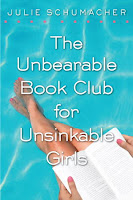
But that's not why we're here, folks! We're here because when I looked up Julie Schumacher, I discovered that she wrote a book called The Unbearable Book Club for Unsinkable Girls. A YA book I liked a lot back in 2012. Really, I thought it was a "marvelous, mainstream novel..." Evidently I'd had it with paranormal YA at that point. 

I believe I've often been disappointed when I've read the work of an author who has written for both adult and YA audiences. But that most definitely wasn't the case here. I'm going to read some of Schumacher's other work, because I often worry that someone will ask me the name of a favorite author. And, of course, I don't have one. But Schumacher could end up qualifying.

Now, to tightly tie my Schumacher reading experience back to the workshop I took--Dear Committee Member was on Janine Annett's, the workshop leader's, reading list. Additionally, it won the Thurber Prize for American Humor in 2015. She was the first woman to win the award.

Thurberesque.

Saturday, December 26, 2020

A Love Story About Family

I missed The Swap by Megan Shull when it published six years ago, even though it was a big enough noise to inspire a Disney Channel movie. It's an entertaining read and about something a little different.

Ellie and Jack, both middle school athletes with single parents, barely know each other, though Ellie certainly knows about Jack who is quite highly regarded. They end up swapping bodies and having to spend the weekend with each other's friends and families and dealing with each other's problems. The book switches from one point of view to the other, which I'm not usually of, but it works well here. Yes, humorous situations all over the place. 

Some things I particularly like about this book:

  • First and foremost, though there's lots of talk of preteen romance in this story, Ellie and Jack's love interests are familial. It's the other character's family that is their love object. 
  • This isn't a "walk-a-mile-in-my-shoes-and-learn-something" story. Instead, Ellie and Jack each find something in the other person's life that they need. In fact, they're each able to do something for the other while they're stuck in the wrong bodies. 
  • I loved Jack's siblings, though I found their sports culture somewhat over the top. However, I've never done team sports and know nothing about that world, so I'm willing to accept them.
  • I also liked that Jack, his hockey-playing brothers, and his team mates are all portrayed in positive ways. There are no stereotypical evil kid athletes here.
  • While I also found the mean girl over the top, I liked that so many of the other kids, while not willing to try to take her down, certainly knew what she was. It reminded me of something a neighbor girl told me about the popular kids at our local high school. "The popular kids are people nobody really likes."

So this was a good find, a good end-of-the-year read.

Monday, December 21, 2020

A Middle Grade Book About Something Different


The Fourteenth Goldfish by Jennifer L. Holm is about a girl whose grandfather, lodged in a teenage boy's body because the old guy thought making himself young again was a good idea, leads her to an interest in science. At least, that was the big attraction for me. Yes, main character, Ellie, is also growing apart from her best friend, a classic middle grade situation. But I got really excited when the science aspect came in.

A particularly entertaining part of the book involves the fact that gramps has turned back time for his body, but not his mind. He's still, in reality, an older scientist, who has now been thrown into a teenager's world.

I thought Ellie's epiphany toward the end was a little abrupt, but, nonetheless, this is a neat book, both entertaining and with some different content. 


And a sequel came out earlier this year.        

Thursday, September 19, 2019

YA Thrillers

I am just beginning a new project, a YA mystery or thriller that I'm working on in order to have new material to bring to my writers' group. As part of getting myself pumped up for this, I've been reading the occasional YA mystery or thriller.

How I Would Love An Island Retreat


The Kindle edition of We Were Liars by E. Lockhart turned up on sale this past spring. It's main character, Cadence, belongs to a stinking rich extended family that has a multi-house compound on an island. Before the book starts, something happens to Caddie. She just doesn't know what.

As I began reading this atmospheric novel, I thought, I want a multi-house compound somewhere--an island, anywhere--for my family. Later, I began to think, Hey, why don't any of these kids have summer jobs? Sure, they're stinking rich, but you'd think they'd want jobs as a way to strike out on their own. Then I thought, Wait a minute. Why don't any of their mothers have jobs? Sure, they're stinking rich and all, but you'd think they'd want jobs just for something to do.

Turns out, these were significant questions.

And that's all I can say about this book, because not knowing much is a big part of what makes it enjoyable. It's enjoyable enough that I picked up another Lockhart book, Genuine Fraud.

Ah, What's Going On Here?


Turns out, I'd read Genuine Fraud before. It didn't hurt my enjoyment of this book. This was one of those deals where I remembered each event in the story as I got to it, but couldn't recall what was coming up.

I don't really feel I can say much about this book, because, as with We Were Liars, not knowing what's going on is a huge part of what's good about it. How bad is the bad guy here? How good is the good guy? I can say that a very intriguing aspect of this book is that it's essentially written backwards.

And What Did You Learn From This Reading Experience, Gail?


Theme. I read once that that is an important part of what makes YA YA, and I think it's the case here. With We Were Liars the YA theme involves place in and connection to family. With Genuine Fraud the YA theme is who am I? Who am I going to be?

Oh, also. It's good...maybe even great...to have a big reveal at the end of the story. The story, in fact, is about the reveal.

Friday, March 08, 2019

A Fine YA Thriller

You'll be happy to hear that reading Fake ID by Lamar Giles met one of my objectives for Goal 3. "Read YA thrillers." Good objective, right?

Fake ID deals with a teenage boy in witness protection with his family. They're on their third change of identity, because Dad is trouble and can't keep with the program. Nick...Steven...Tony...finds that his family has been dumped in a town that's nothing but trouble.

It's The YA Characters, Stupid


Fake ID isn't just a good thriller. It's good YA. I've read YA thrillers before that were essentially  adult books with fast cars and dangerous women. The main character is said to be YA, but doesn't act YA or appear to be YA. S/he isn't in YA situations. These are simply adult books that have been retrofitted for YA.

This book isn't like that. Nick is very much part of a YA world...dealing with high school, new people, bullies, a new girl, a possible murder. Well, the possible murder isn't typical of a YA world, of course, but the victim is a YA.  Nick has father issues, which is common with YA novels. In fact, there are two guys with father issues here. On top of that, you could say that this book deals with identity, a classic YA theme, since what is witness protection about but identity?

Fake ID involves a few of those classic mystery elements, red herrings. There are a number of false leads, sending readers after different possible culprits. But it's not giving anything away to say that even on this score this book is about the YA characters, stupid. The fundamental most basic rule of YA, as far as I'm concerned.

Thrillers And Diversity


In addition to being a good read for anyone, Fake ID is an opportunity for young readers of color to see a main character of color in a thriller written by an author of color. 

At about the same time I was reading Fake ID, I read Changing the Face of Crime Fiction: 6 Writers of Color on Writing Mysteries, Crime Novels and Thrillers in Writer's Digest. The article is a round table discussion that begins with the question "Is it really true that the crime/mystery/thriller genre is overwhelmingly white...?" The writers involved in the discussion believe the answer is yes. One of them, Gar Anthony Haywood,  says, "I think support for writers of color starts with promoting crime fiction to young readers of color at an early age. Minority readers of crime fiction tend to discover us almost by accident, after years of reading white authors exclusively, and this is a missed opportunity."

Young white readers are exposed to plenty of mysteries, crime novels, and thrillers with white protagonists and therefore expect to find more of the same for their adult reading. Fake ID gives young nonwhite readers a chance for the same experience.

Monday, April 24, 2017

There Are Fevers And Then There Are Fevers

Okay, I've written here a number of times about the Megan Abbott book I started reading on the plane on my way from Seattle a couple of weeks ago. As it turns out, The Fever is an adult book with a child or YA main character (YA in this case), which is a particular interest of mine. I sometimes write about these  types of books here. In fact, I wrote about an earlier Abbott book, Dare Me.

The Fever is what I'd call a literary thriller. Maybe a mystery, but not a traditional one with a detective-type character of some sort. The mysterious carryings on are carrying on and the characters are enduring them with no one figure working to bring order to this world. By mysterious carryings on, I mean that the girls at a high school are becoming ill with something unexplained and disturbing. Their parents are terrified, as they should be. What is happening to their babies? What is snatching them away (metaphorically speaking), and how can they put a stop to this and get their darlings back?

Interesting Point One: Fever's main character seems to be teenage Deenie, but we often get point-of-view switches to her brother and father, meaning we're talking two generations of narrator. One reviewer described The Fever's story as being told by a family, which I think is a great way of describing what's happening here. They're not just three narrators. We see that kind of thing all the time. They're three narrators tightly bound to one another, without, say, the sexual tension we often see between dual narrators in YA.

And speaking of sex, that brings me to

Interesting Point Two: Sex is used in an interesting way here. (Not that sex isn't always interesting.) Teenage characters are becoming sexually active in this story. I'm reading along thinking, Ah, this is taking me away from who's going to get sick next and what's going to happen to them. Bring me more sick girls. Then I thought,  I guess the author is trying to create a realistic teen angsty world, and teenagers have sex. And angst about it. (Well, who doesn't?) Then I got to the end and realized that sex has absolutely everything to do with this story. It is essential to the plot. Readers just don't get that until the end. Which was a neat little epiphany.

Often in books, particularly YA books, I'll see romance/sex that appears to be there because, Oh, we need some of this. The Fever shows readers sex that truly supports the story it's in.


Friday, September 09, 2016

The Benefits Of A Binge Read

I'm always saying how much I wish I'd read a series in a binge, after several books had been published, instead slowly as they were published. Well, I stumbled upon the Zita the Spacegirl series by Ben Hatke at a local library and thought, Gail, here is your chance.

This was a great experience. Because when I read the first book, Zita the Spacegirl, I thought, That was okay. But as I read the others, Legends of Zita the Spacegirl and The Return of Zita the Spacegirl, I got more and more into this world and this girl's adventures. Seriously, I would have read another book.

These are well done graphic novels in that I don't think there is any narrative text at all. The entire story is told with dialogue and image. Readers have that marvelous experience of sucking in a story fast. I have to say that I sometimes found too much going on in some of the panels, but it didn't slow me down.

There are two things about Zita, herself, that are particularly terrific. One, she always comes up with a solution. And, two, though she is definitely a girl, she transcends gender. This is no pink and green princess story. This is a girl fighting her way across space. Any child can read this.

If you can get them all, read them one after another.

Thursday, August 25, 2016

Do Child Readers Need To Understand Cool Cats To Enjoy Pete the Cat?

I read a couple more Pete the Cat books. Though I found them a little more instructive than I did the first one ("being different is really very cool" in Pete the Cat and the New Guy), I was struck by something about them. Pete the Cat, he's cool.

He's a cool cat in a beatnik cool way. Will the preschool through early
grade schoolers who will probably read these books get the beatnik references? I don't see how they can. If they don't get the cool cat beatnik joke, why do they like these books?

Because anyone can see that Pete the Cat isn't a regular cat. Even by the standards of picture book cats, there's something about this one that makes him unusual. In the world of today's children, cool isn't being different. It's meeting some standard of attractiveness. It's usually about adhering to a group in some way.

But Pete is a totally different kind of cool. He's the kind of cool that's too cool to care. He shouldn't exist in the world. That makes for incongruity.

And incongruity, my friends, is funny. That's why kids don't need to get the beatnik joke.


Monday, May 09, 2016

"Lockwood & Co." A Good Binge Read

Well, it wasn't a total binge read because we're having trouble with Interlibrary Loan here, which may be the subject of another blog post one day. So I knocked off the first two books in this series, and then had to cool my heels for a bit before I could get the third.

Jonathan Stroud wrote the Bartimaeus series, which I liked a great deal, particularly Book Three, Ptolemy's Gate. His new series, Lockwood & Co., is totally different and yet similar because, once again, we are in a very intense and detailed alternative England. Though there isn't a character as amazing as Bartimaeus in these books, they're still very good.

 The Lockwood World


In the Bartimaeus universe, a demon world is controlled by human magicians, at least to the extent that they are able to drag various kinds of demons into the human world to do their bidding. These magicians are in positions of power in government.

In the Lockwood universe, a ghost world is totally uncontrolled. The dead turn up not to do the bidding of the living but to torment and even destroy them. Instead of powerful magicians we have children with powers.

Children are able to see the spirits. Depending on their powers/gifts, children may be able to hear spirits, see them, "feel" a presence. Children and teenagers are tasked with protecting adults from the spirit scourge. That is, until the children age out and become adults who need protecting, themselves.

This is a universe in which we have cars, telephones, and doughnuts, but no computers or cellphones.

The Lockwood Characters


Anthony Lockwood, the teenage head of Lockwood & Co., a small, "select" group of ghost fighters, is charismatic, brilliant, and heroic. Note the English cover of The Hollow Boy to your right. Note that Lockwood appears on all the English covers.

He is not, however, the main character in this series. That would be Lucy, one of his agents. She is extremely gifted, spook-wise, and just a little bit sympathetic to the plight of at least some of the dead who are hanging around where they're not wanted. We readers can see that she is a little bit attracted to Lockwood, too.

The third member of this Scooby Gang is particularly interesting because he's the stereotypical tech nerd for the group. Except, remember, I said there is virtually no tech here. Still, he performs the tech nerd function, because he is always running off to archives to do research on their cases.

Oh, wait. There's another character. A Bartimaeus-like character. He's pretty minor, and I'm not sure what's going to happen with him down the line.

The Lockwood Structure


Each book has it's own story-line/adventure with a violent climax that often has an "all-is-lost" moment. At the same time, each book has a modest cliff-hanger, or at least a lead-in to the next volume, making them part of an overall story encompassing all the books. And, like I said, something's going on with that Bartimaeus-like thing that isn't limited to one book.

And What About The Lockwood Darkness?


These are really dark books. Death is a daily threat for everyone, and there doesn't appear to be any hope of a Heaven waiting for those who don't make it to tomorrow. There's no talk of school for children. They go to work young and at horrible, dangerous jobs. If they don't die first, they'll grow up and lose their ability to see and deal with ghosts. What will become of them then?

A lot of YA fantasy is dark. The Bartimaeus books certainly are. So is Skullduggery PleasantThe Daughter of Smoke & Bones series is pretty grim, particularly for a romance. And, now that I think of it, I believe all those books have a violent climax, too, with some characters at risk or even lost altogether.

Well, conventional wisdom claims that young (and not so young) readers can safely explore disturbing or even frightening subjects in fantasy because none of this stuff can really happen. The dead don't come back. There are no demons controlled by high-ranking politicians. (Yeah. I know. There's a joke there.) Skeletons don't wear fedoras and drive fancy cars.

Not only can readers explore disturbing stuff in fantasy because it doesn't happen, it's okay to enjoy it. If these things could really happen, it would be so wrong.

Another Lockwood & Co book comes out this fall. If you wait for that, you'll have four books to binge on.

That would be fun. Maybe you could do it in October, for Halloween.


Wednesday, March 30, 2016

A Hot, And Evil, Librarian

I bought Evil Librarian by Michelle Knudsen through one of those Kindle deals, and it sat on my e-reader for a while. I love weeding through my Kindle holdings and finding treasures like this one.

There's a lot about Evil Librarian that deals with teenage crushes. This is normally a subject that I couldn't tolerate for more than a few paragraphs. Who am I kidding? I couldn't tolerate it for more than a few sentences. But it works here.

Mr. Gabriel, the new, incredibly hot librarian at Cynthia Rothchild's high school, is a demon from a place very much like hell, though not. He's at the high school to steal juiciness from the young, use people mojo as part of a plot to take over demonville, and hook himself a human, teenage bride. Being young and hot and a demon, Mr. Gabriel is able to overcome all around him, particularly the students. Except for Cyn who is the rare human who is not susceptible to demons.

Cyn's best friend, though, is very susceptible. She goes for this guy hook, line, and sinker. Cyn, on the other hand, is lusting after Ryan, the lead in the high school production of Sweeney Todd, the Demon Barber of Fleet Street, for which she is set designer. Sweeney Todd is a favorite with demons, it turns out. (I've seen a regional production. Don't remember a lot of hummable tunes.)

So you've got your demon fighting thing going on at the same time your teenage "does he love me, because I love him!" thing is happening. What makes this work is that while the fight against evil is happening, teen life goes on. The love angle isn't so much love, as it is uncontrollable drive. It cannot be stopped.

Some little quibbles with logic: The body count keeps going up and no one notices? I can see the demon being able to control what's perceived within the school, but what about those outside the school? Surely they would be aware that someone didn't come home from work. Also, parents are conveniently uninterested and unavailable here. They would have been all over opening night of that play.

But, hey, this is a witty and clever book about demons. You have to let some things go.

It sounds as if a sequel is planned, though I haven't seen anything about it on-line. 

Thursday, February 04, 2016

Environmental Book Club

Well, I have done it. I've found a YA novel with an environmental setting and secondary story line that is not climate fiction or post-apocalyptic or dystopian.

What Kissing Frogs by Alisha Sevigny is, is a YA romance. That is a genre I do not embrace. But main character Jessica is sharper than the romance main characters I've encountered in the past. Seriously. She is smart. She's maintained an A-average across the board while using her brain power to make herself a member of a popular-girl group and snatch one of those shallow, good-looking guys who are never up to any good.

She blows her biology grade, though, which is how she ends up in Panama with a science club from her school that is volunteering to work with an endangered frog species. Her biology teacher is their faculty adviser and offers her the opportunity to take the trip and write a paper to save her average and her chances of getting into UCLA. Some may find that a bit of a stretch, but I find a lot of things that happen in romances a bit of a stretch.

Kissing Frogs is a fish-out-of-water story. Jessica is the outsider with this group, though she's smart enough to be one of them. With this crowd, she becomes the victim of science mean girls, mean girls who had been victims of members of Jessica's posse back at school. That's a neat little twist. There is a bit of a torn-between-two-lovers thing going on, something I always dislike. In this case, though, one of our potential lovers is clearly a player, and Jessica knows it...because, remember, she's smart. She's also no damsel in distress.

The environmental story-line involves the Panamanian golden frog. The Final Wave of the Panamanian Golden Frog at The Guardian suggests Sevigny did a fine job with her factual material. She also does one of the best jobs of integrating environmental information into a main story that I can recall seeing. I won't say there was never a moment when I felt the characters were being just a little over informative. But there was also never a moment when I felt a character was saying the equivalent of "Let's save a species!" either.

Environmental material is going to get out to a lot more people when it can be packaged in main stream books like Kissing Frogs and not just be isolated in disaster stories.

Another interesting thing about Kissing Frogs--it's published by Swoon Romance, which is a "digital-first" imprint. Kissing Frogs exists in an eBook edition only. That might limit its audience, which would be too bad. I don't know how popular eBooks are with teen readers.

On the other hand, if you have a Kindle, Kissing Frogs is only 99 cents.

Thursday, January 21, 2016

Environmental Book Club

Anyone else notice I tend to cover a lot of picture books in this feature? I think what's happening is that most of the YA environmental books I've come upon are dystopian, a genre I'm not fond of. Middle grade environmental books  often fall into a save-an-endangered-species-from-an-evil-company category. Yeah, I've read enough of those.

Picture books cover a little more ground--biography, seasonal talk, and gardening, for instance. I appreciate the variety.

Today's books both deal with fall. Fall lasted forever in New England this year. It only ended after Christmas.

Winter Is Coming deals with a child observing a forest and the creatures in it late in autumn, when "winter is coming." The writing by Tony Johnston  is elegant, but maybe a little too much so in places. I don't know what the line "A lynx with Egypt eyes" describes. The same with "My mother says wild things are full of lights." But overall the text works well with the illustrations by Jim LaMarche, which feature the animals the child narrator is watching.

Fall Leaves by Loretta Holland is far more technical, covering things like the Earth's rotation around the sun and how trees make their own food. I particularly liked the page describing why smoke from chimneys stays low on snowy days. Did not know that. At the same time that readers are getting all these facts, they are also seeing word play with "fall" and "leaves."  Elly MacKay's artwork focuses on children and uses autumn colors.

Same subject but handled differently in written and visual style.

Thursday, January 07, 2016

David The Statue's Story

I was certain I wrote this post weeks ago. I'm sure I didn't lose it. Someone must have taken it. Yeah. That's what happened.

Okay, I became interested in Stone Giant: Michelangelo's David And How He Came To Be by Jane Sutcliffe when I heard the author speak about it at the Connecticut Children's Book Fair. (I know this isn't the first time I wrote that sentence.) She described how she saw the Biblical David's story in the face of  David, the statue.

But Stone Giant is the story of David, the statue, not Biblical David. There are several great elements here. The historical context. The great illustrations by John Shelley. And the basic narrative about a big stone waiting for someone to find David in it.

I like children's books about art. But Stone Giant is about something more specific. It's a book about a specific piece of art. It's also an example of a nonfiction author finding and writing about a little known historical event. 

Jane, and I say Jane because (FTC transparency moment) she's in my writers' group,  has a new book coming out in March, Will's Words: How William Shakespeare Changed The Way You Talk. She'll be signing copies this very weekend at the ALA Midwinter Conference in Boston.

Monday, November 30, 2015

Nana In Her Environment

I considered writing about Nana in the City by Lauren Castillo as part of the Environmental Book Club feature, because Nana lives in a specific environment. But "the city" is not what you'd call a natural environment, at least in the way we think of natural environment. I think it could be argued that cities grow up or evolve in some natural way over time. But not too many people are going to accept that the concrete, metal girders, and glass of the city are natural. So I'll discuss the charming Nana in the City here.

Okay, so this kid's nana lives in the city. The child clearly doesn't, because he finds everything about the city scary. If you know any anxious or high strung preschoolers (or maybe preschoolers, period), this rings very, very true. The book does a very quick, simple job of turning the child narrator's attitude around. The very things about the city that he is uncomfortable about, his nana likes. She's able to make them sound desirable.

Lauren Castillo, who is both author and illustrator, does a great job of using image to carry part of the story. No doubt the committee that awarded her a Caldecott Honor thought so, too.

Monday, August 03, 2015

Terrific Historical Nonfiction

Even though I have a big interest in history, I sometimes find reading it a bit of a chore. Or, at least, not the kind of thing that I want to rush back to. The White House Is Burning: August 24, 1814 by Jane Sutcliffe is not at all a chore to read, and I found myself looking forward to getting back to it.

The book's publisher refers to The White House Is Burning as the "biography of a single day." That is how the book is structured. Sutcliffe takes readers through the day the city of Washington fell to the British during the War of 1812. She does that by using first person accounts. Fortunately a number of people who experienced the burning of the President's house felt moved to write down their thoughts. Note that the Introduction and the last chapter both begin with a reference to how the fall of Washington would be covered in the modern press. Nice frame.

The White House Is Burning is a great read, but it's also lovely to look at. It's illustrated with beautiful period artwork and portraits of historical figures referred to in the narrative. Though this is what might be described as an over-sized book, don't mistake it for a picture book. This is 105 pages of full text accompanied by 7 pages of quotation credits and a 3 page bibliography. And there is an index. I mention all this because I've heard that some teachers in the upper elementary school grades have page requirements for books acceptable for projects. This book ought to meet them.

I don't know how big a place The War of 1812 has in school curriculum. This book, though, is so marvelous a piece of work that it ought to be valuable in teaching how to read history and how history can be written.

Disclosure: I've run into Jane Sutcliffe here and there over the years, and a few months ago, she joined my writers' group. I ordered this book through Interlibrary Loan. I'd hoped to include it in my "Friends' Books" 48-Hour Book Challenge, but it didn't arrive in time.

Wednesday, July 08, 2015

I Bow To You, Bunjitsu Bunny

My reading of Tales of Bunjitsu Bunny is an example of marketing working. Author John Himmelman made a couple of appearances in Connecticut, which ended up on the Connecticut Children's Literature Calendar. I think I saw The Horn Book review, as well. So when I happened upon the book at the library, I snatched it up.


And I loved it.

Isabel trains in Bunjitsu. She is well trained. Each chapter is like a little zenny tale relating to how she integrates Bunjitsu into her life. I wonder if the chapters aren't actual adaptations of some kind of zenny stories. Well, not the takeoff on the tortoise and the hare. Unless, of course, the tortoise and the hare has some zennyness in its background, and I never knew.
 
Isabel's spin on martial arts reflects my experience of it. "Bunjitsu is not just about kicking, hitting, and throwing...It is about finding ways NOT to kick, hit, and throw," she says. This master who used to come to my taekwondo school spoke to us a couple of times about how his proudest moment was when he and some of his master buddies talked some street toughs in, I believe, Scotland out of attacking them. He wouldn't say how they did that, which would have been helpful, but you see my point. I am not at all surprised to see that Himmelman teaches a martial art, hapkido, which I know little about. Of course, I've been doing tai chi for two years now, and let me tell you, that's a mystery.

Someone in my family is going to get a copy of Bunjitsu Bunny when he's a little older. Oh, and look! There's going to be another Bunjitsu Bunny book out this fall.

Thursday, June 18, 2015

What Would Emily And Charlotte Do?

 Always Emily,  an intriguing, quirky book by Michaela MacColl, deals with the Bronte kids before Emily and Charlotte wrote Wuthering Heights and Jane Eyre. The book is structured as a mystery that teenage Emily and Charlotte solve. But they're also very committed writers, and we see how they take experience and work it into their teenage projects.

This Jane Eyre fan was more interested in the puzzle/mind game aspect of the book then the mystery. I kept hunting for Jane references. Girls dying at boarding school would be one. The "mad woman" hidden away would be another. Was Robert Heaton an Edward Rochester stand-in? Fire figures in both Always Emily and Jane Eyre. Charlotte is portrayed in Always Emily as a strong, somewhat moral character, similar to Jane in Jane Eyre.

I was frustrated reading this book because I have so little knowledge of Wuthering Heights, Emily's book. Emily is portrayed as wilder than Charlotte here. Is she like Catherine in WH? Is the young man she knew as a child and finds on the moor a Heathcliff figure? What about the dog!? What about the cemetery?

Emily and Charlotte are intense about their writing here, and we see them taking what they know and using it in the writing projects they're working on in Always Emily. That behavior makes it clear, I think, that what they are experiencing in the world of Always Emily will eventually make its way into Wuthering Heights and Jane Eyre.

MacColl has a new book, The Revelation of Louisa May, dealing with a young Louisa May Alcott. I think I know more about Alcott and her work than I do about the Brontes and theirs, so I'm looking forward to reading Louisa May at some point.


Wednesday, April 15, 2015

And Now For Something Entirely Different

In order to take a break from all this environmental thinking we've been doing, let's talk picture books.

I'd heard of The Farmer and the Clown by Marla Frazee, and it's a book that does live up to its hype. The story of the farmer who sees a little clown fall from a circus train and takes him in is told totally in pictures. It's one of the easiest to follow wordless books I've ever seen.


I "read" this is as a sad story about the farmer. But when I finished, I looked at the front flap and found a much more upbeat interpretation, one I think that works. One that's much more from the clown's point of view.

So two stories going on here, all without a word.


I snatched up Ivan: The Remarkable True Story of the Shopping Mall Gorilla by Katherine Applegate with illustrations by G. Brian Karas because I'd already read  Applegate's The One and Only Ivan. My interest was in seeing an author use the same material in different ways. The picture book really is quite good. I almost thought I might like it better than the novel, but than I remembered Ivan's voice in The One and Only Ivan.

Both novel and picture book are very well done.                        


Wednesday, March 11, 2015

Some Young Ones Are Going To Like This

Books for kids on the lower end of elementary school have improved over the years. Sasquatch and Aliens: Alien Encounter, a chapter book by Charise Mericle Harper has real wit and a legitimate story line. (Well, except for the underwear business at the beginning, which, though fun, sort of peters out.) Two boys, who are not exactly made for each other, stumble upon an alien in the woods. And later a sasquatch. And there's a logical explanation. One that is just a little bit disturbing.

Cartoons are liberally sprinkled throughout Sasquatch and Aliens. They do more than illustrate. They carry some of the story, replacing traditional text in the narrative. That ought to make this book attractive to readers who may not be that fond of reading.