Showing posts with label Environmental Book Club. Show all posts

Friday, November 18, 2022

Environmental Book Club

I've been interested in minimalism for a number of years now. My understanding of minimalism is that, as Joshua Fields Millburn and Ryan Nicodemus say at the The Minimalists , it "is a tool that can assist you in finding freedom."  I would say freedom to do things, because it is a tool that helps me to find time. Time that I'm not spending taking care of things, looking for things, shopping for things.

So you can see why I had a reason to snatch up Living Simply: A Teen Guide to Minimalism by Sally McGraw when I saw it on display at my favorite library. However, it seems to have little to do with the minimalism I've studied. It's much more about leading an environmentally sensitive lifestyle, which is certainly a worthy and legitimate subject. But I think that referring to this as minimalism is confusing.

In its advertising copy for the book, the publisher says, "Twenty-first-century minimalism is an increasingly mainstream response to global environmental crises such as climate change, the garbage glut, fast fashion, and other manifestations of the harmful impact of consumerism." I just don't know that that's the case. Minimalism is about individuals finding ways to do what they value with their lives. Consuming fewer things should, indeed, be a more environmentally sustainable way of life. But it's a side effect of minimalism. It's not the point.

Living Simply includes what might be described as sidebar types of material that includes suggestions for how to do specific environmentally sensitive activities such as shopping for secondhand clothes or interviews. Early in the book a fourteen-year-old minimalist is interviewed. He has very little to say about the environment. What he does say, though, is "It's really rewarding to just not have a lot of stuff. When you've got a whole bunch of useless stuff that you don't ever use, and it occupies the same space as you do, you almost feel like a prisoner." He's only been a practicing minimalist for a year, but he seems to have a good grasp of what it is and what it is doing for him.

While this book has a lot to say about how to live sustainably, I don't think it has a lot to say about minimalism. Losing the minimalism hook altogether and making this a teen guide to sustainable living would have been much clearer about the good things Living Simply has to offer.


Thursday, October 06, 2022

Environmental Book Club

What I usually see in middle grade environmental books are stories about kids fighting a big bad company that's doing nasty environmental things to endanger something like an animal or a wetland. Very formulaic and predictable. With The First Rule of Climate Club by Carrie Firestone we're talking more of an us-against-the-world thing. Some may find it a bit pedantic, but it's far more sophisticated than other books of this type that I've read.

First off, I feel I should point out that while the book's publisher is marketing it as middle grade, the library I borrowed it from classified it as "Teen." The kids are 8th graders and have access to more social media than I would expect from true middle graders and more freedom to get around. None of this means middle grade students shouldn't read it or like it, just that the more mature characters help explain their access to more mature situations. By mature I don't mean engaging in sex, but understanding racism and that they have the ability to become involved with environmentalism in realistic ways.

Mary Kate is a student in a pilot science class involving climate science in a town near Hartford, Connecticut. She has students from Hartford attending school with her. Living in this area, I can tell you that this is realistic. The kids seem gung-ho for environmentalism, but this makes sense, because they had to apply to attend the class. Only kids who can prove they have an interest and reason to be there are there. 

The kids have various interests, meaning environmentalism is covered in a more whole life type of way then in the "let's save the little wild rodent from the big bad oil company" kind of books. Food waste, composting, fast fashion, electric vehicles are among the topics pulled into the story. One of the things I particularly like about this book is that many of the things covered, such as composting and fast fashion, middle grade and above students could make part of their lives now.

Another topic Firestone covers--the connection between climate/environmentalism and race. Embarrassed to say that I was not aware of that. And my trash was going to the Hartford incinerator she writes about. (Interesting sidenote--before the incinerator came to Hartford, there was an enormous landfill there, known as Mt. Trashmore. It was right along a major highway north of the city. Landfills are not supposed to smell, but this one most definitely did.)

Another important aspect Firestone touches on--the potential for knowledge of climate change to cause anxiety in children. This isn't a book that just takes the attitude that children can and will fix everything for us.

The chapters in this story are very short and often in different formats--sometimes a traditional narrative, sometimes a podcast, sometimes a letter. I do like to move along when I'm reading.

This really is a book that should be valuable for a number of reasons. I hope it makes the short-list for the Connecticut Book Award next year, being both by a Connecticut author and set in Connecticut.


Thursday, April 07, 2022

Environmental Book Club

Copy provided by NetGalley

Publication Date: May 3, 2022

A World Full of Nature Stories 50 Folktales and Legends  by Angela McAllister with illustrations by Hannah Bess Ross is a lovely collection of folktales and legends from around the world that, as the title says, feature nature. They are often creation stories relating to some natural feature or event. Arguably they are not nature stories so much as they are stories trying to explain nature from the standpoint of people who had no understanding of natural science. 

What makes them attractive for American readers, in particular, is that many of them are unfamiliar to us. They are new and novel. At the same time, though, it appears that foolish kings and jealous, nasty siblings are common all over the world, as are the rewards of good character.

As a child, I was a fan of a couple of books of short pieces to be read over a long period of time. For that reason, I can see A World Full of Nature Stories getting a lot of use in a home library. Elementary and middle school librarians in schools with units on folk tales and legends or foreign countries should really consider this, too. 

I read an e-arc but what I saw suggests that, in addition to its fine content, this is a beautiful looking book.

Thursday, September 30, 2021

Environmental Book Club

Copy provided by NetGalley

Publication Oct. 12, 2021?

According to NetGalley, Busy Spring, Nature Wakes Up by Sean Taylor and Alex Morss with illustrations by Cinyee Chiu publishes the week after next. However, looking around on-line, including at the publisher's website, it appears to have come out this past March. That makes a great deal more sense, a spring book publishing in the spring, not in the fall.

Whenever it became available, Busy Spring is an excellent selection for our Environmental Book Club. It's a beautifully illustrated story about a boy and girl who go out to work in the garden with their father, just because it is spring. They ramble about, doing a number of things in the yard, while Dad explains various things in a nonscientific way. "The spring sunlight is nature's alarm clock. Life's waking up. Plants are racing to get more light." A better than adequate explanation for young readers of what's happening in springtime.

The illustrations and layout of this book reminded me of The Ox-cart Man by Donald Hall with Caldecott Medal winning illustrations by Barbara Cooney.  Both books also deal with nature, by way of the changing seasons. Ox-cart Man is about what the ox-cart man does over the course of the year, while Busy Spring is about what a family does in spring time.

Busy Spring has several pages of back matter, including a lengthier poetic explanation of spring and then a section on what is going on with plants and animals at that time. But, really, the main text about the family working together is enough. 

Taylor, Morss, and Chiu have an earlier book, Winter Sleep, A Hibernation Story.

Thursday, July 01, 2021

Environmental Book Club

I wish I could recall why I requested Outside In by Deborah Underwood from my library's e-book service. Was it on one of my 2020 monthly book release posts? Deborah Underwood and I follow each other on Twitter, so I may have heard about the book there. Or, since it appears the book has picked up a number of awards, it may have crossed my psyche in other ways. For instance, it's a Caldecott Honor Book for illustrator Cindy Derby's moody artwork, which really melds with the moody text. Since I read library e-books on my iPad and not on my ancient Kindle, I was able to enjoy said artwork.

Putting aside the mystery of how I found this book, reading it was a true experience. I was not terribly impressed with the first line. "Once we were part of Outside and Outside was part of us." Then came the next two. "There was nothing between us. Now sometimes even when we're outside...we're inside." With a perfect illustration.

It was at this point that I felt the top of my head come off, so to speak. If you are knowledgeable about Emily Dickinson, which I'm not, or have been watching the TV show Dickinson, which I have, you may be familiar with Dickinson's definition of poetry. If she is reading a book, she said, and "If I feel physically as if the top of my head were taken off, I know that is poetry."

I don't want to claim this book is poetry. I don't know enough about poetry to do that. I've seen nothing to indicate Underwood considers herself a poet, and her attitude is the all important one. But last year I developed a modest interest in prose poetry, and that's how I read this book--as a prose poem expressing a specific thought in an intense way.

Maybe that was because I had that top-of-my-head-off feeling while reading it.

Why Is This An Environmental Book Club Post, Gail?

Well, Outside In, is, I think, a description of how we live with the outdoors even when we don't know that we're doing it. I wrote off the first line as just the beginning of another cliched nature tale, about how humans have lost nature. But "Once were were part of Outside and Outside was part of us" isn't a lead in to that kind of story at all. Because what I think Underwood is saying here is that Outside has come in with us. That's how we live now with the Outside In with us.

Back on Earth Day, I wrote (twice) "In environmental children's literature, the environment is something that's not part of our general day-to-day life." This led, I believed, to A. Children needing to learn a lot of facts about the environment so a lot of children's environmental books are nonfiction; and B. Children needing to fight evil corporations in environmental fiction, needing to do something about some Other that's causing problems.

But Outside In most definitely is about day-to-day life and how we live with the outdoors now. It doesn't require readers to do anything. They don't have to learn anything. They don't have to become outraged about a bad guy. They are just led to see.

Who Would Like This Book, Gail?

The publisher describes this book as being for ages 4 through 7 and grades Pre-K through 3. I tried reading it to a nearly 4-year-old whose tastes run to Mike Mulligan and His Steam Shovel and Pete Oswald's Hike. In spite of the multitude of mini-hikes he did during the pandemic, Outside In was lost on him. Keeping in mind that one is not a statistically significant number, perhaps this book would be better for the readers on the older end of this age range.

Or how about:

  • Using this book as a classroom read aloud?
  • Using this book as part of a classroom unit on nature?
  • Using this book as part of classroom unit to encourage writing about nature?
  • Using this book as part of a nature writing workshop for adults?
  • Giving this book as a gift to an adult outdoorsperson?

Yeah, I'm kind of enthusiastic about this one.


Thursday, April 29, 2021

Environmental Book Club

I recently read Boys, Bears, and a Serious Pair of Hiking Boots by Abby McDonald. While I was a lot more interested in the serious pair of hiking boots than I was in the boys, it is an example of the kind of environmental book I'm interested in finding in YA and childlit. 

American Green Teen Jenna heads off to Canada for the summer. This is a classic story start, one in which there is a disturbance to the main character's world. Why, I've used it myself. More than once. While off to our neighbor in the north, Jenna finds herself dealing with a lot of very traditional YA issues: summer boyfriends, growing away from a long-term friend, dealing with unpleasant people, mom and dad in meltdown. Arguably there is enough here for a couple of books.

But then there is her environmentalism.

An Environmental Theme

I have trouble finding environmental themes in books. What many consider themes, I consider subjects. Environmentalism is a subject, not a theme, for instance. Single words usually are just subjects, in my opinion. So 'environmentalism is necessary' is closer to a theme, though as far as writing is concerned, it doesn't have a lot of built-in narrative drive.

Last month I attended a writing workshop in which we were told to ask ourselves "what is the central dramatic question of your story?' And that, friends, gets a lot closer to theme, as far as I'm concerned. What dramatic or life question is your story trying to answer?

In Boys, Bears, and a Serious Pair of Hiking Boots, I think the theme/question McDonald is trying to answer is "how do we live an environmentally responsible life?"

How DO We Live An Environmentally Responsible Life?

Jenna is very hot for environmentalism when her story starts. But everything in life has consequences of one sort or another and just as not living environmentally has consequences, so does living environmentally. Those consequences are not all clean air and water. There are sometimes impacts on people's livelihoods, and Jenna has to confront them here. 

The book also includes a character who evolves into a cliched, strident environmentalist, probably meant as a cautionary tale. But her path is another possibility to consider when toying with how to live a life that is as environmentally sound as possible.

I can't say that all the elements of this book come together smoothly here. Loading Jenna up with so many YA issues distracts from her coming to terms with what kind of person/environmentalist she's going to try to be. But I very much appreciate that she's coming to terms with that at all.

Thursday, April 22, 2021

Environmental Book Club

Am I actually doing an Environmental Book Club post on Earth Day? Well, it's a Thursday, the day I do EBC posts, when I do do them, and it's April 22, so, yes, yes, I am.

Because it actually is Earth Day I don't want to just write about another book or post another list of books. I want to do something different to mark the day. So, after making efforts to seek out environmental children's literature over the last few years, I'm going to pull together a few impressions.

  • Impression 1. Environmental children's literature tends to be nonfiction. Nonfiction, of course, is created to transfer information not to, say, transform it into a world within which readers can live a story line, which is what fiction does. There is nothing wrong with nonfiction, by the way.
  • Impression 2. In environmental children's literature, the environment is something that's not part of our general day-to-day life. It's outside children's general experience. They need to learn a lot of facts about. Thus all the nonfiction.
  • Impression 3. When children's environmental literature is fiction, it often involves evil big companies vs. small good guys.  Now, some people may say, "Gail, that is reality." I'm open to that. However, in literature it is a cliche. You don't have to read/see many story lines like this before you become numb to them. Also, kids are well aware that in reality they can't fight big companies. Adults think children are our future and will save us, but kids know they need to get things like driver's licenses and degrees and be able to vote before that will happen.
  • Impression 4. In environmental children's literature, the environment is something that's not part of our general day-to-day life. The only way we can do anything to support it is to fight the large companies that are out to destroy it, which is why we see that in books.
  • Impression 5. There's a lot less environmental nonfiction for YAs. Environmental fiction for them tends to be climate fiction. It may turn up in thrillers or could be the barely addressed backstory for a dystopian world.
  • Impression 6. In environmental fiction for YAs, the environment is something that's not part of our general day-to-day life. Because it's not part of our general day-to-day life, something terrible is going to happen. Now, some people may say, "Gail, that is reality." I'm open to that. However, in literature it is a cliche. You don't have to read/see many story lines like this before you become numb to them. You don't have to be out of your teen years before you begin to wonder if climate fiction isn't just entertainment, because there's so much of it.
  • Impression 7. In children's environmental fiction at all age levels, environmentalism is rarely presented as a lifestyle that is here and part of readers' lives.


Things I Would Like To See In Children's Environmental Literature


More environmental fiction for all levels.

Fiction in which the plot is unrelated to environmentalism but environmentalism is the setting and backdrop of the story.

Setting/Backdrop Examples: 
 
  • Family having to find charging stations for electric cars or having to remember to charge.
  • Neighborhood wildlife getting into the trash and recycling that have been out at the curb and mixing them.
  • Parents having jobs such as owning companies that install solar panels or working at water treatment plants. 
  • Teen summer jobs at nature camps or with landscapers who specialize in native plantings.

These additions would need to support setting or character or some other element of the story, because everything in a piece of fiction must support the story. But, otherwise, they would be treated as unremarkable. 

I'm talking no child characters working to save endangered species and no teenagers dealing with the repercussions of adults trashing the environment in the past. I'm talking characters just living sustainable lives. 

Why Isn't That Happening In Books, Gail?

I can only speculate, something I rather enjoy doing here at Original Content.

  • Environmentalism became politicized at some point, and the conflicts that caused slowed the environmental movement on the personal level.
  • The United States experienced economic recessions in the early 1980s and 1990s and a big one in 2008. Environmentalism may not be perceived as an immediate problem the way losing a job is, and interest in the personal and government changes required to create a sustainable lifestyle may have decreased during those times. 
  • Because of politicizing and economic insecurity, environmentalism never become an unremarkable norm in our culture, though we've been talking about it for decades.
  • Literature reflects the culture that produces it, thus we don't see an environmentally sustainable lifestyle as a book norm.

In the meantime, children's fiction continues to present environmentalism as something that has bad guys and good guys, not everyday guys kids actually see in their lives.

Feel free to offer book suggestions that contradict my impression of what is going on with environmental children's books in the comments. They could become the subject of future Environmental Book Club posts.


Thursday, April 15, 2021

Environmental Book Club

Earlier this month, Publishers Weekly ran a column on Environmental Kids Books for 2021. In her introduction, compiler Cady Zeng writes "These varied, informative books for young readers provide introductions to the Earth’s environment, its history, and its inhabitants, while offering guidance on how to live sustainably for a better and enduring future." "Informative books" that offer "guidance on how to live sustainably for a better and enduring future" sound like nonfiction, and that is what we see on this list.

There's nothing wrong with this being a list of nonfiction. I'm just wondering what's being published in the area of environmental fiction for children. I've done a quick Internet search and can't find anything. Environmental books for children seem to focus on teaching them something. There doesn't seem to be many books out there with fictional worlds built around characters living an environmental lifestyle as a sort of setting or background, as a norm instead of something someone must learn to do because of a looming crisis. Or many books with fictional worlds about living within nature as a given.

Also, I don't see any YA on this list. Nor have I been able to find a list anywhere of environmental books specifically for that age group.  Eco-fiction Books Coming in 2021 at dragonfly.eco includes a couple of titles described as YA. 

Thursday, April 08, 2021

Environmental Book Club


Another Earth Day month, another attempt to fire up the Environmental Book Club for a few weeks. 

Today I am directing your attention to Dragonfly.Eco, a site that describes itself as "an exploration of eco-fiction." Dragonfly appears to be quite extensive, so much so that it includes a Tour Guide. It also has an 800+ entry database that can be searched in multiple ways, including Children's  and YA/Teen. And Humor

That database includes an entry for Saving the Planet & Stuff. That's just a fact, not shameless self-promotion. Adding the book's two covers, as I just did, is shameless self-promotion.

FASCINATING UPDATE: I noticed this morning on the Dragonfly.Eco  Tour Guide page that Dragonfly.Eco is a new domain for an older site called eco-fiction.com. That sort of floated past the reasoning portion of my brain. I had also noticed that Dragonfly.Eco and I follow each other on Twitter, with Dragonfly.Eco using @Eco-Fiction as its Twitter handle. Again that knowledge didn't actually lodge anywhere. But, hey, in addition to working on this post, I was working on a Twitter challenge, a book chapter, and some research. 

So, this afternoon, instead of continuing to work, which I obviously should have been doing, I went walking. And I'm off in the woods, on this narrow trail, headed for a waterfall, when eco-fiction pops up into my mind.  Eco-fiction! Back when Google+ was a thing and not a memory, I was a member of an eco-fiction community there. It was connected to a website with a database of books and the woman who moderated everything accepted Saving the Planet & Stuff for said database.

My point being, oh, my gosh! I know these people!

This is a classic example of a breakout experience, by the way. Content entered my mind--the information about Dragonfly having originally been eco-fiction and my Twitter connection with it. I left the work world behind to do something totally unrelated that didn't require mental heavy lifting on my part. While my body and mind were relaxed, the tie-in between Dragonfly and my memory of eco-fiction broke out.


I'm including a picture of the waterfall we saw today just because. I mean totally unconnected to anything.


Thursday, April 09, 2020

Environmental Book Club

I meant to fire up my Enviromental Book Club feature last Thursday as part of an April-long Earth Day observance. What with collecting info on April and May book releases, so I can mention them at some point here, and obsessing over making cloth face masks, the beginning of April slipped my mind. And by "obsessing over making cloth face masks," I mean that I'm getting close to slipping into a dark, Tana French world and someone from the Connecticut version of the Dublin Murder Squad is going to be sniffing around here soon.

But until then, I hope to get at least a couple of Environmental Book Club posts up on Thursdays this month. And today I can tell you that The Nature Generation has announced the long list for its Green Earth Book Award. A quick scan immediately brings up an interesting point, which is that there are only two YA titles.


Thursday, October 24, 2019

Environmental Book Club

Today I'm referring you to Katherine Hauswirth's First Person Naturalist for a review of No Entry by Gila Green. I found the review interesting because the book sounds like YA that has an environmental or, at least, nature element without being apocalyptic or climate fiction.

In my experience, books like that are few and far between. 

Thursday, August 15, 2019

Environmental Book Club

The Guardian in England reports that there is a Greta Thunberg Effect--"a boom in books aimed at empowering young people to save the planet." Thunberg is a sixteen-year-old Swedish climate change activist.

I wonder if this Greta Thunberg Effect is only in England, since The Guardian is an English publication. Greta Thunberg is on her way to America as I write this, so we'll see if she makes an impact in childlit here.

Okay, I'm going to admit that I'd only heard of Thunberg because she's one of the women on the cover of the September issue of British Vogue, guest edited by our own duchess, Meghan Markle.

Thursday, August 01, 2019

Environmental Book Club

I bet you all thought I'd forgotten about the Environmental Book Club just because I've done only one post in the last year. Hahahahaha. I never forget anything. Hardly ever. I don't forget for long, anyway. I remember sooner or later.

Today's EBC post isn't about a book. Instead, I'm sending you to an Electric Lit article, All Literature Is Climate Change Literature by Jeffrey Arlo Brown. In it Brown makes the fascinating argument that while we talk about climate fiction as being a very contemporary genre, writers such as Shakespeare and Dante used "the language of climate" in their work. Something like climate fiction was being written before we knew what climate fiction is. "..our vulnerability to the climate," Brown writes, "is familiar."

Give some thought to the flood that's addressed in the Old Testament, as well as the early literature of other cultures. Could that be describing climate change, maybe?Hmm?

Should make you think twice when you're reading some of those boring, dead, white guy books, eh?

Friday, December 14, 2018

Environmental Book Club

Sierra, the national magazine of the Sierra Club, has a nice round-up of environmental book gifts for readers. The list includes a wide variety of titles.


And if you're looking for an eco-comedy for a humor-loving Kindle reader, there's always Saving the Planet & Stuff.


Thursday, August 09, 2018

Environmental Book Club

I discovered April Pulley Sayre last winter. She uses photography to illustrate her writing. Or maybe it's the other way around. Maybe her photography inspires her writing.

Full of Fall  combines stunning photography with spare, expressive, poetic writing.


This spring I became interested...just a bit, to be truthful...in nature poetry. That's what Sayre's Best in Snow is. Nature poetry for children with some more fantastic nature photography. I wouldn't have thought I would like the photography as much as I did.

Thursday, July 12, 2018

Environmental Book Club

This list of climate fiction is made up of adult books, not children's/YA. But the last one, South Pole Station by Ashley Shelby, is supposed to be funny. Clifi, as a general rule, is pretty grim.


Thursday, May 03, 2018

Environmental Book Club

Compost Stew: An A to Z Recipe for the Earth by Mary McKenna Siddals with illustrations by Ashley Wolff is, as the title suggests, an alphabet book. I don't read a lot of these. I know they're often on a particular subject, but this one is really informational. All the letters connect with items that can go into compost piles.
From "Organic Life"*

Now, I didn't pick up this book just because compost is an environmentalish subject. No, I have a compost pile. I was going to take a picture of it for this post, but I forgot and now it's dark. So I'll just say it's one of these three-bin systems like the one to your right. I'm not an expert or anything. I will confess that in the winter I am often too lazy to go out to the bins with my compost. And I don't know if you're supposed to use compost bins in the winter. What I don't know about compost would fill a book.

But not Compost Stew.

Filled With Surprises


The point I'm getting around to is that though I am not a composting neophyte, there were items in this book I hadn't heard of. I had heard of putting hair clippings in a compost pile, for instance, but not oatmeal. Egg shells, but not lint. So I'm sitting there reading this with a young child going, "What?" "Whoa, there."

Note about the illustrations: They are collage-like and have a recycled look that fits the theme of the book. Very neat.


*How to Build a Three-bin Compost System Because you know you want one.
Thursday, April 26, 2018

Environmental Book Club

And the winners of this year's Green Earth Book Awards are:

Picture Book


Creekfinding: A True Story, Jacqueline Briggs Martin, illustrated by Claudia McGehee

Children's Nonfiction


Sea Otter Heroes: The Predators That Saved an Ecosystem, Patricia Newman

Children's Fiction


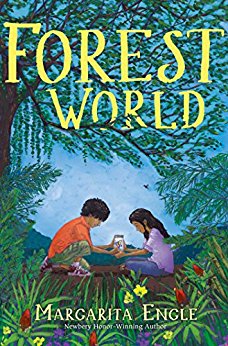
Forest World, Margarita Engle

Young Adult Nonfiction


Trashing the Planet: Examining Our Global Garbage Glut, Stuart A. Kallen

There are also Honor Books in all the categories

Sunday, April 22, 2018

Environmental Book Club

I am back on-line in time to get this Environmental Book Club post on reality-based picture books up for Earth Day.

I haven't been doing many environmental book club posts this past year because I find so few "environmental" books, particularly in fiction, that I want to read. Forgive me, if I've said this here before, but too often I find novels about the environment pedantic and predictable. They tend to be about saving an animal or piece of land from an evil business (middle grade) or a post-apocalyptic world that exists because of an environmental disaster caused by humans (YA). I find myself drawn, instead, to picture book stories based on true environmental situations. Reality is actually more interesting and less predictable than fiction.

The Water Princess by Susan Verde with illustrations by Peter H. Reynolds is about an African village whose women must travel for miles each day to get water. This isn't an entirely new-type of narrative. We've heard of water problems in Africa before. But the fact that this story is based on someone's experience gives it a sense of reality a totally fictional account wouldn't have. This was one of my ReFoReMo reads. Rather than reinvent the wheel, I'll just repeat what I've already said about it. "...what makes this book so workable is the main character, who fantasizes about being an African princess. Also, she recognizes the struggle she and the women she knows deal with, making a lengthy round-trip each day to get water, but she doesn't lecture the readers about it. The author trusts us to recognize that this is a tough subject."

I also liked One Plastic Bag by Miranda Paul with illustrations by Elizabeth Zunon, another ReFoReMo title.  This book is based on a group of Ghambian women who handled a solid waste problem caused by plastic bags piling up and up around them by crocheting them into purses. I thought the author used repetition well, giving the book a "creative nonfiction vibe."  One Plastic Bag reminded me of Ada's Violin, a book about a group in Paraguay recycling solid waste in a creative way. Ada's author, Susan Hood, also uses creative nonfiction techniques well.

Friday, April 13, 2018

Environmental Book Club

I am sure you recall that last weekend I went on a writing retreat where I read some nature poetry. Well, I've read some more. I'm rather liking this stuff.

I picked up the picture book Snow Toward Evening: A Year in a River Valley (illustrations by Thomas Locker and poetry selected by Josette Frank) at a library without giving it a lot of thought. When I sat down to read it, I wasn't expecting much. I am not much of a poetry reader, have little knowledge of it, and it's not something I have much experience of.

Why, I may be much like a child reader in those ways.

I was taken with Snow Toward Evening immediately. The first poem, January by John Updike (Updike! Never got into him, either.) begins "The days are short,/The sun a spark/Hung thin between/The dark and dark." How is that for an image?

There are only twelve poems here, one for each month of the year, with a nature/landscape illustration. The poetry isn't children's poetry (Updike!), though it is very accessible. (Hey, I liked it.) The book functions:
  • As beautiful in and of itself
  • As a lead-in to adult poets for young readers who may be unfamiliar with them (Updike!)
  • As a cross-over book for adults.

Unfortunately, you're going to have a hard time finding Snow Toward Evening. It was published in 1990 and is out-of-print. Way out-of-print, presumably. Both the illustrator and compiler are dead, and it looks as if finding some good used editions could take a little effort. Personally, I'm suggesting this as a gift some family member can make the effort to find for me.

By the way, the book title comes from the poem Snow Toward Evening by Melville Cane, which is included in this collection.