Showing posts with label 2010. Show all posts

Thursday, April 29, 2021

Environmental Book Club

I recently read Boys, Bears, and a Serious Pair of Hiking Boots by Abby McDonald. While I was a lot more interested in the serious pair of hiking boots than I was in the boys, it is an example of the kind of environmental book I'm interested in finding in YA and childlit. 

American Green Teen Jenna heads off to Canada for the summer. This is a classic story start, one in which there is a disturbance to the main character's world. Why, I've used it myself. More than once. While off to our neighbor in the north, Jenna finds herself dealing with a lot of very traditional YA issues: summer boyfriends, growing away from a long-term friend, dealing with unpleasant people, mom and dad in meltdown. Arguably there is enough here for a couple of books.

But then there is her environmentalism.

An Environmental Theme

I have trouble finding environmental themes in books. What many consider themes, I consider subjects. Environmentalism is a subject, not a theme, for instance. Single words usually are just subjects, in my opinion. So 'environmentalism is necessary' is closer to a theme, though as far as writing is concerned, it doesn't have a lot of built-in narrative drive.

Last month I attended a writing workshop in which we were told to ask ourselves "what is the central dramatic question of your story?' And that, friends, gets a lot closer to theme, as far as I'm concerned. What dramatic or life question is your story trying to answer?

In Boys, Bears, and a Serious Pair of Hiking Boots, I think the theme/question McDonald is trying to answer is "how do we live an environmentally responsible life?"

How DO We Live An Environmentally Responsible Life?

Jenna is very hot for environmentalism when her story starts. But everything in life has consequences of one sort or another and just as not living environmentally has consequences, so does living environmentally. Those consequences are not all clean air and water. There are sometimes impacts on people's livelihoods, and Jenna has to confront them here. 

The book also includes a character who evolves into a cliched, strident environmentalist, probably meant as a cautionary tale. But her path is another possibility to consider when toying with how to live a life that is as environmentally sound as possible.

I can't say that all the elements of this book come together smoothly here. Loading Jenna up with so many YA issues distracts from her coming to terms with what kind of person/environmentalist she's going to try to be. But I very much appreciate that she's coming to terms with that at all.

Monday, January 25, 2021

January Diversity Reading: One Crazy Summer

One Crazy Summer by Rita Williams-Garcia was a National Book Award Finalist, a Newbery Honor Book, and won the Scott O'Dell Award for Historical Fiction as well as the Coretta Scott King Award. Lots of times I read award winning books and think, Why? Not with this one. One Crazy Summer is fantastic.

Three sisters, the oldest being only eleven-years-old, head out from the east coast to California in 1968 to spend some time with the arty mother they've never known. These very traditional young girls expect to see the ocean and go to Disneyland. Imagine their surprise when they discover that mom, who doesn't seem to want to have much to do with them, is involved with the Black Panthers! 

What a terrific premise. How did I miss this book all these years?

Narrator Delphine has heard of the Panthers and turns a somewhat jaundiced eye on some of their more benign community work. She has been well brought up by her father and grandmother and tries to keep those younger sisters, upon whom she also often turns a jaundiced eye, in line while they are eating breakfast each morning at a children's day camp the Panthers run in their neighborhood. The book is fascinating and funny.

And there are two more books about Delphine and her sisters.

As an adult and a mom, I felt the kind of anxiety reading this book that I often feel when I'm reading books for children. The father and grandmother seemed way too conscientious and attentive to send the girls into a situation they knew so little about. No, no! They wouldn't have done that! Also, I wanted to snatch Delphine and the sisters away and take care of them. Realistically, three kids is one more than I know how to manage. But I would have fed them! Their mom wouldn't even feed them! She kept sending them out for takeout or to eat with the Black Panthers. Who did a good job with providing breakfast, by the way.

This is one of the books I read this month, because Multicultural Children's Book Day is coming up later this week. An excellent read.


Tuesday, June 11, 2019

Not All YA Is Obvious YA

I recently finished reading The Agency: A Spy in the House by Y. S. Lee, the first in a series of four YA historical mysteries. It's set in the nineteenth century and ends with a couple of feminist twists I appreciated. I grabbed it on a Kindle sale, because historical mysteries are something I read. My Kindle is loaded with them. My heirs will find them.

How These Historical Mysteries Work


Okay, so I've read dozens of these things...dozens. And the dozens and dozens of the adult historical mysteries set in the nineteenth century that I've read involve a female/male couple, who meet angry, end up with lots of sexual tension, and, after a few books, sex. At least one part of the couple is either tormented or has some torment in his/her past. One or the other of them ends up in physical danger that the other one saves them from. As a general rule, the characters are of more interest than the mysteries. And, in my experience, many of these series do the literary equivalent of jumping the shark at some point, and the characters and the sex aren't enough to keep you reading.

"A Spy in the House" And The Historical Mystery Pattern


A Spy in the House pretty much follows the pattern for the first book in one of these series. The female lead has a rough background, she's in conflict with the male lead, at least one of them ends up in physical danger and the other one saves the day. The ending may or may not be typical of these series. I'd have to read the next book to see.

A couple of times references are made to the leads' ages. The male is twenty, the female seventeen, but that's pretty much the only way we know how young they are. At the halfway point, something comes out about the female character's family and background that adds a bit of search for identity to the book world, something that is YA-ish. But it isn't a major part of the rest of the story. The sexual tension isn't very high in this book, though there's enough to suggest something could come of it down the line. This lower key love interest could be a nod to the YA audience.

Otherwise, this is pretty much an adult book with teen characters. The teens could be pulled out and replaced with adults with very little effort.

Nothing Wrong Here


A Spy in the House isn't the first book I've seen that works like this.  Au Revoir Crazy European Chick from 2012 has an adult-like character in an adult-like thriller geared toward teen readers. I Hunt Killers, also from 2012, is a teen Dexter. Illuminae from 2015 is a science fiction space thriller in which teen characters definitely function in very adult ways.

There's nothing wrong with any of this. We're just not talking books with traditional YA themes and YA situations. At most there may be a loose connection to a missing parent to tie the books to the genre. Otherwise, you could imagine any number of adult actors playing these characters in the movie adaptation.

And that is probably the point. These books give teen readers an opportunity to imagine themselves in far more adult and thrilling roles than those they find in more traditional contemporary YA books.

Monday, August 01, 2016

Everything I Wanted To Know About Barbie

Let's get this out of the way. I am not a Barbie fan. I didn't have a Barbie when I was a child and don't remember caring. I don't even remember hearing about Barbie until my youngest sister got one. I do recall making her doll a red jumpsuit. That was back in the day when I sewed a lot of clothing, compared to now, anyway. But sewing for Barbie was a b-- ...ah... was difficult. Sewing those little tiny seams was hard! By the time I had children, I found Barbie kind of slutty. Yeah, I slut-shamed Barbie. When my younger son was invited to a little girl's birthday party, he instructed me to get her something for Barbie. "She likes Barbie." I walked up and down the aisle of the toy department in some store and kept saying to myself, "I can't buy any of this stuff." I finally got her some kind of a Barbie careers board game. That was the best I could do without feeling dirty.

So why did I read The Good, the Bad, and the Barbie by Tanya Lee Stone? Well, the book looked like a popular history of a pop culture...thing. I like a little history, and I definitely believe popular culture has significance. It deals with how we actually live. Additionally, Tanya Lee Stone is a pretty well-known New England children's writer whose work I hadn't read before. One, two, three reasons to read this book.

Fascinating Bookie Bits


  • The Good, the Bad, and the Barbie begins with very interesting material about Ruth Handler, Barbie creator. Ruth comes up again at the end of the book. Nice bookending. Love when that happens.
  • The Ruth Handler section is classic historical research. Then comes some original research. Stone reports on material she collected from former and sometimes present Barbie owners. I've no idea how, say, sociologists would feel about how this was done but it was very readable.
  • My neighbor, Joan, did have a Barbie. Her big memory (fondest memory?) of playing Barbies with her friends is of...uh...well...in a word...dismembering...the dollies. According to Stone, that's a thing.

A Great Model For Student Writers


When my kids were in elementary school, I noticed that they rarely were assigned to read the kinds of things they were expected to write. They read novels, but they were expected to write short stories and, more importantly, nonfiction. The Good, the Bad, and the Barbie would be a great model for student writers and student historians.

A Little Added Doll Attraction


This weekend while trying to find podcasts to listen to (I told you about that yesterday), I did find this nice little essay, You Play With Dolls, by Bess Winter at Black Warrior Review.  It seems appropriate to share it here.


Thursday, May 12, 2016

Picture Book Research

I'm making an attempt to write a picture book manuscript, something I've tried before without success. While at the NESCBWI Conference at the end of April I came up with an idea with something else to do with my material. Nonetheless, I'm going to slog through trying to complete a draft.

I decided to do a little picture book research while working on this project. I'm particularly looking for humorous picture books. I'm finding them harder to find than I expected. For one thing, there doesn't seem to be a spot in the library for "Gut Busting Picture Books." Also, I may not understand picture book humor. One of the local librarians picked out some picture books for me that she found funny. Er...ah...uh.

Keep in mind, just because we were looking for humorous picture books, it doesn't necessarily follow that these books are meant to be funny. That may very well have not been the authors' intent.

I'm finding picture books to be a bit of a mystery.

Grumpy Bird Jeremy Tankard. This has a subtle story. The humor is also subtle. Kids who understand grumpiness will enjoy this more than kids who haven't had their own or others' grumpiness pointed out to them yet. The book also has an intriguing ending that I didn't notice the first time I read it. Overall, a nice work.

Little Owl Lost Chris Haughton. Love the artwork here. This is the story of an owl who falls out of his nest and is helped to get back to his mom by a squirrel. The squirrel keeps finding the wrong mom. Child readers might find the mistakes humorous and enjoy taking Little Owl's part and setting squirrel straight over and over again. That's an interesting idea. The reader brings the humor to the story. Again, a nice work overall, but this one I didn't find that funny. I think the librarian gave it to me.

Let's Sing a Lullaby with the Brave Cowboy Jan Thomas. I'm really liking bold, not particularly representational, art in these books. This is another one. This is a bedtime book, and as bedtime books go, this one is probably pretty funny. The humor here is around the fact that the cowboy isn't brave. I definitely find incongruity humorous. I wonder at what point kids get that?

Bug in a Vacuum  Melanie Watt. Okay, this definitely isn't meant to be funny. A fly experiences a crisis and then goes through Elizabeth Kubler-Ross's five stages of grief. It was published as a children's book, aimed toward the lower grades of elementary school. Perhaps as instructional? If you are an adult with a dark sense of humor, you'll find a lot of jokes here. I don't think it's going to help me as a model/mentor text for preschool picture book humor.

There Are Monsters Everywhere Mercer Mayer. Don't know why I thought this would be funny. Good story about a kid overcoming monsters that may or may not be everywhere. But not much in the way of humor.

The Pout-Pout Fish Deborah Diesen. This is another book that I think readers bring the humor to. The pout-pout fish's face lends itself to spreading the dreary-wearies. That is, until someone changes his mind by.... I don't want to spoil the story. I can imagine a child listener and adult reader having a good time with "glub-glubs" and kisses. But this isn't the kind of humor I'm thinking of.

Twelve Terrible Things Marty Kelley. This isn't actually a story. It's more like the picture book equivalent of a listicle. Very realistic art illustrates twelve terrible things that happen to many kids: gravy day at the school cafeteria and elderly ladies looming in for a cheek pinch. This is clever and witty and probably for grade school age readers who will have experienced these "terrible things" and recognize that "terrible" is being used loosely here.

Monster Trouble Lane Fredrickson with art by Michael Robertson. Okay. This one has both the story and humor I'm interested in, for the age group I'm interested in.

Pete the Cat and His Four Groovy Buttons Eric Litwin with art by James Dean. I am sure I picked this book up because it had "groovy" in the title. It is a groovy book about...math! Again, it has the story and humor I'm looking for. Also, I know someone who would love this.

The Hueys in the New Sweater and The Hueys in It Wasn't Me Oliver Jeffers. The thing about the Hueys is they're thumb people. Come on. No one notices that? Or maybe they're bean people. But for such unsophisticated bodies, they have sophisticated issues related to uniformity and getting along. There is some humor here, but the books are also thinkers. I like It Wasn't Me because of the randomness of the climax.


Thursday, November 05, 2015

I Feel Bad About Why I Liked "Bamboo People"

I have this feeling that I should have liked Bamboo People by Mitali Perkins because it dealt with young people from a culture unfamiliar to me who overcome dire problems. I should be sensitive to all that.

Instead, I liked Bamboo People because the first half is a mash-up of a young people from a culture unfamiliar to me with dire problems story and a traditional prison camp tale. Okay, technically the characters are in the Burmese military. But their training site is like a prison camp. You've got your evil commandant, your friendly guard, your inmates who suck up to those in power, your clever, street-smart guy who often saves situations. Anyone else hear the theme music to Hogan's Heroes? On top of that, the young Burmese men being trained in their military's camp were, shall we say, impressed into service, similar to the way the British impressed male citizens into serving in their navy before the nineteenth century. Chiko, our main character, certainly seemed imprisoned.

I was disappointed at the mid-point when bookish, educated young Chiko gets out of the prison--I mean, training--camp. At that point, Bamboo People became a mash-up of a young people from a culture unfamiliar to me in dire circumstances story and a traditional war story. Chiko is still there, but he's now a secondary character in a new guy's account of his war experience.

You could say that the two parts of the book are two sides of the same story about conflict in Burma, with the young main characters not having a lot of control over their parts in what is happening.

Bamboo People would be a good book to offer students as a reading option for world studies classes, because young readers may find themselves hooked by the same aspects of the book that hooked me.

As an aside, last week I discussed in my NaNoWriMo workshop how creating friends for a main character can help a writer develop plot. I used Chiko's two friends in Bamboo People as an example.

Another aside: I feel so worldly after reading this book, because I now know that Burma and Myanmar are the same place. Also, since reading this book, I've been seeing references to Myanmar or Burma over and over again. It looks as if one of my Facebook friends is there now.


Saturday, June 20, 2015

Thriller? Problem Book?


Last night I said that I was delighted to see that my first book for the 48 Hour Book Challenge was written in the present tense. Well, wouldn't you know, so was my second.

Scars by Cheryl Rainfield is the story of how fifteen-year-old Kendra deals with the trauma of having been a long-term victim of sexual abuse. In short, she deals with it by cutting. She also had a romance go bad and is about to embark on another. I don't want to say too much about that, because I felt that the romance is slowly revealed, and I don't want to do any spoiling.

Scars is sort of a combo thriller and problem book because when our story opens, Kendra is being stalked. She believes the stalker is her abuser, whose identity she has repressed. She's repressed it for good reason. He threatened her if she revealed it. But Kendra is quite a talented artist, and some of her old experience is coming out in her work. Especially in the beginning there is a sense of paranoia and threat because, since Kendra can't recall who raped her repeatedly as a very young child, she has to fear that it is any of the men she knows.

As I was reading this, I kept thinking of Hitchcock, and imagining what I was reading as a movie. I was kind of embarrassed about that, because the book is dealing with some very serious issues. But now I'm thinking of Kendra as a twenty-first century YA teen trapped in a Hitchcock movie, which is at least a little arty. Who would Hitchcock cast as the kind, caring, gay adult friend? Are there any gay characters in Hitchcock movies to provide a model? How about Colin Hanks and someone like him for Dad and Mr. Blair, the math teacher? And lets cast three cool Hitchcock blondes as Mom, Mrs. Archer the art teacher, and Carolyn the therapist. I'm thinking Nicole Kidman, Charlize Theron, and somebody else. (I'm on  a tight schedule here, folks, and can't spend much time casting this. I've only got 48 hours, remember.)

Disclosure: Cheryl Rainfield and I were blogging buddies years ago and are Facebook friends now. I read the eBook edition of this book, which I got sometime back during an Amazon promotion.


Monday, February 02, 2015

But Jo March Wasn't Hunting Werewolves

I am a big fan of Pride and Prejudice and Zombies by Jane Austen and Seth Grahame-Smith. I thought the literary mash-up of Austen and zombies worked "very well in the context of the original Pride and Prejudice story because in Austen World the hunt for a husband is life and death, much like encounters with zombies." In Pride and Prejudice and Zombies, the Bennet daughters had pledged to fight zombies until they were "dead, lame, or married." Marriage is pretty much the end for the Bennets in whatever universe they're part of. And the book is funny.

I didn't run out to read other classic/horror mash-ups because I thought it was a situation that would get old fast. Little Women and Werewolves by Louisa May Alcott and Porter Grand jumped out at me at a library book sale, though, and now I have, indeed, read it. The situation isn't old in this book. It just doesn't work the way it did with Pride and Prejudice.

Little Women and Werewolves follows the original book very closely, but with werewolves slipped in. Instead of fighting the werewolves, the way the Bennets fight zombies, the Marches are far more passive, being merely sympathetic to the werewolves' plight, seeing as they have to live in hiding or they'll be hunted down by members of the bullyish Brigade. The March girls have learned from their minister father to be tolerant of werewolves.

But here's the thing: The werewolves are cold-blooded killers. When the moon is full, they kill and eat innocents. They feel no remorse. The Marches have no problem with this. They are not horrified. That doesn't seem to make sense logically in the context of this story about these sensitive, gentle, spiritual people. I wondered if some of the gory scenes were supposed to be funny, but if so, I totally missed the humor.

Little Women wasn't my favorite Alcott book when I was young. (I am a Little Men fan.) As I was reading Little Women and Werewolves, I started wondering what the original book's attraction is. There isn't a lot of story here. Even with werewolves. I may try to reread bits and pieces of it to compare them to the werewolf version.


Thursday, July 10, 2014

Environmental Book Club

Today, my little lads and lasses, I have something different for you. An adult book for our club.

Home to Woefield by Susan Juby takes a cliched memoir subject, the city person getting back to the earth by moving on to a farm, and makes it funny. And she makes it funny without making any of her characters into ridiculous jokes.

Prudence Burns is seriously into sustainability but not having good luck with it in New York. She thinks a great opportunity opens up for her when she inherits a pretty much good-for-nothing farm in Canada. Prudence isn't totally ignorant of how to make a go of it in an organic kind of way, and she's a hard worker. She also earns the good will of all around her. Her problem is that she's overly optimistic.

With the farm she also inherits an elderly hired hand, who's not a great deal of help. She soon takes in a young alcoholic recluse whose main connection with the world is through the celebrity and metal blogs he runs. The three of them also end up with a preteen and her chickens.

These characters could have ended up as cliches, especially the preteen. She could have easily fallen into the wise-beyond-her-years stereotype. Instead, she is a damaged innocent. The elderly, foul-mouthed Earl and the equally foul-mouthed young Seth are also damaged. All these characters benefit from Prudence's can do sustainability.

This is the first book I can recall coming across that I think is comparable to Saving the Planet & Stuff  in that it finds humor in the struggle to live environmentally/sustainably without degrading those who are making the effort to do it. Prudence is not the butt of any jokes here. She recognizes them.

Juby is the author of a number of books for teens or that are marketed to both teens and adults. I'm reading Getting the Girl, whose main character seems like a younger Seth (my favorite from Home to Woefield), Seth before he suffered what he believed to be a humiliation he could never recover from and hit the sauce. I expect to be trying Alice, I Think soon, too.

Home to Woefield was recommended by a friend, by the way. Word of mouth.

Wednesday, December 04, 2013

Now That Was A Good Zombie Book

Okay, Picture Book Month is over. Now it is time for...zombies!

Not to worry. I'm not doing a month on them. I'm not even all that enthused about zombies. I've read a couple of good books, seen a few movies, and that's about all I need. Especially since many zombie books are also apocalyptic novels. And, as Garrison Keillor once said about pumpkin pie, the best apocalyptic novel you've ever read isn't that much better than the worst.

That's why I ignored Rot & Ruin by Jonathan Maberry for a long time when it was on my library's new YA shelf. It wasn't until I saw a review for one of its follow-up books that I gave the first book in the Rot & Ruin series a second thought and made a point of finding it.

What makes this book so intriguing is that while it is set in a vague American future, it has a western vibe. The characters in this book are fourteen years into zombie world and the little group we're interested in are living in a small town they've created to keep themselves safe from the zombie horde. One character goes so far as to compare the people living there to western townspeople protecting themselves from Native Americans. Horses figure in the story because society has fallen and power for machinery is limited.

Our protagonist's older brother fills the roll of the lone gunslinger with his own code, making him noirish, too. There's no law in these parts, so you've got outlaw types who are far worse than the zombies, just as you had outlaws in westerns. Our heroes head out of town to save their woman from said outlaws. There is even a scene that calls to mind the cavalry coming over the rise to save the day.

For those of us who grew up with parents who watched westerns on TV every night of the week, it's fun to pick up all the western, well, cliches. (I didn't enjoy doing this anywhere near as much while watching Defiance.)  It's been a long time since television was populated by cowboys, though. The western connection won't be an issue one way or the other for younger readers.

Rot & Ruin is an apocalyptic novel that works for me because the society in it isn't stagnant. So often in these books the world goes to pieces and stays that way for generations. No one shows any interest in technology or even changing the height of a hemline. Given the last 500 years or so of human existence, that seems unrealistic to me. Cultures evolve.

And there are suggestions that the culture portrayed in Rot & Ruin is going to. It's only been 14 years since the world fell to zombies, and already the young people who are growing up there are thinking that they'd like something better. If the zombies come, it seems likely to me that before long people are going to get sick of them and start thinking of ways to make a better life. Trying to make a better life is what we do.

Tuesday, November 19, 2013

And What Is This Supposed To Be?

I received It's a Book by Lane Smith for my birthday. I recall it getting a lot of attention when it was published in 2010, and I can remember something else, too, though I'm having some trouble putting my finger on it. Was there just a little bit of controversy over this thing? Maybe because of the text on the last page? Because some considered it too adult?

I think the whole book is kind of adult. It's all about a monkey trying to get through to a jackass that a book is a book, not an electronic device. The whole issue of children being too plugged in too early seems to be a very adult concern to me, not one that children are even aware of. You could make the argument that that is the point, to make children see this before they become too enamored of electronics. But if kids haven't yet become enamored of electronics will they understand terms like "text," "tweet," and "Wi-Fi?"

There's an overt message in It's a Book, I think, one that adult readers concerned about keeping reading a traditional book-centered activity will embrace. That's okay. I'm a big fan of picture books for adults. In fact, it could be a fun read-aloud for them with their little ones. I don't know how many young picturebook readers will get this on their own, though.

Wednesday, August 07, 2013

Wit Really Can Take You A Long Way

First off, U.S. Skulduggery fans: No, these books haven't been published here. I ordered them from abroad. Hey, the U.S. publishing world gave up on this series and didn't want me to read these books, but I got around them. I feel like a the main character in a spy movie. Yeah, Angelina Jolie taking down the man.

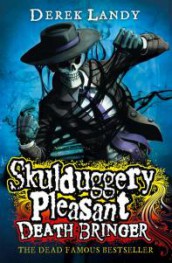
My niece lent me the two Skulduggery Pleasant books I bought for her in March. To be honest, I found them slow getting into, in large part because there's more and more of a serial aspect to these stories now. In fact, when my niece handed them to me, she said, "They're really getting into cliffhangers." With a serial, it's hard to bring yourself up to speed if you haven't read the earlier books recently. There's a wide array of bad guys in the Skulduggery Universe, and, personally, I can't keep track of them over a long period of time. For instance, somebody named Lord Vile becomes important (again, I guess) in Death Bringer, and while the name rang a bell, that was all it did for me.
Both books did develop a certain...magnetic...aspect, though, drawing me back to them over and over. In large part, this is due to clever conversation. I would be hard put to recall the basic stories in any of these books. Many characters, however, are marvelously entertaining. Skulduggery Pleasant is a standout, of course, and he has had a big impact (some would say a bad influence) on his sidekick, Valkyrie Cain, who is the real protagonist in this series. But a wide array of secondary and even minor characters are clever and funny. Scapegrace the zombie, for instance. Valkyrie's parents. Her nitwit cousins. Clarabelle, who doesn't appear to be the brightest light in the sorcerer world. In fact, I'm not sure how she came to be part of it.

Wit and humor are what carries these books. The plots, no so much. The sixth book, Death Bringer, includes an incredibly clever thread (I hate to even call it a subplot) that rips into Twilight's Edward Cullen big time. It's brilliant. I appreciated it a great deal. But it really doesn't have anything to do with the book's basic story, which involves an attempt to kill half the world's population. In fact, this book has a torn-between-two-lovers scenario that I suspect only exists so Landy can make fun of Twilight. Hey, I love making fun of Twilight as much as the next person. More than its many fans. But here the pleasure I took from the humor was distracting.

Here's a fascinating thing that's happening in these later Skulduggery Pleasant books: Valkyrie Cain is becoming more and more unpleasant. I suspect that some of this attitude of hers was always there, but she's now becoming just plain nasty. She has a sort of shadow person who lives her mortal life for her so she can be off saving the world from paranormal bad guys without upsetting the folks. By the fifth and sixth books, Valkyrie is treating it like...yeah, mud, let's say. We may find at some point that this is due to some kind of envy because the duplicate gets to be part of the family Valkyrie has to leave, but in the meantime, Valkyrie is really awful to it. She's pretty dreadful to the two boyfriends. She has the...mud...beaten out of her by a character who is seeking revenge for all the cruel taunts Valkyrie has directed toward her in the past. Valkyrie doesn't seem to get that she had a part in bringing that down upon herself. She tosses around the words, "Shut up" and "Moron" as if they are fine examples of witty repartee, which they most certainly aren't, in case anyone is wondering, not even here. She is turning into a very unlikable main character. 

I like that. I find it intriguing. Where is Landy going with this? Or is he going anywhere with it? Does he find her as unlikable as I do, or does he, indeed, believe, "Shut up" is the soul of wit?

I suspect that Landy is intentionally going dark and unlikable, because I recently learned he has started a new series featuring Tanith Low, a character from the Skulduggery Pleasant Universe who went over to the side of evil in a big, big way. He is doing a whole series with a main character who is a bad guy. This flies in the face of Writing 101, where writers learn that protagonists must be likable so that readers will want to identify with  them. This is fascinating.

I now want to know how dreadful Valkyrie is going to become. I broke down and ordered book seven in the Skulduggery series, Kingdom of the Wicked, which just goes to show that unlikable characters can sell books.

Friday, June 07, 2013

Why Am I Not Good Enough?

I found Brain Camp by Susan Kim, Laurence Klavan, and Faith Erin Hicks on my To Be Read pile a couple of months ago. It was part of my haul from a used book sale last year. The style of the cover seemed familiar to me, and I realized that Faith Erin Hicks' book Friends With Boys was a Cybils book last year. In fact, it was the winner in the YA graphic novel category. Hicks copyrighted the illustrations, and after reading Friends With Boys, it is easy to recognize her work.

Brain Camp is sort of a traditional nightmare camp story. In this case, parents send their average, or less, maybe, achieving kids to Camp Fielding, "America's best new educational summer camp, guaranteed to prepare any child for the SATs and beyond." The camp administrator looks for kids who "got turned down for math camp, computer camp, art camp..." and have never done well on a test in their lives, to paraphrase one mom speaking of her son. The kids leave camp stellar students because of a mysterious plot, which our two intrepid, and not at all gifted, protagonists discover.

The really intriguing part of this book wasn't the story itself but the feeling it carries of its characters being unacceptable to their families as they are. Love is not unconditional for the children who are sent to Camp Fielding. In the course of the book, we learn just how conditional it is. Yeah, there's a science fiction plot here, but it's the mood that makes readers feel that these children are being thrown to the wolves by the adults who are supposed to love them simply because they can't conform to a standard of achievement that makes Brain Camp striking.

Thursday, February 28, 2013

I've Read A Skulduggery Pleasant Book That Many Of You Probably Haven't

I recently finished reading my niece's copy of Dark Days by Derek Landy, Book 4 in the Skulduggery Pleasant series. What's that? You're wondering where my niece got Dark Days, since she is an all American girl and this book isn't published in the U.S. of A.? Why, she got it from her favorite aunt, who ordered it for her from England for Christmas. Yes, I know. All young people should have aunts like me.

When we last saw Skulduggery here at Original Content, over two years ago, he was in dire straits. I will not get into how dire, because you can get that particular book in this country, and I don't want to spoil it for you. Since this is a series (that is becoming a little more serial like) I don't think I'm giving too much away to say that he's functioning in this book.

I have to admit that this time around I had trouble keeping all the bad guys straight. Since many of them had appeared in earlier books, if some American publisher had seen fit to publish this one, that might not have happened because I would have read it closer to the last book. I am also going to quibble with the red shirt moment  that occurs around the halfway point in which two brand new characters appear so that they can be killed off right away. I wasn't enthralled with the ending.

The book is still filled with the wit this series is known for, though. And I'm very much liking the suggestion that Skulduggery may be quite a bad guy. For those two reasons, and because I think it will make my niece happy, last night I ordered the next two books in the series, from England, for her birthday. They should be here just before Easter, when I'm hoping RJ will be here to eat my holiday bread and cake, though I am not sure exactly what form they will take this year.

My Easter cake is up in the air, but I'm certain I'll be able to read the next two Skulduggery books in rapid order.


Saturday, September 15, 2012

Sometimes Name Recognition Works

I have to admit that I don't have a lot of interest in Albert Einstein. I picked up Albert Einstein when I saw it at the library because I recognized the author, Kathleen Krull's, name. I remember her picture book Fartiste, and I liked what I thought was the novelty of her book Lincoln Tells a Joke. Plus, I believe Kathleen is a Facebook friend. My point being, that name is definitely filed away in my mind, and when I saw it on a book cover, the metaphorical equivalent of a bell rang.

I found Albert Einstein, part of Krull's Giants of Science series, to be a very readable book. Seriously, on a couple of occasions I looked forward to going back to this book over some other ones I was reading at the time. The text seemed as if it could have come from one of those well done magazine profiles that often grab me.

I can't say that I have a better understanding of what Einstein actually did, though I think I do have a grasp of his process. I have a much better understanding of the significance of his work in the bigger scheme of things. I am left, after reading Albert Einstein, not liking him very much. That was an interesting aspect of this book. I felt that Krull put out details of Einstein's personal life (his treatment of the women in his life, for instance) without making any value judgments, herself. I, however, felt free to do so. I also felt she did a good job of placing him within his time period and showing historical events' impact upon him. In one case, in particular, she showed the impact he appears to have had on a historical event.

This book includes a list of sources, but no citations in the text. I am seeing this in nonfiction books for adults, as well as children, and don't know what the significance is. The absence of citations wouldn't keep me from encouraging a young person to read the book.

Wednesday, August 08, 2012

But "The Boy Who Couldn't Sleep" Is Different

There are a lot of misfit-boy stories out there. There are a lot of misfit-boy-who-likes-comics-or-some-other-formerly-outsider-interest out there. It's a scenario that I probably liked the first few times I saw it, but, you know me. My tolerance for familiarity isn't all that great. The Boy Who Couldn't Sleep And Never Had To by D.C. Pierson is very well done, but I almost gave up on it early on, because even though it is funny and poignant, lots of those misfit-boy stories are funny and poignant. I felt I'd read it before.

I stuck with it, though, and the payoff was that Pierson has mashed up that well known misfit-boy story with a science fiction tale. The science fiction aspect actually comes right out of the comic book world the main character, Darren, and his friend, Eric (the boy who couldn't sleep), have been creating. This is what gives The Boy Who Couldn't Sleep And Never Had To a feel of the new. That's what kept me reading.

Pierson is a subtle and impressive writer. An example: Darren, our main character, has an older brother who is like something out of A Clockwork Orange, which is mentioned at one point. (The brother is probably modeling himself on Fight Club, but I haven't seen that, so I can't be sure.) Big Bro' really is repugnant. Yet, he goes  to Outback with his father and younger brother every week. The three of them take off at Christmas time. In what passes as a generous act, he gives his younger brother drugs and doesn't make him pay for them.  In this chilling guy is something rather family oriented. A reader can feel that if he doesn't get killed or imprisoned, he could turn out okay.

I found The Boy Who Couldn't Sleep And Never Had To in the YA section of my local library. Yet it appears to have been published as an adult book. It seems a YA book to me. Yes, Darren is telling his story after it occurs--a couple of years after it occurs, when he's a freshman in college. We're hardly talking a whole lot of adult perspective on the experience here. Yes, there's a lot of rank language and drug use and some real sex, not just the thinking about it kind. I can't recall having read a YA with drug use, but certainly rank language and sex appears in the genre. I can't think of a real reason why this couldn't have been published as YA. I do think it can be viewed as coming-of-age--"Oh, I had a life-changing, grown-up experience." Personally, I think adult readers like that kind of thing more than teenagers do, so maybe these kinds of books get published as adult because that's where their biggest fans may be.

Plot Project: I don't think Darren's story is about something he wants and struggles to get. It's much more about a disturbance to his world--he finds out that his new friend never sleeps, is sort of a living and breathing science fiction character. What possibilities does that open?


Wednesday, July 20, 2011

"Loved It!"


Dust City, by Robert Paul Weston is amazingly inventive. It's also what I like to call a well-balanced book. The elements of fiction are all of equal value--character, setting, plot, point of view, theme. It's not unusual for setting to get too much attention in a fantasy story, but not here.

How inventive is this thing? I can't even imagine how the author came up with the basic premise. Well, actually, I can imagine it because I've now read an article in the National Post that explains some of it. But the very most basic beginning step--that the Big Bad Wolf offed Red Riding Hood and her grandma while on, essentially, drugs--Well, there's a thought a writer can run with, and Weston does.

Weston takes his world of hominids and animalia--here a kingdom of animals that has evolved so that they can stand upright and speak and function in human-like ways, even to the point of attending institutions like St. Remus Home for Wayward Youth--and joins it with a noirish story of a son trying to assist his criminal father. Fairy dust has a part in the story, and my faithful readers are aware of how much I hate fairies. But the beauty of Dust City is that the fairies are kept offstage, which is right where I like them to be.

I would say that Dust City is also elegantly written, even literary, because what is happening with our protagonist, Henry Whelp, in terms of what kind of wolf he could end up being is as important as the plot about whether or not there is dangerous fairy dust and, if so, where is it coming from? It's a sophisticated book for sophisticated teen readers who remember their fairy tales.

Oh, and here's a terrific marketing point about Dust City. On the back cover there are no blurbs. Instead, you see in big print "WHEN YOUR DAD IS THE WOLF WHO KILLED LITTLE RED RIDING HOOD LIFE IS NO FAIRYTALE." I don't know about anyone else, but that's a much bigger draw for me than a quote from some writer I may or may not have heard of saying, "Loved it!"

Dust City was a 2010 YA Edgar nominee.

Tuesday, June 28, 2011

The Past Is A Foreign Country You May Not Want To Visit


Little Blog on the Prairie by Cathleen Davitt Bell has a cute cover, and a lot of the reviews focus on the "fun premise" and humor. The premise is engaging, and a lot of the humor works. It's not that embarrassing strained stuff that turns up in a lot of kids' books. But I think there's a little more going on here than just a funny fish-out-of-water story.

Genevieve Welsh has been dragged against her will to a "frontier family history camp." Gen, along with her brother and both her parents are going to be living in the year 1890, along with three other families who have all paid to stay for the summer with a family of three who have turned their backs on the twentieth century and live in, what for them, is a better time. Hmmm. Or have they?

The campers have to give up all twentieth century technology, as well as twentieth century clothing, food, plumbing, standards of hygiene...everything. Gen doesn't quite do without, because she manages to sneak in her brand new cell phone. The texts she sends to her friends end up on a blog one of them creates as part of her computer camp assignment.

Yes, there's a lot about how hard it is to do without twentieth century comforts. What's interesting, though, is that there isn't a lot about how incredibly wonderful things were back in the good old days. Yeah, there's some fun times playing with other kids every now and then, and, sure, freshly baked bread smells good--if you can figure out how to make it. But a number of the campers...of the adult campers...are suffering big time trying to make the 1890's grade, just as they would have if they'd been living back then. And Ron, the guy who runs this place, is a bit of a sadist, playing people against one another, pressuring them to kill chickens to earn points, and insisting that campers plan an improvement for their individual "farms," which he just happens to own.

I sensed a dark edge to this book, a dark edge I liked. Davitt Bell seemed to me to be trying to maintain a balance between a traditional tween girl story with some mean girl conflict and a potential boyfriend and a deeper tale exposing young readers to something more thought provoking. Why should we do without the technology of the period we were born into? What, exactly, is wrong with refrigeration and showers? Why is the past when people worked themselves to the point of despair and didn't survive accidents (or sometimes even unpasteurized milk, something I couldn't help thinking about as I read this) such a great place?

This might make a good kids' reading group book or a parent/child book club selection. It's out in paperback, and I'm thinking about getting it for my niece.

Oh, and it's also an example of mainstream fiction--no paranormal or fantasy elements.

"The past is a foreign country: they do things differently there."--The Go-Between.

Tuesday, June 07, 2011

And Now For Something Different


I've got to stop ranting for a while and do some Reader Responses. So here goes.

It seems as if I've been reading a lot of YA lately. My own local library purchases a lot of series books for younger readers, which don't attract me particularly, though I will have a post on a couple sometime in the future. So I've had to branch out a little in my book foraging. I found The Secret Life of Ms. Finkleman by Ben H. Winters at another library I've started hitting occasionally. What caught my eye is that it's a contemporary, school-based book. No paranormal elements. Not a serial. No obvious signs of a sequel.

Really, it's a unique offering in today's children's literature climate.

The Secret Life of Ms. Finkleman involves some kids discovering a fascinating secret about their very dull music teacher, Ms. Finkleman, and what that knowledge, once it gets around, leads to. The book uses a third-person narrator without a point of view character--the point of view shifts among characters. This is most unusual in children's literature today. The first-person dominates, and when the third person is used, only one charcter's inner workings is usually featured. That character is on stage all the time. The author manages his shifting point of view just fine, and it will be a bit of an eye opener for a lot of child readers.

Another interesting aspect regarding Ms. Finkleman: It's a book with rock elements, but those elements work much better here than I've seen them in other children's/YA books. I've read a number of YA books in which a character has some rock music obsession that sounds totally unrealistic, particularly if the obsession is with rock music from a decade or two before the kid was born. (Oddly enough, the music was probably from an era when the author would have been listening to it. Hmmm.)

With The Secret Life of Ms. Finkleman, however, punk rock is far more organic to the story/plot. It also isn't used to simply define a character. As in, oh, that's the outsider kid who listens to rock. There is one of those, but he's significant to the story, a story that has to do with punk. He's more than just a few characteristics.

I do think the adult characters are a little over the top. They're cartoonish, while the child characters are far more rounded and realistic. The assistant principal, for instance, is a whipping boy for the dragon lady principal, and one dad makes a rare appearance to encourage his daughter to blackmail a teacher. I think, myself, that this is an illustration of how going for humor can sometimes undermine a story element.

Nonetheless, The Secret Life of Ms. Finkleman is a good read, and a definite relief from the relentless parade of fantasy and girl group stories. For kids who particularly like realistic fiction, it will be a joy.

Though I didn't mention it, Ms. Finkleman has some mystery going on, enough so it was nominated for an Edgar Award. So was Griff Carver by the way.

Thursday, April 21, 2011

A Cat With Attitude

Every now and then I go through the new picture books at my local library. Recently I found two very clever ones by Melanie Watt.


As soon as I saw the "Place My Award Here" spot on Chester, I knew to expect some attitude. The book delivers. The publisher describes it as a story told "by dueling author-illustrators." In fact, Melanie Watt becomes a character in the story, a character who is trying to write and illustrate a book that keeps being hijacked by a cat named Chester. I guess a child reader could either consider him to be a real cat who wants to write this book or a character who wants to take over. Either way, Chester is, as he himself says, "Charming Handsome Envy of Mouse Smart Talented Envy of Melanie Really Handsome."


He returns in Chester's Masterpiece in which the two author-illustrators continue to duke it out on paper. This time, though, Chester's creative struggle "illustrates" plenty about the writing process. A nice addition to a grade school writing program, perhaps?

Chester made a third appearance in 2008 in Chester's Back!, though I haven't read it.

Plot Project: After thinking about plot these many months for my Plot Project, I have decided that some plots are "organic" in that they grow out of situation, rather than falling into the "What does your character want? How can you keep it from him?" format. The plots for these books are organic. They come out of the basic situation of the author fighting with a character.