Showing posts with label Louisa May Alcott. Show all posts

Thursday, December 15, 2022

An Old-Fashioned Girl

Original Content's 20th anniversary year is almost over, and it's been a while since I've done an anniversary post. I stumbled upon these from 2010 related to An Old-fashioned Girl by Louisa May Alcott. I'm doing a post about them, because I think they illustrate something that was going on in the literary blogosphere back in the earlier part of the century. They are, therefore, historical. Also, I don't think anyone says blogosphere, anymore.

Back in the day, it wasn't unheard of to see on-line book discussions. Lauren Baratz-Logsted led a great one at the late, great Readerville community, though I can't remember the name of the book. But the discussion was terrific. Someone at Readerville also led a discussion of short stories, which was good, too. That was how I came to read A Hunger Artist by Franz Kafka and that led to me reading The Metamorphosis.  In 2008 I took part in a "Big Read" of a volume of Shirley Jackson short stories, that wasn't particularly successful, though I finished it.

Then in 2010, Mitali Perkins led a monthly discussion of a classic children's book "focusing on race, ethnicity, gender, and class. She and her followers will be looking for what qualifies the book as a classic, but also looking to see if the attitudes in the book are dated in terms of how we feel about race, ethnicity, gender, and class now." I don't know how many books she discussed, because I took part in only one discussion, the one on An Old-fashioned Girl.

Reading this book was the beginning of a turn-around in my feelings about Louisa May Alcott. You can check out my takes on various aspects of the book below. 

What Do We Think Of Them Now?

An Old-Fashioned Girl: What Is It?

An Old-Fashioned Girl: Poverty Is Ennobling--So Long As You're Not Irish

The Women Of An Old-Fashioned Girl

An Old-Fashioned Girl: And In Conclusion


Monday, May 14, 2018

For Alcott Fans, Women's History Fans, Women's Lit Fans, Art Fans...You Name It

My faithful readers are aware that I can be a bit obsessive about Louisa May Alcott. I've gone on and on here about Little Men, which I reread last year. I went on and on about An Old Fashioned Girl back in 2010. Honest to God, I've read Little Women and Werewolves. I've been to Alcott's house. I've been to her grave. I've been to Fruitlands. In truth, all this activity was spread over many years. We're not talking an Alcott scholar here.

But I'm going on and on like this to explain why I was attracted to the adult book Little Woman in Blue: A Novel of May Alcott by Jeannine Atkins.

 May Alcott was Louisa May's youngest sister, the inspiration for Amy in Little Women, Little Men, and Jo's Boys. This novel about her adult life is impressive in the way it uses what I, at least, know of the Alcotts' lives. There are lots of small details, like the reference to Louisa's childhood birthday party at which she had to give away all the little cakes to her guests and didn't get one herself, that I'd heard of. Or recognized from Louisa's books, which, remember, had some connection to her life. There's also playing off the books. May in Little Woman in Blue is unhappy with how she is portrayed in Little Women. And, when you think about it, who wouldn't be?

This book is a marvelous mind game for readers who have knowledge of the source material.

But it's more than that. In Little Woman in Blue May Alcott is a single woman who is overwhelmed by her family. I will hazard a guess that this is a classic theme in women's literature. In this case, the needy parents and the needy married sister and her family don't seem to even realize what they're doing or that there's anything unusual in draining their family members. I say "members" because it's not just May they're doing this to. Louisa bears the financial burden for all the Alcotts, as she did in real life. Louisa and May could be described as draining each other, too.

This book also shows the life of "single working women" in the 1860s and '70s. It sounds very much like a section in Louisa Alcott's An Old Fashioned Girl. And then there's all the talk of art and specifically art in nineteenth century Paris at the beginning of the Impressionist movement. (Read Sacre Bleu by Christopher Moore, covering the same period? I have.)

So there's something here for several different types of historical fiction readers. And good somethings.

UPDATE: Reading this book motivated me to record Little Women on PBS last night, which I would probably have passed on.


FTD Stuff: Jeannine Atkins is a Facebook friend, one I actually interact with. I purchased an eBook edition of this book during a sale period.

Monday, February 27, 2017

Little Men Reread Part III: Writing


With my Little Men reread I couldn't help noticing that stylistically it isn't like books we see today. It doesn't follow what I've learned about writing. This doesn't mean there's anything wrong with it. It means it was written in a different period when different tastes prevailed.

Point of View.


This is the first thing that struck me while reading Little Men. It's written in the third person and moves around from character to character's head. This isn't something we see a lot of these days. It's not that it's wrong. It's just that it's much more popular in days of old than it is now. Now, particularly in children's and YA fiction, we see first-person narrators. When we do see a third-person narrator, it's often a third-person limited narrator. Meaning the book is written in the third person from one character's point-of-view, getting into only his/her head. That character is on stage always, and the reader can only know what he/she knows. Little Men isn't like that.


That Third Person Narrator


Little Men is written in the third person, except for every now and then when it's not. The first line of Chapter II: "While Nat takes a good long sleep, I will tell my little readers something about the boys, among whom he found himself when when he woke up." The second paragraph begins with "To begin with our old friends." In the middle of Chapter III: "I don't know whether the man understood the child's mute language or not, but when the boys were all gathered together in Mrs. Bhaer's parlor for the Sunday evening talk, he chose a subject which might have been suggested by the walk in the garden." We see "I" again in Chapter IV. Chapter V. Hmm. Does it happen once a chapter? However often it happens, it happens. Who is the mysterious I? We never know.

There's No Real Story Here


There's no main character. There's no one particular something that happens to somebody. These days, we usually expect a character with a goal in books. A character with a problem to solve or with something to want that he or she has trouble getting. This isn't me being finicky or obsessive, by the way. At the beginning of Chapter VIII, "I" says:

"AS there is no particular plan to this story, except to describe a few scenes in the life at Plumfield for the amusement of certain little persons, we will gently ramble along in this chapter and tell some of the pastimes of Mrs. Jo's boys. I beg leave to assure my honored readers that most of the incidents are taken from real life, and that the oddest are the truest; for no person, no matter how vivid an imagination he may have, can invent anything half so droll as the freaks and fancies that originate in the lively brains of little people."

Not something you see a lot of these days.

Fat Shaming


Fat shaming, as such, may not have been "a thing" in the nineteenth century. As such, it probably wasn't a thing when I read this book over and over again when I was a child. I hadn't even heard the term when I read this book to my sons when they were little men. But, man, the fat shaming in this book is hard to ignore. It's all directed toward one character, George, who is called Stuffy by everyone. (Because he stuffs himself, see?)  George's weight, and more particularly, his desire to eat and eat a lot, defines him. It most definitely appears to be considered a character flaw within the world of Little Men. Readers first hear of him as "the fat one."

There used to be a feeling, and perhaps there still is, that the values of the present age cannot be imposed upon the people of an earlier one. For instance, the medical world didn't know about germs until the end of the nineteenth century, so we can't condemn doctors before that period for not washing their hands between patients and thus spreading disease. (Do other viewers cringe while watching the ungloved, unwashed doctors on Mercy Street?) Perhaps someone has done a study of nineteenth century literature, journals, and letters and can attest to the era's attitude toward people like poor George who is, in Little Men, probably not even in his early teens. Maybe this is just the way things were back then.

However, I can't help but find it striking that in a book that pushes values, gives us at least one scene with a story about Jesus, goes on and on about achieving goodness, no one recognizes the cruelty of name calling. While we see examples of one boy protecting another from bullying or pain inflicted by others, no one does this for George. The Professor and Mrs. Jo also do little to protect this child. When Jo's mother (that would be Marmee, Little Women fans) sends little cakes made in various shapes for the boys,  George's is in the shape of a fat pig. When the rind of the melons he's been growing all season is carved with the word "pig," Jo is sympathetic, but instead of punishing the vandals, she helps George play a very lame trick on them.

I have two contemporary YA novels on my Kindle that appear to have overweight main characters. I hope now to get around to reading them soon.

Well, I'm Glad I'm Done With This


Remember how closely I feel my adult life followed a Little Men type of arc? Yeah, this reread has, as I said yesterday, made me feel just dandy about that. And, yet, I now want to reread Little Women and get hold of a copy of  Eden's Outcasts. Because I have trouble leaving this alone.

Check out Little Men Reread Part II Not everything I thought it was.
Check out Little Men Reread Part I My life as Jo Bhaer.


Sunday, February 26, 2017

Little Men Reread Part II: Content

My Little Men
As I suspected in yesterday's post, as an adult I'm nowhere near as fond of the book Little Men as I was when I was a child. Unfortunately, my life is a sort of ode to that book. I could have done worse, I suppose. I read a lot of Marvel comic books as a kid, too. Inappropriate adult spy novels. Historical romances. Nearly everything Agatha Christie wrote. At least in Little Men young boys living in a boarding school are exposed to a lot of improving generic spiritual stuff about sorting out your faults and taking care of your conscience. I don't recall seeing that in The Avengers.


 Does Alcott Romanticize Poverty And Women As Wives And Mothers?


I ask that question because she does it in An Old-Fashioned Girl. So, you know, I wondered.

Money. In Little Men it's not so much that Alcott romanticizes poverty, it's that she holds wealth, and particularly how it's achieved, in low regard. Jo and her husband, Professor Bhaer, run a boarding school and their student Jack represents the evils of business. He's introduced as "sly." "Many men would have thought him a smart boy, but Mr. Bhaer did not like his way of illustrating that Yankee word, and thought his unboyish keenness and money-loving as...an affliction..." Jack's uncle is described as setting a bad example for him, presumably with the keenness and money-loving. Yes, Jack steals from one of his classmates, lies about it, and lets someone else take the blame for it. But that's his function in the story. He's interested in money, so he's bad. Seriously, Jack has warts. He's even physically marked.

Laurie from Little Women darts in and out of Little Men. He has great wealth, but even though there's a reference to him being in business, he is a beloved character who uses his money for good. Why? He's known Jo and her family for years, is married to her sister, and they have had an improving influence upon him. "I'm the first boy Mrs. Jo ever had to take care of...she has been working on me for years and years."

So a variation of the poverty vs. wealth/business issue appears in Little Men.

Women. The women in Little Men are particularly intriguing. First, we have Daisy, Jo's niece, and Nan, an unrelated student. Poor Daisy appears to be being trained for service to family. She attends real classes, but we never see her in the classroom. Her interests appear to be all domestic, and she loves doing things for others, particularly for her male classmates. Her playing involves domestic tasks like cooking and, I kid you not, doing laundry.

Nan is a wild child, not traditionally domestic. Her interests do involve care giving, though. She's already headed for a career in medicine. (I've read Jo's Boys.) Jo believes she will make a "capital doctor" and wants to convince Nan's father to support her, because Nan "...wants something to live for even now, and will be one of the sharp, strong, discontented women if she does not have it." I'm not sure what that means. Do more domestic women like Daisy not have something to live for? Is being sharp and strong and discontented a big negative?

A reader could argue that in Daisy and Nan Alcott is presenting women's choices, choices that most women probably didn't have in the 1860s when this book was written. Then there is little Bess. What about her?

Bess is Laurie's very young daughter, making her another of Jo's nieces, who only visits the school. She is beloved by all, primarily because she is a beautiful child. She may be beautiful inside and out, but the outside gets a lot of attention. Her big chapter is called "Goldilocks."

And then there's Jo. Not once in Little Men do we see a reference to Jo writing, which pretty much defined her in Little Women. (I think it may come up in Jo's Boys.) Nor does she teach at the  school she runs with her husband, not in the traditional sense of the word. She influences all as a loving mother figure, one who teaches through spiritual analogies, and, I guess, mother love. There's a lot of talk of sowing, gardening, and reaping in this book, for instance. There's a lot of intuitive knowing what her boys need. When she was hanging drapes and folding clothes and fitting Nan for a new pinafore, I kept thinking, Jo, Jo, what happened to you? And this exchange between Jo and her husband was a little chilling:

"But needlework is not a fashionable accomplishment, my dear."
"Sorry for it. My girls shall learn all I can teach them about it, even if they give up the Latin, Algebra, and half-a-dozen ologies it is considered necessary for girls to muddle their poor brains over now-a-days."

Yiiiiiikes.

Just as with An Old-Fashioned Girl, there's a lot of romanticizing of women as wives and mothers in Little Men and then one different kind of woman (in this case, Nan) thrown in. It's hard to figure out what is going on here.

And Speaking of "Old-Fashioned"


Alcott uses the express "old-fashioned" a number of times in Little Men and very favorably.

"These were the boys and they lived together as happy as twelve lads could, studying and playing, working and squabbling, fighting faults and cultivating virtues in the good old-fashioned way."

""Once upon a time," began Mr. Bhaer, in the dear old-fashioned way, "there was a great and wise gardener who had the largest garden ever seen." I told you there was a lot of garden talk in this book.

""You shall ferule me in the good old-fashioned way; I seldom do it myself, but it may make you remember better to give me pain than to feel it yourself."

"""First of all, put on this clean cap and apron. I am rather old-fashioned, and I like my cook to be very tidy.""

""Miss Crane kept a school for boys in a quiet little town, and a very good school it was, of the old-fashioned sort.""

"This yearly festival was always kept at Plumfield in the good old-fashioned way..."

"Old-fashioned" is always used to describe something good (except for that feruling business), just as it is in An Old-Fashioned Girl.

What Are You Driving At, Gail? You Are Driving At Something, Right?


Ah...I don't know. Little Men is sometimes considered part of a Little Women trilogy, but it seems to owe a lot to An Old-Fashioned Girl, which was published just the year before. The whole domestic goddess thing I see in these books seems so much at odds with what I know about Alcott's life. She was a woman who had to do what she condemns Jack for in Little Men, care about business and make money. In fact, Susan Bailey says at Louisa May Alcott is My Passion that Alcott wrote Little Men to provide financial support for her young nephews after the sudden death of her brother-in-law. (The John Brooke chapter in Little Men.)

Now, I need to reread Little Women at some point. Also Eden's Outcasts, a double biography of Louisa and Bronson Alcott. (Her father. Yeah. If anyone had understandable father issues, it would be LMA.)

Tomorrow


Sadly, I am going to have to do a third Little Men post, because there are some things I want to share about how the writing of the book differs from what we expect today. And I've got to get the fat-shaming business off my chest.

Part III. Writing.

Saturday, February 25, 2017

The "Little Men" Reread Part I: Why?

I wanted to take part in Read-at-Home-Mom's Old School Kid-lit Reading Challenge sometime this year. This month the Challenge's category is Books You Loved In Childhood. This was a 'fall into Gail's lap' sort of situation because my favorite book from childhood is Louisa May Alcott's Little Men, which is certainly old school, and I've been interested in rereading it for years. Thus I'm beginning what I hope will be a two-part (no more) Little Men Old School arc.

Some Backstory. Lots Of Backstory, To Be Honest

Read to death.

What do I mean when I say that Little Men was my favorite book from childhood? I mean that I read
our house copy until the last page fell out. By "house copy" I mean an edition published in 1913, which I think came from my mother's family, though she has no recollection of it. So I may not have to have read it very often to make that page drop out and disappear. As it turns out, I still have this copy, and it's what I read this month. As you  can see, time has not been kind to it. The front cover was already close to coming off, but this last read toasted the back.

Husband with beard. Two sons.
You used to hear that all girls wanted to be Jo in Little Women. I wanted to be Jo in Little Men. To a very great, and bizarre, extent, I succeeded. I wrote books like Jo. Like Jo, I married a man who eventually grew a beard. (He isn't a professor, but his father was.) We had two sons.


Running boys
For years, my yard was full of boys. I mean, full of boys. And while I didn't run a school, I volunteered at our elementary school for probably eight or nine years, taught Sunday school for maybe eleven, and was an assistant taekwondo instructor for three. I will argue that my teaching time is comparable to Jo's because she spends a lot of time in Little Men hanging curtains and darning socks.

  
Look at all the boys!
 At any rate, I felt I was one of the lucky few who had lived the   dream.

And Then...


...I read Alcott's An Old-Fashioned Girl. I found it "hardcore nineteenth century instructive, improving literature for the young. In her Preface, Alcott is very clear that this is no accident. She knows exactly what she's doing:

'The 'Old-Fashioned Girl' is not intended as a perfect model, but as a possible improvement upon the Girl of the Period, who seems sorrowfully ignorant or ashamed of the good old fashions...'"

In OFG, Alcott romanticizes poverty  and  women as wives and mothers. Lots of stereotypes. Old- Fashioned Girl left me wondering, Was Little Men, which I'd kind of based my life on, like this, too?

 Part II tomorrow.


Monday, February 02, 2015

But Jo March Wasn't Hunting Werewolves

I am a big fan of Pride and Prejudice and Zombies by Jane Austen and Seth Grahame-Smith. I thought the literary mash-up of Austen and zombies worked "very well in the context of the original Pride and Prejudice story because in Austen World the hunt for a husband is life and death, much like encounters with zombies." In Pride and Prejudice and Zombies, the Bennet daughters had pledged to fight zombies until they were "dead, lame, or married." Marriage is pretty much the end for the Bennets in whatever universe they're part of. And the book is funny.

I didn't run out to read other classic/horror mash-ups because I thought it was a situation that would get old fast. Little Women and Werewolves by Louisa May Alcott and Porter Grand jumped out at me at a library book sale, though, and now I have, indeed, read it. The situation isn't old in this book. It just doesn't work the way it did with Pride and Prejudice.

Little Women and Werewolves follows the original book very closely, but with werewolves slipped in. Instead of fighting the werewolves, the way the Bennets fight zombies, the Marches are far more passive, being merely sympathetic to the werewolves' plight, seeing as they have to live in hiding or they'll be hunted down by members of the bullyish Brigade. The March girls have learned from their minister father to be tolerant of werewolves.

But here's the thing: The werewolves are cold-blooded killers. When the moon is full, they kill and eat innocents. They feel no remorse. The Marches have no problem with this. They are not horrified. That doesn't seem to make sense logically in the context of this story about these sensitive, gentle, spiritual people. I wondered if some of the gory scenes were supposed to be funny, but if so, I totally missed the humor.

Little Women wasn't my favorite Alcott book when I was young. (I am a Little Men fan.) As I was reading Little Women and Werewolves, I started wondering what the original book's attraction is. There isn't a lot of story here. Even with werewolves. I may try to reread bits and pieces of it to compare them to the werewolf version.


Friday, July 05, 2013

If I Had All The Time In The World, I Would Spend Some Of It With "Louisa May Alcott Is My Passion"

Yes, that's right. I didn't get back here on Wednesday, as I'd planned. The 4th of July totally kicked my--did me in. If I hadn't been cleaning and cooking on Wednesday and Thursday, I would have liked to have spent some time at Louisa May Alcott is My Passion. I hit that site last year, and because I Liked  LMA is my P's Facebook page, I realized this week that there was a post there I just couldn't resist.

Little Men: Autobiographical Elements was the big draw for me. I looove Little Men, which I would have thought I would have mentioned here at OC sometime in the last eleven years, though I can't find anything on it. I also have a big, big interest in how authors work their lives into their fiction. You can see how I had to read that post.

I did a little poking around while I was there, and I found a post comparing Louisa May with Margaret Fuller, who got a big mention in the Autobiographical Elements. Louisa's interest in service and domesticity? I would love to be able to delve more deeply into that.

I don't know how this happened, but I found two posts at LMA is my P on An Old-Fashioned Girl. And look! I have a whole series of posts here at OC on An Old-Fashioned Girl!

This is most definitely a case of one thing leading to another. I had to run away, because clearly I could just stay at that site for hours and hours if not days and days.


Monday, September 10, 2012

Another Blogger Visits Concord

I visited the blog of a recent commenter, Jane Greensmith, and discovered that she was in Concord this summer. It's been two years since I've been there. Jane took more pictures.

Oddly enough, we were just going through our 2010 digital pictures of Concord this weekend, determining, for instance, whether or not we really needed to make hard copies of every shot of various points on the trail around Walden Pond.

Monday, July 30, 2012

The Inside Story On Fruitlands

First off, quite some time ago I "Liked" the Louisa May Alcott is My Passion Facebook page, hoping that when I saw posts that interested me, I would follow links, do some reading, and so on and so forth. Saw lots of posts that interested me, but none of the other stuff happened until today, when Louisa May Alcott is My Passion linked to Fruitlands: Bronson Alcott, Charles Lane and Their Unsuccessful Search for Utopia at Failure Magazine. (Really, how wonderful a concept is that for a magazine? Or for anything?) Surely, you all remember that back in July, 2004 I visited Fruitlands. So I was very motivated to read the Failure article.

The article is actually an interview with Richard Francis author of Fruitlands: The Alcott Family and Their Search for Utopia.  I'm particularly fond of two portions:

1. Francis's explanation of Transcendentalism. I don't know that it is correct. All I know is that I can understand it. Usually Transcendentalism is quite beyond me, which is too bad, since I find the whole eighteenth century Concord, Massachusetts crowd so fascinating, and Concord was lousy with Transcendentalists back in the day. Francis says, "The most important aspect of it was a belief in the perfectability of humankind. Transcendentalists believed that Jesus wasn’t the son of God, but was simply a perfect human being, setting an example for other human beings to become perfect likewise." This makes Transcendentalism sound like my understanding of secular humanism. Which is fine.

2. Francis's material about Marmie--I mean Mrs. Alcott's--beliefs. "...the Alcott’s, particularly Mrs. Alcott, thought of family as the heart of society. She was interested in creating a well-functioning nuclear family that would be an example to other families." (Hmm. Could that be what Louisa May was doing with her writing?) He also says she very cleverly manipulated the situation so she could put an end to the Fruitlands experiment.

The interview doesn't make Bronson Alcott look good. However, I have never read anything that made him look good. It looks as if he made a fortunate choice of wife who got his fat out of the fire, at least as far as Fruitlands was concerned, and raised one sharp daughter. Beyond that, he seems most impressive for his failings.

I wonder...what if he wasn't really that bad? What if history has been unkind? It would make a great, sad story.

Wednesday, June 20, 2012

Save Me

One for the Murphys by Lynda Mullaly Hunt (whom I have known for over ten years) is a touching, sweet-natured story of a toughened girl from a rough background who falls in with the right crowd. After living what sounds like a day-to-day life in Vegas with her single mom, Carley Connors ends up in suburban Connecticut with her mother and an abusive stepfather. Stepdad becomes violent, and Mom and Carley end up hospitalized. Mom, who hasn't been nominated for Mother of the Year, ever, lands in rehab because of her injuries. Carley lands in foster care with the Murphy family, who she finds oppressively good, particularly the mom.

I happened to start reading One for the Murphys as I was finishing up one of those mysteries set in the nineteenth century with a clever upper class female lead and an outsider male (who is still a gentleman, of sorts, of course) counterpart who are clearly attracted to one another but always taking one step toward a relationship and then experiencing misunderstandings that keep them apart. (Yeah. I read those, but I'm not bragging.) As a result, I saw parallels in One for the Murphys. It appears to me to be what I'll call a "family romance," a story in which an outsider child does the one-step-forward-bump-into-misunderstandings dance with a truly good family that has the potential to save her/him if child and family can only get together.

All the time I was reading about Carley in Murphys, I was thinking about Dan in Little Men.When I was a child, Little Men was the Alcott book as far as I was concerned, not Little Women, which I liked well enough but even then probably found a little holier than thou. Carley is so much like Dan, craving mother Julia Murphy as Dan craves mother Jo Bhaer. There is an actual love interest in these stories, a mother/child love interest between real mothers and children they have no biological connection to. Both child characters in the relationships have redemptive scenes with their mother figures' biological children. It's clear that Carley's personal story will continue past the end of One for the Murphys. Dan's personal story continues in another actual book, Jo's Boys.

One for the Murphys will be a good read for adults who hope they could save a child if they had to and for children who hope there is an adult out there who could save them if they needed it.

I have met many other writers, but I don't think I've known one as long as I've known Lynda or known one before she started publishing. Reading the early chapters of this book was a bizarre experience because I could often hear Lynda's voice speaking Carley's dialogue and visualize her facial expressions and body language.

Oops. I almost forgot to mention that I purchased my copy of the book. It was not a gift from the author or an arc.


Thursday, June 14, 2012

"Subversive?" I Don't Know About That.

I've seen some talk about The Mother of All Girls' Books by Deborah Weisgall in The American Prospect and just finished reading it. The article is subtitled "The Secret Subversiveness of Louisa May Alcott's Little Women." My question is, How is it subversive?

Was Alcott secretly trying to upend the position of "little women" in nineteenth century New England society? Were the good little women of her book who sacrificed and always tried to improve themselves different from other girls of that time? I don't know. Certainly by our standards, Jo is the subversive character in the book, the young woman with literary ambition. But as Weisgall says, "Alcott piles punishments on Jo." She loses the young, good looking man to a sister who isn't half the woman she is and gives up writing at the urging of the man she marries. I don't remember feeling particularly outraged by this when I was a child reader. If I was supposed to be distraught and want to live differently, "the secret subversiveness" was too secret for me.

This article has encouraged me, once again, to read more about Alcott. Maybe by the end of the year.


Tuesday, December 07, 2010

An Old-Fashioned Girl: And In Conclusion

Today is December 7th. In addition to being the anniversary of the attack on Pearl Harbor, it's the last day of the Cuci Mata discussion of An Old-Fashioned Girl by Louisa May Alcott. Fortunately, I am just about out of thoughts on this subject and ready to put it to rest. The bottom line is we're supposed to decide if we think this book stands the so-called test of time when it comes to race, ethnicity, gender, and class. Does it deserve classic status?

An Old-Fashioned Girl deals much more with gender and class than it does with race and ethnicity. The little it has to say about race is not positive. Early on, Polly, the protagonist whose values and behavior are superior to that of almost all the other characters, objects to a play she's been invited to for a number of reasons, one of them being that the players, whom she originally thought were supposed to be "sparkling creatures" from "fairy-land," "sang negro melodies, talked slang, and were a disgrace to the good old-fashioned elves whom she knew and loved so well." Of course, given that Alcott had that Transcendentalist thing going and the Transcendentalists were pro-abolition, maybe she really is just talking musical taste. I guess you can believe a people shouldn't be enslaved without loving their music. Today's young readers, however, living in a twenty-first century world where African American musicians are highly regarded and popular, may be mystified by the comment. The same is true of Alcott's depictions of Irish women servants. Most child readers will never have seen a servant, anyway, forget about one who arrived from Ireland so recently that she still speaks with a heavy accent.

Are there enough race and ethnicity problems to deny An Old Fashioned Girl classic status? Probably not.

I have to say that the same is true for gender and class. An Old-Fashioned Girl is all about gender and class. While I don't like the stereotypes here and would even go so far as to say that I find most of them uninteresting, I have to say that a lot of them appear in contemporary fiction. Maybe stereotypical, uninteresting teenage behavior makes a book timeless.

I would argue that An Old-Fashioned Girl isn't a timeless work of children's literature for other reasons--its awkward structure connecting what is essentially an adult book with an older children's story, its extremely judgmental and instructive attitude, and its romanticizing of poverty and women as wives and mothers. But that's not what we were asked to consider in making our judgment.

An Old-Fashioned Girl is a marvelous piece for an adult reader interested in children's fiction and women's history, though. It's been a fun blogging week.

Monday, December 06, 2010

The Women Of An Old-Fashioned Girl

You guessed it, followers. Today we are considering gender in An Old-Fashioned Girl.

Louisa May Alcott covers a wide array of women in An OFG. Are they classic types? Are they stereotypes? In addition to Polly, whose perfection stems from her adherence to old-fashioned values, we have her friend, Fanny, who might be the only character with any real depth and certainly the only character who is at all dynamic, since she changes. 

She begins as a shallow rich girl, interested only in being with her friends and fashion. This is a character we see a great deal of in YA today. Even in books that are not of the teen-girl-gone-bad variety, adolescent young women are often portrayed as being fixated on friends, clothing, and boys. Personally, I have no idea whether or not they are or the adult publishing world simply believes they are. With Fanny, there is a sense that she, unlike most of the other shallow rich girls she knows, is just a bit troubled. Particularly after she reaches adulthood, she appears to be looking around with a "Now what?" attitude. (I see this as a twenty-something scenario, by the way, not YA.) Oddly enough, Fanny has what might be described as a posse, like the ones you see in many YA books today. The members of it are pretty much interchangable, which you often see today, also. In fact, you could probably switch some of Fanny's posse members with some from a contemporary posse without a lot of effort. A timeless element. Also, that's an idea for a book! I've got to remember to write that in my journal. 

Grandma Shaw is a revered elder woman. At the beginning of the book she is neglected and unappreciated by the young until Polly teaches everyone that she has much to offer them. Elderly people are often portrayed this way in all kinds of literature today, suggesting that writers are terrified of growing old.

Mrs. Shaw, Fanny's mother, is a minor but fascinating character if you know anything about late nineteenth century women's history. Lucky for you guys, I do. Mrs. Shaw is a sickly woman. The infirm woman is a late nineteenth century phenomena, of which much has been written. She appears in adult fiction in Charlotte Perkins Gilman's The Yellow Wallpaper. (I am sure all you former women's studies students remember that fondly.) What is so intriguing about Mrs. Shaw is that the third-person narrator really, really dislikes her. Both the narrator (who occasionally breaks out of omniscient mode to address readers as "I") and Polly have absolutely no sympathy for Mrs. Shaw, who they portray as not pulling her weight as either a mother or a wife. I'm not an expert on nineteenth century fiction and can't recall reading many other fictional portrayals of invalid women from that period. I'd be interested to know whether or not this is a common attitude toward them or if Alcott is doing something unique here.

When Polly moves to Boston to work as a music teacher, she rents a room with a spinster (a word that appears to have no negative connotations for Alcott--maybe it didn't in her day), Miss Mills, who could easily end up being Polly's future if she remains unmarried. Miss Mills, maybe even more so than Polly, is a saintly character. She's poor enough to have to rent out rooms in her house but not so poor as to have to wait on others like the Irish women servants. Thus she is the right kind of poor. And being ennobled by poverty, she spends her time doing good works for others. 

So we have a lot of very traditional portrayals of women here--very good girl, shallow adolescent, revered grandmother, bad mom, and saintly caretaker. And then, out of nowhere, in a chapter called "The Sunny Side," we get something entirely different.

Polly takes Fanny, who, remember, is sort of at a loss as to what to do with her adult self, particularly since she hasn't been able to catch the attention of the guy she's interested in, to visit some friends we didn't know she had. They never appeared in the story before, and they never appear again. Becky and Bess are artists. I'm not sure what Bess does (except that she does it with a block and some tools), but Becky is a sculptor who is working on a woman's figure. It's supposed to be her "idea of the coming woman," and Polly, who, remember, is an old-fashioned girl with values rooted in the traditional past, finds it "bigger, lovelier, and more imposing than any we see nowadays; and at the same time, she is a true woman." These women then get into a discussion of what item to put in the sculpture's hand, an item that would define her. Becky, the sculptor, objects to the suggestion of a man's hand because her woman can stand alone; she says no to a child because her woman is going to be more than a nurse.

All of a sudden, in a very positive portrayal, we've got 1860s era bohemian women discussing the status of women. And then they're gone. How out of place is that scene and those women in this story? Go back to the Preface and look at Alcott's statement of her intentions for the book: "The 'Old-Fashioned Girl' is not intended as a perfect model, but as a possible improvement upon the Girl of the Period, who seems sorrowfully ignorant or ashamed of the good old fashions which make woman truly beautiful and honored, and, through her, render home what it should be,--a happy place, where parents and children, brothers and sisters, learn to love and know and help one another." In that statement Alcott is using a romantic view of women to keep them narrowly confined as wives and mothers. What were the bohemian women doing discussing women's status and work and living on their own and travel in a book that states straight out that it's about women in the home? Polly says at the end of the chapter that she and her friends will be showing Fanny "the sunny side of poverty and work," but they never appear again.

And just what is this sunny side of poverty and work that Polly is talking about? Intellectual stimulation? Independence? Art? I know I overthink things. Actually, I don't know that. I've been told that. But what I'm overthinking here is that Louisa May Alcott never lived as a wife and mother. She was a writer who needed to generate income to support herself, her parents, and maybe her sisters early on. She went off to nurse soldiers during the Civil War. In Minders of Make Believe, Leonard Marcus says she worked as a magazine editor for a while. Did she believe any of the "good old fashions which make woman truly beautiful and honored, and, through her, render home what it should be" stuff? Were those women artists the real Alcott leaking into this book? 

Does it matter what was going on with Alcott since what we're supposed to be talking about this week is whether or not her portrayal of gender is timeless, the kind of thing that makes a book a classic? Only to the extent that those women artists types/stereotypes butting up against the very traditional female types/stereotypes make for a little confusion.

Sunday, December 05, 2010

An Old-Fashioned Girl: Poverty Is Ennobling--So Long As You're Not Irish

Today we will consider class and, to a much lesser extent, ethnicity.

In An Old-Fashioned Girl Alcott romanticizes what used to be known as genteel poverty--your better-quality people who have fallen on hard times or perhaps have just never had much in the way of disposable income. Polly Milton comes from just that sort of background. She hasn't been exposed to wealthy adults who encourage materialism in their young and who enjoy seeing children imitating adult behavior. (Something that many would argue hasn't changed since Alcott's time.) Whether fourteen or twenty, Polly is full of so many good qualities that seem to be a product of her poorer upbringing--She knows how to have good, clean fun making candy, how to empathize with those who are even poorer than herself, how to get over her envy of others who have more, how to remake last season's clothes, how to respect and admire her elders, how to play in the snow, how to make others feel good. These things either come naturally to her or are taught to her by her poor but noble mother "whose dress never was too fine for little wet cheeks to lie against, or loving little arms to press." Polly's fine manners don't come naturally to the wealthy Shaw children, whose own mother, Polly believes, doesn't have a "right motherly heart" and didn't teach her young to stand when Grandma enters the room or to show proper sibling love toward one another.

The Shaw children's father is a man of business who worked his way up from humble beginnings to an upper-class New England life. He is a very sympathetic character; his early poverty is a big plus and, presumably, is the reason he recognizes Polly's sterling qualities and hopes they will rub off on his own daughter.

Polly's kind of poverty is placed on a pedestal. Another figure in the book suffers from much more serious want. Jane Bryant (whose name, I think, is sometimes Jenny) is a seventeen-year-old girl who is alone in the world and unable to make enough money to live. She finds her situation so dire that she tries killing herself. But even here we have a romanticized ending when she is saved by the "old and homely, and good and happy" Miss Mills and befriended by "dear, kind" Polly.

Polly's kind of poverty is good. Jane's kind of poverty is bad. But the very poor can benefit from Polly's attentions just as the very rich can.

How good is Polly's kind of poverty? There is only one path to nobility for the Shaw family. They must become poor like Polly. In fact, you could argue that Polly's eventual mate only becomes good enough for her when he loses his money and becomes noble and poor like she is.

Except for Jane/Jenny, we don't see a lot of truly poor characters. The few servants who appear are Irish women who are portrayed as weak or even cowardly. In a warm-hearted intergenerational scene, Grandma Shaw, who is everything you could ever ask of a grandmother (though I don't think she bakes) tells the children a story from her childhood in which she refers to her family's servant as "our own stupid Biddy" and then goes on to make fun of her, including an imitation of her brogue. Neither Polly, nor the third-person narrator, object to this.

Legend has it that Alcott and her family nearly starved one winter when her father made his ill-fated attempt at communal living. She also served as a nurse during the Civil War. She was the main source of support for her parents as well as herself. This is a woman who experienced real poverty and saw real suffering. So what's going on with the glow she throws around Polly? (And, to my recollection now, the March family in Little Women?) Is it a coping mechanism to make her own past more acceptable? She also romanticizes the elderly (Grandma Shaw) and the West (Tom goes out there to make his fortune and comes back so brown, healthy, and manly). Is this some kind of Victorian thing? She grew up in a Transcendental culture. Does romanticizing the common person in the form of the poor (but not too poor) have something to do with that philosophy? Or was Alcott a shrewd marketer who was writing to an audience?

You still see elements romanticized in children's books today, particularly eccentric small town characters and the elderly. Not so much poverty, though. I think that with the advent of photography and film and mass journalism, the realities of poverty are all too well known, even to children. Today's child readers might have a very hard time accepting An Old-Fashioned Girl because they know too much to buy into the joys of being poor.

Thursday, December 02, 2010

An Old-Fashioned Girl: What Is It?

We're in the midst of the Cuchi Mata discussion period for Louisa May Alcott's An Old-Fashioned Girl. We're going to be considering how race, ethnicity, gender, and class are treated and whether or not those treatments stand the test of time.

I am so overwhelmed with thoughts about this book that it's going to take more than one post to contain them.

First off, what is this thing about? According to the author's own Preface, An Old-Fashioned Girl is really two books. The first book is about Polly Milton, a poor, old-fashioned girl who comes to Boston to visit her much better off friend Fanny Shaw and her family. Polly, I believe, is around fourteen and Fanny a year or two older. A visit back then means two months. (It's an accepted fact in my family that I can only tolerate being with other people for three hours. I can double that for a holiday, but I will need to rest most of the next day. I found the idea of a two-month visit both fascinating and horrifying.)

This portion of the book reminded me a lot of Best Friends for Never, the one volume of The Clique series that I've read. You've got the same outsider less-well-off girl circling the group of wealthy girls. In that way, you do seem to have a timeless situation here. The big difference is that Alcott provides an extremely judgmental third-person narrator. There is absolutely no doubt that Polly is Polly Perfect, that old-fashioned country values are far preferable to nineteenth century Boston's big city ways.

Evidently that first half of the book about fourteen-year-old Polly was the original book. The second half takes place six years later and appears to have been written because Alcott received requests for a sequel. Polly has been visiting the Shaws regularly over the years and now comes to Boston to work, while Fanny is sort of struggling with ennui and her brother, good-natured Tom, is living the good life at college. This second half would probably not be published as a children's book or even a YA today. While the characters are determining what kind of people they are going to be (good old-fashioned sorts or bad modern types), a theme that I associate with YA, they are also all in their twenties and sorting out work and settling into marriages, not a YA situation. The third-person narration makes it clear that Polly's work ethic and values are still to be preferred over all but those of an older spinster who has committed her life to serving others.

This is hardcore nineteenth century instructive, improving literature for the young. In her Preface, Alcott is very clear that this is no accident. She knows exactly what she's doing:

"The 'Old-Fashioned Girl' is not intended as a perfect model, but as a possible improvement upon the Girl of the Period, who seems sorrowfully ignorant or ashamed of the good old fashions..."

"If the history of Polly's girlish experiences suggests a hint or insinuates a lesson, I shall feel that, in spite of many obstacles, I have not entirely neglected my duty toward the little men and women..."

Speaking of little men and women, I suspect that there was a lot of this same type of instruction in those two works I loved so when I was young. This makes me wonder if children can tolerate preaching a lot better than adults can.

Okay. The stage has been set.

Thursday, November 12, 2009

I Want To Go To Concord!

I so wanted to get back to Concord last spring. Or this fall. Or anytime. It's not going to happen this year. Knowing that Mitali Perkins has recently been to both Walden Pond and Orchard House only rubs salt in the wound.

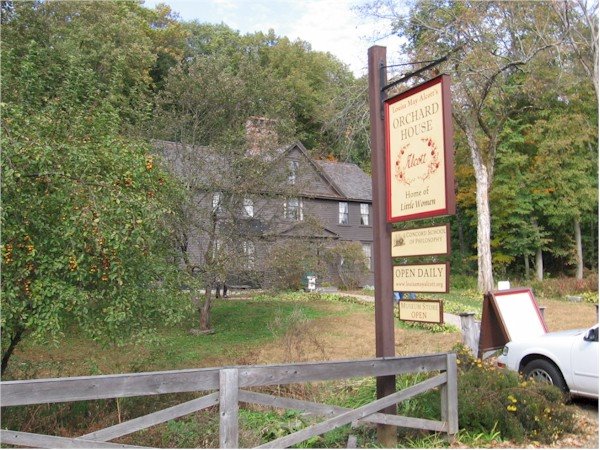
Orchard House is wonderful.

Monday, November 02, 2009

An End Of The Year Gift

Another one of my obsessions, Louisa May Alcott, will be getting an American Masters special on December 28 at 9 PM. Evidently we're going to learn that she was another unhappy writer.

Is there any other kind?

Tuesday, November 18, 2008

Some Alcott Info You Won't See At Just Any Litblog

When I was at Orchard House last month (Orchard House being the Concord home of the Alcotts, of course), my traveling companion noticed the property survey hanging on a wall. Being someone who is in to surveys, site plans, etc., he noticed the surveyor's signature.

Well, now you can see said survey, too. Click on the plan, scroll down to the bottom, and you'll see that the surveyor was Henry D. Thoreau.

The Concord Free Public Library has a whole array of Thoreau's surveys available on-line.

I'd gotten the impression that he didn't do a whole lot. I've just started rereading Walden (because you just can't be reading too many books at once), and in that first essay I feel (as I did when I first read it, according to my notations) that he doesn't hold working folks in much esteem. Seeing that he really did meaningful work--that could come into play in twenty-first century title searches--may have an impact on my reading of his book.

But is that a good thing? Shouldn't the meaning and significance of his work be right there on the page in front of me regardless of what I know about him?

Ah, a question I struggle with frequently.

Nonetheless, surveyors are cool.

Sunday, October 26, 2008

My Transcendent Day

Well, yesterday I finally went walking around Concord, Massachusetts, presumably in the very spots many transcendentalists walked before me. There is so much transcendentalist stuff to do in Concord! We're going to have to go back.

We left the center of town and walked out to the home of Nathanial Hawthorne. We didn't have time to tour that spot, but will hit it another day because not only did Hawthorne (who, I must admit, I'm not wildly enthusiastic about) live there, but the sign out front says Margaret Sidney, who wrote The Five Little Peppers and How They Grew also put in some time there. On top of that, the place looks old and intriguing.

We did stop next door at Orchard House, where Louisa May Alcott lived with her family. I had toured the place once before many years ago, but you can't tour Orchard House too many times. Our tour guide was fantastic, too.

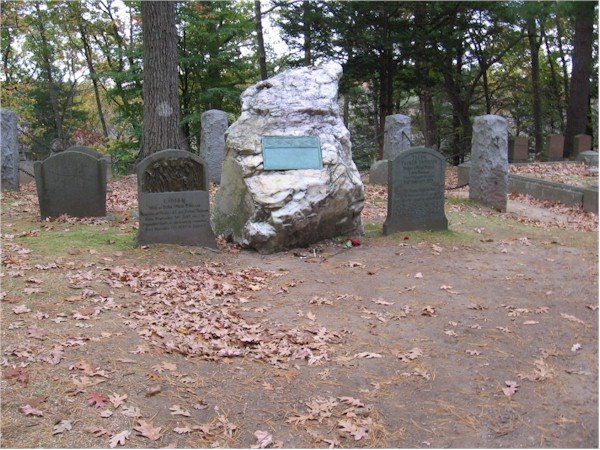
We were meeting someone late in the day, so we had to hustle back to the center of town and drive to the Sleepy Hollow Cemetery instead of walking. The cemetery contains an area called Authors Ridge where you can find a number of famous dead writers all in one place. It really is an impressive place, because it's both beautiful and modest.

Though I'm a big Alcott fan, the most thought-provoking spot at Authors Ridge yesterday was Ralph Waldo Emerson's grave, not because of the grave itself but because someone had left him a gift--a fresh rose was lying in front of the headstone. We wandered about a while and noticed another couple visiting the Emerson family plot. When we went back to get a picture, we found that in addition to the rose, there was now a small piece of paper with writing held down with a stone on top of the grave.

What an incredible tribute because the guy has been dead for something like a hundred and twenty-five years.

By the way Eden's Outcasts: The Story of Louisa May Alcott and Her Father by John Matteson won this year's Pulitzer Prize for Biography.

For more images on the Transcendentalists in Concord, check out my The Transcendental Writers of Concord Pinterest board

Friday, June 20, 2008

Captain Kirk's Connection To Kidlit

William Shatner has been in the news a bit lately because he has a new book out. This morning, I was thinking of Little Men, I had been reading about The Shat last week, and all of a sudden the two unrelated mind-threads came together.

Well, by way of Little Women, anyway, because Wild Bill played dear Professor Bhaer back in a 1978 television version of that story. Scroll down at the link I just gave you, and you'll see him in the very first row of images. (Shouldn't he have had a beard?)

If you scroll down to the fourth row, right in the center, you'll see a youngish man talking to a big hat. That's John de Lancie before he played Q on STTNG.

I have actually seen this version of Little Women, though, of course, I was very young at the time.