Showing posts with label 2011. Show all posts

Sunday, October 31, 2021

A Good Mean Girl Book

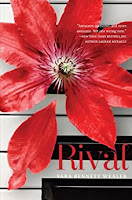
First I would like to share how I happened upon Rival (now available in a very affordable e-book) by Sara Bennett Wealer, because it's another example of social media at work. And working.

This fall, I became involved in a fascinating discussion on Facebook about a  literary fight that was getting a lot of press at the time. Sadly, I love that kind of stuff. None of the people involved in the discussion were people I actually knew because I, like many writers, am Facebook friends with many authors I don't actually know. We're all networking. After engaging with them for a while, I thought, Who are these people? I looked up a few and tried to find their books in the e-book library system I use. Sara Bennett Wealer's Rival was there, and I ended up with a very good read. 

Two Great Things About Rival

  1. The two rivals are not rivals for high school status but for top honors in a major, high quality singing competition. These young women are highly talented and trained singers. They have something very interesting going on in their lives beyond who-gets-to-sit-at-which table in the cafeteria. They have a passion and an interest beyond the next dance. The character who we would probably consider the bully in this story doesn't even care that much, or maybe even at all, about the high school social world she dominates. She wants to win the singing competition and impress her father. Because if there is one thing we've learned from the second season of Ted Lasso it's that everyone has daddy issues. The character we would consider the victim needs the competition scholarship money. She does not keep her eye on the real price as much as she should
  2. It's hard to tell who the real bad guy is here. As I said, Queen B, the pseudo-bully, really doesn't care about things like the important dance after the football game. She cares about singing. Whereas the victim, who needs to win the competition for college money, bends over backwards to get in good with the clique around the bully. In fact, she does one thing I think most people would consider criminal and for a very shallow reason. Then there's a third character, a member of what we'd usually consider the mean girl clique, who is highly active behind the scenes. She might have a little sociopath thing going on. I now want to read more books about characters in her position. What the heck kind of life are they living and making for themselves? 

The Music Is A Great Asset

I am not a fan of teen friend angst stories, especially when related to cliques, mainly because if you've read one book about that, you've pretty much read them all. However, adding a talent to work with for the two main characters makes them so much more interesting. And I don't even know anything about singing. Wealer does. According to her website, she sang in choirs as a teenager and majored, at least for a while, in voice performance in college.

She makes great use of her knowledge in Rival and does some interesting things with what could have been very cliched characters.

Friday, April 03, 2020

YA Historical Thriller...Ah...Mystery

The Girl is Murder by Kathryn Miller Haines was one of my thriller/mystery reads. Reading it met an objective for one of my 2020 goals. 

The Girl is Murder, published in 2011, reads like the set-up to a series, and a second book about its main character, Iris Anderson, was published in 2012. Iris and her father have hit a bad patch financially. Mom killed herself, and we're not sure what that was about. Pop lost a leg at Pearl Harbor and while the war continues, he is trying to make a go of it as a private detective. Things are not going well with that, and he and Iris have had to board with a nice landlady in a lesser part of town. Iris has also had to leave her private school to attend a public one. She wants to help with the family business. Dad says no. When a hot classmate turns up missing, Iris starts a hunt, anyway.

I didn't find the mystery here that compelling or interesting, particularly since Iris, herself, didn't solve it. And it was kind of anti-climatic.

The historical setting was pretty amazing, though. Haines, who writes adult mysteries as well as the two Iris Anderson volumes for YAs, appears to specialize in the World War II era. Not having been there, myself, I can't say that she's got that period down pat, but she sure creates an impressive world, right down to voice.

I believe that as far as world-building is concerned, historical fiction rivals science fiction. The Girl is Murder proves my point.

When I've been writing here about mysteries and thrillers, I've been using the term interchangeably. Mystery, Thriller, or Suspense: Does the Label Matter? by Stacy Woodson at DIY MFA suggests I shouldn't.


Sunday, December 03, 2017

Thanksgiving Weekend Reading

I had a fun reading experience over Thanksgiving. It was picture book weekend with a young family member.

Hide and Seek by Ill Sung Na. Because my guy really likes to play hide and seek.


Ready, Set, Build! by Meg Fleming with illustrations by Jarvis.
This was my reading buddy's favorite. We read it twice. Possibly because the main character is blue.

Thanksgiving at the Tappletons by Eileen Spinelli with illustrations by Maryann Cocca-Leffler. I haven't found many good Thanksgiving books over the years. I don't know what the issue is. This one about Thanksgiving dinner going awry I liked.

Polar Bear Morning by Lauren Thompson with illustrations by Stephen Savage. I picked this for the illustrations. Lots of blue. Seriously. The other reader likes blue. A lot.


Mouse Paint by Ellen Stoll Walsh This is a lovely combo of story, art, and even a basic color lesson that you hardly feel is a lesson at all.

Where's Wallace? by Hilary Knight. I snatched this one up because our reader loves to hunt for images in pictures. And he is good at it. Where's Wallace has quite a bit of text for a search book, but the great thing about it is that when we were stuck for time, I could edit it down and get us right to the illustrations, which is what we were interested in.

I was looking forward to my Thanksgiving reading, and these picture books delivered.

Wednesday, April 13, 2016

What Self-publishing May Be Good At

Why am I writing about Due North, an adult mystery by Melanie Jackson? Three reasons, people.

  • It's self-published, as is the eBook edition of Saving the Planet & Stuff, which I am featuring here this month. (See how I just managed to mention Saving the Planet again?) From time to time, I try reading a self-pubbed book, in an attempt to provide a little support for authors doing what I've done myself.
  • Due North is the best self-published book I've read to date. 
  • And, finally, it's an excellent example of the importance of world-building in a realistic, nonfantasy/scifi story.


The Story


Due North is set in the remote Canadian town of McIntyre's Gulch. We're talking remote in a not- everybody-has-a-phone-or-even-a-radio-connection-to-the-outside-world remote. In a you-might-not- see-your-neighbors-for-a-few-days-during-a-snowstorm remote. In a there-are-only-two-church- services-a-month-when-a-person-of-the-cloth-comes-by remote. The red-headed residents of McIntyre's Gulch come in two varieties--McIntyres, who are related to one another, and "self-selected Joneses...transplants from the outside: refugees, outcasts, and sometimes actual outlaws." The McIntyres come by their red hair naturally. Some of the Joneses "owe a debt to L'Oreal and Clairol." Which I assume they must have to have flown in. I can't recall why the outsiders choose to go red, unless they're trying to blend in with the natives and thus not draw attention to themselves.Which they all have reasons to want to do.

This is a rough crowd choosing to live in a rough climate, because they need to get away from it all. A disturbance comes their very well-drawn world when a plane falls out of the sky. It's not so much the plane that's disturbing as what's in it. The McIntyres and the Joneses respond about the way you'd expect them to. And the owner of the plane's contents responds about the way you'd expect him to.

I have to say, it is often a chore to read self-published books, something I do to try to make myself feel as if I'm doing good. That was not the case with Due North at all. It was an enjoyable read.

The Traditional Publishing Problem


I can understand, though, why traditional publishers would have a problem with a book like this. It's described as being part of the Butterscotch Jones Mystery Series, though it's not really all that mysterious. It's also described as representing "a new genre of cozy thrillers." I don't know if thriller readers are looking for cozy. This book and its sequels are on the short side, too. In its paperback edition, Due North is only 123 pages. Some of the other books are even shorter. Maybe it would be better to call this a short, eccentric, caper story.

My point being that traditional publishers would probably have a problem fitting this book into a marketing niche. They wouldn't know how to sell it. Publishers are in the business of selling books. If they don't know how to sell one, it logically follows that they wouldn't see much point in publishing it.

What Self-publishing May Be Able To Do


When self-publishing works well, with good writing, editing, and production, it may be able to provide a home for books like Due North. I'm talking books that are square pegs that won't fit into round holes and can't be sold with a tried-and-true marketing plan that everyone's comfortable with. In this best of all possible self-publishing scenarios, the reading public would be offered more options, options they can't find in traditional publishing.

You'd need a self-pub reading market that knows these kind of quirky books exist, of course, and how to find them. I believe I stumbled upon Due North in my Twitter feed. Someone tweeted that the eBook was only 99 cents, so I took a chance on it. It was worth the gamble.


Saturday, January 23, 2016

Some Storm Reading

I took these two books north with me on retreat week, where I saw nowhere near as much snow as I'm seeing now. And nothing like my readers in the mid-atlantic states are seeing. But those of us in New England know that there are many up sides to snow. One of them involves sleds.

Sledding by Elizabeth Winthrop with illustrations by Sarah Wilson is a story in verse about the incredible effort it takes to get ready to go sledding. And then once you get out there...

The only words in Red Sled by Lita Judge are the sounds various creatures make while enjoying a red sled whose young owner left it leaning against the house. A great narrative told only in pictures with a neat surprise ending.

Read about sledding this weekend and then, when you're not shoveling snow, go out and do some. Though, quite honestly, when I was a kid, we called it sliding.

Friday, October 16, 2015

A Vacation Zombie Story

I had a little trouble sticking to A Girl of the Limberlost while I was on vacation, because I was also reading Dust & Decay by Jonathan Maberry. It's the second book in his Rot & Ruin series. I liked the first book, Rot & Ruin, for its western genre overtones and because it's one of the few apocalyptic novels I've read in which a second generation is fed up with the status quo and wants to move on.

While Rot & Ruin was a Wild West story with a lone lawman character, Dust & Decay is more of a lost in the Badlands tale. And, once again, the zombies are not the worst things main character Benny and his crowd have to contend with.

Thoughts on structure: Lots of point-of-view switches. As I've said before, I'm often bothered by point-of-view switches. They slow down narrative drive for me. That was not the case here. I noticed that many chapters were short, only a scene. I thought, Gee. Is this something I should try?

I got so into this book that while we were walking across the desert-like terrain of Dune National Lakeshore in Michigan, I kept wondering how the ol' zoms would fare there. Would that be a relatively safe place for humans? If the humans could stand it?

I was quite unhappy with how things turned out for one particular character who shall remain nameless. Yet, as a writer, a writer of books for young people, I think it was a very wise thing to have done.

So that was some good vacation reading. Good enough that when I got home, I picked up Flesh & Bone, Book 3. Now, Flesh & Bone would probably be considered a journey story, except that Benny and his guys are stopped dead in their tracks by post-apocalyptic religious creepies who are fighting among themselves. Our heroes are facing one disaster after another, all in the course of a day.

Interesting points: Fascinating thing the author did with that situation I was unhappy about in Book 2. Plus, Mayberry does a very good job with creating characters who are different from one another. Lilah and Riot, for instance. They could easily have ended up being mirror images. I realized while reading that Chong is truly different from Benny. All this is probably important to me because I just read a recent adult novel with a lot of buzz in which the three narrators sounded so much alike that I thought I was going to find out that they were all the same person.

Rot & Ruin is an excellent series for older, sophisticated teen readers. I say that not just because the books are grim, though they are, and I mean that in a positive way. They also don't deal with black-and-white situations. As I've mentioned elsewhere, the zombies are often not the worst things that have to be dealt with in this world. They're deadly, but in a benign way. The relationships between male and female characters aren't your traditional teen boy meets teen girl romances, either. These are people who are badly scarred by their experiences and have life-and-death issues they care about beyond who is going to end up with whom.

There appears to be only one more book in this series. I will, of course, be reading it.

Thursday, November 06, 2014

Environmental Book Club

Operation Redwood by S. Terrell French is one of the first pieces of fiction with an environmental setting/theme that I think I've read for this project. It deals with a boy from the city who learns of an endangered old growth forest of redwoods and gets involved with a child-directed initiative to save it. It's very much a city-people-with-money-bad, rural-farm-people-good story. That kind of stereotype is not a big drawback in children's publishing because child readers have not had time to become widely read. Old scenarios are new to them. In fact, Operation Redwood won the Green Earth Book Award in the children's fiction category in 2010. For this adult reader, the most interesting part of the book was the Author's Note in which French, an environmental lawyer, describes the history of redwood preservation, which also gave some idea of the inspiration for some of the events and characters in the book. The novel includes a lot of information and could easily be a reading list staple for school environmental units.

Reading this book raised lots of questions for me about environmental fiction. For one thing, what exactly is an environmental theme? In the case of Operation Redwood, I would say that it's that humans have a responsibility to act as caretaker for the Earth. But what would other themes be? Are there other themes? Is there any way for a writer to use the humans-as-caretakers theme without making it instructional instead of thematic?

And what about my desire to see environmental books that include an immersion in some kind of natural experience? Can you get that particular type of sense of place while working a plot?

How does Saving the Planet & Stuff fit in with all this? Thematically, that book is about having to decide how we'll live our lives. There's an environmental setting. There are environmentalist characters. If there's any kind of environmental theme, I'd say that it's the difficulty of living an environmental life.

Wait! Wait! Go back three paras at which point I asked for other environmental themes! I just came up with one!

Well, I look forward to reading more environmental fiction and obsessing on this further.


Thursday, August 21, 2014

The Environmental Book Club

I think I was on the page 3/4 spread of Swirl by Swirl: Spirals in Nature by Joyce Sidman with illustrations by Beth Krommes when I gasped because of the fantastic concept. I know this business about spirals in nature is something I should have known about, and I had heard of it. But I know a whole lot more now and in such an incredibly easy way.

Sidman explains in an afterward that a spiral is "a shape that curls around a center point. Spirals occur over and over in nature because they work so well in so many ways." In her marvelous picture book she organizes her information around various kinds of natural spirals. Some expand, some protect, some reach out.

What is particularly impressive is that this really is a picture book for the very young. There is only a modest amount of text. In fact, I can imagine sitting with this book and a child and not even reading the text, simply hunting for spirals on the pages.

I'm kind of excited about all my new spiral knowledge.

Monday, June 02, 2014

An Odyssey For Those Of Us Who Don't Care For The Odyssey

I'm not a big fan of The Odyssey. Nasty folks in that story, doing nasty things. The Cyclops has all my sympathy. I appreciate The Odyssey's impact on literature and culture...in a creepy sort of way...but perhaps you can understand why I didn't rush out to read Stickman Odyssey by Christopher Ford.

But Stickman may be my kind of Odyssey. Main character Zozimos is an Odysseus-type in that he is pretty objectionable while managing to pull his sorry, and stick-like, backside out of one mess after another. And there are some references to familiar Odyssey scenes. But there's a great deal that's new here, too. This is quite a different story, if I remember The Odyssey correctly. For instance, I don't think there were any golems in the original work from ancient Greece.

David Elzey compared the Stickman books to Rocky and Bullwinkle's Fractured Fairy Tales. A neat idea.

Monday, March 24, 2014

We'll See Where We Go From Here

I am a big fan of Maureen Johnson's Suite Scarlet, which I described as being a "combination of mainstream fiction and screwball comedy." I sought out her book, The Name of the Star, for that reason and because it was a contemporary thriller. I can take or leave that genre, in general, but I'm interested in it when combined with YA.

I have to say that I found The Name of the Star slow getting started. I'm not giving anything away by saying the story deals with a Jack the Ripper copycat murderer. He's carefully mentioned in each of the early chapters, but those chapters are used primarily to get main character, Rory, established in her English boarding school. I liked the premise behind the Scooby Gang that is hunting the killer, but this particular case seemed a little weak to me.

That being said, The Name of the Star is the first in a series, The Shades of London.  I'm going to pick up a copy of The Madness Underneath, Book 2. As I said, I liked the Scooby Gang, and I think it's possible that after The Name of the Star set up the universe, succeeding books could end up being stronger.

Another interesting point: That slow start I mentioned above definitely makes The Name of the Star YA. It's all about secondary school, getting along with other students, getting away from Mom and Dad, and does that boy like me? It doesn't read like an adult book whose adult protagonist has been replaced with a teenager.

Monday, November 04, 2013

But Where Was Bess?

When I was in sixth or seventh grade, I was a big fan of The Highwayman by Alfred Noyes. No idea how I stumbled upon that in one of my one-room schools. I was on Team Bess. I remember next to nothing about the highwayman, except, of course, that he came "riding--riding...up to the old inn door." "Bess, the landlord’s daughter, Plaiting a dark red love-knot into her long black hair" was so clearly the hero of this thing.

Many years later, I would read a critique that suggested that The Highwayman wasn't high art. I was stunned, stunned I tell you.

You can understand, therefore, what drew me to The Highway Rat by Julia Donaldson with illustrations by Axel Scheffler. Get it? Highwayman? Highway Rat? The book is about a...well, highway rat...who rides a horse and steals food. The story is told in verse with some of the same style as The Highwayman. "I am the Rat of the Highway, The Highway--the Highway..."

There's no Bess, though. There's no romance for junior high readers to get excited about. Yes, that's probably because this is a picture book for much younger children.

If you want to overthink this, and I do, The Highway Rat is quite a deep book. Highwaymen were thieves and murderers, not romantic heroes. The rodent highway rat is probably more true to life in that sense than the human highwayman of the poem.

Friday, October 04, 2013

One Of The Reasons I Like Cybil

Stupid Fast by Geoff Herbach was the 2011 Cybil winner for YA fiction. It illustrates one of the reasons I like the Cybils. Stupid Fast is not a a paranormal romance or fantasy or part of a dystopian or apocalyptic trilogy, all of which attract big sales. Nor is it a heart-warming overcoming-adversity-in-a-small-town-filled- with-eccentric-characters-story, which attract awards. It has the overcoming adversity thing but with an edge, maybe even a desperate edge. Books like Stupid Fast don't fit into the standard marketing molds used right now.

Neither does the Cybils. It is made for books like Stupid Fast. The book was well reviewed, but I would never have heard of it without its Cybils win. What's more, it has two sequels that I only heard about a couple of hours ago when I started preparing this post.

Felton Reinstein is limping through adolescence when he suddenly starts to grow. And that growth spurt makes him fast. It's a life-changing event because his speed makes him desirable to the coaches at school as well as to the student athletes who had never been part of his world before. Felton is evolving. He is in transition. He's in a liminal state, as the anthropologists might say, he is most definitely in some state that is neither one thing or another, neither child nor man.

This makes Stupid Fast so a YA book. I say that because it's not unusual for me to read a YA book that is perfectly decent as a story, entertaining, but what about it is YA? You definitely know why Stupid Fast is YA.

Now, while Felton is doing his transitional thing, he is living with a parent who is descending into mental illness and a brother who is in need of help in dealing with her. It's as if he's living two different, simultaneous lives, one in which he is becoming more and more desperate, and another in which he is becoming more and more competent and part of the world outside his home. Something similar happened in Alice Bliss where Alice was dealing with her father's deployment while continuing to grow up, because that's what adolescents do. Adolescents have to grow and change. They can't help themselves. It's the nature of the beasts.

I think someone could argue that Stupid Fast's ending is a little too much of a turn around. A deus ex machina type character shows up to make everything right, and things work out really well for Felton. But this adult reader also felt that Felton could have his good moment because things weren't going to stay that way for him. If I ever get around to reading the sequels, I suspect I'll find out that I'm right.

While reading Stupid Fast I kept wondering about YA problem novels versus the adult equivalent. Stupid Fast probably could be described as a problem novel. When adult novels deal with characters with problems, what are they? Are they ever referred to as problem novels or as something else?

Wednesday, August 07, 2013

Wit Really Can Take You A Long Way

First off, U.S. Skulduggery fans: No, these books haven't been published here. I ordered them from abroad. Hey, the U.S. publishing world gave up on this series and didn't want me to read these books, but I got around them. I feel like a the main character in a spy movie. Yeah, Angelina Jolie taking down the man.

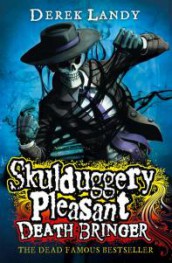
My niece lent me the two Skulduggery Pleasant books I bought for her in March. To be honest, I found them slow getting into, in large part because there's more and more of a serial aspect to these stories now. In fact, when my niece handed them to me, she said, "They're really getting into cliffhangers." With a serial, it's hard to bring yourself up to speed if you haven't read the earlier books recently. There's a wide array of bad guys in the Skulduggery Universe, and, personally, I can't keep track of them over a long period of time. For instance, somebody named Lord Vile becomes important (again, I guess) in Death Bringer, and while the name rang a bell, that was all it did for me.
Both books did develop a certain...magnetic...aspect, though, drawing me back to them over and over. In large part, this is due to clever conversation. I would be hard put to recall the basic stories in any of these books. Many characters, however, are marvelously entertaining. Skulduggery Pleasant is a standout, of course, and he has had a big impact (some would say a bad influence) on his sidekick, Valkyrie Cain, who is the real protagonist in this series. But a wide array of secondary and even minor characters are clever and funny. Scapegrace the zombie, for instance. Valkyrie's parents. Her nitwit cousins. Clarabelle, who doesn't appear to be the brightest light in the sorcerer world. In fact, I'm not sure how she came to be part of it.

Wit and humor are what carries these books. The plots, no so much. The sixth book, Death Bringer, includes an incredibly clever thread (I hate to even call it a subplot) that rips into Twilight's Edward Cullen big time. It's brilliant. I appreciated it a great deal. But it really doesn't have anything to do with the book's basic story, which involves an attempt to kill half the world's population. In fact, this book has a torn-between-two-lovers scenario that I suspect only exists so Landy can make fun of Twilight. Hey, I love making fun of Twilight as much as the next person. More than its many fans. But here the pleasure I took from the humor was distracting.

Here's a fascinating thing that's happening in these later Skulduggery Pleasant books: Valkyrie Cain is becoming more and more unpleasant. I suspect that some of this attitude of hers was always there, but she's now becoming just plain nasty. She has a sort of shadow person who lives her mortal life for her so she can be off saving the world from paranormal bad guys without upsetting the folks. By the fifth and sixth books, Valkyrie is treating it like...yeah, mud, let's say. We may find at some point that this is due to some kind of envy because the duplicate gets to be part of the family Valkyrie has to leave, but in the meantime, Valkyrie is really awful to it. She's pretty dreadful to the two boyfriends. She has the...mud...beaten out of her by a character who is seeking revenge for all the cruel taunts Valkyrie has directed toward her in the past. Valkyrie doesn't seem to get that she had a part in bringing that down upon herself. She tosses around the words, "Shut up" and "Moron" as if they are fine examples of witty repartee, which they most certainly aren't, in case anyone is wondering, not even here. She is turning into a very unlikable main character. 

I like that. I find it intriguing. Where is Landy going with this? Or is he going anywhere with it? Does he find her as unlikable as I do, or does he, indeed, believe, "Shut up" is the soul of wit?

I suspect that Landy is intentionally going dark and unlikable, because I recently learned he has started a new series featuring Tanith Low, a character from the Skulduggery Pleasant Universe who went over to the side of evil in a big, big way. He is doing a whole series with a main character who is a bad guy. This flies in the face of Writing 101, where writers learn that protagonists must be likable so that readers will want to identify with  them. This is fascinating.

I now want to know how dreadful Valkyrie is going to become. I broke down and ordered book seven in the Skulduggery series, Kingdom of the Wicked, which just goes to show that unlikable characters can sell books.

Monday, April 15, 2013

My World Book Night Book

World Book Night is a week from tomorrow, and a couple of days ago I finished reading The Language of Flowers by Vanessa Diffenbaugh, the book I'll be giving. I chose this book on the recommendation of a family member. As it turns out, the protagonist, Victoria, is a young woman in her late teens who has just left the foster care system. We follow two story lines in alternating chapters, one about Victoria's childhood involvement with Elizabeth, the foster mother who teaches her the language of flowers, and the second about her experience as she tries (or I should say, is almost forced) to make a life for herself. The young character makes this a book of particular interest to me, because I like to ponder the differences between a children's/YA book with a child/YA character and an adult book with a child/YA character.

Flowers is a good book in which Diffenbaugh, a first-time novelist, shows a lot of control. For instance, in places she teeters on the edge of what I like to call the Magical Mommy, treating motherhood as some kind of mystical experience that has the potential to cure all. But she juuuust pulls back. Victoria is also only able to maintain herself because she happens to run into people who take to her and offer significant help. Coincidence is never good in fiction, but I was able to accept it here because the people who help her are outsiders. (And maybe because my experience of the world suggests that many young people like Victoria only succeed at all because someone helped them help.)

Diffenbaugh also does a good job showing why  Victoria is filled with anger and does ugly things. In lots of books with characters like that the behavior is just there without enough development to make what they're doing make sense. Readers are expected to accept it and move on with the story.

What readers of this blog might find particularly interesting about this book is that while it's an adult book, I thought it seemed very much like a YA problem novel--a teenager, usually a girl, has a specific problem that, after much struggle, she overcomes. If you removed the Victorian language of flowers from The Language of Flowers, I think it would have seemed even more like a bare bones YA problem novel.

I think this is a novel that could end up on library book lists for teenagers, just as I thought Alice Bliss would.

Thursday, December 06, 2012

More From Ivy And Bean, Two Of My Favorite Girls

I have been a fan of the Ivy + Bean books by Annie Barrows for years. As I said back in 2007:

"Bean could be described as a Junie B. and Clementine type of child in that she tends to go her own way. Her creator describes her as "loud and wild." The difference between Bean and the other leads in the big, girl series is that Bean is comfortable with who she is. She isn't always anxiously interacting with adult characters who reassure her in some way or are involved in helping her learn a reassuring lesson. Most of Bean's interaction is with another child and not adults. She interacts with Ivy, her co-lead, who, superficially, is your stereotypical quiet little girl.

Yeah, your quiet little girl who is into magic and potions, and who is sharp as a tack. Talk about still waters running deep." 


Their eighth book, No News Is Good News, is more of the same, and the same is very good. Ivy and Bean want to take part in a school fad that requires money. Their first plan to make some involves selling potions that Ivy would make. Surprisingly, that doesn't work. So they fall back on creating a neighborhood newspaper, as Bean's father did when he was young. They grasp the concept of selling subscriptions right away. That they will have to provide something to the people who paid up comes as something of a surprise to them. They also struggle with the concept of "news."

Yes, stories about child-run newspapers have been done before. But not with Ivy and Bean.

Ivy + Bean No News Is Good News is a Cybils nominee in the Easy Readers/Short Chapter Books category.


Monday, July 23, 2012

Louise Rennison Is Always Good For A Laugh

My very second blog post back in March, 2002 related to Angus, Thongs, and Full-Frontal Snogging. I am a serious Georgia Nicholson fan. If I'm going to read a book about boyfriends and shopping, Georgia better be in it.

Georgia's creator, Louise Rennison, has an excellent new series out, about Georgia's younger cousin, Tallulah. Tallulah could be said to have a little more depth than Georgia. Her interests  involve more than boys but not to the point that it ruins her sense of humor.

In Withering Tights Tallulah is off to Yorkshire, home of the Brontes and the school for performing arts where she's putting in a summer session rather than do an Outward Bound course with her brother. What, exactly, is Tallulah's performing talent? Ah...well. She and her friends have read Wuthering Heights and Jane Eyre, though, and are capable of some really clever Heathcliff and Mrs. Rochester jokes. In the Glossary at the back of the book, Tallulah defines Heathcliff as "The 'hero' of Wuthering Heights. Although no one knows why."

I found the boy interests in this book a little more touching than I recall feeling about Georgia's many, many, many interactions with boys. Everything's still funny, but there's also an underlying feeling that these are more realistic young people moving on in life.

Happy Day! I am coming late to Tallulah. She already has a book of second artistic adventures, A Midsummer Tights Dream.

Plot Project: Hey, this book starts with a disturbance to Tallulah's world--she's off to a performing arts college where she must board with a local family she's never met and meet all new people. The artistic types at the school...the Brontes... This is a plot that definitely seems to me to have evolved from its original situation.

Wednesday, July 11, 2012

Bradburyesque

I have finally read some Shaun Tan, and I do like his work. Tales From Outer Suburbia, in particular, reminded me of the Ray Bradbury short stories I read in my early teen years. My uncle Mickey, a college graduate who married into the Gauthier family, had an enormous trunk filled with paperback books. Once when my parents, sisters, and I were visiting him and my aunt in the old house their were living in up in the mountains, he opened that treasure chest and pulled out a couple of Bradbury books to give me. They, along with To Kill a Mockingbird, were among the first adult books I read.


My recollection of the Bradbury short stories, and his book Dandelion Wine, a particular favorite of young Gail's, is that they were small town stories about things that just weren't quite every day. And that's how I read Tales From Outer Suburbia and Lost & Found, too, though in this day the action shifts to suburban towns rather than whatever small towns used to be back when Bradbury was writing.

Tan tells his tales in part with visuals, making his books picture books and seemingly for the very young. I see them more for older readers, older children, as I was when I first read Ray Bradbury, and adults.

Check out Shaun Tan's essay PICTURE BOOKS: Who Are They For?, in which he addresses the question "Who do you write and illustrate for?" Among the things he has to say while trying to come up with an answer: "I suspect that much art in any medium is produced without a primary concern for how it will be received, or by whom. It often doesn’t set out to appeal to a predefined audience but rather build one for itself. The artists’ responsibility lies first and foremost with the work itself, trusting that it will invite the attention of others by the force of its conviction." He also says, "What makes art and literature so interesting is that it presents us with unusual things that encourage us to ask questions about what we already know. It’s about returning us, especially we older readers, to a state of unfamiliarity, offering an opportunity to rediscover some new insight through things we don’t quite recognise (as it was for all of us in the very beginning)."

I think that's a very good explanation for why adults like picture books, in general, and Tan's books, in particular. The strangeness of both Tales From Outer Suburbia and Lost & Found do make the familiar unfamiliar, much as Ray Bradbury's short stories did years ago. 


Wednesday, May 23, 2012

Talk About A Disturbance To A World

Daughter of Smoke & Bone by Laini Taylor could be described as both a romance and a fantasy, neither of which I enjoy reading. I did like it, though, and I think it might be because this story also has elements of mystery. What happened? Who is the main character, Karou? Why is the guy with the wings always hanging around her?

Recently I read about story secrets, and this story has three good ones that I'm aware of. Two I wasn't even thinking about, they just hit me, and a third I realized was a secret but I was wrong about what the secret was.

Karou is a seventeen-year-old art student in Prague. She, a human, was raised in an alternative world by four creatures who physically would be considered monsters. She moves back and forth between the human world and her "family's" magical one, often called by Brimstone, a father figure, who sends her on errands to collect teeth. Soon after being attacked by a beautiful stranger with wings, she's cut off from Brimstone and her other loved ones. Her plan is to get back into her old world and find her family.

A couple of factors make this more than a traditional boy-meets-girl story. For one thing, Karou has a journey thing going apart from the romance. For another, she's a person whose identity is unknown to herself and us and slowly revealed to both character and reader.

This was one of those books that became distressing as I approached the end because I realized that it was going "to be continued," as it says on the last page. It's the first in a projected trilogy. Quite honestly, though, I would have been fine with the ending of this book being all we get.

Plot Project: I most definitely think this is a disturbance story rather than a  think-up-a-problem-to-lay-on-a-character story. Karou straddles two worlds--one of them is then shut off to her. That is a first-class disturbance. It gives an author all kinds of opportunities to ask and answer questions. Then you've got the business about the mysterious flying stranger showing up. Again, classic disturbance. It is at the point where these two things happen that the story action actually begins.


Wednesday, April 11, 2012

I Would Watch This Movie

Au Revoir, Crazy European Chick by Joe Schreiber   sounded like a movie thriller when I saw the review for it in The Horn Book  a while back, which is why I sought it out. Hey, I like thrillers. It also reads very much like a movie, so it's not surprising to read that movie rights sold around the same time that the book was accepted by its publisher.

The book is an entertaining mash up of two genres. First you have your traditional (or stereotypical) YA story of an older teen boy getting ready to head off to college soon and having problems with his successful, powerful, and demanding father. And, of course, the boy is in a rock band. Secondly, you have your traditional (or stereotypical) violent assassin who is actually seeking revenge for some terrible wrong. We've all read or seen those stories before. Putting them together in one place makes them if not actually new, at least more interesting and fun.

Okay, I feel a little bit of guilt about finding murder fun. Or, actually, I feel a little bit of guilt about not feeling guilty about it. But, it's a book, right? Lighten up, Gail.

Crazy European Chick has a lot of narrative drive and a wonderful female character who can always be counted on to pull a razor out of a sock or a helicopter out of thin air just when one is needed. She's not actually a YA character, the male lead is the YA character, but she's the one who makes the book.

Plot Project: This is definitely a plot that is dependent upon a disturbance early on. Young Perry is just your regular upper middle class YA guy who has been wait-listed at Columbia and is a member of a rock band. Then his mother and pushy father force him to take their incredibly dumpy eastern European exchange student to the prom. Gobi has big plans for prom night, but none of them have anything to do with dancing or going out drinking later. She needs Perry to drive her around from hit to hit in his father's fast, expensive car. Once Perry's life is disturbed, he's got to deal with the consequences for the rest of the book.

Wednesday, January 04, 2012

Not A Lot That Was New

I was a big fan of The Adoration of Jenna Fox by Mary E. Pearson. I found the sequel, The Fox Inheritance, to be a lot more traditional dystopian future story.

My recollection of Jenna Fox is that it was a more complex and subtle story, without clear bad guys. The Fox Inheritance has a very archvillain type of character, and he is a scientist. Scientists are often the heavies in dystopian novels. The main characters are being pursued through a Big- Brother-can-see-you kind of world. I didn't feel I was seeing a lot there that I hadn't seen before.

There were some aspects of the book that I wish had been developed more or even had become the focus of an entirely different story. Two secondary characters have been alive for hundreds of years. One has outlived her husband by a long, long time. The other has buried six of them. So what would that be like, outliving everyone you know, over and over again? I wish Pearson had written that book. Though, of course, that probably wouldn't have been YA.

Plot Project: Sometimes when I'm speculating about plots, I have to wonder about the initial idea for the story. I'm speculating here that Pearson wanted to write about two characters who are sort of just referred to in The Adoration of Jenna Fox. This may have been a story that began with characters. Then the author had to come up with a situation for them, and then a plot. I would have found that a difficult thing to do.