Showing posts with label mysteries. Show all posts

Tuesday, October 14, 2025

Getting Serious About Humor: More Humor With Mystery

Timmossholder on Unsplash

I picked up The Mystery of the Crooked Man by Tom Spencer while browsing at a library, and I'm blogging about it now because I really need to get it back there. One of the book's blurbs described it as "riotously funny," and while I wouldn't go that far, main character Agatha Dorn is extremely drole in a bitter way that I enjoyed very much. 

In my inept study of humor writing I have found very few truly funny works of fiction. They tend to involve wry point-of-view characters and how they perceive what is happening in the story. Perhaps what I should learn from this is that humor in fiction is usually about character, not situation or plot.

Of another humorous mystery, Everyone in My Family Has Killed Someone by Benjamin Stevenson, I said, among other things, that the narrator's inner life contributed to the humor. The same is true of the main character in The Mystery of the Crooked Man. Agatha might argue that she doesn't have much of an inner life or much of a life at all, which ends up being far funnier than you'd think it should be.


Of course, any readers of mysteries, or at least any readers of a certain age who have been reading mysteries for a long time, are going to raise their brows at a main character named Agatha in a mystery novel. Agatha Christie has become as famous for being Agatha Christie, Mystery Author, as she is for being Agatha Christie the author of mysteries, if you follow my thought there. She's sort of transcended her work. 

Now that I think of it, you probably don't need to be a reader of mysteries to know who Agatha Christie is and to note the use of that unusual first name in a book. 

Here is an interesting bit from the The Mystery of the Crooked Man that casual readers may not get and is not a spoiler: Agatha Dorn is a museum archivist who is a specialist on an author from the Golden Age of Detective Fiction named Gladden Green. Gladden Green had a real mystery in her life, because she disappeared for a few days while at the height of her career and later turned up in a hotel. This all right out of the real life of Agatha Christie. In case I haven't been clear, Agatha Dorn is a specialist on a character modeled on Agatha Christie. And get this...Gladden Green's husband's name is Archie. Agatha Christie's husband at the time she disappeared was also named Archie. She got another one later.

Now, of course, none of this is particularly funny, but it is fun. Also, is it metafiction? I've never been one hundred percent clear on what that is. 

I'm obsessing.

I must say that I felt this book dragged a little in the middle in terms of plot and mystery. But then it came roaring back with one of the best mystery endings I can recall. I didn't see it coming, but it made perfect sense.

I don't know how Agatha Dorn can come back for another mystery, but I'm definitely onboard if she does.


Thursday, April 10, 2025

Getting Serious About Humor: A Truly Funny Novel

Timmossholder on Unsplash
While reading humor books, I haven't come across a lot of fiction I found truly funny. Until I read A Most Agreeable Murder by Julia Seales. The book's publisher calls it a "cozy mystery," but I think it's a parody. And not a parody of cozy mysteries, though I don't read a lot of those so I can't be sure. I think it's more a parody of the couple-historical-detective series I'm fond of and Pride and Prejudice. There's also a nod to the classic/horror mash-ups that were popular fifteen or twenty years ago. (Side note: My husband, son, and daughter-in-law all agreed to see Pride and Prejudice and Zombies with me, even though none of them had read Pride and Prejudice. We all liked the movie.) 


A Most Agreeable Murder
is such a good parody, I wonder if people unfamiliar with what is being parodied will get it. Must be they do, or enough do, anyway, because a sequel is coming in June.

A Note About the Pride and Prejudice References in A Most Agreeable Murder


Many years ago, I read an essay in which the author noted that while Mrs. Bennet in Pride and Prejudice is portrayed as shallow and foolish and only interested in finding husbands for her daughters, she is also entirely correct. Without husbands, her daughters will be in dire straits when their father dies. They will have no income, they won't even have a home. While Mrs. Bennet is going all over the neighborhood frantically trying to find men to take care of her daughters, because in the world they live in they need men, her husband is portrayed as this intelligent, benign soul, disappointed by his choice of wife and burdened with her. Yet he is doing nothing, absolutely nothing, to save his children, leaving all the work to their mother.

Yeah, well the Steele family in A Most Agreeable Murder are clearly the Bennets from Pride and Prejudice, and Mr. Bennet/Steele here gets the treatment he deserves. While Mrs. Bennet/Steele gets a little respect.


A Note About the Couple-Mystery-Detective Series References in A Most Agreeable Murder


The couple-historical-detective series I'm familiar with have all involved heterosexual couples, so I don't know how this would play out with same sex couples. But with the heterosexual couples, the woman is usually (but not always) the main character. The male may or may not have some kind of connection, amateur or professional, to solving crime. The two of them meet in the stereotypical hate-to- love/Pride and Prejudice manner, end up working together, and, at some point in the series, become romantically involved.

The male characters fall into a particular predictable pattern. While manly and intelligent and superior in some way, either through achievement or family status, they are always damaged. They had a bad war experience. (As if there are good ones.) They have daddy issues. They had a bad war experience and have daddy issues. They have migraines. They have migraines and daddy issues. They've had bad experiences with women. They've had bad experiences with women, and they have daddy issues.

They are damaged while the female character is not. Other than being female, of course.

I'm recovering from a couple of mild illnesses, so I'm not going to try to unravel what's going on with that situation. But, certainly, something is.

What I'm getting to here is that Inspector Drake in A Most Agreeable Murder plays to the damage business in a very obvious manner, if you're aware of the damage trope/cliche. And another less obvious manner, which I won't mention because I don't want to give it away.

Some Other Random Thoughts


The unsavory cousin who is set to inherit the Steele daughters' house out from under them and is a variation on the same character in Pride and Prejudice was terrific, though I might have found him over-the-top, if I didn't know the parody business going on with him. 

The multiple murderer possibilities were well done. 

The fart joke was excellent, in large part because it was so incongruous.

This is a funny book that also has quite a decent mystery. I definitely look forward to the next book in what may end up being a series.


Thursday, November 30, 2023

Some Annotated Reading November 30

True Biz by Sara Novic is one of those books that has such a long waiting list on Libby that by the time it turns up for me, I've forgotten why I placed the hold. It takes place in a boarding school for the deaf and deals with a multitude of teenage things, but, additionally, two methods of communication for the deaf, sign language or ocular implants. Interesting point: I often complain about books for the young that appear to be written to teach them something, claiming that I don't see that in adult books. This book does seem to be written to teach adult readers something, it just seemed to do it really well. Or perhaps it's just that the deaf community is something I know very little about, so being exposed to it was fascinating.

I was looking for mystery/thrillers to read and Gone Girl by Gillian Flynn had been on my Kindle for some time. I bought it on sale, but because I'd seen, and liked, the movie years ago, I didn't bother to read it. I bothered this month, and it is a very good read. I rewatched the movie this past weekend. The ending of the book is much grimmer than the ending of the movie. Interesting point: Writers often read that they must have likable characters, certainly a likable main character. One of Gone Girl's main characters is unlikable and the other is a psychopath. Yet Flynn pulls it off.

So then I decided to read one of Gillian Flynn's earlier books, Dark Places. Holy Moses, it makes Gone Girl look light and fluffy. Interesting point: Talk about unlikable characters! This one has some unlikable child victims. Again, Flynn pulls it off.

Another interesting point: All three of these books use multiple points of view, something I didn't realize was used that much in adult work. With Flynn's books, in particular, you really get different voices with the different point of view characters, something I think doesn't happen a lot with YA and middle grade, in which the characters often sound alike.


Wednesday, October 02, 2019

Boarding School Book Number 1

I picked up Truly Devious by Maureen Johnson because it falls into that YA mystery/thriller category I'm interested in this year. Additionally, I've read other books by Johnson that I've liked. What's more, this book deals with a contemporary character who is trying to solve a mystery in the past. I just happen to have a completed unsold middle grade manuscript with that scenario.

Stevie Bell has been accepted into Ellingham Academy in Vermont, which she wants to attend because of the murders connected with the place back in the 1930s. She's interested in becoming a detective and solving the Ellingham Academy case, she believes, will bring her closer to her goal.

I like the historical period in which the murders occurred. Yes, it's true. I have many historical periods I like...so long as they're nineteenth into twentieth centuries.

The setting for this book is great for me, too. Stevie and her parents start out on I-89 from Burlington. I was just there at the end of August! I've done the I-89 route many times over the years. And when they get off the highway onto a "smaller road dotted with stores and farms and signs for skiing, glassblowing and maple sugar candy?" I bet that's the road that goes past Waterbury to Stowe.

Truly Devious works for me in almost all ways. My main complaint? It's the first in a serial. I've enjoyed serials in the past, but mainly completed ones that I could binge read. I will admit, I will keep my eye out for Book 2, The Vanishing Stair, which was reviewed in the March/April The Horn Book. The reviewer highly recommends reading Truly Devious first, though she also says it's a "fulfilling second volume."

And, she says, information is held back for a third volume.

Well, I'm hoping to get my hands on a copy of The Vanishing Stair in the next month or so. Which I guess is why serials exist.

This is, as I said, a YA mystery/thriller, part of my study of the genre. What am I taking from this? So far, the romantic or physical attractions in this book do not overwhelm the story or world, as they so often do. The romances seem to exist because this is a teenage world, and teenagers do this sort of thing. There is a logic to it. It becomes part of the setting.

Thursday, September 19, 2019

YA Thrillers

I am just beginning a new project, a YA mystery or thriller that I'm working on in order to have new material to bring to my writers' group. As part of getting myself pumped up for this, I've been reading the occasional YA mystery or thriller.

How I Would Love An Island Retreat


The Kindle edition of We Were Liars by E. Lockhart turned up on sale this past spring. It's main character, Cadence, belongs to a stinking rich extended family that has a multi-house compound on an island. Before the book starts, something happens to Caddie. She just doesn't know what.

As I began reading this atmospheric novel, I thought, I want a multi-house compound somewhere--an island, anywhere--for my family. Later, I began to think, Hey, why don't any of these kids have summer jobs? Sure, they're stinking rich, but you'd think they'd want jobs as a way to strike out on their own. Then I thought, Wait a minute. Why don't any of their mothers have jobs? Sure, they're stinking rich and all, but you'd think they'd want jobs just for something to do.

Turns out, these were significant questions.

And that's all I can say about this book, because not knowing much is a big part of what makes it enjoyable. It's enjoyable enough that I picked up another Lockhart book, Genuine Fraud.

Ah, What's Going On Here?


Turns out, I'd read Genuine Fraud before. It didn't hurt my enjoyment of this book. This was one of those deals where I remembered each event in the story as I got to it, but couldn't recall what was coming up.

I don't really feel I can say much about this book, because, as with We Were Liars, not knowing what's going on is a huge part of what's good about it. How bad is the bad guy here? How good is the good guy? I can say that a very intriguing aspect of this book is that it's essentially written backwards.

And What Did You Learn From This Reading Experience, Gail?


Theme. I read once that that is an important part of what makes YA YA, and I think it's the case here. With We Were Liars the YA theme involves place in and connection to family. With Genuine Fraud the YA theme is who am I? Who am I going to be?

Oh, also. It's good...maybe even great...to have a big reveal at the end of the story. The story, in fact, is about the reveal.

Saturday, February 17, 2018

A YA Historical Mystery

Anyone familiar with what I call nineteenth century historical mysteries? Obviously they are mystery series set in the nineteenth century. Some examples: 1813 or so--Sebastian St. Cyr Mysteries, 1890s to post WWI--Amelia Peabody, 1890s--Veronica Speedwell, 1880s or 90s--Gaslight Mysteries (Hillary Clinton's a fan). My Kindle is heavy with these things. The ones I read usually have a female and male amateur detectives or an amateur combined with a professional detective. The ones I read also have some kind of romantic tension and then involvement between the male and female leads.

Well, The Lost Girl of Astor Street by Stephanie Morrell reads to me like the first entry in one of those series. Except for being YA. And set in the early twentieth century.  I would not describe it as "Downton Abbey in downtown Chicago" the way one of the blurbs does. It has a lot more story than that show ever did.

Piper Sail (eighteen years old, on the high end for YA) is the daughter of a well-known defense lawyer in 1920's Chicago. A lawyer with Mafia clients. (This is hardly Lord Grantham we're talking about.) When her best friend disappears, Piper gets involved in the hunt for her. She also gets involved with the hot, young Italian cop on the case. And who, guess what!, also has Mafia connections. Piper is one of those women who is trouble because she won't stay in her place. Mariano, an outsider to both his Mafia family and WASP Chicago culture, can tolerate her.

They are a couple made for a historical mystery series.

Friday, January 20, 2017

2017 Edgar Award Nominations For Juvenile And YA Books

Best Juvenile


Summerlost by Ally Condie (Penguin Young Readers Group – Dutton BFYR)
OCDaniel by Wesley King (Simon & Schuster – Paula Wiseman Books)
The Bad Kid by Sarah Lariviere by (Simon & Schuster – Simon & Schuster BFYR)
Some Kind of Happiness by Claire Legrand (Simon & Schuster – Simon & Schuster BFYR)
Framed!
by James Ponti (Simon & Schuster – Aladdin)
Things Too Huge to Fix by Saying Sorry by Susan Vaught (Simon & Schuster – Paula Wiseman Books)


Best Young Adult


Three Truths and a Lie by Brent Hartinger (Simon & Schuster – Simon Pulse)
The Girl I Used to Be by April Henry (Macmillan Children's Publishing Group – Henry Holt BFYR)
Girl in the Blue Coat
by Monica Hesse (Hachette Book Group – Little, Brown BFYR)
My Sister Rosa by Justine Larbalestier (Soho Press – Soho Teen)
Thieving Weasels by Billy Taylor (Penguin Random House – Penguin Young Readers – Dial Books)

These awards are named for Edgar Allan Poe (I've got a post coming up on him some day) and given by the Mystery Writers of America.

Check out the other categories.

Tuesday, February 16, 2016

Cybils Middle Grade Finalist: "Book Scavenger"

Codes! Attempted murder by nitwits! Hidden books! A chase through the streets of San Francisco! Musicians in a van! Edgar Allen Poe! A treasure hunt!

Got your attention yet?

In Book Scavenger by Jennifer Chambliss Bertman, our main character, Emily, has moved once again, this time to San Francisco. She's not a fan of the moving, but she's not a vagabond because her family is running out on bills or one of her parents puts a career before loved ones or any of the usual kids' book reasons for that kind of thing. She's a vagabond because that's her parents' lifestyle. They like to move, and the kids go with them. This is Emily's personal problem in this story.

San Francisco is a great place for her to land, though, because it's the homebase of a publisher who runs a Book Crossing type on-line book finding game that Emily loves. No sooner does she arrive than he is shot, his survival left in question. And he'd been about to release a new game, too. Emily can't let that go.

Will she find the new game and solve the puzzles involved with it? Will we find out who shot the publisher dude? Hey, and what's with that teacher?

I believe two more Book Scavenger books have been accepted for publication.

There's no Time Management Tuesday this week, so I can attend to all the Middle Grade Cybils finalists.


Monday, April 14, 2014

An Adult/Children's Book Mash-up

I have been a fan of Flavia de Luce, the eleven-year-old protagonist of a series of adult mysteries set in England in the 1950s, for a long time. I've also wondered why she hasn't received more attention from the YA world. Her most recent adventure, The Dead in Their Vaulted Arches, isn't my favorite, but it is a great example of why Flavia, created by Alan Bradley, is such an incredible combination of adult and even children's fiction elements.

Flavia has an incredibly unique, sharp voice, and she's extremely knowledgeable about a sophisticated subject, chemistry. While she jumps on her bike and has the kinds of adventures that are the stuff of children's books, that voice that adult readers love so much might not be acceptable to child readers. Adults like her because a child shouldn't sound like she does or do the things she does. Child readers might just find her unbelievable. Adults don't care about believing her. Adults like that this brilliant child knows nothing about sex. In this most recent book, she thought she could use her massive knowledge of science to bring someone back from the dead. It was a childish belief that adult readers would find touching. Child readers, on the other hand, might not get that this attempt on Flavia's part was more about character than plot.

I also suspect that Flavia isn't an entirely reliable narrator when it comes to her family. She perceives her sisters as hating her, but they have routinely come through for her over the course of the series. And in this volume it's clear that she hasn't understood her father's behavior toward her. I'm not aware of a lot of unreliable narrators in children's books or even YA.

In all these books a mom has been missing--a classic children's book situation. In The Dead in Their Vaulted Arches, we get an actual dead parent. Children's literature is littered with those. What is really fascinating about Vaulted Arches, though, is that here we get a child suddenly learning that her family has a special function and that she is chosen--not those others--to be part of it. This is a cliche of children's fantasy, and there is almost a whiff of fantasy about Flavia at that point.

So what have we got here? While these definitely aren't children's books, do they have enough children's elements to bring young readers into the world of adult reading? 

Alex Waugh of The Children's War has also been writing about Flavia.

Monday, November 26, 2012

May Have Revived My Interest In Sherlock Holmes

I've written about Sherlock Holmes quite a bit  here over the years. As I've often said, I read the Holmes books when I was a youngish teenager, but as an adult, I don't know why kids are fascinated with him. The publishing world certainly is, but child readers? I don't get it.

I put off reading the Enola Holmes books by Nancy Springer because, without recognizing a child/Holmes connection, I didn't feel any compelling need to read a Holmes story about his younger sister. I wasn't very hopeful.

Well, I stumbled upon the last book in the series, The Case of the Gypsy Good-bye, and, since the author and I are Facebook friends for some reason, gave it a try. Wow. A marvelous book.

This series appears to have had an arc involving Enola's (and Sherlock's and Mycroft's) mother disappearing. Enola has been on the hunt for her and while doing so has taken on her own cases. She's also been on the run from Sherlock and Mycroft because, since she's only a female in her early teens and they are the men of the family and this is the Victorian Era...Well, you get where I'm going with this.

It was incredibly easy to come up to speed with that back story. Additionally, this volume includes a mystery that really is well done with a marvelous solution, especially for those of us interested in women's history.

The writing is just incredible. Enola's first-person narration makes her sound like a young woman from another time, which is exactly what she's supposed to be. The historical world-building is fascinating without becoming a tedious lesson in what it must have been like to live in nineteenth century England. The detail...Well, I've already said incredible, haven't I?

And Springer uses the world Suffragist. SuffragIST and not SuffragETTE, which would have been considered derogatory. I would have forgiven a lot, just for that one point. But I didn't have to forgive anything.

The publisher lists this book as being for ages 8 and up. I found it in the YA section of my local library, where I believe it belongs, if only for the sophistication of the historical world and voice.


Wednesday, September 19, 2012

Agatha Christie Agrees With Me

In a newly published essay that she wrote back in 1945, Agatha Christie indicates that she is not a fan of Harriet Vane, the character some of us believe brought down the Lord Peter Wimsey mystery series. A Guardian article on the essay claims Christie says that Wimsey "became through the course of years merely a 'handsome hero', and admirers of his early prowess can hardly forgive his attachment to, and lengthy courtship of, a tiresome young woman called Harriet".

Yeah, Agatha, that's pretty much it.

I would argue that the Wimsey/Vane relationship became a model for other characters in other mystery novels. For instance, Ramses and whatever that woman's name was that he pines after for volumes in the Amelia Peabody books.

I read the Lord Peter books when I was in college, as a new adult. I see many lit bloggers talking about the series. In fact, it was a children's writer/lit blogger Facebook Friend who linked to the Guardian story about Christie's essay. But I don't know if new adults actually read them, or any so-called "golden era" mysteries, anymore.

Monday, December 27, 2010

YA Vs. Adult Themes

I've written before about the Holmes on the Range books by Steve Hockensmith, because I felt that, thematically, they'd be of interest to older YA readers. You know, the YAs old enough to tolerate plenty of foul language and dead bodies in sad states.

The first three books, I thought, dealt with twenty-something young men (one all the way to twenty-seven) who were seeking a place in the world, deciding who they wanted to be. The whole Who am I? thing works for YA readers.

I just finished the fourth book, The Crack in the Lens. It's still fine reading (Hockensmith does some great work with the word "fudge."), but thematically it's different from the earlier books. Old Red, who still hasn't reached his thirtieth birthday, is no longer intent on becoming a deducifier like his hero Sherlock Holmes. Now he's wondering if he made the right choice in turning his back on cowpunching in order to become a detective. Do Holmes' methods even work? Yeah, there's plenty of whore talk in this volume, but it's the looking back and worrying about regret that make this book more adult than the earlier ones.

What am I going to be?/looking forward--YA

Did I make the right life choices?/looking backward--Adult

Hot damn. There's a new Holmes on the Range story coming out next month.

Tuesday, October 13, 2009

A Possible Crossover Book


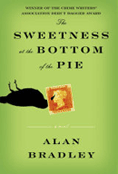
You know, lots of times I'll hear some book has won an award. I go ahead and read it and am left thinking, Gee, was nothing else published that year? That's not the case with the truly terrific The Sweetness at the Bottom of the Pie by Alan Bradley, which won the Crime Writers' Association Debut Dagger Award in 2007. Anything that could have beaten it would have had to be incredible.

Imagine a noncriminal Artemis Fowl in a book with an intellectually vigorous style similar to that of Octavian Nothing that is set in an English village that you might find in one of Dame Agatha's 1950's era novels. And then imagine that that the book you're talking about is very well-written on top of all that.

You're beginning to get the picture.

The Sweetness at the Bottome of the Pie is an adult mystery novel with an eleven-year-old main character, Flavia de Luce. She is one serious piece of work, the youngest child of what seems to be a depressed, country gentleman/stamp collector and his late, lamented wife who disappeared in the mountains years before. She has two older sisters, Ophelia, who plays the piano (classical music, of course) and Daphne who reads Dickens, with whom she is at constant war. They all live in a house the family has inhabited for generations, and Flavia has taken over an ancestor's personal laboratory. She is seriously into chemistry. She is extremely witty in a dark, brittle sort of way. And, yet, she is also innocent.

A body turns up in the cucumber patch. You can take it from there.

Setting this book in 1950 was a stroke of genius. Flavia is a bit over-the-top. Oh, hell, she's a lot of over-the-top, which is what makes her so marvelous. But no one could begin to believe she could exist in the twenty-first century. Her extensive knowledge of...all kinds of things...could only be acquired in a world without TV, malls, dance lessons, sports, and, it would seem, traditional schooling. (School is never mentioned.) And, for me, a big stumbling block with child mysteries is the fact that kids can't get around places on their own. But Flavia's always jumping on her old bike and pedaling off all over the place. It's believable in a pre-suburban world. I have ridden my bike to the library and even a church tag sale, but it's a huge undertaking, taking a big chunk out of my day. Traffic being what it is, I'm taking my life in my hands every time I do it. But in Flavia's world, it works.

The Sweetness at the Bottom of the Pie is the beginning of series. While I'd be delighted to spend more time with Flavia, I've often been disappointed with follow-up mysteries. She may be able to pull this off, though.

This series could definitely have crossover potential for sophisticated teen readers who enjoy literary humor.

Tuesday, March 10, 2009

Adult Books For YA Readers: Point Of View, Voice, And Distance

The kidlit publishing world loves, them, their first-person narrators. They're all over the place in children's and YA books. I can tell you from first-hand experience that a first-person point of view is a quick and dirty way of creating a strong voice, something that's also liked in kidlit. Not that there's anything wrong with that. Who doesn't enjoy reading a book with a strong voice, whatever your age? In kidlit, first-person narrators sometimes sound a lot alike, though. You've got your smart girls, your wise-ass boys, your angst-ridden teens, your smart, wise-ass girls, your wise-ass, angst-ridden teens, your precocious smart, angst-ridden kids of either gender.

To be fair, it's hard to come up with anyone who hasn't been done before--a lot.

Related to point of view and voice, at least in my mind, is distance. One of the defining elements of a children's or YA book (to my knowledge, anyway) is that the action is taking place now. Those first-person narrators are living their experiences as they are relating them to us. Adult characters recalling their childhoods usually appear in adult books because there is an adult sensibility at work. These adults are now distant from their childhood selves. The adult narrator has knowledge of what happened after the events in the story, which child narrators living in the moment do not.

All of this relates to the adult books I'm talking about this week. They both use a first-person narrator with a strong voice. Their narrators are quite different in terms of their distance from the events they're relating to us, though.

The Dead Father's Club's eleven-year-old first-person narrator, Philip, uses a very strong voice that speaks to us in a sort of stream-of-consciousness manner. We're not talking Virginia Woolf To the Lighthouse stream-of-consciousness here. But Philip doesn't waste any effort on quotation marks for dialogue or apostrophes for contractions, and his mind does tend to jump from one thing to another. This appeared to me to be an attempt to duplicate the thinking of a child. I'm not sure how successful the author was with this, because I can't recall how eleven-year-olds think. Does this narrator sound like a child or does he sound the way adults think children sound? Don't know.

Philip is, though, both funny and tragic. It seems to me that he could serve as a gateway narrator, a child leading teenage readers, particularly students of Hamlet, into the world of adult mainstream fiction.

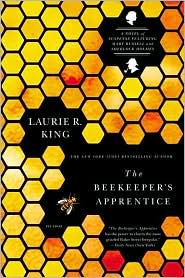
Mary Russell of The Beekeeper's Apprentice also has a very powerful, first-person voice. She is very distant from the World War I era story she tells, though, since in an "Author's Note" she indicates that she is now in her nineties. She makes it clear that she is dealing with memories. The very first words of the first real chapter--"I was fifteen when I first met Sherlock Holmes"--indicate that this story is not happening now. And her knowledge of what is going to happen definitely has an impact on what she tells us, as when she says when introducing a case she and Holmes take on, "...had Holmes...not allowed me to participate, God alone knows what we would have done when December's cold hit us, unprepared and unsupported." Russell knows what's coming, and it's bad.

Mary Russell, whether the elderly story teller or the teenage protege of Sherlock Holmes, is an extremely intelligent and highly educated individual who speaks in the elegant, sophisticated manner of another age. She is no Georgia Nicholson or Holden Caulfield wannabe, that's for sure. Why would the book she narrates be of interest to young readers?

Because point of view, voice, and distance are not the only things that attract readers to books. You also have to consider theme. And tomorrow we will.

Monday, March 09, 2009

Adult Books For YA Readers: What's With Mysteries?

The Beekeeper's Apprentice, one of the two books I'm stuck on this week, is as much a character study as it is a mystery. But it most defintely is classified as a mystery. It is spun off from the Sherlock Holmes mystery classics, after all. While my second book, The Dead Father's Club, is main stream fiction (its original material is Hamlet, remember), for me it developed a mysterious element. While I accepted the truth of what dead dad had to say at the beginning of the story, I began to wonder if he was all that reliable. Did Uncle Alan really do him in? Is he really a bad guy?

Child readers are notorious mystery lovers, and adult mysteries are often bridge books into adult reading, as Jen Robinson has said. (I kind of like the expression "gateway books," myself.)

Why the attraction to mysteries?

I think kids find mysteries comforting. At the beginning of very traditional mystery novels, the social order has been disrupted. A body has been found in the library. Jewels have been stolen. Someone has disappeared. At the end, the social order has been restored. The perp has been tracked down. Justice has been done. Things go back to the way they are supposed to be. What a relief.

Kids are instructed to stay in line. To be fair. To follow the rules. They have been taught to maintain order. They're comfortable with order. This may be a factor in tattling. What, exactly, is wrong with tattling? Why do we dislike it so much? All the tale bearers are trying to do is restore the order we've taught them to maintain.

With a mystery novel, kids can safely explore a disordered world because it's not the world they actually live in. The detective restoring order at the end of the story provides a satisfying conclusion. The world goes back to the way kids have been taught it should be.

An adult mystery that follows that pattern provides young readers with familiarity--the pattern itself. It also gives them the impression that the adult world is orderly like theirs. Grown-ups aren't supposed to do certain things, just as children aren't supposed to do certain things. If adults do them, justice will be done, and the adult world will go back to the way it's supposed to be.

A lie, of course, but that's beside the point.

Sunday, March 08, 2009

Looking For Adult Books For Younger Readers

I am frequently attracted to adult books with child and YA protagonists. I'm very interested in how books with those kinds of leads end up being published as adult lit versus kidlit or vice versa. I'm also interested in whether or not those adult books could be of interest to nonadult readers. I think it was at Read Roger that I once read that one of a YA librarian's responsibilities is to lead adolescent readers to adult books. I'm certainly not a YA librarian, but I do like the idea of books that will lead kids into the grown-up world. (Because the adult world is such a terrific place and everyone should want to be here, right?)

I recently read two fine adult books with child-ish characters. Oddly enough, they're both books that jump off from older works. (This isn't all that odd, because I like those kinds of books. It's a little bit odd that I happened to read one right after the other.)


In the first, The Dead Father's Club by Matt Haig, poor eleven-year-old Philip Noble is haunted by his dead dad who insists that Uncle Alan did him in because he wanted the pub and Philip's mum. In order to save dad from an afterlife with something called the Terrors, Philip needs to avenge his death by killing Uncle Alan. Very good book that I would have enjoyed much, much more if I knew more about Hamlet, upon which it is based. I'm not even sure I've ever read the original source material, though I did realize that Philip's fish being named Gertrude is a joke.

The second book, The Beekeeper's Apprentice by Laurie R. King, was recommended just a couple of weeks ago by Jen Robinson. The beekeeper of the title is Sherlock Holmes. His apprentice is Mary Russell, a young woman in her late teens with whom he develops an intense father/child relationship.

Both these books could be of interest to YAs, though maybe to older, more sophisticated readers--and not because young Philip is always going on about mum getting sex from Uncle Alan and the questions that are raised in The Beekeeper's Apprentice about Holmes' willingness to disguise himself in women's evening gowns and the content of the photograph of him at a Turkish bath. Voice, theme, point of view, and some other stuff I'm interested in discussing with a captive audience as well as some subjects I may not have thought of yet, should all be considered when determining which audience is most likely to go for a particular title.

So over the next few days, Gail is going to make like Mary Russell at Oxford and do a little study of these two books and how they could engage teen readers. You have been warned.

Monday, February 09, 2009

A High Class Mystery


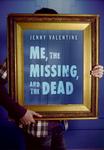
I like a British YA voice. I think it's because of the novelty of hearing someone talk about a "bloke fancying my mum" and "tenners." So I was taken with Me, the Missing, and the Dead by Jenny Valentine right away. I did wonder if there is a first-person British YA voice that sounds similar in many British YA books the way there's a first-person YA voice over here that most definitely makes a lot of YA books sound alike. But I decided I didn't care.

Lucas, our first-person British YA voice in Me, the Missing, and the Dead, could easily have ended up as the protagonist in a traditional problem novel. Dad is missing. Mum is depressed. Older sister is behaving badly. Younger, fatherless brother never knew Dad, having been born after he disappeared. Grandpa has dementia. Grandma's a corker but falls and breaks something so you know how that's going to go. Family friend is an alcoholic. Girlfriend's mother has cancer.

I mean, seriously, this is the kind of book I usually find laughable because of the problem pile on. Let's not miss anything.

But Lucas has that great voice, and he has a mystery to solve. The problem-ridden characters are just that--characters and not set-ups for some kind of coming-of-age learning experience. The adult characters, in fact, are so incredibly multi-layered that Me, the Missing, and the Dead could easily serve as a crossover book, a great title for an adult/teen reading group.

Right off the bat Lucas stumbles upon an urn of ashes that has been abandoned in a taxi company's office. Feeling for the neglected occupant, he manages to get custody and becomes obsessed with it. And, slowly, he realizes that the ashes that were once an elderly woman have a connection to his own father's disappearance.

There's a little twist of what might be called magical realism in this otherwise dark, deep mystery told with attitude. And Lucas could be said to have evolved as a result of his experience solving the puzzle of the urn. But the mystery is the point here, not some story of a child learning to live with a sorry state of affairs.
Jenny Valentine has another book coming out next month, Broken Soup.

Tuesday, January 20, 2009

Vacation Reading: Book One, An Adult Mystery With YA Appeal

I took a sabbatic from reading kids' books while I was on vacation. And, yet, three of the books I finished have a kid connection of one sort or another.

For instance, On the Wrong Track by Steve Hockensmith has what I would call a thematic connection to YA. On the Wrong Track is the second in the Holmes on the Range series, Western mysteries set in the 1890s. Our narrator is twenty-year-old Otto "Big Red" Amlingmeyer, a cowboy who wanders with his twenty-seven-year-old brother Gustav "Old Red."

Seems pretty remote from twenty-first century YA readers, doesn't it? Well, the thing is, Gustav wants to be more than an illiterate cowpoke of few words. He wants to be a deducifier like his hero, Sherlock Holmes. And his little (though physically quite enormous) brother, Otto, wants to write up their adventures and publish them like Dr. Watson did Holmes'.

Though these two red-headed brothers are twenty-somethings, they seem younger (to the extent that people who are handy with guns and foul language can seem young) because they're trying to determine who and what they're going to be. In this book, they run into a burned out, dime novel hero who is not what he once was and maybe never was. They have to deal, each in his own way, with a young, very intertriguing, woman. They are confronted with disappointment and all kinds of road blocks in pursuing their goals.

I'm not saying that On the Wrong Track is a YA book, but it deals with issues that are common in YA novels and that should have appeal for YA readers.

I also think that On the Wrong Track is a good historical novel. Many historical novels for younger readers are what I'd describe as unbalanced. A lot of attention has been given to the historical setting but characters are often underdeveloped or cliched and plots are weak. My own guess is that children's and YA historical fiction is viewed as being educational. Such books are supposed to teach something about the period and are given a pass on other elements.

The Holmes on the Range books, however, provide a strong setting, terrific characters who are at home in that setting, and real plots. Okay, a lot of those terrific characters use realisitic, coarse language, so you might not want to be the adult who hands off one of these things to a delicate twelve year old. But mid-teens will have heard it all before, and a good historical mystery could open their minds to the opportunities historical novels offer.

Tuesday, November 11, 2008

Possession For Kids?


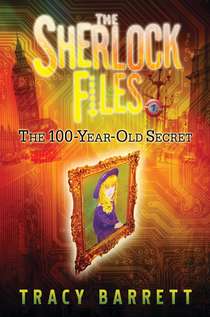
The 100-Year-Old Secret by Tracy Barrett is the first in a series called The Sherlock Files because the two main characters, Xena and Xander Holmes, learn they are descendants of Sherlock Holmes and set to work solving one of his unsolved cases.

I found the Sherlock Holmes connection problematic. Anyone familiar with Sherlock Holmes will doubt he had any descendants because, 1. he was fictional, and 2. in the stories he doesn't come close to having any kind of relationship that would produce offspring. (That includes Irene Adler.) So for the basic premise of The Sherlock Files to work, some kind of alternative history needs to be provided in which Sherlock Holmes is real and did, indeed, produce heirs. Nothing like that appears in the first volume. There are references to some Holmes' stories--a pub is named The Dancing Men, for instance, (The Adventure of the Dancing Men ) and Dr. Watson's young descendant has red hair (The Red-Headed League), but beyond that, I didn't see any what you'd call world building.

Now, an argument could be made that young readers won't be familiar with Sherlock Holmes, anyway, so they won't have any problems with the lack of logic behind the story. But if they aren't familiar with Sherlock Holmes, why does the whole Holmes' business need to be there?

Putting the Holmes' set-up aside, I actually liked the art history mystery in The 100-Year-Old Secret. The kids hunt for a portrait missing for a hundred years. The art talk is interesting. And the minor, nonrecurring characters who provide information about the long-dead artist are far more realistic and able to hold this reader's attention than the members of the Society for the Preservation of Famous Detectives, who I suspect are going to turn up in later adventures. A story about contemporary characters solving a mystery about a historical arty figure--with kids--has real potential, I think.

I picked up The 100-Year-Old Secret because I thought it looked like a mystery for younger readers. Though Amazon describes it as being for 9 to 12 year olds, I think kids on the younger end of that range will appreciate it best.

The second book in the series will be published next May.