Showing posts with label literary fiction. Show all posts

Monday, November 19, 2012

No Vampires, Werewolves, Fairies, Zombies, Or Any Other Paranormal Beings. Just Real Kids In A Good Book.

Summer for teenagers is supposed to be a fantasy of dream jobs in dream places with dream people. Teenagers know that because they've read it in books. In reality, summer is frequently far more like what the four characters in The Unbearable Book Club for Unsinkable Girls by Julie Schumacher experience. They're stuck in town without their friends because that's the way things fell into place. They're injured, like Adrienne, The Unbearable Book Club's main character. Or they're in trouble with their parents, like CeeCee the well-to-do snotty girl. Or they're high achievers working away at their ho-hum summer jobs like Jill because they have goals they're going to meet. Or, like Wallis, they're from families in which teenagers don't get to do any of the fantasy dream stuff that shows up in YA books.

I guess I would have to say that this book is basically about four girls without much to do who are thrown together for the summer. The frame for the story is the AP English mother/daughter book club that three of the girls' yoga-loving mothers put together for them. Over the course of the book, the girls read four novels that scream AP English. ( I had an AP English student living in my house not too long ago. Yes, he had to read The Awakening, just as these girls do. ). Bits of the books relate to what's happening to the girls in The Unbearable Book Club. It could be argued that not much does happen to them, which, to me, is in large part what makes this book so believable. Lots of times, not much happens to us. Schumacher writes about not much happening very, very well.

And yet someone dies in this book. As Adrienne says in her introduction, "Book clubs can kill you."

Adrienne is a marvelous character because she's having a rough summer in which she does modestly unsavory adolescent things without a whole lot of justification for her behavior. That happens. Okay, sure, she's never known her father, but why pick this particular summer to let it get to her? Because a bottle of gin just sort of fell into her lap. And, yes, that's how things happen in real life.

I loved CeeCee because she's the stereotypical mean girl, but she isn't. Over and over in books and movies I see that same cliche. Here the cliche gets a working over. CeeCee reminded me of Dalia in Suburgatory but way smarter. She has a sophisticated wit. Don't believe she could get into AP English reading just the summary of books on-line, the first couple of chapters, and then the end? I've known people who got through college reading like that. And they did well there. It can be done.

This is a marvelous, mainstream novel that could be another crossover book. I'm surprised it didn't get nominated for a Cybil or for one of the Goodreads awards that are being voted on now.

I've just read that Unbearable Book Club's author wrote an earlier, adult novel, The Body is Water, about Adrienne's mother sixteen years earlier. I love the idea of using characters in two different books, even in two different genres.

Tuesday, January 25, 2011

We Might Call It A Sophisticated Mystery


I am not fond of traditional problem books, which I see as validating themselves because they are about something really, really important. A problem. I particularly dislike those books that pile on problem after problem to make sure we all get the point about how serious they are. Jellico Road by Melina Marchetta involves a lot of problems. To make matters worse, when a librarian friend saw me leaving with the book, she told me she'd cried over the ending. That is not my idea of a recommendation.

I didn't cry over the ending of this marvelous book, but I came damn close.

The many problems the many charcters in Jellicoe Road suffer through are not there to instruct us on how people should deal with their trials. Instead, they are there to support character and plot. They explain why characters behave the way they do, and each ordeal is literally part of the plot in this story of a tough, witty, capable seventeen-year-old girl who appears to be alone in the world but most definitely is not. Taylor appears to be caught in an age-old battle among three groups of teenagers--the private school students like herself, the Townies, and the Cadets who are just in the neighborhood for a few weeks. Really, she is in paradise, a pardise that is slowly revealed to her along with the story of another group of students, Townies, and Cadets who had lived in that very spot nearly eighteen years earlier.

This is a demanding book. The story of the earlier kids is told by means of a manuscript that Taylor has been reading out of order. It takes time to work out those kids' relationship to each other. We have to also work out what they have to do with Taylor, something that I was sometimes able to figure out before she did--but in the most satisfying way.

There are also multiple mysteries here. In addition to Taylor's personal mysteries and the mystery surrounding the earlier teenagers, there is a serial killer at work here, maybe some arsonists, and a tunnel keeps coming up. Everything is resolved, nothing is forgotten.

How good is this book? It's good enough that its weaknesses don't stop the narrative drive. Why don't the adults in the book tell Taylor more about her life? Everybody seems to know and to be keeping things from her. Isn't the manuscript a little contrived? Isn't the crisis at the dorm at the end of the book a little over the top? Hey, let it all go, and enjoy the ride.

Jellico Road might be a great crossover book between traditional mysteries and mainstream literature. The mystery will engage mystery-loving teen readers, and the quality of the writing will make them want more of the same.

Plot Project: Several times in the book, Taylor talks about what she wants. More. More from everybody. Is this a case where the author gave her character something to want and then came up with a plot by throwing in stumbling blocks to getting it? I don't think so. Come on. More? Plus there are too many threads here for something so simplistic as roadblocks to happiness to have kept things running. My guess is that this is a book that started with a situation. You've got this group of kids involved in this elaborate war that in reality is a game that enables them all to interact together, and they start learning about another group of kids who were doing the same kinds of things twenty years before. From there the plot is all about revelation. One revelation leads to another revelation and then another.

Wednesday, April 14, 2010

An Interesting Read, But...


The Death-Defying Pepper Roux is another book I picked up simply because I like the author. Geraldine McCaughrean wrote Peter Pan in Scarlet, which I liked a great deal, and I was impressed by Not the End of the World. The Death-Defying Pepper Roux is a rewarding read for a McCaughrean fan. It has a fascinating premise and is beautifully written. I just don't know how kids will feel about it.

Pepper Roux is the story of a fourteen-year-old boy who has been brought up believing that he is going to die on his fourteenth birthday. (There was a Sleeping Beauty aspect to the story, I thought.) He's a good child and has accepted his fate--until the last minute when he tries to escape the notice of the angels and Saint Constance, who he believes are out to get him. The book might be described as picaresque except that Pepper is innocent rather than roguish. He moves from one improbable situation to another where his basic goodness always comes out. The escapades are not over-the-top enough to be funny, but too over-the-top to be believable. For instance, one character is a crossing-dressing ship's steward. I loved the guy, but it's hard to believe he could have existed in the time and place in which he's been dropped down.

Speaking of time and place, the time setting is vague, which could confuse young readers. It might be the 1950s, since there's a chapter about the French Foreign Legion recruiting soldiers to send to Africa, which I think would have been happening post- World War II. (This indicates that I find the time setting confusing, at least.) It's set in France and is quite...French...with the significance of Pepper's name hanging on the similarities in pronunciation of pauvre and poivre. It's also quite Catholic, with bored priests hearing confessions and nuns' habits being stolen. Hey, a French, Catholic book is just fine with me, and I like to think those aspects of Pepper Roux make it a unique read. But, once again, I don't know how kids will feel about it.

So what we're talking about here is an intriguing, unusual book that may be for more sophisticated child readers.

Plot Project: Now some people might say that this book is about a child who wants to live and that the writer just put in obstacles to his living. I don't think so. I think this book is all about the situation--the child who believes he is doomed but isn't. I think this is obvious to the reader, especially since in many of the episodes Pepper could be said to be in trouble of some sort, but not in danger of losing his life. The plot isn't really causal, by the way. One episode doesn't lead to another, though there are plenty of recurring threads that get picked up along the way.

Training Report: 1,350 words, which is damn fine when you consider that over my last three work days (last Wednesday, Friday, and Monday) I might have just broken 1,000 altogether. I finally was able to do a very small amount of research for another book, and I have a submission ready to go out tomorrow.

Sunday, May 25, 2008

How Come One Writer Shines And Another Doesn't?


Sometime ago, I met a writer who had just published her first book. I set out to read said book, really wanting to like it. I didn't. It started out with a trite situation about best friends separating when one friend was attracted to a new group of girls, leaving her old friend behind. Nothing about the writing elevated the book beyond that cliche. What I was reading was what I sometimes think of as just words on pages. I had to give up on it.

Last week I read All Alone in the Universe by Lynne Rae Perkins, which is also about a girl left behind when her best friend takes up with someone else. It is not just words on a page. It is a lovely book.

How do you explain why one writer can write something you want to read and another can't?

All Alone in the Universe is not just an "Oh, woe is me. My heart is broken" story. It is the entire story of how Debbie either was cut out by her friend Maureen's new friend or merely felt cut out. (I think the fact that Perkins raises a question in our mind about just what was going on gives the book more sophistication.) It is the entire story of how Debbie either was cut out by her friend Maureen's new friend or merely felt cut out and how she lived through that experience and came out the other side.

She didn't come out the other side better than ever. She didn't come out victorious. She just came out the other side. That's pretty much what happens to all of us when we have a bad experience. Some day we get over it. We're not necessarily better people or happier as a result of what happened to us. We're just over it.

Perkins is the author of Criss Cross, a Newbery winner I loved and Pictures from Our Vacation, a picture book of which I am very fond. All Alone in the Universe is an earlier work. Personally, I think it's not quite as accomplished. The wealthy woman and her employee don't seem necessary to me. And I didn't get the long passage at the end of the book in which the adults in the neighborhood get together at Christmas time and talk about doing things for others. I wasn't sure what that had to do with Debbie and her story. But those stumbles aren't enough to ruin the book, by any means.

Like Criss Cross, All Alone in the Universe isn't specific about its setting, but details suggest the events take place in the sixties, just as events suggest the same time period for Criss Cross. Perkins is just a master at evoking the decade of her childhood. (If Wikipedia is to be believed regarding her birthdate.) Whether child readers appreciate her sense of place in terms of time, I don't know. But as far as Universe is concerned, many children will appreciate all too well the suffering of its main character.

Monday, May 07, 2007

Yeah, I Grew Up Feral, Too

And I'm afraid I stayed that way.

Bookseller Chick had a good guest post yesterday by Marta Acosta on the divide between genre and literary fiction. She says, "Because I grew up feral in the wilds of the public library, I never learned the rules about books. No human explained that literary fiction was superior and distinct from genre fiction; no one cautioned me against the acute boredom of a thick literary tome."

And so she innocently read everything.

Sometime in the last couple of months I read a suggestion that literary fiction is, itself, genre fiction. It's a "type" of fiction, a classification, and thus a genre. Sorry I can't remember where so I can attribute it properly.

Sunday, April 01, 2007

More Literary Fiction For Kids?


When I started reading Firegirl by Tony Abbott, the only thing I knew about it was that it was written by a guy from Connecticut. I've had some of my very best reading experiences when starting a book from a position of nearly total ignorance like that.

First-person narrator Tom Bender appears a little dull in the opening pages of Firegirl, and at that point a reader can't be blamed for wondering if she'll be able to stand being with him for very long. His best friend is an obviously shallow classmate Tom clings to because he doesn't have anyone else. Even his fantasy about saving the girl he's attracted to doesn't seem all that engaging...though he does dream of doing it with the help of various small superpowers. Nothing too ambitious for this run-of-the-mill kid.

When a new classmate appears, a jaded reader might begin to worry that this is going to turn into a problem book. The new classmate is, after all, a terribly disfigured girl who is undergoing treatment at a local hospital for the burns she suffered over a large portion of her body.

But Firegirl isn't about Jessica and how she deals with her personal tragedy. No, it's about sadsack Tom and how he deals with Jessica entering his life.

This poor boy is struggling so hard to hold on to his one friend, who really is no prize. At the same time, he is overwhelmed with the desire to do the right thing by Jessica whose injuries are so horrible that his classmates are shaken by her presence.

The intensity of Tom's turmoil and Jessica's family's suffering as well as the mystery around just what happened to her elevate this story well above a traditional what-would-you-do-if-this-happened-to-you tale.

At the end of the book, Tom, himself, says that very little has happened. Externally, he's right. The plot to this book is all inside Tom. A few weeks ago while blogging about another book, I talked about the difference between commercial (above-the-surface plot) and literary (below-the-surface plot)fiction. Firegirl seems to be a very fine example of the latter.

Sunday, March 18, 2007

Or Maybe I Just Live In The Twilight Zone


The coincidental occurrence of events that seem related but can't be explained as having some kind of conventional causal relationship is known as synchronicity. I know this because I just looked it up.

Okay, you will all recall, I am sure, that last weekend one of my young relatives and I got going on popular vs. literary fiction. And then, just two days later (Two days is a recurring theme--see my last post.), I stumbled upon a couple of posts on that very subject. (Getting goosebumps?) Nathan Bransford says that in genre (popular/commercial) fiction, the plot tends to be above the surface and that in literary fiction it tends to be below the surface. If I'm understanding his entire post, popular fiction could be said to be about exteriors and literary fiction about interiors.

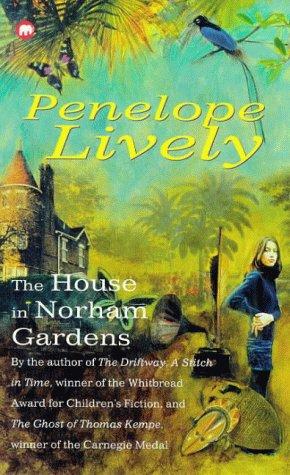
Now, this same week, I receive a call from my local library (not yours, A Reading Fool) telling me that the copy of The House in Norham Gardens by Penelope Lively that I'd requested through ILL had arrived.

Though I'm interested in Penelope Lively, I only requested this book because Michelle at Scholar's Blog is leading a book discussion on it this month.

Have you got all that? Have you got how random it all is? How unconnected?

Everything that happened earlier in the week led up to my reading The House in Norham Gardens. Everything that was discussed in the car and read on-line led up to my reading that book.

The House in Norham Gardens is about a teenager living with elderly aunts in a house the family has owned for four generations. It is filled with stuff from the family, right down to great-grandma's fancy clothes. And including an item that great-grandpa, the anthropologist, brought back from New Guinea--an item that represented ancestors to the people there just as all the old things Clare lives with represent all her relatives.

This may be the most literary book for young people I've ever read. Most definitely, the plot is interior. Nearly everything that happens, happens in Clare's mind. She is changed as a result of the incidents in the book, but they almost all involve her own thoughts. The exterior events that are described are almost all of a very mundane, daily-life variety. The writing is very lush and detailed and focuses on life.

The House in Norham Gardens was originally published in 1974. (The edition I read is not the one pictured here. I couldn't even find mine on the Internet.) As I was reading it, I kept wondering if it would be published today. I don't think it would. We're in love with the first-person narrator now (she said, almost always using a first-person narrator herself), and a "YA voice" that is nowhere near as introspective as it thinks it is. Perhaps A Certain Slant of Light could be described as literary. Maybe The Book Thief. But I can't think of anything I've read that comes close to The House in Norham Gardens in the literary with a big L category.

Is anyone interested in this kind of thing now? Are people prepared to read it?

*The first paragraph of this post was edited because I realized I made a mistake in my recollection of an event I attended. Plus, the material was pointless and unnecessary.

Tuesday, March 13, 2007

Ye Don't Even Have To Seek And Ye Will Find

When I go to a blog like, say, A Chair, A Fireplace & A Tea Cozy, and I read a post about, maybe, Buffy, and I see that that post received 3 comments, I actually read the comments. What's more, if an individual making a comment is someone I don't know, I may very well follow his hyperlink.

That's how I came to stumble upon a post called Confessions of a Reformed Commercial Fiction Slut at a blog called Confessions of an MFA Seeking Writer. That post included a hyperlink to a blog maintained by one Nathan Bransford, Literary Agent and his post What Makes Literary Fiction Literary?

Both these guys said pretty much what I've always heard--commercial/popular fiction=plot; literary fiction=character. But they went into more depth and sophistication. And Bransford, in particular, was respectful of both types of fiction. The stereotype you usually hear about is literary people looking down their noses at commercial people and commercial people getting all defensive because they feel looked down upon.

What really was astonishing about this whole thing--creepy even--is that I was talking/wondering/ruminating about this very topic just two days ago.

Now I must go back and read posts I've found at Bransford's site on whether or not editors edit. That's another subject I've been known to ponder.

Sunday, March 11, 2007

An Interesting Question About Literary Versus Popular Fiction

My computer guy was in a bit of a panic today when he saw that I hadn't posted anything since Thursday. I think he was afraid there was something dreadfully wrong with the blog and that he was going to get stuck dealing with it. Not the case, though.

Part of the reason for my absence was the arrival of a young relative who had the misfortune of being stuck alone in a car with me for an hour yesterday. We discussed his short story writing class.

I, too, took a couple of fiction writing courses while I was in college back in the day, though they were not specifically geared to short stories. He is reading and discussing short stories, not just writing them. I don't recall reading any published fiction in my classes. If memory serves me, we wrote a great deal more than he seems to be doing.

I don't know how I feel about that. Certainly, I didn't get much out of my writing classes. I sort of just floundered around and can't say I learned much of anything. I can't recall discussing point of view, plot, anything at all. Reading and discussing some published works might have done me some good. I definitely don't believe that a person can learn to write simply by writing just anything.

But that is my frustration. Young relative is experiencing frustration of his own because he is a popular fiction kind of guy and college is a literary fiction kind of world. The short stories he's being exposed to are meaningless to him. "Nothing happens," he keeps saying.

All this leads up to the interesting question this young guy asked me in the car: Are there publications that publish mainstream fiction that is not what we call "literary?" There are all kinds of literary journals and The New Yorker for so-called literary fiction. There are all kinds of publications for science fiction and mystery. But are there magazines and journals that publish mainstream fiction that would be described as "popular?" By which I guess we mean accessible.

Accessibility should not necessarily mean without depth. And, of course, obscurity is not necessarily profound.