Showing posts with label Sherlock Holmes. Show all posts

Monday, May 16, 2016

Sherlock Holmes: Nineteenth Century Superhero

Like many young people, I read Sherlock Holmes as a teenager. I struggled to learn the difference between inductive and deductive reasoning. (Yeah. I never worked that out.)  I wanted to be Holmes.

As an adult, though, I've wondered why I see so very many children's and YA books relating to Sherlock Holmes.The original Sherlock is not a fun guy. He's kind of stodgy. I can't recall any young people in the original stories. Thematically, the original stories are not about place in family or separating from family or finding a place in the world, which is what child and YA books traditionally are about.

But I recently read two Sherlock-related stories, one after the other, that suggested something new to me. Sherlock Holmes was an early superhero. His superpower? His intelligence.

A Study in Charlotte


In the YA Sherlock update A Study in Charlotte by Brittany Cavallaro Holmes, Watson, and Moriarty were all real people, not characters in books, and their descendants walk among us. (Hmm. That's sort of like The DaVinci Code.) The present Holmes and Watson representatives are teenagers Charlotte Holmes and Jamie Watson. Their families no longer have contact with one another, so what a coincidence that they should land at the same private boarding school in Connecticut. Jamie's kind of a regular guy. He is, after all, just the descendant of a writer. Charlotte, however, is something else. Holmeses have been Holmeses for generations. She is a chippy off the ol' Sherlock block, brilliant, intense, a bit haughty, and fond of drugs. She's been known to help out at Scotland Yard. So, of course when someone starts framing her and Watson for murder, she doesn't just sit back and let the local police take care of things. No one can handle the case as well as she can. Because, you know, she's got that super intelligence superhero thing going on. And now with Jaimie, she's got a sidekick, too.

This book's neat stuff:
  • The members of the Holmes and Watson families are not a hundred percent terrific people. The members of the Moriarty family are not a hundred percent awful. 
  • Though Holmes and Watson are drawn to each other, I didn't read this as a romance. (Though I may be mistaken.) It's more like Holmes and Watson are more together than they are apart.
  • I've read YA books that were essentially adult thrillers in which the main character had been replaced by a teenager, a teenager who was very adultish, we were all just saying s/he was YA. That could have easily happened here, since the source material is adult fiction. But it doesn't. Charlotte, for all her Holmes-behavior, is also very young. She actually gets along with her boarding school roommate. She may have actually wanted to go to that dance. She's a victim of...well, I won't give that away.
  • Like Marvel superheroes, Charlotte suffers.
  • A couple of YA thrillers I've read recently are very unrealistic in their portrayal of adults. In order for the YA characters to have control of the action, the authors don't deal with the fact that, realistically, some adults somewhere would have been wondering what was going on and trying to protect their kids. Here the adults are present and trying to do what they can for young Holmes and Watson.
A Study in Charlotte trailer: Though this is twice as long as I thought book trailers are supposed to be, if you've read the book, it's like watching a mini-movie adaptation! I hope this is Emma Pfaeffle's audition for the real movie adaptation.

Powerless


In the middle grade Powerless by Matthew Cody, Holmes and Watson were characters in books. In this book, main character Michael just admires Holmes and studies him. It's a good thing he does, because he moves into a new town, a new town with kids who have secret superpowers. Real ones like flying and super strength. While Michael seems powerless in comparison, being merely smart and heavy on acquired Holmes knowledge, when these superkids are having their superpowers stolen from them, they don't need another guy with superpowers to lose.

This book's neat stuff: 
  • These kids are losing their powers on their thirteenth birthdays. Some kind of comment here about puberty destroying childhood? Because adolescence is a freaking train that knocks you right off the tracks? 
  • Is Michael an everyman character?  A regular person who readers can identify with because there's nothing special about him? And then he saves the day, just as we like to feel we would if were in that situation? Or...
  • Is Michael a superhero in his own right, his intelligence making him the equal of the super kids?
Well, you know what side I come down on in that discussion. Obviously, he is a Holmesian superhero.

Why Child Readers--And All Readers--Like Sherlock Superhero


My theory now is that child and YA readers are not attracted to the man Sherlock Holmes, who only only comes out of his apartment to work and who only has one friend. What they're interested in is what I was interested in as a child reader of Sherlock Holmes--his ability to right wrongs and serve justice simply with his mind. His super intelligence didn't come to him because he is an alien or was exposed to some kind of chemical that changed him. It's something he just had or developed on his own.

Therefore, Holmes is a hopeful hero for us, because while we learn pretty young that exposure to chemicals and radiation leads to some grim things and not spidie sense and that nothing alien has ever arrived on our planet that looked like Superman, intelligence is another thing. Maybe we have super intelligence like Sherlock Holmes and don't know it, or maybe we can develop it somehow.

There's a chance we can become like Sherlock Holmes. And that's why there continues to be a child audience for Holmes-related stories.

Thursday, October 28, 2010

I've Been Meaning To Mention...

...that the first episode of Sherlock, an up-date on you-know-who, was fantastic. Among its wonderful elements:

Dr. Watson isn't treated like a buffoon the way he often is in Holmes' movies.

Holmes is not adored by one and all, but addressed as "Weirdo" by at least one character and viewed as same by many more. He refers to himself as a "high-functioning sociopath." One who is really into technology. I don't know if I'll ever by able to watch another version of Sherlock Holmes.

Detective Inspector Lestrade is played by Rupert Graves, who was Young Jolyon in The Forsyte Saga. Loved the book series when I was in college, loved this film version years later.

Tuesday, October 06, 2009

Back To Work

House guests are fine and dandy, particularly when they do dishes all weekend and strip their bed and gather all their linens before they leave. But it's rough to go long periods of time being pleasant and keeping the house clean rather than checking e-mail, reading, and exercising, which, quite honestly, is how I spend the bulk of my time when I'm on my own.

I came away from my family weekend with a lovely anniversary collectors' edition of Anne of Green Gables, direct from Canuckistan, as well as a couple of new writing magazines that I bought for myself when we were all in a bookstore. Two more publications I'll never have time to read. Because e-mailing, reading, and exercising are so time consuming.

Since I've often written here about Sherlock Holmes, I thought I'd mention that this weekend we visited Gillette Castle, a seriously marvelous place. The castle was built by William Gillette, who originated the character of Sherlock Holmes on stage and is responsible for many of the characteristics the public associates with that character.

While we were there, who shows up but ol' Bill himself in character as S. Holmes. So what we're talking about here is an actor playing an actor playing a character. It was a neat touch.

Thanks to YouTube, you can catch a bit of an audio clip of Gillette as Holmes.

Thursday, July 23, 2009

This May Explain The Fascination With Holmes

For years I've been wondering about and speculating about whether or not kids today are interested in Sherlock Holmes. The author of The Return of Conan at Guys Lit Wire offers a theory.

"Conan the Barbarian in one of those iconic characters--like Sherlock Holmes or Dorothy Gale--that people think they know without bothering to read the actual stories they appeared in."

This has inspired another line of speculation on my part. Perhaps Holmes has become a mere celebrity these days, famous for being famous. Therefore, we don't have to worry about tossing him into a book or movie because people will know about him because...he's famous.

Thanks to Oz and Ends for the link.

Training Report: Don't ask.

Saturday, May 12, 2007

Will The Young Read Westerns?


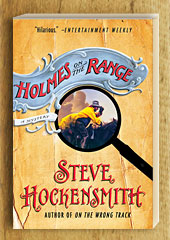
A few weeks ago, I experienced an uncontrollable urge to read some adult books. But when I went to the library, I found myself drawn to titles that had a young slant of one kind or another. I was drawn to Holmes on the Range by Steven Hockensmith because of the Sherlock Holmes connection. Traditionally, Holmes has been connected with young readers, though I'm not at all sure if he's of much interest to them these days.

Holmes on the Range has a marvelous premise. A cowboy is exposed to some Sherlock Holmes stories and becomes so enamored of them that he wants to take up deducing himself. The book has a wry, dry, and earthy wit, many engaging characters, and what appears to be an authentic setting. Is it a book of interest to the young? Well, for older teens and early twenty-somethings, I think it could be.

Otto and Gustav Amlingmeyer are cowboys who drift from one cowpunching job to another. Otto is twenty years old (young character!) and known as Big Red because he's the enormous red-headed brother. (Ho! as one character often says. Red-headed brothers! Red-headed League!) Gustav is twenty-seven and known as Old Red because he's the older red-headed brother. Gustav is a bright guy. More than bright, maybe. But he is totally illiterate. Only his "little" brother, the youngest and only surviving member of their family, learned to read and write. He reads and writes well enough, in fact, to have worked in a feed store as a teenager.

It is young Otto who reads the Sherlock Holmes stories aloud to his brother while they're around campfires or in the bunkhouse. And it is Gustav, whose crazy uncle taught him not to believe in the predestination that many of their German calvinist neighbors still subscribe to, who cannot accept that he will be nothing but a poor, ignorant cowboy. He wants to be more. He wants to be a detective like his hero, Sherlock Holmes. (Who is real in the world of this book, though he doesn't actually appear.) He sets out to find himself a case to solve and find one he does. Solving the case means real life or death for the two brothers, but for Gustav it means spiritual life or death as well.

By the end of the book, the Amlingmeyers, who have had no direction in their lives other than staying together, both have plans for a future. Who am I? What am I going to be? Sounds like a YA-related theme to me.

And, really, in spite of the rather impressive body count by the end of the story, Holmes on the Range is a hopeful book.

Now the book includes what some might call classic western situations and some might call western stereotypes--the European ranch owners, the eastern dudes, the cowpoke who can't speak to women. Whichever attitude you take, Hockensmith does fun things with them. On top of that, the last generation and a half didn't grow up on a steady diet of TV westerns. This may be new, fertile ground for them. Or, having no concept of the Old West in their psyches, they may feel too removed from it to be interested. It could go either way.

Don't hand this book off to some delicate thirteen-year-old looking to move up from Nancy Drew or the Hardy Boys, by the way. Hockensmith does some wonderful things with similis but a lot of them are built around the business of outhouses. The dead bodies are graphicly described. And some of the characters exhibit the racist attitudes you might expect of the 1890s. By no means are the black cowboys portrayed in a racist way. But there are a few racists among their compadres.


If you want a less adult but equally entertaining western for younger readers, try Sunshine Rider, The First Vegetarian Western by Ric Lynden Hardman. The book was quite buzzworthy back when it was published in 1998. And that was when there were nowhere near as many Internet sites to create buzz.

Tuesday, October 25, 2005

Stuck on Sherlock


So I finished watching the new Sherlock Holmes television movie I was talking about yesterday. I was watching the final few frames in which Holmes is looking all moody and thoughtful after having attended the wedding of his middle-aged buddy, Watson, to his middle-aged fiance(She appeared to be widowed or divorced as well as a professional woman.), and I thought, How did the Sherlock Holmes stories end up on student reading lists? Who decided these were books for kids?

By no means do I want to suggest that Holmes is inappropriate for kids. My question is, what's the attraction? Everything I know and believe about kids and reading says to me that there's nothing for them at 221 Baker Street. Is the main character a child or teen? Is there a child or teen's voice? Do the themes deal with child or teen issues of separation or identity? Are there child/teen problems that the child/teen reader can resolve while reading the book.

No, no, and no. And no.

So how did Sherlock Holmes become associated with kid reading? I will make a couple of guesses.

First, in the late 19th Century when Arthur Conan Doyle began writing the Holmes books, there wasn't a great deal of children's literature. Children's literature became more popular in the 20th Century when it became possible to mass produce color illustrations and when "specialization" became popular. (You no longer just had doctors, you had specialists; you no longer just had literature, you had specialized literatures). At the time Holmes was created, the various generations tended to read the same things. (By the way, I heard all this at a lecture a few years ago. Unfortunately, I can't remember who gave it.) So late 19th Century young people were exposed to Holmes and probably found him far more readable than, say, the works of Henry James. In that way, Holmes could have become canonized as literature for young people.

Second, young people have traditionally enjoyed reading mysteries. There's a logical reason for this. Up until the late 20th Century, mysteries followed a pattern--social order was disrupted by a crime, the detective solved the crime, social order was restored. (Not so much now, when fictional crimes may be of a particularly horrendous nature and the criminal may avoid justice in some way.) But that restoration of social order was comforting for readers. Young people may particularly appreciate that comfort as more and more of life's problems are being revealed to them.

This would explain why, as a teenager, I read not only Sherlock Holmes but Miss Marple.

I read him as a teenager, but are teenagers reading him now? The British are constantly doing new television versions of Holmes' stories (they also like to keep redoing Rebecca and Pride and Prejudice), so he seems to be part of the public consciousness. But who reads him now?

Monday, October 24, 2005

What's on TV?


In my younger days, I loved mysteries, and I certainly recall reading my share of Sherlock Holmes in my early teen years. And regretting that I wasn't more like him, if memory serves me. I don't think I could always follow his reasoning. (To this day, I can't tell the difference between deductive and inductive reasoning.)

Anyway, last night I taped Sherlock Holmes and the Case of the Silk Stocking, and I'm halfway through watching it. Rupert Everett makes a wonderful Holmes. And not just because he's good looking. His Holmes is a little kinder and more sensitive than I recall him being but also plenty intense. For those of us who like intensity.

This is a newly written Holmes story, which might upset some purists but doesn't bother me a bit. It's not for the kiddies, what with Holmes toking up in an early scene and a lot of talk of twisted sex crimes. Teenage Holmes fans should be fine with it, though.

Did you like Holes by Louis Sachar? Did you enjoy the movie? Then what about a sitcom!? One is supposed to be in the works. What can they be thinking? Maybe Hogan's Heroes for kids? (Thanks to Kids Lit for the link.)

Tuesday, December 21, 2004

Hoooowwwwwl!


I have avoided reading anything by Diana Wynne Jones because she writes fantasy, and, as I may have stated before, I really don't care for it. However, I had been reading that an animated version of one of her books was making a big splash in Japan so I decided to give it a try.

I am talking about Howl's Moving Castle.

Now, I found the plot hard to follow. The curse the Wizard Howl was worried about was a mystery to me. However, Howl, himself, was marvelous. The book is so worth reading for that one character. The fire demon was a charmer, too, and the spunky girl narrator was, well, spunky. But Howl--what a creation.

I definitely believe that a good character can redeem a book. Anne Shirley is the powerhouse that drives the rather formulaic Anne of Green Gables. Sherlock Holmes is the only reason to read any of the books involving him. And Howl just plain rocks.