In his post Going down a dark hall at Read Roger, Roger Sutton asks "Is Du Maurier still doing things for teens?" (As in Daphne.) I asked a similar question back in April. Neither one of us got a big response.
Roger talked about reading more than one Du Maurier book in his earlier days, as did I. That little stroll down memory lane, combined with the responses of a couple of his commenters, got me thinking about the way I used to read book after book by the same author when I was young. Certainly nowadays you hear about kids reading every book in a particular series by one author or another. But how about going through all the work of a nonseries writer?
One commenter talked about reading Victoria Holt as a substitute for Du Maurier because she didn't know there were other Du Maurier books she could read. The idea that a reader can be so interested in a writer that she needs to find a substitute when no more of the original author's works are to be found is very intriguing. (That's not the word I'm looking for, but the only word I found.) Another commenter said she read Du Maurier's Rebecca when she was in high school because it was on a reading list. That made me wonder if reading lists encourage the same kind of faithfulness to an author that stumbling upon gems by wandering up and down the stacks in the high school library did in me?
Then I got to thinking about how I don't do that kind of reading any more, myself. I'll keep up with reading books in a children's series, but I can't seem to find time to even try more work by, say, Philip Reeve or Sarah Vowell, the way I wanted to after reading one of their books. Forget about reading everything they're written. (I have read a lot of Scott Westerfeld and M.T. Anderson, though. And David Sedaris.)
My inability to read my way right through an author's collected works these days is probably due to the fact that there are so very many books out there to read and so many authors I want to read. I can't stay with a particular author the way I used to because I am distracted by all the other authors I find when I walk through a library or bookstore. I don't think having a huge selection of anything to choose from is a bad thing. But my guess is that it has changed the way I, and maybe others, read.
Thursday, January 31, 2008
Wednesday, January 30, 2008
My First Picture Book Of The Year
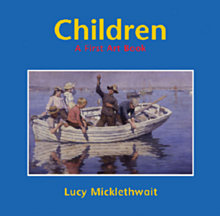
Children: A First Art Book by Lucy Micklethwait is a collection of works of art used to illustrate common childhood activities. I thought it was kind of interesting, a way of introducing children to the idea that looking at traditional art can be a pleasurable experience.
Micklethwait has a series of I Spy books that also serve as introductions to fine art.
Monday, January 28, 2008
I Just Liked Her Because She Was Played By Hayley Mills
Sunday morning I caught the last few minutes of Pollyanna: Spirit of Optimism Born Out of War on National Public Radio. I've never read the book, and have fond memories of the Disney movie only because I was a big Hayley Mills fan and she played the the title character. In fact, Mills is interviewed as part of the NPR program. Doesn't her voice sound marvelous? And have I given away my age by droning on about her?
Interesting points in the NPR program:
NPR claims the Golden Age of Children's Literature came to an end at the beginning of the twentieth century. Clearly, I need to read a book on kidlit history.
Pollyanna was hugely popular, though you'd never know that now. As someone who's interested in history, I'm fascinated when I hear about things--and books, in particular--that were highly regarded in their time but then pass from popular interest. Or, as in the case of Pollyanna, even become unpopular. It makes me wonder about what will happen to the things we love now.
Jerry Griswold, a professor of children's literature at San Diego State University, who was also interviewed as part of the NPR program, wrote about Pollyanna in The New York Times back in 1987.
Interesting points in the NPR program:
NPR claims the Golden Age of Children's Literature came to an end at the beginning of the twentieth century. Clearly, I need to read a book on kidlit history.
Pollyanna was hugely popular, though you'd never know that now. As someone who's interested in history, I'm fascinated when I hear about things--and books, in particular--that were highly regarded in their time but then pass from popular interest. Or, as in the case of Pollyanna, even become unpopular. It makes me wonder about what will happen to the things we love now.
Jerry Griswold, a professor of children's literature at San Diego State University, who was also interviewed as part of the NPR program, wrote about Pollyanna in The New York Times back in 1987.
A Bionic Jane Austen
I can't say I'm enjoying The Complete Jane Austen as much as I thought I would. I just finished Northanger Abbey and found it kind of anti-climactic. I remember reading it as a teenager and finding it disappointing after Pride and Prejudice.
This morning I started watching Mansfield Park. What did I see but the new (and, from what I've heard, already out of work) Bionic Woman playing an Austen woman (Maria Bertram).
I was standing there going, "Come on, Jaime! Kick that poser's butt!"
I don't think she's going to do that, though.
This morning I started watching Mansfield Park. What did I see but the new (and, from what I've heard, already out of work) Bionic Woman playing an Austen woman (Maria Bertram).
I was standing there going, "Come on, Jaime! Kick that poser's butt!"
I don't think she's going to do that, though.
Saturday, January 26, 2008
And What About Sci-fi For Kids?
I wonder if Clive Thompson isn't lumping science fiction with fantasy in his Wired column Clive Thompson on Why Sci-Fi Is the Last Bastion of Philosophical Writing. He says, "Teenagers love to ponder such massive, brain-shaking concepts, which is precisely why they devour novels like Philip Pullman's His Dark Materials, the Narnia series, the Harry Potter books, and Ender's Game. They know that big-idea novels are more likely to have an embossed foil dragon on the cover than a Booker Prize badge." I'm not going to dispute his basic argument, but "an embossed foil dragon" usually says fantasy to me, not science fiction.
Now, students, after you've read Mr. Thompson's column, think about how his theory that "Science fiction is the last great literature of ideas" applies to children's literature. Is there all that much science fiction being written for children these days? Or is it primarily fantasy? And should those two genres be lumped together?
Now, students, after you've read Mr. Thompson's column, think about how his theory that "Science fiction is the last great literature of ideas" applies to children's literature. Is there all that much science fiction being written for children these days? Or is it primarily fantasy? And should those two genres be lumped together?
Friday, January 25, 2008
Amazon Reader Reviews
In Reading the Book: A Novel Approach to Reviewing at Publishers Weekly's Beyond the Book blog, Barbara Vey talks about those Amazon Reader Reviews that can be so very, very...interesting. This is clearly a subject that hit a nerve with her readers, since she received 59 comments.
Vey directs readers to a very recent Slate article by Garth Risk Hallberg entitled Who Is Grady Harp? on the same subject. Hallberg describes a reviewer hierarchy at Amazon and how it can be manipulated. I had a little trouble following the whole social networking aspect of the review system, but, then, I have trouble with social networking, anyway. (Ask anyone who knows me socially.)
I believe some of my reader reviews began life as book reports.
Thanks to child_lit for the link to Publishers Weekly.
Vey directs readers to a very recent Slate article by Garth Risk Hallberg entitled Who Is Grady Harp? on the same subject. Hallberg describes a reviewer hierarchy at Amazon and how it can be manipulated. I had a little trouble following the whole social networking aspect of the review system, but, then, I have trouble with social networking, anyway. (Ask anyone who knows me socially.)
I believe some of my reader reviews began life as book reports.
Thanks to child_lit for the link to Publishers Weekly.
Thursday, January 24, 2008
A Serious Book For Younger Readers
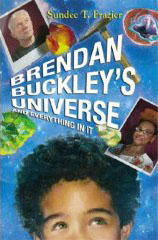
My goodness! I've read another award winner! Brendan Buckley's Universe and Everything in It by Sundee Frazier won the Coretta Scott King/John Steptoe New Talent Author Award last week.
The back of Brendan Buckley contains the following information: "In ten years, I'd never once met my grandpa. My mom didn't want to talk about him. Now suddenly I'd discovered him, and he was a scientist, just like me. Where had he been? Why couldn't we talk about him? This is what I found out..."
As God is my witness, I read that, and I looked at what I took to be a fun cover, and I thought, Oh, grandpa's going to be some kind of mad scientist or something! What fun!
Well, grandpa's not a mad scientist. Not even close. This isn't the first time I've made a mistake like this. I'll spare you the details.
I will tell you, though, that I enjoyed Brendan Buckley a lot more then you would think, given my embarrassing misunderstanding about what I was getting into.
First off, I have to say I think the book would have been better served with a third- person narrator rather than a first. Brendan doesn't have a particularly powerful or unique voice, anyway, and sometimes he sounds too cute. I think a third-person narrator would have helped avoid that.
And though I'm always happy to read about Tae Kwon Do, in this particular case, it seemed as if the TKD thread's only function was to teach ethics. I'm not faulting Frazier's knowledge of the subject, by any means, but I think the Tae Kwon Do material detracted from the story.
Now that I've got that off my chest, I'll also point out that the story is Brendan Buckley's big strength. Young Brendan is a biracial child. He's got a great little life going. He's got wonderful parents, he's got friends, and school doesn't seem to present any big problems for him. His black grandparents are terrific. (Grandma is a pistol.) Though his father has tried to warn him of what he may confront in the future as a young black man, to date Brendan hasn't experienced a lot of racism. The worst thing that has happened to him so far in life is the death of his beloved grandfather a few months before our story begins.
When he accidentally meets his white grandfather for the first time and realizes gramps lives nearby even though the two of them have never laid eyes on one another before, he figures this is his chance for another grandpa. He picks up on the fact that there's something wrong within the family--no one wants to talk about this grandfather, who, at first, doesn't even know who Brendan is. So Brendan sets out on his own to approach the old man and try to develop a relationship with him.
Now, even though this adult reader easily figured out what the old guy's problem was, I wanted to keep reading because this is a compelling family story. Identity within family...connections across generations...I love that stuff. I wondered if kids would be as interested. I'm guessing they will. Again, identity and one's place within the family are supposed to be classic themes of children's literature. Plus, there is a mystery element here that kids may really enjoy.
In addition to having a good story, the second thing I think Brendan Buckley has going for it is that, while it may sound like one on paper, it isn't a problem book. Racism isn't a problem for Brendan at this point in his life. When ol' granddad comes out with the cliched argument against inter-racial marriage--"It's always the kids who suffer," Brendan replies, "I'm not suffering."
The third thing I think Brendan has going for it is that, though Amazon lists it as having a reading level of 9 to 12, I think it leans toward the lower end of that range. It's not an oppressively heavy book and could serve as an introduction to the world of more serious reading for, say, third or fourth graders.
I'd never heard of Brendan Buckley's Universe and Everything in It before I stumbled upon it at my library. I hope the award it won last week brings the title more attention.
Wednesday, January 23, 2008
We Need Many, Many More Juvenilia Panels
For the last decade or more I've heard talk of kids "publishing" their writing. Sometimes that meant little books cranked out in grade school classrooms. Sometimes it meant school literary magazines. Sometimes it meant publications that existed for the sole purpose of publishing student writing. Sometimes it meant teenagers paying to have their work self-published hoping they would become the next Christopher Paolini. Sometimes it meant a reading teacher contacting me for advice on where one of her intermediate school students could get his work published.
I've probably mentioned before that I really can't get behind the child publishing thing. School publications are one thing, but anything beyond that is probably gilding the lily at best. Writing prodigies are few and far between. Few writers, of any age, perfect their craft without years of study and work. Suggesting to kids that they can take short cuts to publication is doing them a serious disservice.
So I was delighted to see at Justine Larbalestier's blog a post called The Juvenilia Panel. It seems Ms. Justine was part of a panel whose members read aloud their early writing. Their very early writing.
She says a couple of the panelists read "teenage monstrosities so bad that we wept on account of laughing so hard. WEPT!"
She also says, "Sharing our crappy writing from when we were beginning writers has the salutary effect of making it clear to those what aspire to be published writers but aren’t there yet that we published folk didn’t step fully formed from Zeus’s head. There was lots and lots and lots of bad words and phrases and sentences and stories and novels written before we were good enough to be read by anyone other than our doting parents."
Exactly.
There's a great deal very young writers can be doing and should be doing as part of their training. Reading, for instance. Reading about writing. Taking writing classes. Going to writing workshops. Going to hear writers speak. Forming writing groups. And writing, of course. That goes without saying. All of this kind of effort will go a long way to making young writers forays into the real writing world less painful.
My own juvenilia? I do have a few pieces from grade school that are notable, no matter what their quality, because they indicate my interests haven't changed much. But as a teenager, I didn't finish much writing. I liked to think about being a writer, but at that point I wasn't too keen on sitting down and doing the work. If I were on a juvenilia panel, I might have to read work from my twenties, which would be seriously humiliating.
Nonetheless, I really think juvenilia panels are a marvelous idea.
I've probably mentioned before that I really can't get behind the child publishing thing. School publications are one thing, but anything beyond that is probably gilding the lily at best. Writing prodigies are few and far between. Few writers, of any age, perfect their craft without years of study and work. Suggesting to kids that they can take short cuts to publication is doing them a serious disservice.
So I was delighted to see at Justine Larbalestier's blog a post called The Juvenilia Panel. It seems Ms. Justine was part of a panel whose members read aloud their early writing. Their very early writing.
She says a couple of the panelists read "teenage monstrosities so bad that we wept on account of laughing so hard. WEPT!"
She also says, "Sharing our crappy writing from when we were beginning writers has the salutary effect of making it clear to those what aspire to be published writers but aren’t there yet that we published folk didn’t step fully formed from Zeus’s head. There was lots and lots and lots of bad words and phrases and sentences and stories and novels written before we were good enough to be read by anyone other than our doting parents."
Exactly.
There's a great deal very young writers can be doing and should be doing as part of their training. Reading, for instance. Reading about writing. Taking writing classes. Going to writing workshops. Going to hear writers speak. Forming writing groups. And writing, of course. That goes without saying. All of this kind of effort will go a long way to making young writers forays into the real writing world less painful.
My own juvenilia? I do have a few pieces from grade school that are notable, no matter what their quality, because they indicate my interests haven't changed much. But as a teenager, I didn't finish much writing. I liked to think about being a writer, but at that point I wasn't too keen on sitting down and doing the work. If I were on a juvenilia panel, I might have to read work from my twenties, which would be seriously humiliating.
Nonetheless, I really think juvenilia panels are a marvelous idea.
Tuesday, January 22, 2008
Beloved Book Earns Newbery Honor
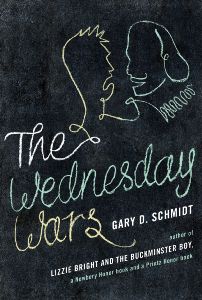
I had the good luck to read The Wednesday Wars by Gary D. Schmidt just before the ALA announced it had been named one of this year's honor books. I wasn't surprised. The Wednesday Wars is adored on my listservs and there was Newbery talk regarding it way back in April.
Personally, I didn't think there was a whole lot of story to Wednesday Wars. It's more just charming episodes from the life of seventh grader Holling Hoodhood. I think the title "Wednesday Wars" refers to conflict between Holling and his teacher who are alone together every Wednesday afternoon when, back in 1968 when our story takes place, all the Jewish and Catholic kids (Holling is neither) in the classroom are released early from school to attend religious classes. However, this aspect of the plot is dropped pretty early on. His teacher, Mrs. Baker, remains an imposing character, but after the first few chapters Holling no longer talks of her hating him. We get a lot of history lessons by way of Holling's family who represent, in rather superficial ways, various aspects of 1960's life. His sister is a big Bobby Kennedy fan. (I wondered how many kids would know who Bobby Kennedy was.) Dad is a conservative supporter of the Vietnam War. Mom desperately needs to read The Feminine Mystique.
But while I found the book only so-so, I understand that Newbery books tend to be books (other) adults like. I'm okay with that. I can see what those other adult readers found so very attractive about The Wednesday Wars. Holling and his teacher end up (probably? improbably?) reading Shakespeare together and that gives the book a very literary tone. The book is also improving. In addition to the instruction relating to literature, readers also get lessons on tolerance and, to a lesser extent, good parenting.
Many adults in kidlit do believe children's books should be instructive, and this is an attitude toward literature for the young that goes back for generations, if not centuries, according to my sources on my listservs. While overt lessons are not something I look for in any of my reading, I understand that the adults in kidlit who do want it have tradition to justify their position.
For all the flaws I find in The Wednesday Wars, it may be a Newbery book that child readers can actually enjoy. Some kids may find the 1960's world portrayed here far less disturbing than the one they live in in the twenty-first century. The bad dad in The Wednesday Wars is merely narrow-minded, demanding, and focused on his work rather than his family. He's absolutely quaint compared to the bad dads we see in the news now who molest and murder their children. The bully in Wednesday Wars is kind of sweet. He just roughs up kids on the playground or on their way home. No knives are pulled. No one is beaten to death just for the hell of it. He is a traditional, card-carrying bully, who we know isn't going far in life. He's not a kid from the top of the social hierarchy taking pleasure in tormenting those less fortunate than himself.
I really don't care about using literature as a pulpit. But if some young readers can find escape in The Wednesday Wars, I'm all for it.
"I Realized That That Was The Beginning Of A Story."
It's a Picture Book, a Novel, a Movie in Book Form... is another one of those how-they-done-it articles that I like so much. This one is about Brian Selznick and Hugo Cabret.
By the way, I've been seeing questions raised about Hugo getting the Caldecott this year because of the whole question of what is it? A picture book or a novel? Fortunately, I'm pretty ignorant about picture books, and I don't have strong feelings one way or the other on the subject.
Thanks to child_lit for the link.
By the way, I've been seeing questions raised about Hugo getting the Caldecott this year because of the whole question of what is it? A picture book or a novel? Fortunately, I'm pretty ignorant about picture books, and I don't have strong feelings one way or the other on the subject.
Thanks to child_lit for the link.
Subscribe to:
Posts (Atom)