Monday, June 30, 2008

Three Robbers Celebration--More Books For Younger Kids


To celebrate the publication of A Girl, a Boy, and Three Robbers on Thursday, I'm blogging about other books for younger kids this week.

I came upon the Mr. and Mrs. Green Books by Keith Baker during that period when I was looking for short stories. Like Zelda and Ivy, these stories are for the younger chapter book readers-color illustrations on each page with limited amounts of text. The Mr. and Mrs. Green stories in the two books I read all dealt with common childhood activities, such as camping, eating, going to the fair, taking part in a talent show, and losing things. Though these are common childhood activities, Mr. and Mrs. Green aren't children, but adults. Okay, they're adult alligators, but they're adults.

Children's books are supposed to center on children, but it's not unusual to find adult animals in very young children's books. I, personally, prefer my animal characters to be children, if they're going to be animals at all, and I've wondered why put adults in a kids' book.

Then today I realized that making adults animals really cuts the grown-ups down to size. And when the adult animals are a couple, it's not unusual for the husband to be childlike in addition to being an animal the way Mr. Green is here. Also think poor Dad Berenstain. The wives, on the other hand, are highly efficient caretakers.

So in our culture, the stereotypical male head of family is an imposing, powerful figure. In our animal children's books, we make him childlike if not an out and out bumblioni. In our culture, the stereotypical female co-head of family is a nurturing, loving figure. In our animal children's books, we make her a maternal goddess.

I so wish I'd taken more than Psych 1 so I could figure out what's going on here. Wait! Unle-e-e-essss, the male figure is supposed to be the child--of either sex--who is fearful and sometimes foolish and the female figure is a comforter who makes everything okay. Hmmm. That could work.

In which case, the Mr. and Mrs. Green books could provide young child readers with some easy reads about familiar situations that should make them feel comfortable.

The Three Robbers Blog Tour--Day Two


Day two of the A Girl, a Boy, and Three Robbers blog tour, is hosted by Sam Riddleburger. Sam is also a writer, so we did a little talking about ARCs and agents and industry trends. I am sure that now that Sam has mentioned Shania Twain once at his blog, he'll be talking about her all the time. Thanks, Sam!

Tomorrow I'll be stopping at Seven Impossible Things Before Breakfast.

In the meantime, don't miss your chance to win a copy of A Girl, a Boy, and Three Robbers.

Sunday, June 29, 2008

Three Robbers Celebration--Books For Younger Kids


I don't want my blog tour hosts to carry the entire burden of celebrating A Girl, a Boy, and Three Robbers' publication this Thursday, so I've tried to plan a few special things for this week, too. Off and on, I'm going to try to bring some attention to other books for younger kids--since that is what Three Robbers is.

I picked up Zelda and Ivy: The Runaways by Laura McGee Kvasnosky before the last 48 Hour Book Challenge because the title turned up while I was searching a library database for short story collections for kids. These three stories are for very young kids. They don't involve a lot of text and every page includes a charming color picture of the slightly mousie- looking fox sisters, Zelda and Ivy.

The last story, about creating a concoction (which I can remember doing when I was somewhere between five and seven years old) is probably the most creative. The first story, The Runaways, is pretty familiar, being about a couple of kids who run away and then come home when no one misses them. But the first two sentences are so fantastic that I was hooked right away.

"Dad's making cucumber sandwiches for lunch," said Ivy.
"Not again!" said Zelda. "That's it. I'm running away."


Talk about not wasting time on tedious exposition! Talk about introducing conflict early! This intro could be an example in a writing textbook.

Sometimes I don't get animals that think they are humans in kids' books. They work best for me when they are like Zelda and Ivy--characters living as realistic children in happy, comfortable situations, who just happen to be foxes or frogs or toads or pigs.

Three earlier Zelda and Ivy adventures appeared in picture book format.

The Three Robbers Blog Tour--Day One


The blog tour for A Girl, a Boy, and Three Robbers begins today at books together. Anamaria and I discuss ways in which chapter books are distinguished from other kidlit categories, the challenges of writing them, and that monster cat, Buttercup, who appears in both volumes of The Hannah and Brandon Stories. Many thanks to Anamaria for hosting me.

Tomorrow the tour stops at Sam Riddleburger's blog.

A Girl, a Boy, and Three Robbers will be published this Thursday, July 3rd. Remember you have until the end of that day to enter to win a copy of the book.

Saturday, June 28, 2008

That Weird Repetition Of Never Before Experienced Events

I am sure you all remember my post of this past Monday, not even a week past, in which I mentioned reading of someone named Paul Valery, whom I had never heard of. Ever. Not a word.

Well, yesterday while reading the revision chapter of Writing Fiction, I came upon this line: "'In the first draft is the talent,' said French poet Paul Valery, 'in the second is the art.'"

Come on! What are the chances of that happening?!!!

But that's not all.

Last night I watched the pilot episode of Weeds in which Mary-Louise Parker plays a tough single mom dealing weed to subarbanites to keep her brood together. (Oh, look. I'm talking about my TV viewing.) Then today I saw The Spiderwick Chronicles in which Mary-Louise Parker plays a tough single mom dueling with goblins (I think) to keep her brood together.

The situation in the TV show was only slightly less improbable than that in the movie.

I love it when this weird repetition thing happens.

Friday, June 27, 2008

In Which We Talk About Different Ways Of Not Reading


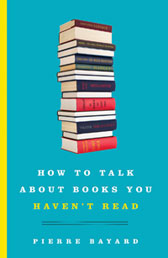
Pierre Bayard describes in How To Talk About Books You Haven't Read four ways of not reading books:

Books You Don't Know: I don't recall a whole lot about this section. At this point, I was still wondering if Bayard was joking.

Books You Have Skimmed: I have to admit, I've had to do this many times. There are a lot of books out there that I feel I should be familiar with but find really dreadful. So once I decide that I'm too old to be wasting valuable hours of my life reading this dribble, I start skimming so that I have a feel for the work. Seriously, I think it's much better to have a feel for a book then to have no knowledge of it at all. As it turns out, Bayard agrees with me.

Books You Have Heard Of: Reading reviews, articles, and blog posts about books can give you a handle on the books' place in the booky scheme of things, or the collective library, as Bayard calls it.

Books You Have Forgotten: Sadly, we're going to forget a lot of what we read.

You know the way of not reading that Bayard doesn't cover in his book? Books you have read and not understood. Sophie's World comes immediately to my mind. Perhaps Bayard, being a French intellectual and all, has never experienced this kind of not reading.

Just How Much Do Inquiring Minds Want To Know?

In her blog post A Blogger's Challenge: Privacy Vs. Authenticity, Mitali Perkins raises the question of how bloggers (her examples are all authors, but the question could apply to any blogger) balance an authentic voice with privacy. Can they be authentic and genuine without writing about all aspects of their lives?

Well, I think Mitali's question is an interesting one, and I've been dwelling on it since I read her post last night. (Not that it kept me up or anything.) I've recalled how I've noticed that many people become their work. We've known an engineer for many years. Engineering is absolutely a huge part of his identity and has an influence on all his interests. We know musicians who have worked, part-time, as musicians all their adult lives while supporting themselves and their families with day jobs. They are musicians--their lives are built around rehearsals, performances, attending musical events. Their lifestyle had a huge--and positive--impact on how they raised their children.

Over the years, I have become a writer. I think it informs and is connected to nearly everything I do. When you read this blog you really are getting an authentic view of my life because a great deal of my life is thinking about writing--what I'm writing now, what I could write about in the future, what other people have written. If I were to talk here about my children, my TV viewing, my shopping trips, what I make for dinner, you might be getting a less authentic voice, because I would be trying to isolate those portions of my life in order to say, Look, I have kids! I watch TV! I go shopping! Or you would be getting still more writing talk because my kids are a big part of my writing life, I analyze plots and characterization while I'm watching TV, and while I'm shopping I get ideas for stories that I sometimes forget about because I don't write them down or, if I remember that I have a notebook in my purse, I write them down and find them months and months later.

See, I just blogged about shopping and it turned into blogging about writing.

So, my long, drawn out point is that while people may choose to blog about whatever they like, at least in the case of writers, I don't believe we need to blog about anything but writing in order to be authentic.

Thursday, June 26, 2008

Giving Away Books

You have one week left to try your luck at winning a copy of A Girl, a Boy, and Three Robbers. Hurry, hurry, hurry.

I am not the only person giving away books. You have a couple of other chances to win books right now:

Interesting Nonfiction for Kids (I.N.K.) is giving away fifteen signed books--all to one winner. Included in that stash is a book by Karen Romano Young whom I met last month.

Cynsations is giving away a signed set of Mitali Perkins' First Daughter books. Scroll down Cynsations' post to find out how to enter. You only have until June 30th.

Wednesday, June 25, 2008

Thinking About Blogging

Susan at Chicken Spaghetti has a post on "Blogging Thoughts" related to my interview at this month's The Edge of the Forest . She's got a nice little conversation going in the comments.

Read the original interview and read and take part in the conversation.

Tuesday, June 24, 2008

In Which We Talk About Our Collective Library

When Pierre Bayard talks about not reading, he's not talking about reading in the sense of an enjoyable experience, becoming one with a character, or any of that good stuff. He's talking about acquiring knowledge about how a book relates to the rest of the world.

Societies, Bayard suggests, maintain what he calls a "collective library," meaning a virtual collection of books that the culture is familiar with. (You know, the way most Americans are familiar with characters from The Wizard of Oz without having read the book or maybe even having seen the movie.) One of his points is that sometimes a book is more significant for its relationship to other books in the collective library than it is for its own content. If individuals understand or at least know about the book's significance, they can talk about the book in that way. And it would be very legitimate for them to do so. 

Imagine, if you will, that it is the year 2057. A turn-of-the-century series of children's books about a kid named Harry Potter is oh, so yesterday. No one reads them, but everyone knows about Harry because of all kinds of literary references, movie references, maybe some song references. Harry Potter, though not read, is part of the collective library. 

Say you are a graduate student in the year 2057, and you wouldn't read any of the Harry Potter books on a bet. But you are aware that the appearance of Harry Potter in the 1990s brought masses of adult readers to children's literature, encouraged serial novels, knocked problem novels off their pedestal in kidlit, and popularized fantasy. Knowing the significance of the series in relation to other books is arguably as important as anything in the books and certainly gives you something to discuss if Harry P. comes up when you're trapped in your advisor's office. In fact, there are probably many books we should know something about even if we haven't read them.