Showing posts with label how to read. Show all posts

Thursday, March 31, 2022

A Book That I Do Recall Reading


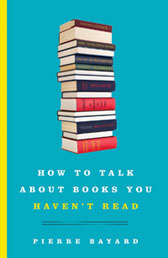
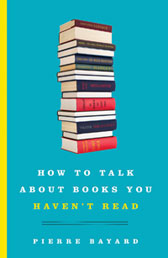
Here is the last of the three reposts from 2008 about Pierre Bayard's How To Talk About Books You Haven't Read. I know you've been waiting for it.

You'll  note in this post that I saw Bayard writes that we're going to forget a lot that we read. Vrai, vrai. The interesting thing about How to Talk About Books You Haven't Read is that I haven't forgotten it. I don't recall every word, of course. Reading these posts was a nice refresher. But the book, itself, and Bayard's point about how we often have knowledge of books we haven't read because of the significance of the books for our culture has definitely stuck with me.

Friday, June 27, 2008 In Which We Talk About Different Ways Of Not Reading


Pierre Bayard describes in How To Talk About Books You Haven't Read four ways of not reading books:

Books You Don't Know: I don't recall a whole lot about this section. At this point, I was still wondering if Bayard was joking.

Books You Have Skimmed: I have to admit, I've had to do this many times. There are a lot of books out there that I feel I should be familiar with but find really dreadful. So once I decide that I'm too old to be wasting valuable hours of my life reading this dribble, I start skimming so that I have a feel for the work. Seriously, I think it's much better to have a feel for a book then to have no knowledge of it at all. As it turns out, Bayard agrees with me.

Books You Have Heard Of: Reading reviews, articles, and blog posts about books can give you a handle on the books' place in the booky scheme of things, or the collective library, as Bayard calls it.

Books You Have Forgotten: Sadly, we're going to forget a lot of what we read.

You know the way of not reading that Bayard doesn't cover in his book? Books you have read and not understood. Sophie's World comes immediately to my mind. Perhaps Bayard, being a French intellectual and all, has never experienced this kind of not reading.

Monday, March 28, 2022

How Does A Book Relate To The Rest Of The World?


Below is part-two of the three-part arc from 2008 on Pierre Bayard's How to Talk About Books You Haven't Read that I'm republishing during my twentieth anniversary year. 

If I had all the time in the world, I'd read Bayard's book Who Killed Roger Ackroyd? The Mystery Behind the Agatha Christie Mystery I don't mean to brag, but I recall figuring out who the killer was in that book by the time I got to page three. And that was before I learned why the book is famous.

Tuesday, June 24, 2008

Tuesday, June 24, 2008 In Which We Talk About Our Collective Library


When Pierre Bayard talks about
 not reading, he's not talking about reading in the sense of an enjoyable experience, becoming one with a character, or any of that good stuff. He's talking about acquiring knowledge about how a book relates to the rest of the world. 

Societies, Bayard suggests, maintain what he calls a "collective library," meaning a virtual collection of books that the culture is familiar with. (You know, the way most Americans are familiar with characters from The Wizard of Oz without having read the book or maybe even having seen the movie.) One of his points is that sometimes a book is more significant for its relationship to other books in the collective library than it is for its own content. If individuals understand or at least know about the book's significance, they can talk about the book in that way. And it would be very legitimate for them to do so. 

Imagine, if you will, that it is the year 2057. A turn-of-the-century series of children's books about a kid named Harry Potter is oh, so yesterday. No one reads them, but everyone knows about Harry because of all kinds of literary references, movie references, maybe some song references. Harry Potter, though not read, is part of the collective library.

Say you are a graduate student in the year 2057, and you wouldn't read any of the Harry Potter books on a bet. But you are aware that the appearance of Harry Potter in the 1990s brought masses of adult readers to children's literature, encouraged serial novels, knocked problem novels off their pedestal in kidlit, and popularized fantasy. Knowing the significance of the series in relation to other books is arguably as important as anything in the books and certainly gives you something to discuss if Harry P. comes up when you're trapped in your advisor's office. In fact, there are probably many books we should know something about even if we haven't read them.

Saturday, March 26, 2022

A Book About Reading I Did Like


My last dip into the Original Content archive resulted in a repost on a book about reading that I really didn't enjoy reading. Today, as part of my continuing observance of my blog's twentieth anniversary, I'm starting republishing a three-post arc from 2008 on  Pierre Bayard's How ToTalk About Books You Haven't Read. This was a book on reading that I did like.

Once again, there are some dead links in the following post. There are live ones in the above paragraph.


Monday, June 23, 2008 In Which We Begin To Talk About A Book We've Read

Pierre Bayard's How To Talk About Books You Haven't Read isn't really about faking itAu contraire. It's very much about reading. In fact, it's a far more interesting and heartfelt discussion of reading than the "classic" How to Read a Book, which I'm guessing has destroyed the will to read in generations of Americans.

Bayard's tone is often slightly tongue-in-cheek, particularly in the early chapters. In fact, for a while I wondered if he was making up a couple of the authorities he cited early on. But, no, there really was a Robert Musil and a Paul Valery. And I've just admitted I'd never heard of them. Yikes.

But I am talking about them.

One of the many interesting things about this book called How To Talk About Books You Haven't Read is that each chapter includes a discussion of an author or a work that Bayard, if all his footnotes are to be believed, has read. All the books he discusses, either nonfiction or fiction, included a discussion of avoiding reading or a character who is in some kind of situation in which he can be said to have to talk about books he hasn't read. Bayard does more than use this material to support his own arguments. He makes these books sound interesting.

Thursday, March 24, 2022

How To Read....ZZZZZZZZZ

I recently read an article I can no longer find about reading. It mentioned a book on reading that I recall burning. I also did a blog post about it. As part of my blog anniversary observance, I'm going to republish that post. Later, I'll rerun some on a book about reading that I liked much better. 

I'm aware that a couple of the links in this post go nowhere. It's fourteen years old. What can we expect?


Sunday, June o4, 2006 I Give Up


I have been broken.

Last summer I began reading How to Read a Book, The Classic Guide to Intelligent Reading by Mortimer J. Adler and Charles Van Doren. I've read 238 of its 346 pages (not counting the reading list and exercises and tests at the end). I've decided to throw in the towel because life is just too short.

Clearly, intelligent reading is beyond me.

One of the things the authors suggest readers do is write in their books. I'm totally with them there. In the front of my copy of How to Read a Book I wrote out the fifteen (that's 15) steps to reading a book. In addition, I wrote out the four questions to ask about a book, the four ways to look at words, and the four ways to look at facts. (My notes also say these are also the four aspects of encyclopdias.) The last 100 pages must have had more lists, but since I can't remember the ones I wrote down it seems unlikely that I would have gained anything from reading and writing down the rest of them.

I found How to Read a Book repetitive. It also used long analogies that increased the verbiage.

Quite honestly, I only remember those points because I wrote them down along with all my lists.

How to Read a Book was originally written in 1940 and the last copyright date is 1972. It's very dated, and not just because the authors keep referring to readers as "men."

My own faithful readers (the ones who are still with me since yesterday) will recall that I just wrote about the large number of books being published today. Far, far, more books are being published now then when How to Read a Book was being written or even when it was being revised. While many of the individual steps Adler and Van Doren suggest are worthwhile, it just isn't practical for readers to keep a couple of dozen tasks in mind while trying to keep up with today's load of reading.

At one point, Adler and Van Doren suggest which steps to keep in mind while reading a book for the first time. Other steps are saved for subsequent readings.

Subsequent readings????

Okay, sure, researchers planning to write a scholarly work better read their texts more than once. But the rest of us? Let's face facts. It's just not going to happen.

It's very possible that I could use some advice on how to read a book. I couldn't get through this one, after all. But I need that advice to be readable and practical and relevant to the situation I find myself in--"so many books and so little time." That appears to be a much different situation from the one that existed when Adler and Van Doren were writing their book.


Tuesday, September 06, 2016

Time Management Tuesday: More On Making Use Of Reading Time

For the last two weeks, I've been writing about reading less in order to make time to read more:

But I Have More On Reading!


Yes, reading is such a big time issue in my life that I've thought about it and written about it here before, including some posts in 2012 on Pierre Broyard's How To Talk About Books You Haven't Read and how his thinking can help readers manage time. What follows is an annotated bibliography of my reading posts with links.

An Introduction To Reading. Maintenance reading vs. professional reading. Also "Select what is important to read and don't sweat the rest." Rita Emmett

Forget About Reading Every Word. Skimming and reading articles about books when you can't get to the books, themselves.

An Example Of Skimming. Picking out what interests you in an essay.

Be More Discriminating About Reading. Early thoughts on how to decide what kinds of reading to cut back on.

More Time For Reading. This deals with reading tips from one of those articles with numbers in the title that I'm cutting back on reading now. But I wasn't then.

Reading all this information could help you better manage your massive amounts of reading. However, if you've been following my TMT posts the last couple of weeks, you'll be aware that not reading it could also help you  with your reading time.

Gotta love a win-win situation.

Tuesday, August 30, 2016

Time Management Tuesday: Read Less To Read More, Part 2. Goals.

Okay, lads and lasses, last week we discussed some of the types of reading we (meaning I) could cut back on in order to make more time to...read.

So once we've cut back on listicles, articles with numbers in the title, clickbait that ends with some variation of "you won't believe what happened next," random marketing and writing process Internet articles/blog posts, and news articles that are really just entertainment, what are we going to read? You know what we ought to do? We ought to set some goals.

By Goals, I Mean What We're Going To Read, Not How Much


It's not unusual to see litbloggers writing about their reading goals, by which they mean how much they plan to read this year. I believe Goodreads members can set up annual reading goals there and keep track of how they're doing over the course of the year. But for writers who are trying to make the best use of time, what we're reading is more important than how much. We want our reading to do something for our work or our writing lives, to support it, so we can't rely on random reading. Otherwise, we could stick to reading listicles.

Could you elaborate on that, Gail? you ask. Oh, come on. When can I not elaborate on something?

Some Possible Reading Goals


Reading in our genres.Writers should read in the genre they're interested in writing in order to understand how  children's books, romances, mysteries, etc., work. That's not to say that we should study the field and then write like everyone else does. But we should know that when we do something different, we are doing something different and why. For instance, someone writing for children will learn from their reading in that genre that children's books are rarely written from an adult point-of-view. Mystery writers will know from their reading that there are an enormous number of tortured detective protagonists out there. They may want to follow that genre standard. They may want to do something different. But they should know what's being done with the protagonists in children's and mystery books in the first place.

Reading within our genre is particularly important for children's writers. Occasionally you'll hear of  pre-published children's authors who want to write books like the ones they enjoyed when they were young back in the '60s, '70s, '80s. Will a book like that find an audience among 21st century child readers? There may be a limit on how many Pals in Peril and Penderwicks books the contemporary child market can support.

Then there is the "comparable thing." You know. That thing where authors pitch their manuscripts to agents and editors as being like some best selling book. Maybe being like a mash-up of a couple of them. I heard at the spring NESCBWI conference that agents like to hear comparables not just because it takes care of doing some of their selling for them or because they can only understand a new story in relation to one they already know about. No, they like to hear the comparable thing from writers because it's an indication that the writers know their genre and are thus serious about it. They haven't just knocked off a sweet tale and will never do another piece of work.

So reading in your genre is an excellent use of new found reading time.

Reading Literary Journals. Writers who are interested in writing short stories, and publishing them (that's me again), may want to spend some of their new writing time keeping up with reading literary journals. In The Ultimate Guide To Getting Published In A Literary Magazine, Lincoln Michel says that the best literary journals are the ones that actually publish work we like. "It’s much more satisfying to appear in a journal you read and love, next to authors you read and love, than it is to be in a slightly more prestigious journal among writers that make your skin slough off in boredom."  Finding some literary journals we actually like reading (I'm leaning toward Carve right now) and spending time reading them should help us determine if we share some kind of world view with the editorial staff. Could publications we like become a home for us and our writing? Exploring literary journals and reading some of them regularly is truly a reading shift for many writers.

Now that I've cleaned all the marketing and writing process articles out of my bookmarks, I'm filling them with links to litjournals I want to either try out or to read regularly.

Targeted Process Reading. I made a point last week of writing about cutting back on reading random writing process articles. I've found them repetitious and sometimes superficial. But a targeted process article or even book is something different.

With targeted process reading we are reading about something specific. We may be aware of a problem in our writing, and we're seeking out help. We're also going to want to go deeper into this kind of reading then we would with the process articles we stumble across on-line or sometimes even in some established writing magazines.

I Could Go On And On. Then there's research for books we haven't even started or for workshops we haven't even created yet. And pleasure reading, of course.

Oh. Wait. Is anyone else getting overwhelmed with reading again?

Keep Changing Reading Goals


Another thing we can do to help control or at least organize our reading and make better use of time is to keep changing our goals. January we're going to do a certain type of reading. We can then switch to something else in February. Taking part in National Novel Writing Month? We could plan to do any research reading over the summer leading up to our November writing binge.

The whole reading burden seems smaller and more manageable, if we've broken up the reading we want to do and assigned it to specific time periods. What we're going to do, when we're going to do it.

And What About Adding Objectives To Our Reading Goals?

Again, adding objectives to our goals will help make the volume of reading we want to do within the time we have seem more manageable by precisely telling us what we're going to do.

For instance:

Reading Goal 1. Read Within My Genre
Objective 1: A specific book
Objective 2: Another specific book
Objective 3: Still another specific book.

Reading Goal 2. Read Literary Jouranls
Objecive 1: Read Erika Dreifus's Monday Markets and Jobs for Writers to find new (to me) journals
Objective 2: Subscribe to Carve (Or, in my case, ask for a subscription for my birthday)
Objective 3: Check on-line journal 1 once a month
Objective 4: Check journal 2's website once a month for new material

Can You Summarize This Gail?


Of course, I can.

1. Eliminate unnecessary reading to create time
2. Create reading goals and objectives to make the best use of that new time.


Tuesday, August 23, 2016

Time Management Tuesday: Read Less To Read More, Part 1

The numbers on annual book publication vary just a bit. I've seen claims that  300,000 books, more or less, are published each year. I've also seen the 1,000,000 figure used. I suppose that after a certain point, it doesn't matter how many books are generated each year. More are published than you or I can read.

Then there are magazines, newspapers, and professional and literary journals. The Internet is groaning under the burden of blog material being generated. There's more of that coming out than you or I can read, too.

But many of us want to read. We want to read lots and lots of things. How to find time for all the reading we want to do?

My theory is that if we read less of some things, we'll be able to read more of others. But what should we choose to ditch? Well, of course, I have some ideas to share.

Reading I'm Cutting Back On


Listicles. Listicles are articles written in the form of a list. We're not talking bulleted material broken out of a section of an essay in order to make effective use of white space and highlight information for readers. No, the hardcore listicles really are just lists of related or semi-related facts. Sometimes they're clever and witty, but there's rarely any development of thought. I gave up reading these a few years ago.

Interesting point about listicles: Some on-line publications indicate in their submission guidelines that they're interested in publishing listicles. Yeah, I'm not going to speculate about what that means.

Articles With Numbers In The Title. Seventeen Agents Give Us Their Biggest Turnoffs In Submissions. Our Six Best Procrastination Tips. These articles are more sophisticated listicles. But not much. The quality of the listed items varies a lot. Depending on the number of items in the overall article, you might find a couple that are useful. And those you'll wish had been developed into essays by themselves.

As a general rule, there are only so many facts about any subject, so there's often a lot of repetition both within these number articles and among different ones. If you're reading a number article on a subject that you're at all knowledgeable about, you're probably going to see things you already know.  I cannot tell you how many numbered time management articles I've read that included suggestions to eat properly and get a good night's sleep and plenty of exercise as three of their items.

I have cut way back on the number articles. I try to limit myself to ones with small numbers in the title.  And even then, I skim them.

Clickbait That Ends With Some Variation Of "You Won't Believe What Happened Next." If I won't believe it, why bother reading it? Also, if you've been suckered into reading some of these things, as I obviously have, you are aware that the unbelievable portion of the article isn't that unbelievable. It's usually cute (if it involves animals) or heart warming (if it involves people). I have had enough cuteness and warmth to last a lifetime. I can avoid these and read something else.

Random Marketing and Writing Process Internet Articles/Blog Posts. If you're a new writer, reading all kinds of info on writing and marketing is probably going to benefit you. But if you've been doing it for decades, it's like the Articles With Numbers In The Title thing above. There's a lot of repetition. Lots of marketing/writing process items are written by writers who have been advised to start a blog and then told, heck, write about writing process and marketing. You know what I'm talking about because you've read that kind of thing here. Once again, there are only so many things to say about writing and marketing just as there are only so many things to say about everything. Over the last year, I've picked up a few good things about marketing and read a terrific process book that I heard about at the NESCBWI Conference. But that's a small figure compared to the enormous number of articles I've read.

I've finally cleared out my bookmarks. My plan now: If I see something that's good enough to read, it's good enough to read right away. I'm staying away from the bookmark section of my toolbar.

Are We Reading News Or Are We Reading Entertainment? In The Influencing Machine, Brooke Gladstone says, "Neil Postman once observed that back when we had only newspapers, "news"was information we could use and act on locally. Postman says the moment we could get instant news from everywhere--news not directly relevant to us--that's when news became entertainment." She then goes on to argue that we are in a different era now and news from everywhere these days is relevant. It is "news that affects us all."

But is it? How many of the articles at news sites or in traditional newspapers about events far from you involve news you can use? Instead, how often are we reading pieces about murders and deaths in other parts of the country or the world, personal tragedies that are hugely important to the people involved and their communities but with no relevance to us at all? They will never impact our lives other than providing us with a few minutes of distraction while we're reading about them. Sometimes we're spending more than a few minutes reading about a specific tragedy because new details turn up, but the basic story doesn't change. A child far from us died under horrific circumstances. A child we didn't know, whose family we feel for but have never met, a crime that will not impact anything in our town.

Why do we keep reading those things? Is it for...entertainment?

Now when I see articles about children killed by their parents or how couples planned murders, I feel like a dirty voyeur. Yes, that does help me to trim my reading of "news."


So You're Going To Just Read More With This Time You've Saved By Reading Less, Gail?


I'll have some thoughts about that next week.

In the meantime, what kind of reading can you cut back on in order to make more time for reading other things?

Tuesday, August 04, 2015

Time Management Tuesday: More Time For Reading

Writers have an enormous amount of reading to do. Keeping up on what's being written in our genres. Material on process. Material on marketing. We need to be researching publications that could end up being markets for our short writing. We need to research agents and editors for submission.

And then, of course, there are all the bright, shiny things we just have to have at the library, at bookstores, at used book sales, and or our e-readers. Oh, how I love to binge read eBooks. Just bought another one in an adult mystery series a few hours ago.

Well, how to find time to do all this reading? Because, you know, we're supposed to be writing sometime, too.

Last week I stumbled upon 13 Tips for Getting More Reading Done at Gretchen Rubin's website. (I found this on Twitter, actually.) Lots of good ideas here. My favorites:

1. Quit Reading. Unless you feel you need to read something for work, just quit what's not working for you. Then move on to something else. If you really have to read something you don't care for, see 4 below.

3. Watch Recorded TV. Yeah, yeah, yeah. I know we should all be giving up TV so we can read all evening next to the oil lantern. Let's be honest. That's not going to happen. Recording television means you're not a slave to the TV schedule. You can watch TV around reading instead of reading around watching TV.

4. Skim. This is particularly useful with books that fall into the first category above. You feel you need to read the last bloated volume of a well-known series, but you're afraid you're going to die of old age before you finish it. Skim it. If you're not being paid to write a professional review, you don't need to read every word or even most of the words. What you want is to learn the book's significance and how it relates to other books like it. Skimming will let you do that.

7. Always Have Something To Read. Come on. That goes without saying.

10. Set Aside Time To Read Taxing Books. I love this idea. I'm going to try to do it. I just don't know when.


Friday, November 07, 2014

The Suck Fairy--You'll Recognize Her

Have you ever read a book, thought it was terrific, remembered it fondly, finally re-read it and...it sucked? That's the work of the Suck Fairy.

Author Jo Walton (whose Farthing books I've read, btw) has a great essay from 2010 on the Suck Fairy at Tor.com. Walton says, "You can say that you have changed, you can hit your forehead dramatically and ask yourself how you could possibly have missed the suckiness the first time—or you can say that the Suck Fairy has been through while the book was sitting on the shelf and inserted the suck."

I can recall reading Mists of Avalon with a book club years ago. I did not care for it at all. I had read The Once and Future King when I was a teenager. I knew what a good Arthurian novel was. I decided to re-read it to get the taste of Mists of Avalon out of my mouth. You guessed it. The Suck Fairy had been there. But according to Walton the Suck Fairy allows me to retain my happy memories, to remember "what’s good while not dismissing the newly visible bad."

There's a whole flock of re-reading fairies out there. Ever re-read a book and can't imagine how you missed the racism, sexism, or homophobia? That's right. Your book was visited by the Racism, Sexism, or Homophobia Fairies.  After reading Louisa May Alcott's An Old-Fashioned Girl four years ago, I'm afraid to re-read Little Women. I suspect it will have been visited by the Message Fairy.

Walton says the Message Fairy often hits "children’s books or books read when you were a kid. Kids are really good at ignoring the heavy-handed message and getting with the fun parts. It’s good they are, because adults have devoted a lot of effort writing them messages thinly disguised as stories and clubbing children over the head with them."

Yeah, I'm really worried about re-reading Little Women.

Thanks to Facebook Friend Suzi Steffen for tipping me off about the Suck Fairy and directing me to Jo Walton's essay.


Wednesday, October 22, 2014

What? There's A Percy Jackson Problem?

In The Percy Jackson Problem in The New Yorker, Rebecca Mead discusses the old "so-long-as-the-kiddies-are-reading-they-will-move-on-and-up" strategy vs. the old "you-can't-start-'em-on-Shakespeare-too-young" theory. According to Mead, Rick Riordan's Percy Jackson books fall into the first category. Ouch.

Mead finishes her essay speculating about what will happen if reading books like Percy Jackson doesn't lead to young minds moving onward and upward to eagerly sucking up the Assigned Book List. "What if instead of urging them on to more challenging adventures on other, potentially perilous literary shores, it makes young readers hungry only for more of the palatable same?"

I have no problem with palatable. We live in a free country, kids! Go rogue with your reading!

Tuesday, September 30, 2014

Time Management Tuesday: Be More Discriminating About Reading

What I Learned On My September Vacation


When I got my own personal laptop and was no longer sharing computers with family members, I became very excited over bookmarking sites. I bookmarked a lot of them. I classified them. I stockpiled the things and fantasized about reading them. I looked forward to reading them on this vacation I just took.

I did read a great many of them. And what I found was that in many cases I didn't need to have bothered. A lot of these things were repeats of information I'd already seen elsewhere. There is only so much information out there on writing and marketing, but there are a lot of blogs and websites with writers who have just discovered this stuff and think it is newsworthy.

How much time could I save myself by being a lot more discriminating about my reading material? Well, I decided, let's see.

Personal Precedent For Creating More Time By Cutting Reading


Quite honestly, I've been cutting reading for years.
  • Giving up. Yes, yes, I used to be one of those readers who had to finish any book she started. It was an obsession or some kind of moral code. When did things change? I don't know. Maybe around the time I started hearing stories about a million books being published every year. (I don't know if that's actually true, by the way.) Which may have coincided with me reading one too many bad books. Which may have been around the time I realized life is short. I should be fussier about how I spend my time.
  • Skimming. I also skim books, particularly those that have some significance in my field but I just don't like. Skimming definitely lets you hit the high points in a work, get a feeling for its world, and just find out what happens. "That's a skimmer," is a phrase I often use, but only to myself. (Did I just write that out loud?)
  • I gave up reading listicles a year or two ago. There's something I've never missed. Seriously, ever seen a listicle called "The Top 10 Cures For Cancer" or "5 Ways To Find God?" Okay, you probably have. In which case, you know what I mean.

How Can I Cut More?


  • Impose Limitations. Some time management specialists suggest making to-do lists on post-it notes in order to force yourself to be reasonable about what you can do in a day. I'm going to try limiting myself to just three to five bookmarks in any category. I want to add a new one? I have to take one off, either by reading the thing or just dropping it.
  • Give Them A Chance To Make Their Case. To make the bookmark list, a post will have to meet a two-paragraph test. It has to prove to me in that time that it has material new to me or compelling in some new way.
  • Size Matters. Personally, I believe the Internet is different. Material written for it should be concise. Otherwise, it should be in The New Yorker. Over the years, I've moved away from blogs that regularly ran long. I'm not saying I'll never read a magazine article on-line, but if I do, it won't be a random act.
  • If You Haven't Read It In A Year... Ever hear that advice about getting rid of clothes you haven't worn in a year? Yeah, I could do that with bookmarks.

Seriously, How Much Time Do You Expect To Gain With This, Gail?


Hmm. Maybe not that much. But I won't have a long list of bookmarked sites hanging over my head, which can only be a good thing.

Friday, November 09, 2012

An Example Of Skimming

In my last Time Management Tuesday post, I talked about strategies for reading more in whatever time we have. Today I've been reading a lot. I've been researching Internet sites to approach for promoting Saving the Planet, and I've been taking notes on a nonfiction book that will be the basis of a post here and maybe have an impact on my work some day.

When I went to The Millions for one of those breaks between 45-minute work binges I do, I didn't feel I had a lot of time. I settled on Elegy for a Grey Cat by Janet Potter because it included an His Dark Materials reference in the sub-title.

The essay is divided into three sections. I skimmed just enough of the first section to determine that it was about a human's relationship with her cat, a subject that doesn't hold a whole lot of interest for me. (Yes, I am an awful person.)  But sections 2 and 3 dealt with books, By the Shores of Silver Lake and The Amber Spyglass, respectively. I've read Silver Lake and a lead-in to Amber Spyglass. Those sections of the essay interested me.

Those sections were, in fact, quite lovely, as far as I'm concerned. Have I not gained something in pleasure and thinking from having "just" skimmed the first part of this essay? Isn't my reading experience valuable, even though I didn't read every word of the whole piece? Because I'll tell you, if I were an all-or-nothing type of reader, I wouldn't have started a cat essay at all. And what would I have gained from that?

Tuesday, November 06, 2012

Time Management Tuesday: Forget About Reading Every Word

Okay, as I was saying back before we were interrupted by a hurricane, writers, like people in any other field of work, need to do a lot of professional reading. How can we find/make time to do it all?

Well, maybe we should be looking at this problem differently. Instead of finding/making time to read, maybe we should be trying to read differently so we can read more in whatever time we have.

Iin his book How to Talk About Books You Haven't Read, Pierre Bayard actually writes about reading, not about not reading. He's talking about acquiring knowledge about how a book relates to the rest of the world. When writers are reading for professional reasons, to a great extent that is what we're trying to do. More specifically, even, we're trying to acquire knowledge about how a journal, editor, agent, or other author--whatever we're reading about--relates to us. How can we use this information in our work, our lives? We don't need to read every word in order to do that. We can hunt for specific info and then zone in on that material that is really necessary to us.

Bayard talks in his book about different types of what he calls not reading but, of course, I would say he is talking about just the opposite. Two of the types of reading are skimming and collecting info about the book through reading about a book rather than the book, itself. For instance, there's info all over the Internet about Bayard's How to Talk About Books You Haven't Read. You can get a lot of  information about it. If you have nearly two hours to kill, you can hear him speak and not have to read anything at all. (But two hours is a long time for those of us who struggle with time.) You can benefit from his ideas without having to read every word of the book that contains them. Or even any word at all.

Bayard also talks about books we've read and forgotten about. For example, I can't remember if Bayard says what percentage of what we read we actually retain. A quote from his book at 3:17 am describes our retention as "in truth no more than a few fragments afloat, like so many islands, on an ocean of oblivion." You get the idea. Does this suggest that we really should be reading more of what we read in the hopes of remembering a better percentage or that we should be reading less and looking for the important stuff, those "few fragments" that will stick with us? You choose.

A case in point: Several summers back I read The Art of the Short Story by Dana Gioia and R.S. Gwynn. I can guarantee you I didn't read every word. Now I can't remember most of the authors I was excited about at the time. What I remember is Franz Kafka's The Metamorphosis. I read it in my sun room in the evenings. To have culled just that memorable experience from that book is worth everything I've forgotten and if it had been all I'd read of that book, it would have been enough.

So, if you've been skimming this blog post (and if you were, good for you), the point here is to think about your definition of "reading."  Are you going to insist that reading means reading every word and completing every piece of writing you encounter? Or are you going to sometimes define reading as acquiring information that you need, for whatever reason?

If the latter, consider:

1. Skimming, particularly nonfiction or anthologies from which you are looking for particular kinds of information. When you find what you're seeking, you can always slow down and start giving more attention to detail. Personally, I will also often skim fictional works that I don't care for but feel a responsibility to familiarize myself with. (I'm thinking of you, last Harry Potter book, whatever the heck you were called.) I refers to such books as "skimmers."

2. Reading articles as well as reviews about a book you're interested in. This will help you decide whether or not you should dedicate time to the book, itself, and particularly in the case of nonfiction it could provide you with the information you need on some particular subject so that you don't need to read the entire book at all.

Tuesday, October 23, 2012

Time Management Tuesday: Introduction To Reading

I'll be talking more about procrastination after I read a second book on the subject. However, my next blog topic, reading, was inspired by Rita Emmett's The Procrastinator's Handbook. She seems to write more about time management than procrastination, and at one point she uses the heading "You Can't Read Everything." "No one can these days," she goes on to say. "Until you accept that fact, you'll be creating a lose/lose situation. Either you'll feel like a loser for procrastinating about all your unread papers, or in the time spent trying to read everything, you'll feel like a loser because you've put off some of the really important things in your life."  She ends that section with, "Select what is important to read and don't sweat the rest."

First, I think that there are a lot of people who can't get to all their reading because they don't have time to do it, not because they are putting it off for the sake of putting it off, which is, I think, an aspect of procrastination that makes it procrastination rather than just having too much to do. Second, for many people reading is one of the really important things in their lives. Third, I got kind of excited when I read "Select what is important to read and don't sweat the rest," because I thought that was a transitional sentence, and she was going to discuss how to do that in her next section. But this whole reading thing ended up being part of the clutter segment of the book, and she talked about throwing away magazines and newspapers that have piled up.

Emmett has a point with cutting back on subscriptions for magazines you'll never read and not letting catalogues accumulate. (I don't bring them into the house, myself. The recycling box is in the garage, and I throw them in there on my way in from the mailbox.) However, that's a very small portion of the reading most of us do. You can throw away all the periodicals you want. It doesn't change the fact that there comes a point when we should be reading and must read.

We  have two kinds of reading:

Maintenance Reading--Reading we need to do to manage our daily lives. Depending on the person this could include reading about politics, economics, education, and health, just to begin with.

Professional Reading--Reading we need to do to manage our professional lives. For writers this would include reading in our genre to keep up with what is being published and, presumably, read, and in other genres we're interested in writing. It should also include reading about process, in order to always be training in what we do. For writers interested in writing short stories and essays, (like myself), it would also include reading journals and magazines to research markets. Oh, and then specific writing projects may require research, more reading. We also need to be reading about marketing and technology. If we're interested in teaching workshops, we'd probably be doing some reading about that.

For any person, in any profession, there's going to be professional reading. It takes time. Lots of it. Are there ways to try to get some of this reading done in less time? I think so.

Next week, I'm going to discuss Pierre Broyard's How To Talk About Books You Haven't Read, which is more about reading than it is about not reading. He writes about the different kinds of reading we actually do, anyway, and knowing we're reading in those ways could help us manage our reading workload.

A bientot.

Tuesday, December 06, 2011

Reading As A Nonlinear Activity

I had a night out with M.T. Anderson recently. It was more like an hour late in the afternoon, actually. And maybe 80 or 90 other people were also having an hour with him.

Anderson's appearance at Eastern Connecticut University last Tuesday evening was the "public" part of a three-day visit he was doing there. It took the form of a conversation between him and Professor Susannah Richards, who was very well versed in her suspect--M.T. Anderson.

There was all kinds of good information about M.T., but for thought-provoking blog-material, I liked a comment of Susannah's in which she said something about how reading and writing are not necessarily linear activities, though we often teach them that way.

I wanted to think and know more about that whole idea, so I googled "writing" and "linear activity." I came up with a lot of stuff about linear equations. Googling "reading" and "linear activity" got me a little more, a blog post called On Reading and Linearity; or, the virtues of disorganization.

First off, I want to tell you that the Gina Barreca to whom the blogger refers is a professor at UConn, and I've heard her speak. Secondly, I want to say that I wonder if reading in a nonlinear way necessarily means reading in a disorganized way.

For instance, the fact that I know who Gina Barreca is and bring that knowledge to my reading of this blog post--doesn't that add a bit of nonlinear experience to my reading of it? Toward the end of the post, the blogger says, "we don’t read from beginning to end, we skip the dull parts, we read ahead to see if what we’re ploughing through at the moment is really worth it, we attend to the dialogue rather than the description, or vice-versa. We forget what we read a week ago and start over, or we forget and skip forward to something that looks interesting." That does seem to describe a nonlinear process, but is it necessarily disorganized? "Disorganized" suggests that there's something wrong with that reading process. But is there something wrong with circling back and forth, maybe looping through a reading experience? Or is that just reading, period?

When I reread something like Walden, using the same text I used the first time and rereading my notes, and have a far different and better experience, isn't that reading Walden in a nonlinear way? To get anything out of the book, after all, I had to read the thing twice, with intervening years of living and, probably, reading to bring to that second read. Another person who had lived those intervening years differently and read different things during that time might not have responded the same way I did. Is that disorganization because there isn't a set plan to get from unread to read? Or is there a set plan, and I don't know about?

I hope to do some thinking and writing about writing as a nonlinear activity sometime in the future. If anyone has any thoughts on that subject, I'd be glad to hear them.

Friday, June 27, 2008

In Which We Talk About Different Ways Of Not Reading


Pierre Bayard describes in How To Talk About Books You Haven't Read four ways of not reading books:

Books You Don't Know: I don't recall a whole lot about this section. At this point, I was still wondering if Bayard was joking.

Books You Have Skimmed: I have to admit, I've had to do this many times. There are a lot of books out there that I feel I should be familiar with but find really dreadful. So once I decide that I'm too old to be wasting valuable hours of my life reading this dribble, I start skimming so that I have a feel for the work. Seriously, I think it's much better to have a feel for a book then to have no knowledge of it at all. As it turns out, Bayard agrees with me.

Books You Have Heard Of: Reading reviews, articles, and blog posts about books can give you a handle on the books' place in the booky scheme of things, or the collective library, as Bayard calls it.

Books You Have Forgotten: Sadly, we're going to forget a lot of what we read.

You know the way of not reading that Bayard doesn't cover in his book? Books you have read and not understood. Sophie's World comes immediately to my mind. Perhaps Bayard, being a French intellectual and all, has never experienced this kind of not reading.

Tuesday, June 24, 2008

In Which We Talk About Our Collective Library

When Pierre Bayard talks about not reading, he's not talking about reading in the sense of an enjoyable experience, becoming one with a character, or any of that good stuff. He's talking about acquiring knowledge about how a book relates to the rest of the world.

Societies, Bayard suggests, maintain what he calls a "collective library," meaning a virtual collection of books that the culture is familiar with. (You know, the way most Americans are familiar with characters from The Wizard of Oz without having read the book or maybe even having seen the movie.) One of his points is that sometimes a book is more significant for its relationship to other books in the collective library than it is for its own content. If individuals understand or at least know about the book's significance, they can talk about the book in that way. And it would be very legitimate for them to do so. 

Imagine, if you will, that it is the year 2057. A turn-of-the-century series of children's books about a kid named Harry Potter is oh, so yesterday. No one reads them, but everyone knows about Harry because of all kinds of literary references, movie references, maybe some song references. Harry Potter, though not read, is part of the collective library. 

Say you are a graduate student in the year 2057, and you wouldn't read any of the Harry Potter books on a bet. But you are aware that the appearance of Harry Potter in the 1990s brought masses of adult readers to children's literature, encouraged serial novels, knocked problem novels off their pedestal in kidlit, and popularized fantasy. Knowing the significance of the series in relation to other books is arguably as important as anything in the books and certainly gives you something to discuss if Harry P. comes up when you're trapped in your advisor's office. In fact, there are probably many books we should know something about even if we haven't read them.

Monday, June 23, 2008

In Which We Begin To Talk About A Book We've Read


Pierre Bayard's How To Talk About Books You Haven't Read isn't really about faking it. Au contraire . It's very much about reading. In fact, it's a far more interesting and heartfelt discussion of reading than the "classic" How to Read a Book, which I'm guessing has destroyed the will to read in generations of Americans.

Bayard's tone is often slightly tongue-in-cheek, particularly in the early chapters. In fact, for a while I wondered if he was making up a couple of the authorities he cited early on. But, no, there really was a Robert Musil and a Paul Valery. And I've just admitted I'd never heard of them. Yikes.

But I am talking about them.

One of the many interesting things about this book called How To Talk About Books You Haven't Read is that each chapter includes a discussion of an author or a work that Bayard, if all his footnotes are to be believed, has read. All the books he discusses, either nonfiction or fiction, included a discussion of avoiding reading or a character who is in some kind of situation in which he can be said to have to talk about books he hasn't read. Bayard does more than use this material to support his own arguments. He makes these books sound interesting.

Sunday, February 25, 2007

Maybe I Should Read This

I didn't have good luck reading a book on how to read books. Perhaps I should try this one--How to Talk About Books You Haven't Read by Pierre Bayard.

Actually, Bayard sounds very interesting. He says that many people (at least in France) "see culture as a huge wall, as a terrifying specter of 'knowledge'...But we intellectuals, who are avid readers, know there are many ways of reading a book. You can skim it, you can start and not finish it, you can look at the index. You learn to live with a book."

I think they may throw the word "intellectual" around more freely in France than we do here. I mean, the only time I hear it, it's being used as a slur. (As in, "Why, thank you, intellectuals, for telling us we don't know how to read.") But once I got past my first knee-jerk response, I read that quote of Bayard's and went, "Mais oui!"

Thanks to artsJournal for the link.