Showing posts with label Pierre Bayard. Show all posts

Thursday, March 31, 2022

A Book That I Do Recall Reading


Here is the last of the three reposts from 2008 about Pierre Bayard's How To Talk About Books You Haven't Read. I know you've been waiting for it.

You'll  note in this post that I saw Bayard writes that we're going to forget a lot that we read. Vrai, vrai. The interesting thing about How to Talk About Books You Haven't Read is that I haven't forgotten it. I don't recall every word, of course. Reading these posts was a nice refresher. But the book, itself, and Bayard's point about how we often have knowledge of books we haven't read because of the significance of the books for our culture has definitely stuck with me.

Friday, June 27, 2008 In Which We Talk About Different Ways Of Not Reading


Pierre Bayard describes in How To Talk About Books You Haven't Read four ways of not reading books:

Books You Don't Know: I don't recall a whole lot about this section. At this point, I was still wondering if Bayard was joking.

Books You Have Skimmed: I have to admit, I've had to do this many times. There are a lot of books out there that I feel I should be familiar with but find really dreadful. So once I decide that I'm too old to be wasting valuable hours of my life reading this dribble, I start skimming so that I have a feel for the work. Seriously, I think it's much better to have a feel for a book then to have no knowledge of it at all. As it turns out, Bayard agrees with me.

Books You Have Heard Of: Reading reviews, articles, and blog posts about books can give you a handle on the books' place in the booky scheme of things, or the collective library, as Bayard calls it.

Books You Have Forgotten: Sadly, we're going to forget a lot of what we read.

You know the way of not reading that Bayard doesn't cover in his book? Books you have read and not understood. Sophie's World comes immediately to my mind. Perhaps Bayard, being a French intellectual and all, has never experienced this kind of not reading.

Monday, March 28, 2022

How Does A Book Relate To The Rest Of The World?


Below is part-two of the three-part arc from 2008 on Pierre Bayard's How to Talk About Books You Haven't Read that I'm republishing during my twentieth anniversary year. 

If I had all the time in the world, I'd read Bayard's book Who Killed Roger Ackroyd? The Mystery Behind the Agatha Christie Mystery I don't mean to brag, but I recall figuring out who the killer was in that book by the time I got to page three. And that was before I learned why the book is famous.

Tuesday, June 24, 2008

Tuesday, June 24, 2008 In Which We Talk About Our Collective Library


When Pierre Bayard talks about
 not reading, he's not talking about reading in the sense of an enjoyable experience, becoming one with a character, or any of that good stuff. He's talking about acquiring knowledge about how a book relates to the rest of the world. 

Societies, Bayard suggests, maintain what he calls a "collective library," meaning a virtual collection of books that the culture is familiar with. (You know, the way most Americans are familiar with characters from The Wizard of Oz without having read the book or maybe even having seen the movie.) One of his points is that sometimes a book is more significant for its relationship to other books in the collective library than it is for its own content. If individuals understand or at least know about the book's significance, they can talk about the book in that way. And it would be very legitimate for them to do so. 

Imagine, if you will, that it is the year 2057. A turn-of-the-century series of children's books about a kid named Harry Potter is oh, so yesterday. No one reads them, but everyone knows about Harry because of all kinds of literary references, movie references, maybe some song references. Harry Potter, though not read, is part of the collective library.

Say you are a graduate student in the year 2057, and you wouldn't read any of the Harry Potter books on a bet. But you are aware that the appearance of Harry Potter in the 1990s brought masses of adult readers to children's literature, encouraged serial novels, knocked problem novels off their pedestal in kidlit, and popularized fantasy. Knowing the significance of the series in relation to other books is arguably as important as anything in the books and certainly gives you something to discuss if Harry P. comes up when you're trapped in your advisor's office. In fact, there are probably many books we should know something about even if we haven't read them.

Saturday, March 26, 2022

A Book About Reading I Did Like


My last dip into the Original Content archive resulted in a repost on a book about reading that I really didn't enjoy reading. Today, as part of my continuing observance of my blog's twentieth anniversary, I'm starting republishing a three-post arc from 2008 on  Pierre Bayard's How ToTalk About Books You Haven't Read. This was a book on reading that I did like.

Once again, there are some dead links in the following post. There are live ones in the above paragraph.


Monday, June 23, 2008 In Which We Begin To Talk About A Book We've Read

Pierre Bayard's How To Talk About Books You Haven't Read isn't really about faking itAu contraire. It's very much about reading. In fact, it's a far more interesting and heartfelt discussion of reading than the "classic" How to Read a Book, which I'm guessing has destroyed the will to read in generations of Americans.

Bayard's tone is often slightly tongue-in-cheek, particularly in the early chapters. In fact, for a while I wondered if he was making up a couple of the authorities he cited early on. But, no, there really was a Robert Musil and a Paul Valery. And I've just admitted I'd never heard of them. Yikes.

But I am talking about them.

One of the many interesting things about this book called How To Talk About Books You Haven't Read is that each chapter includes a discussion of an author or a work that Bayard, if all his footnotes are to be believed, has read. All the books he discusses, either nonfiction or fiction, included a discussion of avoiding reading or a character who is in some kind of situation in which he can be said to have to talk about books he hasn't read. Bayard does more than use this material to support his own arguments. He makes these books sound interesting.

Tuesday, November 06, 2012

Time Management Tuesday: Forget About Reading Every Word

Okay, as I was saying back before we were interrupted by a hurricane, writers, like people in any other field of work, need to do a lot of professional reading. How can we find/make time to do it all?

Well, maybe we should be looking at this problem differently. Instead of finding/making time to read, maybe we should be trying to read differently so we can read more in whatever time we have.

Iin his book How to Talk About Books You Haven't Read, Pierre Bayard actually writes about reading, not about not reading. He's talking about acquiring knowledge about how a book relates to the rest of the world. When writers are reading for professional reasons, to a great extent that is what we're trying to do. More specifically, even, we're trying to acquire knowledge about how a journal, editor, agent, or other author--whatever we're reading about--relates to us. How can we use this information in our work, our lives? We don't need to read every word in order to do that. We can hunt for specific info and then zone in on that material that is really necessary to us.

Bayard talks in his book about different types of what he calls not reading but, of course, I would say he is talking about just the opposite. Two of the types of reading are skimming and collecting info about the book through reading about a book rather than the book, itself. For instance, there's info all over the Internet about Bayard's How to Talk About Books You Haven't Read. You can get a lot of  information about it. If you have nearly two hours to kill, you can hear him speak and not have to read anything at all. (But two hours is a long time for those of us who struggle with time.) You can benefit from his ideas without having to read every word of the book that contains them. Or even any word at all.

Bayard also talks about books we've read and forgotten about. For example, I can't remember if Bayard says what percentage of what we read we actually retain. A quote from his book at 3:17 am describes our retention as "in truth no more than a few fragments afloat, like so many islands, on an ocean of oblivion." You get the idea. Does this suggest that we really should be reading more of what we read in the hopes of remembering a better percentage or that we should be reading less and looking for the important stuff, those "few fragments" that will stick with us? You choose.

A case in point: Several summers back I read The Art of the Short Story by Dana Gioia and R.S. Gwynn. I can guarantee you I didn't read every word. Now I can't remember most of the authors I was excited about at the time. What I remember is Franz Kafka's The Metamorphosis. I read it in my sun room in the evenings. To have culled just that memorable experience from that book is worth everything I've forgotten and if it had been all I'd read of that book, it would have been enough.

So, if you've been skimming this blog post (and if you were, good for you), the point here is to think about your definition of "reading."  Are you going to insist that reading means reading every word and completing every piece of writing you encounter? Or are you going to sometimes define reading as acquiring information that you need, for whatever reason?

If the latter, consider:

1. Skimming, particularly nonfiction or anthologies from which you are looking for particular kinds of information. When you find what you're seeking, you can always slow down and start giving more attention to detail. Personally, I will also often skim fictional works that I don't care for but feel a responsibility to familiarize myself with. (I'm thinking of you, last Harry Potter book, whatever the heck you were called.) I refers to such books as "skimmers."

2. Reading articles as well as reviews about a book you're interested in. This will help you decide whether or not you should dedicate time to the book, itself, and particularly in the case of nonfiction it could provide you with the information you need on some particular subject so that you don't need to read the entire book at all.

Monday, November 24, 2008

What's With Her Eye?


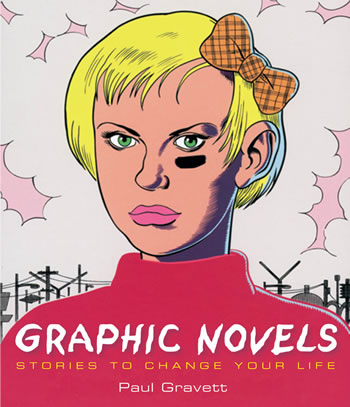
As part of my crash course on graphic novels, I read Graphic Novels: Stories To Change Your Life by Paul Gravett. The book covers scads of graphic novels with excerpts from each and an analysis. Plus the graphic novels are organized into topics, such as "The Long Shadow: Surviving war and its aftermath" and "The Undiscovered Country: Childhood's happy days or painful memories."

So now I've read about a great many (adult) graphic novels. Which means that I should be able to talk about books I haven't read!

Sunday, February 25, 2007

Maybe I Should Read This

I didn't have good luck reading a book on how to read books. Perhaps I should try this one--How to Talk About Books You Haven't Read by Pierre Bayard.

Actually, Bayard sounds very interesting. He says that many people (at least in France) "see culture as a huge wall, as a terrifying specter of 'knowledge'...But we intellectuals, who are avid readers, know there are many ways of reading a book. You can skim it, you can start and not finish it, you can look at the index. You learn to live with a book."

I think they may throw the word "intellectual" around more freely in France than we do here. I mean, the only time I hear it, it's being used as a slur. (As in, "Why, thank you, intellectuals, for telling us we don't know how to read.") But once I got past my first knee-jerk response, I read that quote of Bayard's and went, "Mais oui!"

Thanks to artsJournal for the link.