Saturday, October 31, 2009
Flash Fiction For Kids
At The Excelsior File David Elzey reviews Half-Minute Horrors, which sure sounds like flash fiction for kids.
Friday, October 30, 2009
How Do You Spell Success?
According to The Chicago Tribune article Irish author Derek Landy trying to get his skeleton-detective hero into Americans' skulls (Is that really a title or the entire article?), the Skullduggery Pleasant books are nearly Twilight/Harry Potter successful in England. Not so much here in the United States.
I wish the article had explained what it meant by "haven't caught on" here. What kind of sales are we talking about? Because I've heard of Skullduggery a lot on-line. It's a teen nominee for Connecticut's Nutmeg Award, which suggests a certain amount of acceptance by the gatekeepers who run that show.
Is the book considered not to have "caught on" because it isn't the kind of hit it is in England? Is it just moderately successful here?
Thursday, October 29, 2009
I Have Details
I've been meaning to mention that I have details about my appearance at the Connecticut Children's Book Fair. I'll be there on Saturday, November 14th with a presentation at 12:15 PM and signings from 11 AM to noon and 1 to 2 PM. The fair will be held in the Rome Commons Ballroom of Rome Hall on the South Campus of UConn in Storrs, Connecticut. Here are your driving directions.
I am working on a new PowerPoint presentation. Whenever I make an appearance I seem to need a new PowerPoint presentation.
I am working on a new PowerPoint presentation. Whenever I make an appearance I seem to need a new PowerPoint presentation.
Wednesday, October 28, 2009
Quick! I Have Books Due At The Library!
I did a little graphic novel reading this fall, and I can't renew the books at the library again, so I guess I'd better blog about them, if I'm going to.
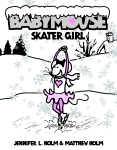
First, I read a couple of the Babymouse books by Jennifer L. Holm and Matthew Holm. I think what makes these books work is that they are graphic novels. While the stories are fine, the basic plots of the two I read, Skater Girl and Puppy Love, weren't particularly unique. But joining those plots with the graphics and the mouse, definitely elevated them.
I found it a little unusual that the books sometimes use a third-person narrator who speaks directly to Babymouse and wondered if kids found that confusing. Presumably not, since there are a lot of Babymouse titles.
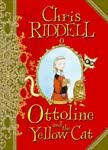
Our library classifies Ottoline and the Yellow Cat by Chris Riddell as a graphic novel, though I think I'd describe it as more of a heavily illustrated novel for younger readers. It's a beautiful looking book with an interesting basic story, though I could have done without the Cousin It-like character, myself. Readers frequently have to stop reading to study the illustrations, which do, indeed, sometimes tell part of the story. (Though sometimes they're just illustrations.) I wondered if young readers would find that frustrating. On the other hand, a young, not-very-enthusiastic reader might find it a relief to stop and enjoy the scenery.
If you go to the Original Artwork From Children's Book Illustrators site, be sure to watch the slideshow of Riddell's Illustrations to Unwritten Books. It's very clever. Among my favorites...Hot Comfort Farm and Wuthering Tights. But there's lots of good stuff there.
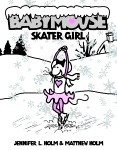
First, I read a couple of the Babymouse books by Jennifer L. Holm and Matthew Holm. I think what makes these books work is that they are graphic novels. While the stories are fine, the basic plots of the two I read, Skater Girl and Puppy Love, weren't particularly unique. But joining those plots with the graphics and the mouse, definitely elevated them.
I found it a little unusual that the books sometimes use a third-person narrator who speaks directly to Babymouse and wondered if kids found that confusing. Presumably not, since there are a lot of Babymouse titles.
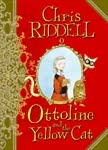
Our library classifies Ottoline and the Yellow Cat by Chris Riddell as a graphic novel, though I think I'd describe it as more of a heavily illustrated novel for younger readers. It's a beautiful looking book with an interesting basic story, though I could have done without the Cousin It-like character, myself. Readers frequently have to stop reading to study the illustrations, which do, indeed, sometimes tell part of the story. (Though sometimes they're just illustrations.) I wondered if young readers would find that frustrating. On the other hand, a young, not-very-enthusiastic reader might find it a relief to stop and enjoy the scenery.
If you go to the Original Artwork From Children's Book Illustrators site, be sure to watch the slideshow of Riddell's Illustrations to Unwritten Books. It's very clever. Among my favorites...Hot Comfort Farm and Wuthering Tights. But there's lots of good stuff there.
Tuesday, October 27, 2009
Index Cards Come In How Many Colors?
I'm going shopping for index cards later this week. I read Pick A Card, Any Card at R.L. LaFevers' blog (referred there by Becky Levine), and now I'm thinking that colored index cards could help with the story arcs (which are like mini-plots) in the 365 Story Project. They could certainly help keep track of characters meandering through the year of stories.
I'll let you know how that goes.
I'll let you know how that goes.
"Feminism Has Gone Down The Toilet"
Last week I was with some friends of a certain age. We were talking about how we could remember a day when the word "girl" was derogatory, and how could the present crop of young females not only allow themselves to be spoken of in such a way but even use the word to describe someone over the age of fifteen or thereabouts themselves? Back in the good old days, we wanted to be women. And we made damn sure we acted the part, too.
"Feminism has gone down the toilet," my friend Pat said.
I thought of that just now while reading a Globe and Mail interview with Mavis Gallant. The female interviewer asked Gallant (an eighty-six-year-old award-winning writer) if women can be fulfilled without giving birth. What the Hell century is this? I thought.
You'll notice Gallant gave her a good reply.
Thanks to Blog of a Bookslut for the link.
Monday, October 26, 2009
Perhaps It's Just A Matter Of Finding The Right Terminology
I haven't had good luck over the years with writing in a journal regularly. I have dozens of them and have used them successfully in fits and spurts, but nothing that truly satisfied me.
I've tried meditation in the past, hoping it would help my concentration. You know--staying on task and all that? I think that if you have to concentrate on meditating you might be missing the point. Or if you're trying to use meditation you may be lost before you start. At any rate, it didn't work.
Earlier this year, though, I combined the two and started calling my journal work writing meditation. That I'm able to do several times a week. Of course, this is Gail we're talking about, so writing meditation for me is probably not what anyone who actually knows anything about the subject would call writing meditation. But I like the words "writing meditation." And so I use the journal more. (Perhaps if I used it less, I'd write more offical saleable stuff. Perhaps writing mediation is not a good thing. One morning I will meditate on that in my journal.)
I've had a similar experience recently regarding first drafts. I've written here frequently about my difficulty getting through a first draft. I love the advice so many writers give about just get through it and revise later. I can never do that, though, because by the time I get to Point G I've decided I want something to happen at Point M that can only happen if something different happens at Point C. So I have to go back and make changes. Many of these changes are good. They make it possible for me to proceed for a while. Until I have to do another do over somewhere along the line.
Well, last week I discovered the term "discovery draft." My moments of on-line research lead me to suspect that many people who use that term simply mean "first draft." It may just be a pretentious way of saying first draft.
However, the idea of a discovery draft makes me feel so much better about not being able to get through a first draft without starting over...and over...and over. Because what I'm doing with that discovery draft is discovering material and if it's just about discovery, then it's okay--in my mind, at least--to do things with those discoveries.
So what I'm thinking right now is you just have to find terminology that makes what you do make sense to you.
We'll see how long that works for me.
Re-establishing His Eccentric Self
Great article on Sherman Alexie in The New York Times.
Alexie was adored after the publication of The Absolutely True Diary of a Part-time Indian. It was very successful, and he was embraced by the YA world. He could have followed up Part-time Indian with another YA book and got himself some more lovin', at least from YA people.
But he didn't. Instead, he published War Dances, a volume of short stories and poetry. In the Times article, In His Own Literary World, a Native Son Without Borders, Alexie says, "I think the new book was an attempt to re-establish my eccentric self: ‘I’m not supposed to sell as many copies as I just did, so let me write something that won’t.’"
Yes, short stories and poetry should do the trick.
I also liked Alexie's description of how he works: "I’ll write whatever’s going well for a few months at a time and move around." He might write 150 pages and jettison it or turn it into a small part of a poem.
And what was really terrific was that he didn't just write Part-time Indian and go, "Well, would you look at that--I wrote a YA book," or have an agent or editor point that fact out to him, the way many writers of adult fiction write their first YA books. He was aware of his audience and studied YA novels while "figuring mine out."
Sunday, October 25, 2009
Wasn't It Just A Couple Of Years Ago That Everyone Was Looking Down At Blogs? That's All Over.
A New-Media Read On Books At Huffington Post in the Los Angeles Times is thought-provoking in so very many ways. I will mention just one:
"Hertz argued that authors, their editors and publicists should all be pushing their books on blogs, engaging their readers in direct conversations and opening their publicity campaigns months earlier than they have in the past."
Presumably she means in their own blogs, which would obviously be about marketing and thus on the up and up as far as the FTC is concerned.
I'm fine with that plan, since that is exactly the kind of blog I have here. But there's something about the L.A. Times article that made traditional reviews seem very...quaint. Though we in publishing liked to make reviews about selling by quoting any possible bit that could make us look good, in reality that's not what their function is. It would be a shame if criticism/analysis can't co-exist with marketing.
Link from artsJournal.com.
Mary Sue Has A History
I suffered some Mary Sue Anxiety last spring. I don't know if learning she's been around the track a few times makes me feel better or not.
Subscribe to:
Posts (Atom)