Showing posts with label Julia Child. Show all posts

Thursday, January 18, 2024

Some Annotated Reading January 18

In addition to Ms. Demeanor, I also read Murder in Old Bombay by Nev March during my retreat week. This is not the first historical mystery set in India that I've read. Apparently, I'm drawn to them. I also read some short stories by Kelly Link in her book, Get in Trouble. I have enjoyed Kelly Link's short stories in the past, but after reading three or four of these I felt they might be enjoyed better one at a time, now and then.

While I'm on retreat, I often research and read about people I hear about in newspapers or magazines there. Last year, for instance, I read some rather grim, but fascinating, things about mid-century Stowe. This year I read about the Lepine Sisters, who developed some national fame in their day. Also, I saw something about pirates on Lake Champlain, so I had to read about that.

More recently I read A Wicked Stepmother With Empty Nest Syndrome Is Left Wondering, Now What? | by Danielle Martinetti | Slackjaw | Medium

The Birth of My Daughter, The Death of My Marriage by Leslie Jamison in The New Yorker was an odd thing for me to read, because I don't lean toward what you might call depressing memoir. But, man, the title was such a hook. I couldn't look away.

Julia Child Was a Champion for Reproductive Rights, Carrie Mullins interviewing Helen Rosner at Electric Lit was one of three articles I read about Julia Child this past week. It appears that I have developed a mild obsession with her. Yes, I recently finished the second and final season of Julia on Max.

Redefining What Makes a 'Relationship' in Our 70s by Elinor Lipman at AARP. Yes, I am someone who goes 'eh, AARP.' But this is an absolutely charming piece, and it appears that I'm also developing an obsession with Elinor Lipman.

Monday, April 18, 2022

Julia Child Is Everywhere This Spring


Julia Child is having a moment, due to the pretty terrific Julia showing on HBO Max right now.

It looks like pie, but it's cake!
Speaking of which, for Easter I made a gluten free version of the Queen of Sheba cake she makes in the first episode. Except for the no gluten and baking it in a pie plate instead of a spring form pan and using vegan margarine instead of butter, it was just like Julia's.

And speaking of Julia Child, over the last couple of weeks while watching the show about her, which has inspired many, many articles on-line, many of which I have read, I have been thinking about a lovely 2012 picture book by Susanna Reich about Child's cat, Minette. So, as part of my Original Content anniversary observance, I am republishing my post about it. It appears to be available as an e-book. I believe I still have my hard copy.

Friday, May 04, 2012 Blog Tour: "Minette's Feast" As Creative Nonfiction


If you're looking for Day Five of the Minette's Feast Blog Tour, you're in the right spot.

Minette’s Feast by Susanna Reich, illustrated by Amy Bates,  is a lovely picture book with a Parisian setting and a charming story. A woman living in Paris and studying French cuisine adopts a cat, Minette, that far prefers the results of her own food prep—hunting for birds and mice—to the cassouletssoufflés, and pates her owner makes. She is finally won over, at least temporarily, by the leftovers from a dish that had taken three days to marinate.

The descriptions and illustrations of home, cooking, and food, food, food give Minette’s Feast the potential to become a comfort book, so it doesn’t matter that many young readers won’t know who the woman referred to in the book’s subtitle —“The Delicious Story of Julia Child and Her Cat”—is. Furthermore, Minette holds her own as a character. She does, after all, turn up her nose at meals prepared by a student at “Le Cordon Bleu, the famous cooking school.” Whether or not she will be won over to fine human food provides the narrative drive for this sweet piece of creative nonfiction.

That is what Minette’s Feast seems to be to me—creative nonfiction for kids. Creative nonfiction, as I first saw it defined years ago, is nonfiction that reads like fiction. It is written using  “elements borrowed from fiction to tell true stories,” as nonfiction children’s writer Melissa Stewart wrote earlier this year.  Descriptive language (“Julia and Paul were charmed by Minette’s delicate whiskers, her superior nose, and her quick little paws.”), dialogue (“Une maison sans chat, c’est la vie sans soleil!”), and the use of scenes (“And every time they went out for a walk, they enjoyed a fine, fine meal. They nibbled croissants in cafes where cats curled on chairs…”) are all examples of writing elements usually associated with fiction that a writer of creative nonfiction may choose to use.

In fact, in Lee Gutkind's collection of essays by writers of creative nonfiction, Keep It Real, scenes are described as the building blocks of creative nonfiction. They then need to be placed in some kind of order, or frame. In the case of Minette's Feast, Susannah Reich uses a traditional story frame to organize her scenes. A story is an account or retelling of something that happened told in a way that expresses meaning. That's why a beginning, middle, and end are so important to stories. We see the world of the story in the beginning, then a change or disturbance to that world in the middle, and the result of that change or disturbance in the end. We see what happenedMinette's Feast does read like a story--it's an account with a beginning, middle, and end of something that happened to Julia Child or to her cat, depending on which character you prefer to see as the protagonist. We also understand its meaning. This cat wouldn't eat Julia Child's cooking, for crying out loud!

Complete little stories turn up in all our lives (the story of how our parents met, the story of how we wrecked our new bikes, the story of how we came to settle into a career), but they aren’t always easily recognizable. And they don’t necessarily have any great significance or meaning beyond what happened to us. Creative nonfiction writers who choose to use a story frame have to recognize the potential for story while they are doing their research.  In her author’s note to Minette’s Feast, Susanna tells of having wanted to write about Julia Child for children “but I could never figure out how to make the story interesting to children.” She read Child’s memoir, My Life in France, “and discovered Minette, who inspired Julia’s lifelong love of cats. As a cat lover myself, I knew I had finally found my story.” 

Susannah’s story was actually Julia and Minette’s story. Through the use of creative nonfiction techniques, Susannah turned it into Minette’s Feast.

The Minette's Feast Blog Tour continues on Sunday at Great Kid Books. The earlier tour stops were:

Booktalking

Books Together

Tales from the Rushmore Kid

The Fourth Musketeer

After Sunday, the tour continues on Monday at Shelf-employed and Tuesday at ReaderKidZ 

Wednesday, July 01, 2020

Me And Mother Jones, We've Got A Thing Going On

Until this spring, all I knew about Mother Jones was that it was the name of a magazine I'd never read and didn't know anything about, though I can tell you now that it does investigative journalism. Then this spring,  I was reading A People's History of the United States, and the author, Howard Zinn, starts in about "Mother Mary Jones, a seventy-five-year-old white-haired woman who was organizer for the United Mine Workers of America," I thought, Aha! That can't be a coincidence. And it wasn't. The magazine was, indeed, named for Mary Jones, known as "Mother" during her later activist years.

Stick With Me, Folks. There's A Mother Jones Childlit Connection Coming


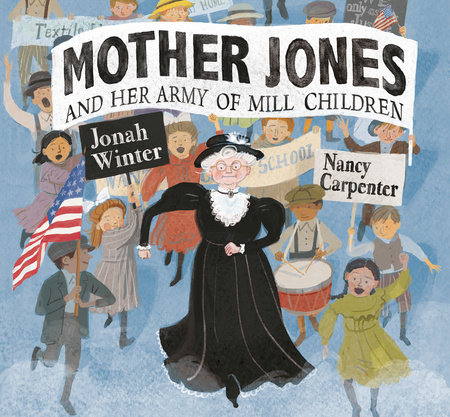
A couple of months after reading A People's History, I'm reading the March/April issue of The Horn Book and what do I see but a review of Mother Jones and Her Army of Mill Children by Jonah Winter with illustrations by Nancy Carpenter! The book deals with an incident that appears in both the AFL-CIO bio of Jones and the Mother Jones magazine material about her in which Mother Jones organized child workers in a march from Philadephia to President Theodore Roosevelt's home in Oyster Bay, New York.

Two Points


  • I love it when something new to me repeats in my life, the way Mother Jones did in the Zinn book and this picture book review. I'm sure I've written about this before here. And I'm guessing there is a word to describe this experience. Not deja vu, since that deals with the experience of feeling you've been somewhere before or lived an experience before. Perhaps the Germans have a word for this, since they are quite good at coming up with words for odd experiences.
  • Though I have not read Mother Jones and Her Army of Mill Children, the set up for this book sounds like a classic way of introducing children to a historical figure we wouldn't necessarily expect them to connect with. The author finds something about the subject children should be attracted to, in this case, other children. That aspect of the book reminds me of Susanna Reich's Minette's Feast, in which child readers are introduced to Julia Child by way of her cat. 


Oh, And Since We're Discussing Introducing The Young To Adult Subjects...


A family member who is a middle school librarian brought  A Young People's History of the United States by Howard Zinn with Rebecca Stetoff  to my attention. It's a young adult edition of Zinn's original book. I would not say that this is the only history of the United States a young person, or anyone else, should read, but it certainly will give someone who already knows something about American history something to consider.