Tuesday, January 31, 2006

Does Anyone Ask These Kinds of Questions in the U.S.?


The Royal Society of Literature asked British authors to come up with lists oftop ten books for school children. In a Guardian article in which Andrew Motion (Britain's poet laureate), J. K. Rowling, and Philip Pullman are all quoted, the word "children" seems to be defined very loosely, since Where the Wild Things Are and Portrait of a Lady were both included.

Motion made an interesting point about difficult works being considered elitist. Nonetheless, I wonder if his list, which included Paradise Lost and Ulysses wouldn't be inaccessible to many college graduates, forget about "children."

Now, I know I'm nitpicky, but if I were asked to nominate ten books for such a list, I'd want to know what I should use for criteria. What's the point? What do we want to achieve with this list? Cultural literacy? Should we include The Bible so people will get the Biblical references in the first Matrix? (I have young relatives who say I ruined that movie for them by pointing out Biblical references. Heh, heh, heh.) Do we want to create a nation of readers? Do we want to include books just because educated people ought to know this stuff? (Says who?)

I feel we have a real problem with people not wanting to read, and I don't think television is entirely to blame. I know this is anecdotal, but I know plenty of intelligent, well-educated people who don't enjoy reading. I'm talking honors course, AP people here, even AP English people. So, if I were going to create a list of books people should read before leaving public school, one of my criteria would be that the books should do no harm. Meaning, they wouldn't send readers running out of the room.

Another criteria would be to choose books that had some kind of impact on literature in general or on popular culture. I think being able to see those kinds of connections would help readers feel the books had some value for them.

And, finally, since this is the United States, I'd like to see books that reflected different regions of the country or different periods of history.

So, some books I might choose for every American to read before finishing public school:

The Odyssey. It's the first journey story, and to this day books and movies use it as a model.

Frankenstein by Mary Shelley. It's theme, that man should not mess with God's business or, put another way, science has run amuck, is timeless. Every child should be able to recognize a "Frankenstein Story" when she sees one. And for a nineteenth century book, this is very readable.

Little Women or Little Men by Louisa May Alcott. These books reflect Alcott's Transcendentalist upbringing. Transcendentalism is unbelievably complicated, but it had an impact on many aspects of life including religion, philosophy, and certainly literature. It was also the first philosophy to start here in America. Little Women touches on the Civil War, though some might find Little Men more readable.

Huckleberry Finn by Mark Twain. Though I recall being bored while we were discussing this in high school English, Huckleberry Finn brought regional dialect to the novel. It's also a variation on The Odyssey--a journey story but with buddies. Personally, I agree that race is a touchy issue in this book. The Tom Sawyer escapade at the end is a jaw dropper. So discuss it.

The Story of David and Goliath, and The Prodigal Son as picture books. Come on. These basic story lines have been used over and over again.

I know I need five more books, but I'm running out of time. Over the next few days I'll try to come up with regional books.
Monday, January 30, 2006

What a Disappointment


I wanted to try reading an older kids' book by Tim Wynne-Jones because I loved his Zoom picture books. (See my November 25, 2005 post.) I stumbled upon The Boy in the Burning House, and what can I say? Not much except that I found the plot jumbled and the writing flat.

I wish I could find a better way to describe what I mean by flat writing.

As usual, if you do an Internet search on The Boy in the Burning House, you'll find that a lot of people liked it.

Late as Usual


About a month ago, a number of people blogged about Far From Narnia an article about Philip Pullman in the Dec. 26/Jan. 2 issue of The New Yorker. Well, I finally got around to reading it. Lucky you, I'm going to share a couple of interesting parts relating to stories

First off, though, I'd like to point out that journalists writing about Philip Pullman just can't seem to get past the fact that he's an atheist. Yes, it's pertinent because religion plays a part in his most famous works, the trilogy known as His Dark Materials. Still, articles about him have become just a little bit predictable.

On the subject of his religious belief, he is quoted by Laura Miller, the article's author, as saying "...we can learn what's good and what's bad, what's generous and unselfish, what's cruel and mean, from fiction..."

I think by "fiction" he means stories. My impression from the article is that Pullman holds the idea of story in very high regard. He refers to himself as "the servant of the story." When The Golden Compass won the Carnegie Medal, he said in his acceptance speech, "In adult literary fiction, stories are there on sufferance. Other things are felt to be more important: technique, style, literary knowingness..."

I think there are probably many contemporary readers who would agree with him there.

He also said, "We need stories so much that we're even willing to read bad books to get them..."

Pullman is also described as "a partisan of the third-person omniscient narrator"--the classic way to tell a story. The storyteller doesn't enter into the story himself, the reader forgets he's there.

So all this talk about stories is what interested me most in the article.

However, there was one last bit that I'm sure grabbed other readers. Pullman has become quite well-known for disliking Narnia. What he really comes across as disliking in this article is Tolkien's Lord of the Rings series.

Sunday, January 29, 2006

Preserved for Posterity


I may not be terribly fond of Looking for Alaska, this year's Printz Award winner, but the author, John Green, has an adorable photo essay up at his website about how he learned he'd won. The essay is so funny, touching, etc., etc., etc., that I have decided right here on the spot to take a shot at reading his next book. Whatever it may be. Whenever it may show up.

Thanks to A Chair, A Fireplace and A Tea Cozy for the link.

Dealing With Library Books


I had to pay a six dollar and forty cent fine at the library yesterday, so I took some couch time this afternoon to polish off the stack of books involved--all by Jon Scieszka. His last name rhymes with Fresca! Now I can talk about him!

I wasn't a huge Scieszka fan, but decided to give him another chance because he had a great article a while back in The Horn Book. I thought I blogged about it, but I can't find it now, which suggests I spelled his last name wrong. Oh, well, one more humiliation to accept.

Anyway, in the past I felt that Scieszka's humor was strained. I took a stack of his picture books out of the library, and here is what I've discovered about them: to get Scieszka, you've got to understand that his humor isn't about the punchline, it's about the set-up. At least, that's my view.

In his Horn Book article, Scieszka wrote about his experience as an elementary school teacher trying to teach a unit on jokes. He told this one great story about a kid getting up to tell a joke that clearly had an off-color punchline, but when the boy got to that point in his story, he'd forgotten it and just ended the story with something somewhat unrelated to what he'd been talking about.

Back in the day when I was a mom-volunteer in a grade school, helping younger kids with their writing, I often saw that kind of thing. Kids would work on a story and just get tired and stop or just sort of ramble off into something unrelated.

I think Scieszka's book Squids Will Be Squids, in particular, reflects that kind of kid sensibility. In the review I linked to, from CM Magazine: Canadian Review of Materials, Valerie Nielsen said, "...this latest collaboration between Scieszka and Lane may not turn out to be a winner. Many of the morals following the fables miss the mark. For the most part, they elicit a puzzled frown rather than a giggle."

That's true. I was reading these things, enjoying the fables, and then getting to the morals and going, "What?"

But kids may not have the same response because kids frequently write and tell stories the same way.

I read Baloney (Henry P.) totally oblivious to the fact that the main character was an alien. (This makes sense. I wrote an entire book about kids whose mom was totally oblivious to the aliens in her yard.) I found all the strange words in the text annoying. Then I got to the end of the book, learned that the words weren't strange, they were... Well, I don't want to give anything away.


While I was reading Math Curse, I kept thinking, Well, I find this humorous, but I'm an adult. Will kids get this? Is there too much text? I like the incongruous options in the muliple choice questions, but what is the real answer? Do readers have to figure out the real answer?

Give it a rest, Ms. Gauthier. This book is for a child who feels overwhelmed--maybe hammered?--by all the math that's thrown at her at school. She wants to be able to laugh about that feeling. Forget about the real answers.

I think many of Scieszka's picture books are not for the traditional picture book audience, preschoolers, but for older children, who we don't necessarily associate with picture books. There's nothing wrong with that, it expands the definition of picture book. I also think Scieszka is definitely a writer who writes who he is--a former grade school teacher.

So, here's an example of Gail giving an author another chance as a result of reading his nonfiction and definitely changing her mind about him. Tomorrow, class, we'll discuss another case, which did not turn out so well.

Thursday, January 26, 2006

It's Like Some Kind of Chain Reaction


Absolutely everyone is talking about snakes today. Big A little a started it, Book Moot picked up on it, and then the subject moved on to Chicken Spaghetti.

I'd just like to point out that this is the kind of information that is worth its weight in gold for a children's writer. I don't mean because it indicates that now would be a good time to write a snake book. (I suspect any time is a good time to write a snake book.) No, I mean that if snakes are hot with the little nippers, then that could be a good detail to use when creating a young character.

My Name is Gail, and I am a Screen Sucker


The January 16th issue of Timehas an article on ineffecient use of time due to multi-tasking (I wish) or becoming distracted. In it, the authors (Claudia Wallis and Sonja Steptoe) define screen sucking as "Wasting time online long after you have finished what you signed on to do."

What do you call it when you sign on specifically to waste time online?

I am constantly interrupting my work to check my e-mail (I don't have a little pinger telling me when some arrives, which means I can check it over and over and over again), check the news, go to Readerville and, now, play Bookworm. (I have made it to Level 7, by the way.) The Time article said that an average of 2 hours a day are lost to such activities and the "recovery time associated with getting back on task." Assuming that happens.

I definitely believe I'm losing two hours a day, because my plan in life is to knock off work around 3 so that I can get some life maintenance work done. Yet I fall so far behind because of all the garbage I do that I often am trying to finish up when I should be starting dinner, forget about doing something else. Then I feel overwhelmed because I haven't folded last week's clean laundry (and, yes, my husband does fold laundry--he folds his as well as all the towels and bedding, which, yes, doesn't leave me with much), I haven't ironed in weeks, the floors are crunchy, and I can write my name on almost every surface in the house.

And that overwhelmed feeling is not good for my work.

This particular issue of Time has pages and pages of stuff on the mind, including a two page spread on the best use of time if you're a morning person or a night person. And, yeah, you guessed it. To the best of my knowledge, I'm neither.

I'm not wandering off the subject of writing here, by the way. I think learning to organize your time is a huge part of being a writer. I'm going to use some of mine to finish reading this magazine, hoping it will give me a clue.

Wednesday, January 25, 2006

This Could Be The Start Of Something Big


Two people in Seattle are suing James Frey and his publisher seeking damages for the the time they "lost" (meaning, I guess, wasted) reading his book A Million Little Pieces.

Seriously, if we all started suing authors because reading their books was a waste of our time, we'd all be in court all the time.

Thanks to ArtsJournal.com for that one.

Worth Every Minute I Spent Reading It


I fell behind reading Louise Doughty's A Novel in a Year column because I was too dimwitted to figure out how to find the new columns without someone else linking to them. But I've got it worked out now.

This project is great. Doughty's second week assignment was "Read." And the really neat thing about the assignment is that she explained why writers should read. "Aspiring writers should read" is one of those bits of advice like "Write what you know" that everyone throws around but no one explains.

"[Reading]Bad writing can be an incredibly positive influence if you learn to analyse why it is bad and resolve not to do the same."

Yes! Yes! Exactly!

Doughty also advices aspiring writers to read contemporary authors.

"...if, as is almost certainly the case, your time is precious and you are trying to focus intently on your own work, you will get more practical help from reading Hilary Mantel or Graham Swift than you will from George Eliot or Leo Tolstoy.

"All writers are products of their own era, however timeless the themes of their writing or the excellence of their prose. If all you read is Dostoevsky, then however much you enjoy his work as a reader, as a writer you will simply get depressed because you will never be Dostoevsky."

I don't know about the getting depressed part, and I have to admit I've never heard of Hilary Mantel, but Yes! Yes! We are all products of our own era!

I've got to go out and find one of this woman's books.

And here's my first sentence from Week One's assignment to write one sentence, beginning with the words, "The day after my eighth birthday, my father told me...":

The day after my eighth birthday, my father told me, "You're a fine son. I love you dearly. But you're not like the rest of us."

Okay, it's not just one sentence. But it's close.

Tuesday, January 24, 2006

I Knew Someone Would Be Able To Tell Me This


Suzi from Words, words, words wrote to offer some advice on which Terry Pratchett books to read next. (See my Jan. 22 post.) She also sent me a link to The Terry Pratchett Read Order, which is actually way too complex for me.

More Travels With Gail


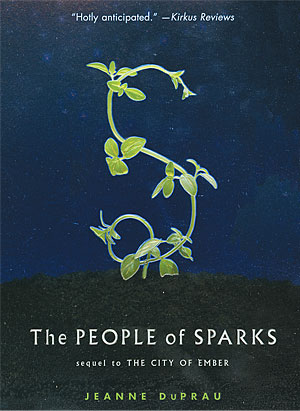
A week ago this past Sunday, I was in the car for twelve hours--twelve hours!--time enough to listen to all of The People of Sparks by Jeanne DuPrau. Sparks is the sequel to The City of Ember, which my husband was so taken with when we listened to it on CD on our last trip, that he made a trip to the library to find this next book.

There are spoilers coming up, in case anyone cares.

Okay, so the folks from The City of Ember have escaped from their underground spideyhole. I think it's unfortunate that we don't see that happen. At the beginning of The People of Sparks we are told about it. Big no-no. But, moving on, the Emberites come uptop only to learn that the Earth has suffered a few wars and maybe a plague or two a couple of centuries back and society has been thrown back a bit. No power sources, no communication, you know the drill.

My objection to that storyline is the same objection I have to most post-apocalyptic stories. Some people survive the apocalypse, but not a single scientist makes it. Not a science teacher, line repairperson, power plant operator...not a soul who at least knows that energy can be made and that maybe they can figure out a way to make it, too. I believe two centuries had passed in the book since all Hell broke loose. I mean, in two centuries mankind won't move on at all?

Other than that, though, I actually liked Sparks better than Ember. It was deeper and more sophisticated, a parable, one might say, about how wars happen. I don't usually care for instructive stories, but I felt interested rather than preached to.

I hear a lot about teachers favoring "problem books" in the classroom, and that boys don't care for such things and are thus turned off from reading. I think The People of Sparks would make a good classroom read aloud for, say, 4th through 6th graders. There's action, things to talk about, and a main character of each gender.

Something for everyone.

The Last Item I Picked Up In Vermont


When I was in Vermont the second week of January, I read about The Young Writers Project, a "partnership of Vermont students, teachers, professional writers and journalists that aims to encourage and improve writing in Vermont elementary, middle and high schools." The professional writers offer advice along with samples of their work. Student writing is published at a website.

An ambitious effort.

Monday, January 23, 2006

I'm Talking About This Because I Have To


I've been avoiding discussing book awards because it seems to me there are a huge number of them--not that that's a bad thing, by any means. But everybody is talking about them, so I figure I should talk about something else. Especially since lots of times I haven't read the books involved.

But today was Newbery,Caldecott, and Printz Day. I am a children's writer and blogger, so...

This year I've actually read a few of the books involved. I didn't read the Newbery Winner, but one of the honor books, Princess Academy by Shannon Hale. Now, if my legions of loyal fans remember, I wasn't crazy about Princess Academy, liked The Goose Girl much better, thought Princess Academy covered a lot of the same ground and was just old wine in a new flask.

However, in discussing Princess Academy and the Newbery today at Readerville, someone made the point that Princess Academy is for a younger age group than The Goose Girl. That person believed that it wasn't inappropriate to rework material when you are providing a new setting and presentation for a group that wouldn't read the first book. The woman who made this argument is a teacher, and she said Princess Academy had made its way around her fourth grade class.

Well, I have an open mind and that discussion has made me rethink Princess Academy. The book has moved up in my estimation. What's more, I'm delighted to hear that a Newbery Book is being read by kids. Because with some of the choices some years, you've got to wonder.

You can go to Shannon Hale's Activity Log to read an account of how she received the news about the Newbery. She had it posted early today. She's right on top of things.

By the way, I read years ago that the Newbery Honor Books are not runners up for the Medal. They are selected with a different set of criteria. I don't know if that's true, because you'll hear other people telling you otherwise. It's all very mysterious.

Regarding one of the other awards, namely, the Printz: I cannot believe Looking for Alaska, another story about the sad lives led by prep school students (though with lots of sex and smoking), won while a unique story like A Certain Slant of Light didn't get so much as a nod for honor book. Don't people read my blog? I'm fine with I am the Messenger getting honor book, though it did have an awful ending.

And then there is the Alex Award, which is given to "adult books that will appeal to teen readers." Included in this year's list of ten is Never Let Me Go. It is fantastic. An incredible book. And, yes, as I was reading it, I did wonder if this disturbing, sad book would be of interest to teens.

The presence of that one book makes me feel that the other books on the list should be worth a look.

Now, see, I had a lot of things I wanted to talk about today, and I spent all my time on awards. #@!!!

Sunday, January 22, 2006


A Fantasy Novel For Those Of Us Who Don't Like Fantasy Novels


In my last post, I bashed the fantasy genre. In my humble and narrow-minded opinion, the average fantasy novel has way, way too much talk about made-up scenery, religions, species, cusine, weapons, and body parts. I just don't need to get that far outside my comfort zone.

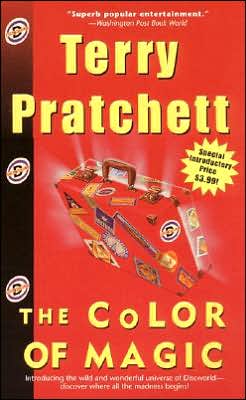
Having said that, I feel that it is only fair to give some attention to a fantasy novel I did enjoy. I finally broke down and read one of the Discworld novels by Terry Pratchett. I had read Good Omens, which Pratchett co-wrote with Neil Gaiman, and liked it a lot. So when I heard about Discworld, probably through the one of the YA Forums at Readerville, I thought I'd give it a shot.

What held me up was that Pratchett has written a lot of books, and a lot of them are Discworld books. I didn't have a clue where to begin.

However, while I was standing in the sci-fi shelf at the Borders in Burlington, Vermont, I saw a woman fingering a few of the Pratchett titles. Since she was holding quite a stack of books, I took a chance that she'd know whereof she spoke. Sure enough, she was a Discworld fan and told me to start with The Color of Magic.

I have to say, the book had plenty of strange names, strange geographical details, and strange stuff in general. But Pratchett doesn't seem to take himself too seriously. I suspect he knows his stuff fantasywise, but he makes his fantasy wry and twisted, not deadly and heavy with meaning. In fact, I'm not sure The Color of Magic has much in the way of heavy meaning. It's a very enjoyable road story. It reminded me of Douglas Adams' books in that the main characters aren't traditionally heroic, and there's plenty of humorous twists. Personally, though, I liked it better than Adams' books, which are just a little bit too odd-English-humor, if you ask me.

The Color of Magic is entertaining reading for readers who like their entertainment demanding. The writing is complex as is the world portrayed in the book. Pratchet is unbelievably inventive.

Douglas Adams was extremely popular with teen readers a few years back and may still be. I suspect the Discworld books will be enjoyed by the same young'uns. Pratchet also writes books that are geared specifically to YA readers as well as children's books.

I will be going back to Discworld. Though I may have to wait until I can find someone in the sci-fi section of a bookstore who can tell me what to read next.

Saturday, January 21, 2006

Post- Holes


Slate calls Louis Sachar a Hot novelist of the sandbox set. The article has plenty of good things to say about Sachar's last book Holes, but isn't as positive about his new one, Small Steps.

The author of the article, Bryan Curtis, says Holes has "touches of magical realism," which I found interesting because I've never been clear on what magical realism is. He also says that "Children's novels often depend in some part on the confinement of their protagonists—whether in algebra class or a dusty old country house..." I found that interesting, too. I'd never heard that before or made the connection, myself, but, yeah, I guess I'd go along with that.

I'd Go Along With This, Too


The Guardian has a wonderful article called Cultureshock in which a children's author named Francesca Simon (I'm not sure if I've heard of her books) makes a deal with her son. She'll read a fantasy novel if he'll read one by Anthony Trollope.

Mom says: "All right, I admit it, I'm biased. I hate fantasy. All those adjectives and elves and weird names. The moment someone says fantasy, I know I'm in for "The three blood-red moons rose over the dusty sand plains of Ut-Tajik as the bald jackal priest of Sidt placed the sacred silver urn of Caldon on the broken altar of the blind god Fifff.""

That is exactly...exactly...what I think of when I think of fantasy.

Sixteen-year-old son says of Barchester Towers (which I believe I read when I was a teenager): "...all characters are introduced by means of lengthy and irrelevant description. The basic doctrine of "show, don't tell" was obviously not around in the 19th century, nor the notion that character and plot work best in tandem, rather than in isolation."

Now, I don't remember much about the book so I have no idea whether or not the kid's argument is accurate. But he states it so clearly and seems so knowledgable that...hey, I was impressed.

I mean, it certainly beat that famous literary appraisal "That sucks" and was even a little more sophisticated than "I don't know why I didn't like it. Does there have to be a reason for everything?"

There usually is, whether we realize it or not.

Thanks to Big A little a for the link.

Thursday, January 19, 2006

A Mission for Litbloggers


Yes, linking to Confessions of a Bibliovore's January 17th post is shameless self-promotion. But it also illustrates what I think of as one of my missions as a litblogger.

We should be bringing older books to the attention of readers.

Review publications limit themselves to the newest releases. I can understand that. There are hundreds of thousands of books out there and these publications can't possibly give space to all of them. They can't even cover all the newest books, let alone the books piling up from years past. There's only so much time to read books and only so much ink to write about them.

General publications look for something "newsworthy" and when it comes to books, in their minds that means new. Or controversial. Or meeting some bizarre standard relating to human interest. A lot of good books will never be mentioned in your average newspaper or magazine.

But is the good book that is published this season going to be any less good next season when no one wants to talk about it? Or next year? Or eight years from now? The book doesn't change.

Bloggers can expand the window of opportunity for book promotion from a few months to...forever. We can bring older books to new readers. We can remind readers of books they were interested in but missed in all the pandemonium of new releases. We can expose them to books they would have never considered reading without us.

We're like every other reader. We're going to want to read what's new, too. But litbloggers read, period. We're writers, librarians, teachers, booksellers, and rabid readers. We read all kinds of things, and we can be talking about them in this forum to communicate our thoughts to others who might just be intrigued enough by them to pick up an older book they hadn't thought of before.