Showing posts with label procrastination. Show all posts

Tuesday, October 15, 2024

Time Management Tuesday: Procrastibaking Is A Thing And Can Illustrate Attractive Aspects Of Procrastination

I'd seen the term procrastibaking a few times over the last couple of years but just thought it was a joke. Until a week ago Sunday. It sure looks real to me, and I also think it illustrates the four differences between procrastivity/productive procrastination and more demanding tasks described by J. Russell Ramsay in Why the ADHD Brain Chooses the Less Important Task--And How CBT Improves Prioritization Skills in ADDitude.

First Off, Procrastibaking


Articles on procrastibaking, like The Joys of 'Procrastibaking' to Avoid Real Work by Christina Ianzinto at AARP tend to treat it benignly. The AARP article was about a new cookbook, so, yeah, I can see that. In this case, procrastibaking is portrayed as a stress reliever. While Why Work When You Can Procrastinate by Julia Moskin at WRAL News includes some material from psychology professor Tim Pychyl on how procrastination, itself, is "one of the few situations in which people consistently make choices that are demonstrably bad, " over all the tone for procrastibaking is cheery.

Since I've mentioned Tim Pychyl's name, I'm just going to remind everyone that in his book The Procrastinator's Digest A Concise Guide to Solving the Procrastination Puzzle, he says that procrastination has a specific definition within psychology. True procrastination "is the voluntary delay of an intended action despite the knowledge that this delay may harm the individual in terms of the task performance or even just how the individual feels about the task or him or herself. Procrastination is a needless voluntary delay."

So I guess procrastibaking is that with brownies.

My Personal Procrastibaking Case Study


What was supposed to happen on Sunday, October 6:


I had two tasks planned that would improve my upcoming work week.

  •  I was going to fold and take care of my clean clothes in the laundry room. I was going to do some of the ironing that has been waiting down there since last winter. We're talking only my clothes. Over the last few years, I've turned into that person who lives out of the clean clothes hamper, which is odd because I wasn't that person when I was washing, drying, folding, and taking care of laundry for four people. But that's neither here nor there. I was going to get my clean clothes dealt with so I wouldn't have to spend time dealing with it on days when I wanted to work.
  • I was also going to do some research to support a minor part of an essay I've been rewriting. That would make the writing of that essay during the week go so much faster, because not only would the research be done, it would have been simmering in my brain for a while, which is always a good thing.

What really happened on Sunday, October 6:

I realized I had ten eggs that were going to expire on Monday, October 7. Even though I knew I could be loosie-goosie with expiration dates for eggs, I spent the afternoon of Sunday, October 6 baking
  • rosemary sea salt bread
  • drop biscuits
  • and hermit bars
I bake gluten free, and gluten free baking sucks up eggs. I had only three left at the end of the day. I used them for lunch the next day, in case you're concerned. 

All the time I was doing this, I knew I was proving the point Ramsay makes in his ADDitude article, but I did it anyway. Mainly for this blog post. But still.

What Does My Procrastibaking Experience Illustrate?


J. Russell Ramsay says there are four differences between the small, unimportant tasks ADHD brains (and I'm going to argue other brains, too) select over more critical ones they put off. I ticked every one of them off with my work choice that Sunday.

  1. Manual focus, meaning the tasks selected are often physical rather than mentally demanding. Certainly, baking was less mentally demanding than research. There's a lot of material on what I was writing about, and I don't find it terribly well organized. I was not running toward that task with open arms. 
  2. Familiar script, meaning something you've done before and will find easier to do. I have been baking for a looong time. Additionally, two of the three things I made I've made a number of times. Sure, I know how to fold and iron clothes. But obviously I don't do it anywhere near as often.
  3. Time frame, meaning a definite and predictable time frame. Recipes are all about time. How long was it going to take me to iron those clothes and find the little bit I needed in that research? I didn't know. 
  4. Task progress, meaning a clear beginning, middle, and end. Again, what clearer beginning, middle, and end can you ask for than a recipe? I didn't expect to finish the ironing, even if I'd started it. Also, in this particular case I had the end date with the eggs expiring the next day. It was not at all difficult to convince myself that I was working on a deadline.


What Can We Take From All This?


For one thing, beware of procrastibaking! It is not benign and cheerful! If you're truly procrastibaking, it means you're not doing something more important. What is it and how are you going to address it?

For another, when you see yourself choosing to do something that doesn't address an important task waiting for you, ask yourself if you're choosing the lesser "work" because it's less mentally demanding, familiar, has a predictable time frame, and has a definite beginning, middle, and end.  A positive answer to any of those could convince you to take another course of action.


If you're wondering if I ever took care of the clothes and did the research I needed to do, the answer is no to the clothes and yes to the research. I could have taken a few minutes this past Sunday to do some work in the laundry room, but now I have a lot of apples to use up. I made an apple upside down cake instead. 


Tuesday, November 23, 2021

Time Management Tuesday: Enjoy Your Thanksgiving Week


Some Positive Procrastination During Thanksgiving Week

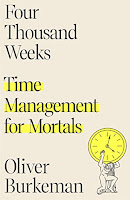
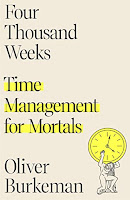
In his book Four Thousand Weeks author Oliver Burkeman writes about how there are so many, many things we want to do in life, and we should learn to procrastinate on some of them so that we can concentrate on others. That doesn't mean we'll never get to do them. But during this year, quarter, month, week, weekend, what-have-you, we are putting something off so we can concentrate on something else.

This week I'm concentrating on finishing a chapter in another one of those never-ending book-length manuscripts you hear me talking about here and getting ready to host Thanksgiving for the first time in years. Original Content will be back after the holiday weekend.

Tuesday, November 09, 2021

Time Management Tuesday: The "Four Thousand Weeks" Read Part 4

Turns Out There's Bad Procrastination, Too. We Did Know That.

So last week as part of my read of Oliver Burkeman's Four Thousand Weeks, I wrote about what Brukeman describes as good procrastination. That would be accepting that we can't do all of the marvelous things we want to do and making a conscious decision to put some of them off so we can concentrate on a few things we definitely want to get done. You know, write.

Bad procrastination is the kind we hear about more often, the kind that takes us away from those few things we want to concentrate on. 

Procrastination Is Not New

Nowadays, we seem to feel that procrastination is a new thing, a new problem of our era brought about in large part by the distractions that the Internet and social media provide. But Burkeman claims that ancient Greek philosophers wrote about distraction, long, long before Facebook and Twitter existed. I find knowing that a negative behavior has existed for generations oddly comforting. Burkeman also says that distractability has an evolutionary benefit. Those hunter-gatherers who were more easily distracted by the approach of a danger were more likely to survive it. I've recently read something similar about anxiety--anxious early people who worried about what that noise was or whether or not all berries were safe to eat were more likely to live long enough to reproduce and get their genes into the gene pool.

Earlier in Four Thousand Weeks, Burkeman wrote that humans have only been imposing the concept of time onto their lives for the last couple of centuries. And now he says that distractability had a benefit for early humans, one that they may have passed on to us? Once again, when we try to manage time, are we working against nature?  Depressing much?

Procrastination/Distractability Is Not A Problem--It Is A Solution To A Problem

So here's an interesting spin Burkeman puts on the whole procrastination issue: Procrastination is not a problem. It's a solution to a problem we don't recognize or at least do nothing about. 

The real problem is that a lot of what we do in life, even when we want to do it, is boring. Or difficult. Making transitions in writing, getting characters and a story from one place to another is difficult for me. Generating new material for gaps in stories is very, very difficult for me. The solution for dealing with those real problems is to flee to something else, say, Facebook or checking the news or almost anything else I can easily get to on-line. 

A very easy, nonwriting illustration of what I'm talking about, is young parents and cellphones. You often see them on their phones while in the company of small children. How awful, right? The phones, and what's on them, are stealing valuable time from those families. Boo-hoo. No, the phones are a solution to a problem the parents are dealing with. A lot of childcare is boring as hell. Or it's difficult. Or it's heartbreaking. Or it's disappointing. Or it's exhausting. Escaping to the Internet provides a temporary relief from those problems.

So procrastination doesn't cause problems for us. It is a solution/cure for living/work problems.

So How Do We Deal With The Real Problems?

Suck It Up, Buttercup. Burkeman suggests dealing with the original problems by accepting that there are no solutions for many of them. We should give up expecting our lives or work situations to be easier than they are. This isn't unreasonable. Here at Original Content, we've discussed trying to develop distress tolerance, developing a tolerance for the stress/distress involved with our work. Pursuing goals (you have to have them in order to do that, people), planning what you'll do in specific distress situations, and making commitments can all help to increase our tolerance for the distress we would otherwise try to escape with procrastination.

Productive Procrastination. Or, we might say, planned procrastination. Some people procrastinate, not with checking out what's happening on the COVID front or looking to see what's going to be on HBO soon, but with more work. When the stress of dealing with figuring out what's going to happen next to the characters in a big project becomes just too much, they escape to another project. A blog post, for instance. Finishing a humor piece that is almost ready to submit. Researching markets. The main project may have hit a wall for this hour or even the rest of this day, but they're still cranking out work. 

So our two options at this point are to accept or to plan more work.


Tuesday, November 02, 2021

Time Management Tuesday: The "Four Thousand Weeks" Read Part 3

Turns Out There Is Good Procrastination. Who Knew?

Unlike most time management books, Four Thousand Weeks by Oliver Burkeman is about thinking about/dealing with time in general and not with something specific in mind that we want to do with our time. Here at Original Content, it's important to remember that with Time Management Tuesday we do know what we want to do with our time. We're all about writing. We're all about protecting time for writing. When Burkeman writes about the issue of having too many things we want to do in life, we writers think, Too many things we want to do in addition to writing. 

Many time management programs, Burkeman says, lead us to believe that if we just organized our time differently, we could do more of all those things we want to do, when, in reality, we really ought to let some things go so that we're doing less. Less of what is not our focus. Remember, our focus here is...writing.

According to Burkeman, we should procrastinate on some of these other things--creating wall hangings, attending virtual art programs, subscribing to and reading multiple magazines, volunteering for everything, for example (I'm speaking for a friend)--to focus on what we've decided matters. Writing.

That is where good procrastination comes in. You choose what you're going to procrastinate on, so you can stick to what you want to do. Write.

I have to say, in my experience, this has been the case. The magazine subscriptions have had to go. The volunteering had to go. The virtual art programs never got started. Those things went, in the belief that I might get to them sometime in the future, so I could write now. Those things may never come in the future, but it's better to procrastinate on those items so I can write, than to procrastinate on writing so I can do all these other things.

Temporal Landmarks: A Humble Suggestion For Positive Procrastination

There are many things we can't, or maybe just don't want to, procrastinate on indefinitely. Using temporal landmarks--special occasions and calendar events that mark the passage of time and create new opportunities to begin new cycles--could help us to procrastinate productively on important things.

  • This past year I read about a writer who is also a college teacher. She limits herself to writing during one part of the year and submitting during another. She could be described as procrastinating on each task so that she can concentrate on it fully later.   
  • I frequently mention National Novel Writing Month here in relation to temporal landmarks. Many writers use that block of time to draft new work. Over the course of the year, they procrastinate getting started on a new project until November, a time when starting will work best for them.
  • Writers who have to work around school calendars either because they teach or have children at home often do one type of work when school is in session and another type when it's not. They are, arguably, procrastinating so that they use the type of time they have in the best way possible.

You can create your own temporal landmarks around anything--holiday months when you want to work less intently so you put off lighter work for that time; a day job's calendar when you can predict that work will be more demanding or less; travel time when you might be able to do more reading and research. Then you can plan what you're going to do (writing or even something else) during those times and put if off--procrastinate with that particular activity--the rest of the year.

However you do it, you're controlling the procrastination.

Tuesday, August 06, 2019

Time Management Tuesday: Stress Mindsets And Getting Started On Changing Them


Getting Back Up To Speed

It's been a while since I've addressed time management and stress mindsets so let's make sure I've covered enough so we can go forth.

This summer I'm reading The Upside of Stress by Kelly McGonigal and trying to relate managing stress to managing time, particularly for writers. Procrastination is a particular problem for writers and stress is very much related to that. Remember, in Upside of Stress McGonigal says that people who see stress as harmful are likely to "try to distract themselves from the cause of the stress instead of dealing with it" and "focus on getting rid of their feelings of stress instead of taking steps to address its source." We distract ourselves with procrastinating. We focus on getting rid of our feelings of stress with procrastination. McGonigal also says that "The desire to avoid feeling anxious overtakes other goals." Getting rid of the stress of working toward finishing a draft overtakes the goal of finishing the draft.

Another of our old friends, Timothy Pychl, author of The Procrastinator's Digest, says something similar about procrastination. Procrastinators procrastinate because they're giving in to the need to feel good immediately. Revising this chapter is so much harder than I thought it would be. I am miserable. A Facebook break would make me feel better. Might even make me feel good. I would love to feel good.

You can see why jobs get dragged out forever and ever. At least, I can see why mine do.

Fight Or Flight...The Most Famous Stress Mindset


It's a rare reader of popular science articles who hasn't heard of the fight-or-flight response. The story goes that while we were evolving, the early humans who were good at deciding whether they should flee or fight wild beasts, natural disasters, or other humans were the ones who survived and whose good little fight-or-flight genes got into the gene pool. Nowadays those same genes have a lot less animal/disaster/other humans to trigger them, so turn their attention to things like public speaking, flying, what's happening with our kids, and work.

For many of us, fight-or-flight is our default stress mindset.

But There Are Other Ways To Experience Stress


In The Upside of Stress, McGonigal argues that there are other, more positive stress mindsets we could be using and even taking advantage of when dealing with stress. So far in my reading I've come upon mindsets involving:
  • Challenge
  • Tend and Befriend
  • Values
But where do they come from? If fight-or-flight is some kind of inborn response that we may not even think about, what are these other mindsets? Where do they come from and how do I get one?

Mindset Interventions


My reading suggests that some of these mindsets may be natural for some people and not others. But according to McGonigal, we can all switch to  more positive mindsets by either taking part in a formal intervention or making our own. She describes a number of research projects in which this is done and offers ideas for making our own interventions.

And that will be coming up.


Tuesday, June 14, 2016

Time Management Tuesday: Can We Do Something About Completion Bias?

Last week I discussed completion bias, our tendency "to focus too much on tasks that are easy to complete -- often at the expense of the tasks that are more important." (Lindsay Kolowich) This week I'll get a little more into the subject and  whether we can try to deal with it.


Are We Talking Procrastination?


Procrastination, according to Timothy Pychyl "is the voluntary delay of an intended action despite the knowledge that this delay may harm the individual in terms of the task performance or even just how the individual feels about the task or him- or herself. Procrastination is a needless voluntary delay." Completion bias sounds similar to me. Even though the tasks we're choosing to do are real tasks (marketing tweets, researching agents or journals to submit to), if we're choosing to do them instead of taking on a more important, but harder, task, it seems as if we're using completion bias to procrastinate.

We might call it productive procrastination. We're not shopping on-line or reading up on the latest elderly actor to die, we're doing real work. What we're doing just may not be important work, or the most important work we could be doing at that particular time. We're doing these tasks because they're short and easy.

To get big, harder jobs done, we're going to have to come up with some strategies.

The Swiss Cheese Method Of Time Management


This seems like a good opportunity to recall Alan Lakein's The Swiss Cheese Method of Time Managment. Lakein's "theory was that many people put off complex tasks, hoping to have more time for them at some later date. Lakein claimed you could get started at jobs like that right away, chipping away at what needed to be done with small chunks of time. These small chunks of time were compared to the holes in Swiss cheese. With enough holes, the cheese either disappears altogether, because the job is done, or enough of it disappears to make the job seem manageable enough to work on in a more regular manner."

For a writing project, this could mean breaking a story down into its elements--character, setting, plot, point of view, voice--and working on planning one at a time instead of trying to sit down and write a whole piece at once. You can add planning scenes to that strategy and then writing those scenes one scene at a time.

All those pieces of the whole become the smaller, easier tasks we can complete and feel good about. But they are pieces of a greater whole, getting us closer to completing a bigger job.

And Then There Is The Unit System


The unit system, you will recall, is my term for working in short chunks of time.  Many time management people discuss some variation of this technique. It helps with maintaining self-control, procrastination, and all types of time woes.

In the case of completion bias, units of time could become an easier task we take on. We can't get on-board for that big revision? Can we get on-board for doing one unit on it three days this week? Every day?

If we're viewing the unit of time as a task, when we complete one, we should get the psychological buzz we'd get from completing any small task. And eventually, if we complete enough of them, the bigger task will have become smaller, just as Lakein describes with his Swiss cheese analogy.

External Supports For Willpower


Yes, we're talking using external supports for willpower here. And we're doing what I would describe as manipulating ourselves.

Go for it.

I'm going to go get my timer, so I can put in a unit on a revision.

Tuesday, March 17, 2015

Time Management Tuesday: Talk Less About Procrastination, Do More

Procrastinating on a Writing Project? Use the 300-Words Trick by Charlie Gilkey is short and sweet. He suggests a reason writers may procrastinate and gives three methods for dealing with it, so they can get right to work.

Reason for Procrastinating


Gilkey thinks many writers put off getting started with work because they don't think they'll be able to finish. I think procrastinating for writers comes about when they don't know what they're going to write next. (Maybe that's just me.) But we may be talking about the same thing. If you don't know what you're going to write next, you're sure going to have some questions about whether or not you're going to be able to finish.

The Gilkey Method of Dealing with Procrastination

  1. Make yourself write 300 words. This sounds similar to the old Swiss Cheese Method of time management. It's a way to get started, and no law says you have to stop.
  2. If you can't write 300 words of straight narrative, you can write something about your narrative. I would add that you can also make lists of things that could happen somewhere in your narrative. A list of dialogue, actions, and reactions, for instance. Why, I did that just this afternoon.
  3. And if you can't write 300 words of narrative or lists, you can write some commentary on the structure of what you're working on. Hmm. I think that would have to be 300 words on how I've put things together wrong and how I can fix it.
The reason techniques like this help? Procrastination is about not being able to start. Three hundred words is starting.

Tuesday, February 03, 2015

Time Management Tuesday: Productive Procrastination

Last week I forgot to bring a book with me to the Laundromat. What to do so I wasn't wasting that precious wash time looking at old magazines? Why I whipped out my trusty iPhone and looked up one of my favorite will power people, Kelly McGonigal. iPhones are wonderful, by the way. So is the Internet. Don't let anybody make you feel guilty about loving those things.

Anyway, it turns out that McGonigal was interviewed at Life Hacker for a series called How I Work. One of the things she was asked was "What everyday thing are you better at than anyone else?" Her response was, "Productive procrastination. Often when I should be writing a chapter or preparing a talk, I decide instead to do a deep dive on some random scientific topic..." And that topic may led to her writing articles or starting some sort of project.

I looked at Ira Glass's How I Work interview and saw something similar.  At one point, he says, "I procrastinate by working." By which he means he'll look over contracts or make business calls that aren't as important as the writing he needs to be doing.

If I had all the time in the world (ha-ha), I'd skim all the How I Work interviews to see how many of these people talk about productive procrastination.

Now, when you have a big job with a deadline, you have to find a way to stay on task and get through it. However, we're not always on deadline. When McGonigal and Glass are off task, they still manage to crank out a lot of work. What I find interesting is that when they procrastinate, they are not checking out Kate Middleton's maternity clothes or trying to figure out who the actress was who had a nonrecurring role in the TV show they were watching the night before. They are, in McGonigal's case, researching something like "What’s the latest animal research on the brain’s default mode network?" or, in Glass's, doing some other type of work, work that does need to be done. They are both working when they procrastinate. They do something with their procrastination.

The trick here, I think, is to train yourself to work when you just have to take a break from the main event. Writers, particularly published writers who have to market themselves, have plenty of work they can be doing. The problem is making sure that "other" work doesn't then become the main event. You don't want productive procrastination to become an excuse to avoid a major project.


Tuesday, August 19, 2014

Time Management Tuesday: Your Mindset Can Impact Procrastination

Dr. Heidi Grant Halvorson wrote a post at her website last winter on procrastination called How to Make Yourself Work When You Just Don't Want To. Among her suggestions and my take on how they apply to writers:

Promotion vs. Prevention Focuses


A promotion focus encourages someone to work to better themselves. Will working today mean meeting a deadline or enable you to make a submission? Will studying today enhance the quality of your writing? Will just putting in time writing enhance the quality of your writing? That's all about promotion.

A prevention focus encourages someone to work to maintain what they have and prevent loss. Will working today help me to maintain my tenuous place on the writing career ladder? Will it help me to stay published? That's about prevention.

Halvorson argues that choosing a focus can keep you working.

Do You Have To Feel Like Working In Order To Work?

This is a question of particular interest to writers and other creatives because there is a stereotype that we have to be inspired in order to work. There are muses that are supposed to visit us. Personally, I think this is a very old-fashioned attitude, at least as far as creative people are concerned. I never hear it from published writers or anyone serious about publishing. Actually, I only hear it from people who don't do creative work, and even then rarely. I don't hear about writer's block, either. The realities of publishing have moved most of us past that.

If-Then Planning

Timothy Pychyl also talks about if-then statements, calling them implementation intentions.  You plan ahead to deal with problem situations--form an intention and plan how you'll implement it. I, for instance, plan to keep working until a timer goes off. Halvorsan says, "...if-then plans dramatically reduce the demands placed on your willpower... In fact,  if-then planning has been shown in over "200 studies to increase rates of goal attainment and productivity by 200%-300% on average."

Tuesday, April 08, 2014

Time Management Tuesday: Procrastination In Our Genes? Shoot.

Did you read Procrastination Is In Your Genes at CNN Health and everywhere else on the Internet today? Did you even see it? Not to worry. I did.

A recent study (using those favorite study subjects, twins) "concluded that procrastination can indeed be genetic, and that it seems to have some genetic overlap with impulsivity." We've covered here at OC the impact of lack of impulse control on self-discipline. Yeah, it leads us to choose to chase after shiny stories about celebrities who haven't aged well instead of knocking off a thousand words a day. And that sounds a lot like procrastination.

The CNN article makes two interesting points. Impulsiveness gave the people of the past who possessed it an evolutionary advantage, presumably because those who could impulsively take off when they saw a wild animal coming for them had the best chance of getting away. Procrastination, the article says, "may be more of a modern phenomenon, since we now focus on long-term goals..."

We can focus on long-term goals because basic survival isn't as big an issue as it was centuries ago. Long-term goals are a luxury of a modern day life that doesn't require racing from wild beasts or rushing to get our share of food from a limited pool of the stuff. But most of us are descended from people who were impulsive, which is why they survived to reproduce. We don't need to run from wild beasts on a daily basis, so we use our impulsiveness to grab at Internet stories, home improvement shows, baking projects, shopping, and whatever else our hearts desire.

Writers, by the way, are modern people who particularly need to focus on long-term goals. But we're as likely as anyone else to have inherited impulsiveness from our ancestors. Check out your relatives to see if anyone else in your family has an impulsiveness/procrastination thing going on. If it looks as if it's in your genes, turn to  The Procrastinator's Digest for help.


Tuesday, December 04, 2012

Time Management Tuesday: Taking On Procrastination

Okay, my lads and lasses, today I am finally taking on the subject of procrastination. No, I have not been procrastinating about doing so. I have been studying the subject. Back in October, I began to wonder if what a lot of us call procrastination had become a catch-all term. According to Timothy Pychyl who maintains the blog Don't Delay at Psychology Today and is the author of the very fine book The Procrastinator's Digest A Concise Guide to Solving the Procrastination Puzzle, I was right. According to Pychyl, procrastination is not just "putting off work for whatever reason," as I stated here in October. It's not just waiting until the last minute and working madly to catch up. It is more than a habit.

Pychyl says that true procrastination "is the voluntary delay of an intended action despite the knowledge that this delay may harm the individual in terms of the task performance or even just how the individual feels about the task or him- or herself. Procrastination is a needless voluntary delay." It has a very specific definition within psychology.

True procrastination, Pychyl explains, is a self-regulation issue. Individuals are not regulating their behavior in order to achieve goals, meaning they are risking not achieving those goals. He doesn't describe procrastination as a time management problem. Instead, it's similar to gambling, drinking, overeating, and trouble managing money. Real procrastination, the hardcore stuff, involves individuals choosing to do something that will, essentially, harm them, meaning not doing the work toward a goal that would benefit them. You can procrastinate about going to the doctor, getting started on a diet, working on a book, submitting writing to an agent or publication.

All these things have value to the individual who wants to do them. Thus, choosing not to do these things is harmful.

A big part of the reason procrastinators procrastinate is that they're giving in to the need to feel good immediately. Yes, loosing forty pounds would make my health better six months from now, but if I eat three cookies now, I'll feel good immediately, so I'll put off starting the diet until tomorrow. Yes, finishing writing this book I've been working on would be a very positive thing because my editor has already voiced interest in it, but feeling good about finishing that won't happen for a couple of months and I can feel good about talking with some friends on Facebook right now.

Pychyl's book is extremely well organized and clearly written. He discusses various aspects of procrastination and strategies for change. Procrastination is much, much more than just a time management issue. However, I think there is one classic time management technique that writers could combine with one of Pychyl's strategies in a very helpful way.

Pychyl talks about implementation intentions. Essentially,  with implementation intentions you're planning ahead what you're going to do in specific situations. (And you know how I love the whole situational thing.) He suggests using an "if-then" format for phrasing the intention you plan to implement. You've heard these kinds of things before relating to other behaviors that require self-regulation. "If I'm going to a party, then I will eat something before I leave so I won't get there hungry and overeat." "If I'm meeting friends at the casino, then I'll only bring $30 of gambling money so I won't risk losing more than I can afford."

Writers concerned about procrastinating can try combining an implementation intention with the unit system. "If I want to stop working while the timer is on, then I'll wait until it goes off."  There are two helpful aspects to this scenario: 1. We've talked about relatively short units of time here, under an hour. So if  procrastinators have to rely on their intention to get them through the unit, they shouldn't have to work long to make it to the end. 2. The break between units can serve as a reward. Whatever they do in the break can make procrastinators feel good now, and they can also feel good because their intention worked for them.

This feeling good thing is important because Pychyl says procrastinators often suffer self-esteem issues over procrastinating. So another plus I see with using the unit system to help procrastination is that if people can't make it through the short unit, they've lost only a small amount of time, and they can start again the same day.  The unit system gives many opportunities over the course of a day to meet the implementation intention, feel good, and actually get some work done.

The Procrastinator's Digest is a marvelous book. If you have an e-reader, you can get it dirt cheap.