Wednesday, January 18, 2006

There are Hundreds of Stories in the Book Jungle


Yesterday I wrote about Teach Me by R. A. Nelson. Teach Me was discussed as part of The Great Blog Experiment. Nadia Cornier, the person behind the experiment, wanted to see if bloggers blogging about a specific title could increase sales.

I'm having trouble telling if The Great Blog Experiment site saw any action after the end of December or what the results of the experiment were.

Anyway, Teach Me was published by The Penguin Group (My publisher, G. P. Putnam's Sons is part of The Penguin Group.) and was reviewed in at least a couple of the usual places. It also got a review at teenreads.com. It's had some blog attention and maybe other attention, too. That's just the stuff that was easy to find.

In my limited experience, that's normal press. Maybe better than normal press. I have no idea what kind of sales that normal press generated.
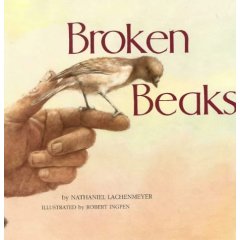


Let's consider another book now, Broken Beaks by Nathaniel Lachenmeyer. I haven't read Broken Beaks, but it's publishing history interests me.

Nathaniel Lachenmeyer is a U.S. writer who published an adult book, The Outsider, in this country. With Random House, in case you didn't follow the link. He, himself, sold the Australian rights to The Outsider to Michelle Anderson Publishing. Agents or, as in my case, publishers usually sell foreign rights to books.

Once he was connected with Michelle Anderson Publishing, he noticed that they'd done some picture books with an Australian illustrator named Robert Ingpen. He decided to do a piciture book on themes related to The Outsider and submit it to Michelle Anderson Publishing with Ingpen in mind to illustrate.

Everything worked. Anderson accepted the book and Ingpen illustrated it. Foreign rights were sold to Korea and Brazil.

Then they start looking for an American publisher so they can sell American rights. Though they received complimentary comments from editors and publishers, this isn't a great time for the picture book market (I've mentioned that here before) and the subject matter (homelessness) wasn't considered an easy sell.

So, the Australian publisher decides to look for someone to distribute the book here, while it remained the publisher. It found a Canadian distributor to distribute an Australian book written by an American writer in the U.S.

Are you following this?

The Australian publisher doesn't have the means to easily contact U.S. reviewers from Australia. So reviewers may not know about the book in order to review it. The distributor is contacing booksellers, not reviewers. Therefore, booksellers may not have heard of the book through the usual review publications.

So while Broken Beaks' author has a history with good publishers, his book may not get the normal attention that R. A. Nelson's debut book received. And we don't even know what kinds of results "normal attention" gets a book.

This is why books that sell a lot of copies get so much attention from the press.
It's just so very difficult to sell books that people are stunned when it happens.

A February Update: Reviews for Broken Beaks have started making their way into general publications.
Tuesday, January 17, 2006

What Should a Blogger Do?


Last week I mentioned the litblog co-op, a group of literary weblogs that try to draw attention to "contemporary fiction, authors and presses that are struggling to be noticed in a flooded marketplace." A few days later, the Society of Children's Book Writers and Illustrators: New England's newsletter came with a notice about The Great Blog Experiment, in which agent Nadia Cornier (that's agent as in literary agent, not Jack Bauer-type agent) is encouraging bloggers and readers to promote a book (Teach Me by R. A. Nelson) in order to see if blogging can have an impact on sales.

I don't know how I feel about all this. Certainly bloggers pass info around through whatever community they are part of--in our case, kidlit, but there are also on-line communities for every kind of interest. Part of the point of blogging is to give a voice to everyone, to those who are outside traditional power structures who wouldn't normally be heard. Sometimes we're just giving a voice to ourselves. Sometimes we're giving voices to the people we're writing about. And I think we should be giving a voice to books and authors the mainstream press doesn't cover because what's the point in just repeating what can be read in a newspaper or magazine?

But if bloggers are uniting, aren't they creating another power structure that's going to speak with just one voice--or at least on a limited number of topics? The litblog co-op describes itself as "uniting the leading literary litblogs," suggesting a little elitism that's going to elbow out litblogs that aren't "leading." I know they're looking for power in support of a good cause. Many good books are ignored because there just aren't enough venues to promote them. But maybe creating a hierarchy on the democratic Internet is going to limit the venues, too.

"Word of mouth" promotion for books is real. But it's word of mouth, enthusiasm for a book that spreads because, well, individual readers were enthusiastic and spread the word. We're talking power to individual readers here, not organized ones.

Oh, jeez. I'm afraid I'm turning into some kind of anarchist.

Monday, January 16, 2006

Not Wild About Harry


Okay, I will not keep you in suspense any longer. The article I read in the November/December issue of Pages that set me off was "A Mind Is a Terrible Thing to Waste" by Ellen Kanner. And it was about Harold Bloom, who gets an enormous amount of press for an academic and literary critic who has never made a movie or dated a starlet.

I am going to be up front with the information that I have never read anything by Bloom (though I may take a stab at How to Read and Why, since I've been reading How to Read a Book for six months now and would like to have something to look forward to when I finally finish it). I've only read about him. And I do wonder if the guy doesn't spout off the way he does just to get attention. If he does, it's working. I wrote about him twice back in 2003.

Nonetheless, whenever I see him quoted, all I can think is "Who died and left you boss?"

Kanner quotes him as saying "If you've read Shakespeare and Milton and so on, then you'll be able to think, but we are no longer a nation that reads...We read Harry Potter, if you call that reading, Stephen King, if you call that reading."

To the general public, Bloom is more well-known for hating Harry Potter and Stephen King than he is for anything else he's done.

Reading is an individual, personal, and highly democratic activity. I, for one, don't appreciate Professor High and Mighty telling me what I should and should not read. I don't even like Harry Potter. This crank makes me want to go out and reread the whole series.

"The deepest motive for reading has to be the quest for wisdom," he is quoted as having said in Where Shall Wisdom Be Found?. I totally disagree. The motive for reading doesn't have to be anything. Personally, I think we read because we are all looking for a feeling of community, we want to feel connected to others, authors who share our world views or address our problems and interests in some way. Wisdom might come, but as a result of having lived through the experience of reading, not because it was spoonfed to us by the Book Police who make sure we're reading the right books.

Saturday, January 14, 2006

A Break From Vacation Talk


Though I am sure everyone is sitting on pins and needles to hear what I'm going to complain about (see end of yesterday's post), I've decided to put it off until Monday because I'm tired of talking about myself.

Not really.

If you scroll down to the January 13 The Doctor Is In post at Buzz, Balls & Hype, you can read about a writing problem I suffer from. (See, I am still talking about me.) I didn't read every word of this entry, but I should.

Fortunately, I was reminded of this year's Bloggies after the nominations closed, so I don't have to worry about humiliating myself by begging people to nominate me. After Friday, January 20th we can all see if anyone we know is up for an award.

Creative Non-What?


I wasn't going to mention the whole Million Little Pieces mess because what can I possibly have to say about this that someone hasn't already said? Particularly since I haven't read the book? And what does it have to do with kidlit?

However, I saw this article on memoirs and creative non-fiction, and all of a sudden I got interested. Because I've always wondered what creative non-fiction is and how you write it. I took a graduate-level essay course. I grilled a young relative who took an undergraduate personal essay course. I've never been able to get much in the way of answers.

You may have noticed that I am sometimes sensitive about being nit-picky, wanting things defined, etc. But, people! Look what happens when terms aren't clearly defined! Everything goes to pieces. A million of them.

(Thanks to ArtsJournal.com for the link.)

And now, for the first time in perhaps 5 or 6 months, I must make an effort to clean my desk. Yes, that means that sometime next week you'll probably be reading about what I find there.

Friday, January 13, 2006

My Favorite Pages


While on vacation I managed to read the two magazines I received for Christmas. (The giftgiver wasn't cheap--I asked for them in order to try them out.) My favorite of the two was Pages. I got the November/December issue, in which I read one fascinating article after another.

For instance, the article about The Lit Blog Co-Op, which is a group of lit-bloggers that bands together to help promote four books a year that they feel aren't getting enough attention, was thought provoking. The thought it provoked in me was, "Hey, there are more and more kidlit blogs being created all the time. Maybe some of us could get together and do something like this."

Then I remembered that I don't liked maybe 75 to 80 percent of what I read, so I decided that probably wasn't one of my better ideas.

Attention, Please by Jennifer Nelson involved kids with ADD/ADHD and reading. Kids with ADD/ADHD often have trouble learning to read. They mature like any other kid and are ready to learn about more sophisticated concepts, but they can't learn about them through reading the way other kids can. The author suggested that parents continue reading to these children so that they don't fall behind in learning concepts or vocabulary just because they can't read the words themselves.

I thought that article was so good that I'm planning to make copies for a couple of relatives studying education.

Another article I liked was about The Jungle Law by Victoria Vinton, a novel about Rudyard Kipling's life while he was living in Vermont. I'm not a particular Kipling fan, but I have always been interested in what the heck he was doing in Brattleboro, which I've driven past a few hundred times.

One last article in the magazine, ticked me off the way articles about its subject always tick me off. You'll have to read tomorrow's post to hear about it.

Thursday, January 12, 2006

Escaping From Ember


So here's some more about my trip:

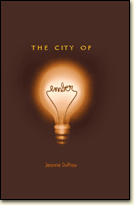
Since I can't read and drive at the same time, I decided to bring an audio version of a kids' book so I could multi-task. I chose The City of Ember by Jeanne DuPrau because I've heard about it on-line, and because I probably wouldn't have read it myself because I thought it was about a dystopian fantasy world. I've already read a couple of those in the last year, and I figure that's about as much as I can take for a while.

Well, I was right. The City of Ember is about one of those societies that's controlled and no one in it knows what end is up. I find those cultures very stagnant and noncreative. Come on. In a couple of hundred years no one thought of trying to create a flashlight or a match? The best form of communication they could come up with was hiring people to run from one end of the city to the other with messages? And accepting twelve-year-old main characters required a suspension of disbelief that I wasn't entirely willing to buy into.

I did think the book was well-written, though, and DuPrau does something interesting with point-of-view. I didn't notice it until toward the end of the book. (Remember, I was listening to it, not reading it.) The book was written in the third person with the point-of-view switching between the two main characters. Every time the point-of-view switched, the author backtracked a little bit so that we saw what had been happening recently with the other character. I'm very self-conscious about point-of-view problems, and I thought that was a neat device.

The book also involves a mystery of sorts and a puzzle that these two kids have to work out. As far as that aspect of the story is concerned, it was far, far superior to, say, Chasing Vermeer, which also involved two kids who had to work out a puzzle to solve a mystery.

Nonetheless, I wasn't crazy about the book, but I wasn't the only person in the car. After the first CD, I was willing to turn it off for a while because I didn't want to force the book on the other traveler. Not to worry. He was very taken with the story, and fed CDs into the player as fast as it would take them.

Now, he's an engineer and the City of Ember involves engineering problems--a generator that keeps failing and pipes that keep springing leaks. (Not my idea of compelling subject matter, but this guy ate it up.) He's so involved with the story that he's going to look for the audio version of the sequel, The People of Sparks, for a daytrip we're taking this weekend.

My fellow traveler had a terrific insight about this book. He said, "You know, this book didn't have to be about twelve-year-olds. The main characters could just as easily have been recent college graduates instead of just getting out of (what we would call) sixth grade and that would have made the story more believable."

He was right. The book could easily have worked as an adult novel, an adult movie script.

This raises a question for me: What is a children's book? Is it merely a book with child protagonists? Does there have to be something else that makes the book a children's book?

Really, I just had an incredibly terrific trip this past weekend.

Wednesday, January 11, 2006

I'm Baaaack


I've returned from a great short trip, and I'm full of all kinds of book thoughts that I feel compelled to share.

First off, I visited a number of bookstores while I was in Vermont this past weekend. And I mean I truly visited them because that's the kind of thing I do while I'm on vacation. I wasn't there to make appearances.

My first stop was the Briggs Carriage Book Store in Brandon. Let me give you a little background on Brandon and myself. I almost grew up there. I actually lived in Sudbury, which is maybe 9 or 10 minutes from Brandon, from third grade until after I graduated from college. But Sudbury was so tiny that Brandon was where Sudburyites went for groceries, library books, and to attend high school. In fact, for many years Sudbury didn't maintain any kind of schools and sent its offspring to Brandon's.

Up until six or seven years ago, I was up in Brandon 3 to 5 times a year because my mother was still living there. She had moved even closer to the town. So I felt I had a relationship with the place.

The Briggs Carriage Book Store opened about 9 years ago. It's an attractive shop, and I've always liked what I've seen of it.

Okay, so I go in there last Saturday, and my husband, as he always does, goes right to the children's department to see if they have any of my books. They do. Two of my books that are now out of print, as a matter of fact. How interesting, I thought. Then I noticed that I'd signed them. This would be lovely, except...I signed them the last time I was up there for my high school reunion, four and a half years ago!!!

Do you get it? The bookstore in my own almost hometown couldn't sell my signed books in four and a half years!!!

I've got to hand it to them, though. The store used to be located on the other side of town. Bless their hearts, when the owners relocated, they brought my books with them.

Well, why was I upset about this? Only because I was so attached to my perception of how sales should go for a hometown girl. That's all about ego. I can give that up.

Yeah. Sure, I can.

So, we continued up Rte. 7 to Charlotte, hoping to stop at Flying Pig, but it was closed. Believe it or not, I tried to go there once before a few years ago, and it was closed then, too.

It is a really tiny place.

A few days later we went into Burlington, where we stopped at two lovely used bookstores, Crow Bookshop and North Country Books. (I can't believe that second place doesn't have a website.) I have a family member who loves used bookstores so I've been in more than a few, but I'm not a big fan because...well...a lot of them are, uh, kind of crowded...dusty...mildewy. But both these places were very attractive. They definitely looked as if their buyers were discerning, not bringing just anything into the shops.

We then went across the street to...Borders!...because I had a gift card I wanted to use on vacation. This time I went to the children's department to see if they had any of my books. Sure enough, they had two copies of The Hero of Ticonderoga. For the second time in my life I offered to sign stock, and for the second time the offer was accepted.

Finally, I went to Bear Pond Books in Stowe. They had two copies of Hero at the front of the store. Lo and behold, they seemed happy to have me sign them, too.

So, really, I am over that first unhappy experience with the unsold books in my hometown.

And did I spend all my time in bookstores stalking myself? No, I bought my first Terry Pratchett novel. After discussing my first foray in Discworld with another shopper in the sci-fi section at Borders, I settled upon The Color of Magic.

I also discovered Sabra Field at a gallery in Burlington and picked up a package of her notecards (utilitarian art) at Bear Pond Books.

Oh, I have so much more to talk about. But another day.

Friday, January 06, 2006

Author I've Never Heard of Starts Column I'm Going to Read


Louise Doughty, who I'm sure is a very fine writer even though I only heard of her two or three minutes ago, is starting a column called Write a Novel in a Year. She estimates it takes three years to write a novel and that the material her readers will have after following her advice for a year will be just the beginning.

Hey, I'm going to read it. I hope it's not a daily column.

Thanks to Blog of a Bookslut for the link.

By the way, Blog of a Bookslut is a great blog. I've never actually used the term "Bookslut" in this blog, because this blog is part of my website which is directed to readers of all ages. In the unlikely event that kids read this blog, I felt I should protect them from the word "slut." I'm not protecting anybody anymore! Oh, wait. Yes, I am. Because I'm not linking to Blog of a Bookslut. The content there is mature, and in the unlikely event that kids read this blog, they'll just have to find Bookslut on their own.

A Holiday I'd Like To Celebrate


Years back when I was a Sunday school teacher, I finally learned what Epiphany is. In the Christian calendar it's the observance of the day the Three Wise Men or Three Kings found the Christ child. In Hispanic cultures it's known as Three Kings' Day and is celebrated to a greater extent than in other parts of the world.

In my neighborhood it isn't celebrated at all. I really got into it for a while, though. One year when we were celebrating a particularly late Christmas get together with family members, I had an Epiphany tea complete with Wise Men candles and a Three King Bread. I wasn't watching the candles, they melted all over my Christmas table cloth, and burned a hole in it.

Great times, great times.

Anyway, when I saw Hurray for Three Kings' Day by Lori Marie Carlson at my local library, I had to snatch it up. I definitely was left feeling that I was right all those years ago. This is a holiday I could really enjoy.

I'm Traveling


I'm leaving tomorrow for five days. This, of course, means that I'll be able to read in the car. I should have much to report on my return.

Thursday, January 05, 2006

It Wouldn't Take Much For Me To Be Overwhelmed


My fellow kidlit bloggers are full of news about more kidlit blogs and websites. Big A little a directed me to the Planet Esme Reading Room (which I don't totally understand)and I also discovered Planet Esme. From there I found Jim Trelease's website. Jim Trelease was speaking and writing about children and reading a good two decades ago.

As I've whined about before and will probably whine about again, there is now just so much about kidlit on the web. I'm thinking about dropping a couple of blogs that aren't updated very frequently from my list of daily reads. When that happens, I can add another.

"Our Dominant Culture Is Visual, Not Literary..."


In a slide-show essay on how Pixar's animated films became the best literature around, Lee Siegel Slate's art critic says that sophisticated animated films are filling a literary void. Siegel claims American novelists often write contrived stories with cartoon-like characters. Pixar's cartoon characters have more depth.

Siegel is talking about adult fiction, not kidlit. He's also talking about writers I haven't read so I can't agree or disagree with his argument. Nonetheless, as a serious reader who has many family members who have rejected the activity, I found the essay thought provoking. Are young people turning to visual "literature" because of some kind of failing in the written kind? Maybe TV isn't the bad guy in our culture's turn away from reading. Maybe it's us. Maybe we're not creating a written word that's compelling enough to keep readers.

And if you start thinking of film, which does have story lines, characters, settings, themes, etc., as a sort of literature, is the moving away from the written word to the "visual word" are a major tragedy? Maybe we're just talking about evolution.

Wednesday, January 04, 2006

I Almost Made It


Tomorrow night is Twelfth Night, if I've counted correctly, so I almost made it through Advent and the Christmas season without mentioning a Christmas book. However, on New Year's Day the family got into a discussion of the story line for The Polar Express by Chris Van Allsburg. After I checked at the library today, I discovered that the others at the table were right, and I was totally wrong in my recollection of the book. Why am I bothering to blog about my own inept memory?

Because I was recalling a totally different book, one I love and want to direct some attention to.

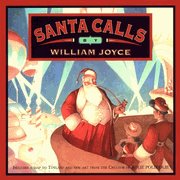
Santa Calls by William Joyce is not your traditional Christmas tale in which a passive child protagonist experiences the North Pole or Santa or the mysterious spirit of Christmas through the intervention of adult characters. No way, Jose. Santa Calls is a Tom Swift type adventure in which the action is initiated by a child (though we don't know that right away) and undertaken by children. Yes, Santa and his very nonstereotypical assistants are there watching over everyone. But it's a kid who comes up with the candy bomb! The kids resolve the action. The story is about the kids, not the adults.

That's what kids' books are supposed to be, by the way.

Santa Calls doesn't trot out that tired old Christmas theme about childhood being a magical time that is lost when the child grows up, either. Instead, Joyce suggests that real relationships and real happiness in this moment right now are gifts, too.

Why am I now able to recall so much about Santa Calls when just a few days ago I had it confused with The Polar Express? Because while I had to go to the library to refresh my memory on The Polar Express, I was able to just pull my copy of Santa Calls off my bookshelf. Rereading it on the Eleventh Day of Christmas was a real treat.