The first issue of Darker Matter, an on-line science fiction magazine, includes an unpublished 1979 interview with Douglas Adams. I mention this because Adams was wildly popular with a couple of teenagers around here a few years ago. In fact, one of them turns up his nose at Hitchhiker-like fiction because he sees such authors as Adams-wannabes. He accepts no imitations.
Link from Blog of a Bookslut.
Friday, April 06, 2007
Thursday, April 05, 2007
More Great Reading I Just Have To Talk About
I knocked off the March/April Horn Book today. My favorite article was An Interview with George M. Nicholson by Leonard S. Marcus. I had never heard of George M. Nicholson, and the interview was all about the history of children's paperback book publishing. Doesn't sound riveting, does it? Well, it was.
Redefining the Young Adult Novel by Jonathan Hunt (a name Adbook listserv members will certainly recognize) was also interesting. He has a lot to say about crossover novels. He places The Book Thief and Octavian Nothing in that category, though I thought a book had to be published as an adult novel (as Book Thief was in Australia) in order to "cross over" to YA.
A few of this issue's interesting reviews:
Margo Rabb's Cures for Heartbreak.
Penni Russon's follow-up to Undine, Breathe.
Cynthia Leitch Smith's Tantalize.
Geraldine McCaughrean's The White Darkness, which was published a couple of years ago in England and shortlisted for the Whitbread Children's Prize and the Carnegie Medal. I was particularly interested in this title because McCaughrean wrote Peter Pan in Scarlet, which I loved. And, I just learned, she also wrote A Pack of Lies, a book I liked very much except for the ending. Perhaps I'm becoming a McCaughrean fan.
Wednesday, April 04, 2007
Glad I'm Not Doing YA This Year
According to Pub Rants, Barnes & Noble is the main seller of YA, and that chain doesn't have any plans to expand shelf space for teen books. She suggests that perhaps B&N thinks the market is a little too crowded.
That's the second time in the last few weeks I've read something that suggests that maybe the YA explosion is becoming a little less explosive. Unfortunately, I can't remember where I found the first suggestion.
That's the second time in the last few weeks I've read something that suggests that maybe the YA explosion is becoming a little less explosive. Unfortunately, I can't remember where I found the first suggestion.
Another Great Way To Start The Day
On Monday I started my work day by reading The Essentials of Plot by Cheryl Klein. Today I started by reading Mitali Perkins' article for School Library Journal, No Place Like Home.
Excellent.
Mitali's essay begins with the premise that teenagers who are moving between cultures like to read books with a strong sense of place. Any place. It's an interesting point, but now that she's brought it up, I wonder if it isn't true of all kinds of teenagers. They're all in transition, anyway, moving from childhood to adulthood.
At any rate, as I was reading along, I thought, Gee, Kiki Strike, which I just finished reading, had a strong sense of place. Lo and behold, Mitali used that very book as an example while explaining techniques used to describe a setting.
What's more, she also provides an excellent theory for Harry Potter's popularity. Those are not my favorite books, but, yeah, I think she makes a good point regarding them.
No Place Like Home doesn't just have a lot of interesting content. It's also very well-written in a traditional essay format. I think it might be an excellent example for teachers teaching essay writing skills to middle and high school students, since you'd think they'd be interested in the subject.
Excellent.
Mitali's essay begins with the premise that teenagers who are moving between cultures like to read books with a strong sense of place. Any place. It's an interesting point, but now that she's brought it up, I wonder if it isn't true of all kinds of teenagers. They're all in transition, anyway, moving from childhood to adulthood.
At any rate, as I was reading along, I thought, Gee, Kiki Strike, which I just finished reading, had a strong sense of place. Lo and behold, Mitali used that very book as an example while explaining techniques used to describe a setting.
What's more, she also provides an excellent theory for Harry Potter's popularity. Those are not my favorite books, but, yeah, I think she makes a good point regarding them.
No Place Like Home doesn't just have a lot of interesting content. It's also very well-written in a traditional essay format. I think it might be an excellent example for teachers teaching essay writing skills to middle and high school students, since you'd think they'd be interested in the subject.
Tuesday, April 03, 2007
A Scooby Gang Takes On A Girl Posse
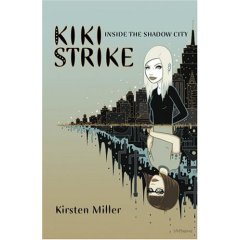
Kirsten Miller works in advertising, and her debut book, Kiki Strike Inside The Shadow City, reads as if a really savvy marketer took a piece of many high profile stories and melded them together brilliantly. You've got a girl spy/criminal in the tradition of Artemis Fowl with her own Scooby Gang (nod to Buffy) that takes on a mean girl posse from...well, any number of recent books and movies. Then you've got a princess, and we love princesses. Really. You've got a world under New York, though it's more like the old Beauty and the Beast series than the Underland.
And you've got some history and mystery, too.
All these elements are worked together very well. The Scooby Gang is known as the Irregulars, which Miller says is a tribute to the Baker Street Irregulars of the Sherlock Holmes' stories. What's more, the book is narrated by a Watson-like character with a voice that is notable and not imitative of other first-person kid narrators. Though I did figure out the ending, I didn't do it right away. And there were plenty of twists and turns before I got there.
Kiki Strike is definitely a good entry in the early teen mystery category.
Markus Zusak Is A Brave Man
Markus Zusak is Writer in Residence at inside a dog. He's uncomfortable about blogging, so he's decided to post chapters from a side project he works on "when things are going poorly with the book I’m trying to write."
I think working on more than one project at a time is a marvelous idea, something I aspire to but not very vigorously. Zusak's post really sounds like something he's just tinkering with at this point, and I admire his guts in exposing it to the world.
I think working on more than one project at a time is a marvelous idea, something I aspire to but not very vigorously. Zusak's post really sounds like something he's just tinkering with at this point, and I admire his guts in exposing it to the world.
Monday, April 02, 2007
Here's Something I Don't Think Of Often
Collen Mondor of Chasing Ray has written an article on young adult adventure books for Eclectica Magazine. Adventure stories for teenagers--there's something about that that sounds very retro. Not that that's a bad thing. In fact, it's very intriguing. I just can't recall reading about that subject recently.
One Of These People Is Having The Best Day Ever
That would be me. I had one of my best work days ever. It began with me reading The Essentials of Plot at Talking Books, editor Cheryl Klein's website. (I found this site because Roger Sutton has spoken of Cheryl a few times.) This write-up of a speech Cheryl gave is fantastic. I've been anxious about the plot for a new project, and reading this speech got my day off to a great start. I finally finished the first chapter, with an ending different and better than I had expected. In fact, I didn't expect that ending until it happened.
I'm hopeful that I can forget about the plot and just work on the story in the future, as Cheryl suggests. I have a great deal of trouble moving ahead in a project until I have a first chapter I'm happy with. It's a foundation thing.
I'm hopeful that I can forget about the plot and just work on the story in the future, as Cheryl suggests. I have a great deal of trouble moving ahead in a project until I have a first chapter I'm happy with. It's a foundation thing.
Sunday, April 01, 2007
The Importance Of Reviews
A few years back I used to refer to Jane Yolen as my on-line mentor because I was obsessed with her On-line Writer's Journal. (If she knew I existed, she probably referred to me as her on-line stalker.) As with most of my obsessions, it finally burned itself out, and I don't go to her journal anywhere near as often as I used to. But the last couple of times I've been there I've found some very juicy stuff.
If you go to her Journal and scroll down to March 11, you'll see a fascinating post about how receiving no reviews for a book is far, far worse than receiving a bad review. Talk about "Telling the True."
Many years ago I was a member of a book club, and we were reading what I thought was a quite fascinating nonfiction book by a couple of professors at UConn. (I can't remember the title or the authors. Really.) It must have been my month to lead the discussion because I researched the book, looking for reviews, and couldn't find any. I asked my local librarian about it. How could there be no reviews for a book that was only a year or so old?
Her response? "The journals must not have thought the book was important enough to review."
I'm not scared of bad reviews. I would prefer not to get them, but I'm willing to take a punch because a bad review means your book is important enough to discuss. You're still a contender. But no reviews? That is my big fear.
If you go to her Journal and scroll down to March 11, you'll see a fascinating post about how receiving no reviews for a book is far, far worse than receiving a bad review. Talk about "Telling the True."
Many years ago I was a member of a book club, and we were reading what I thought was a quite fascinating nonfiction book by a couple of professors at UConn. (I can't remember the title or the authors. Really.) It must have been my month to lead the discussion because I researched the book, looking for reviews, and couldn't find any. I asked my local librarian about it. How could there be no reviews for a book that was only a year or so old?
Her response? "The journals must not have thought the book was important enough to review."
I'm not scared of bad reviews. I would prefer not to get them, but I'm willing to take a punch because a bad review means your book is important enough to discuss. You're still a contender. But no reviews? That is my big fear.
More Literary Fiction For Kids?

When I started reading Firegirl by Tony Abbott, the only thing I knew about it was that it was written by a guy from Connecticut. I've had some of my very best reading experiences when starting a book from a position of nearly total ignorance like that.
First-person narrator Tom Bender appears a little dull in the opening pages of Firegirl, and at that point a reader can't be blamed for wondering if she'll be able to stand being with him for very long. His best friend is an obviously shallow classmate Tom clings to because he doesn't have anyone else. Even his fantasy about saving the girl he's attracted to doesn't seem all that engaging...though he does dream of doing it with the help of various small superpowers. Nothing too ambitious for this run-of-the-mill kid.
When a new classmate appears, a jaded reader might begin to worry that this is going to turn into a problem book. The new classmate is, after all, a terribly disfigured girl who is undergoing treatment at a local hospital for the burns she suffered over a large portion of her body.
But Firegirl isn't about Jessica and how she deals with her personal tragedy. No, it's about sadsack Tom and how he deals with Jessica entering his life.
This poor boy is struggling so hard to hold on to his one friend, who really is no prize. At the same time, he is overwhelmed with the desire to do the right thing by Jessica whose injuries are so horrible that his classmates are shaken by her presence.
The intensity of Tom's turmoil and Jessica's family's suffering as well as the mystery around just what happened to her elevate this story well above a traditional what-would-you-do-if-this-happened-to-you tale.
At the end of the book, Tom, himself, says that very little has happened. Externally, he's right. The plot to this book is all inside Tom. A few weeks ago while blogging about another book, I talked about the difference between commercial (above-the-surface plot) and literary (below-the-surface plot)fiction. Firegirl seems to be a very fine example of the latter.
Subscribe to:
Posts (Atom)