Thursday, October 31, 2013
Jonathan Bean Is All Over The Place
Notice in yesterday's post that Jonathan Bean is going to be at the Connecticut Children's Book Fair in a few weeks? He's at Seven Impossible Things Before Breakfast today.
Wednesday, October 30, 2013
November Connecticut Children's Literature Calendar
November is Connecticut Children's Book Fair month in Connecticut. This year there's another big children's literature event that same weekend. A picture book exhibit also starts that Friday, but it runs for two months, giving viewers plenty of opportunities to get to it.
Sat., Nov. 2, Tommy Greenwald, Barnes & Noble, Westport 2 PM
Sat. Nov. 2, Matt Davies, Westport Public Library, Westport 3 to 4 PM National Novel Writing Month event for children.
Wednes., Nov. 6, Leigh Ann Tyson, R. J. Julia Booksellers, Madison 10:30 AM Story hour
 Thurs. Nov. 7, Doe Boyle, Frank W. Dormer, Deborah Freedman, Lynn Reiser, Sanna Stanley, Marcela Staudenmaier, Jennifer Thermes, Nancy Elizabeth Wallace, Opening Reception and Book Signing for The Art of Picture Books: Creative Process In Visual Storytelling Exhibit, Arts Council of Greater New Haven's Sumner McKnight Crosby, Jr. Gallery, New Haven 5 to 7 PM
Fri., Nov. 8 through Jan. 3, 2014, The Art of Picture Books: Creative Process In Visual Storytelling Exhibit, Arts Council of Greater New Haven's Sumner McKnight Crosby, Jr. Gallery, New Haven, Monday through Friday, 9 AM to 5 PM
Sat., Nov. 9 Tony Abbott, Jennifer Berne, Bryan Collier, Bruce Degen, Deborah Freedman, Patricia Reilly Giff, Susan Hood, Ann Haywood Leal, Barbara Mariconda, Marc Tyler Nobleman, Michael Rex, R. L. Stine, Laura Toffler-Corrie, Dan Yaccarino, Pequot Library Children's Book Festival, Southport, 11:00 AM to 4:00 PM
Sat., Nov. 9, Judi Barrett, The Hickory Stick Bookshop, Washington Depot, 2 PM
 Sat. Nov 9 thru Sun. Nov. 10 Jonathan Bean, Aaron Becker, Nicholas Blechman, Nick Bruel, Diane deGroat, Robert L. Forbes, David Johnson, Ann M. Martin, Shelley Rotner, Phoebe Stone, Tui T. Sutherland, Mark Teague, Elise Broach, P.W. Catanese, Elisha Cooper, Etienne Delessert, Tomie dePaola, Elizabeth Eulberg, Robie Harris, Jeff Hirsch, Alaya Dawn Johnson, Steven Kellogg, Jarrett Krosoczka, Michaela MacColl, Rita Marshall, Michael Northrup, David M. Schwartz, The Connecticut Children's Book Fair, University of Connecticut, Storrs 10 AM to 5 PM
Fri, Nov. 15, Matthew Cody, R. J. Julia Booksellers, Madison 4:00 PM
Mon., Nov. 26, Carol Aebesold, R. J. Julia Booksellers, Madison 6:00 PM
Thurs., Nov. 29, Bob Shea, R. J. Julia Booksellers, Madison 4:00 PM
Sat., Nov. 2, Tommy Greenwald, Barnes & Noble, Westport 2 PM
Sat. Nov. 2, Matt Davies, Westport Public Library, Westport 3 to 4 PM National Novel Writing Month event for children.
Wednes., Nov. 6, Leigh Ann Tyson, R. J. Julia Booksellers, Madison 10:30 AM Story hour

Fri., Nov. 8 through Jan. 3, 2014, The Art of Picture Books: Creative Process In Visual Storytelling Exhibit, Arts Council of Greater New Haven's Sumner McKnight Crosby, Jr. Gallery, New Haven, Monday through Friday, 9 AM to 5 PM
Sat., Nov. 9 Tony Abbott, Jennifer Berne, Bryan Collier, Bruce Degen, Deborah Freedman, Patricia Reilly Giff, Susan Hood, Ann Haywood Leal, Barbara Mariconda, Marc Tyler Nobleman, Michael Rex, R. L. Stine, Laura Toffler-Corrie, Dan Yaccarino, Pequot Library Children's Book Festival, Southport, 11:00 AM to 4:00 PM
Sat., Nov. 9, Judi Barrett, The Hickory Stick Bookshop, Washington Depot, 2 PM

Fri, Nov. 15, Matthew Cody, R. J. Julia Booksellers, Madison 4:00 PM
Mon., Nov. 26, Carol Aebesold, R. J. Julia Booksellers, Madison 6:00 PM
Thurs., Nov. 29, Bob Shea, R. J. Julia Booksellers, Madison 4:00 PM
Tuesday, October 29, 2013
Time Management Tuesday: Fear Drives The Noncreative Demands On Published Writers' Time
I've written here before about the amount of time published writers spend on marketing/reactive activities versus the time they spend on actual writing/creative activities. A few days ago, author Lionel Shriver published an essay, How to Succeed as an Author: Give Up on Writing,
that deals with the same subject in the New Republic. (I question, myself, whether she is responsible for the subheading "The Rancid Smell of 21st Century Literary Success." She wasn't that embittered in the essay, and it sounds an awful lot like clickbait.)
Now Shriver has achieved a high level of international success, and the average published writer isn't going to have to worry about being overwhelmed with invitations to lit festivals all over the world or two-week tours in foreign countries. But published writers of all levels do lose valuable writing time to prepping for both income and nonincome generating appearances, getting our names onto blogs and websites by pumping out content for them, and coming up with marketing schemes to make ourselves better known so that we can hit some of those faraway literary festivals. Shriver is writing about a very real time demand that many, many writers understand.
Unfortunately, many of her commentors focused less on the universality of the experience Shriver is describing and more on the fact that she is very successful and has no business complaining. In hindsight, including information from a few other writers with similar time constraints might have been a good idea, so the essay would have been less about her and more about the situation she's describing. In hindsight, she might have also played up these points that she did make:
"...with the exception of a few select luminaries whose reputations are assured, in this business you’re only as good as your last book. My livelihood started out shaky; it is still shaky."
"A frenzied calendar is my fault. It is the natural consequence of a profound insecurity that, during a dozen long years when I lived a hair’s breadth from having no publisher at all, worked its way into my very bones. That insecurity, some of which is economic, seems to have induced a permanent terror of turning anything down—anything that will make money, fortify my name recognition, or support book sales."
"Sure, there’s no precise requirement that authors put themselves in the way of all that froufrou. But this is a high-anxiety occupation. With publishers’ recent hanky-twisting over whether there will even be a publishing industry in ten years, that anxiety has gone into overdrive. Could we authors learn to “just say no”? Perhaps. Still, how many names that the public has learned to recognize will it soon forget? More than by ambition, “just say yes” is powered by fear."
With those excerpts, I think Shriver does an excellent job of explaining how writers end up spending a huge chunk of their time not writing. I sure saw the anxiety and fear behind this essay. Other readers, though, only saw that Shriver's going to Bali.
that deals with the same subject in the New Republic. (I question, myself, whether she is responsible for the subheading "The Rancid Smell of 21st Century Literary Success." She wasn't that embittered in the essay, and it sounds an awful lot like clickbait.)
Now Shriver has achieved a high level of international success, and the average published writer isn't going to have to worry about being overwhelmed with invitations to lit festivals all over the world or two-week tours in foreign countries. But published writers of all levels do lose valuable writing time to prepping for both income and nonincome generating appearances, getting our names onto blogs and websites by pumping out content for them, and coming up with marketing schemes to make ourselves better known so that we can hit some of those faraway literary festivals. Shriver is writing about a very real time demand that many, many writers understand.
Unfortunately, many of her commentors focused less on the universality of the experience Shriver is describing and more on the fact that she is very successful and has no business complaining. In hindsight, including information from a few other writers with similar time constraints might have been a good idea, so the essay would have been less about her and more about the situation she's describing. In hindsight, she might have also played up these points that she did make:
"...with the exception of a few select luminaries whose reputations are assured, in this business you’re only as good as your last book. My livelihood started out shaky; it is still shaky."
"A frenzied calendar is my fault. It is the natural consequence of a profound insecurity that, during a dozen long years when I lived a hair’s breadth from having no publisher at all, worked its way into my very bones. That insecurity, some of which is economic, seems to have induced a permanent terror of turning anything down—anything that will make money, fortify my name recognition, or support book sales."
"Sure, there’s no precise requirement that authors put themselves in the way of all that froufrou. But this is a high-anxiety occupation. With publishers’ recent hanky-twisting over whether there will even be a publishing industry in ten years, that anxiety has gone into overdrive. Could we authors learn to “just say no”? Perhaps. Still, how many names that the public has learned to recognize will it soon forget? More than by ambition, “just say yes” is powered by fear."
With those excerpts, I think Shriver does an excellent job of explaining how writers end up spending a huge chunk of their time not writing. I sure saw the anxiety and fear behind this essay. Other readers, though, only saw that Shriver's going to Bali.
Monday, October 28, 2013
How A Lady Behaves Around Vampires And Werewolves

This new series takes place before the original series and some of The Parasol Protectorate's secondary characters appear in the new book as teenagers or children. That's a fun aspect of the book for an adult reader such as myself, though YA readers won't get it. If they move on to the adult books at some point, finding these characters as their much older selves should be entertaining. Or disappointing, if they don't like how they turned out.
The book involves a young girl leaving home to attend what she and her family believe is a finishing school. (A disturbance to her world!) What she's gotten into, though, is a training program for spies and assassins, one that involves learning how to get some dirty jobs done while maintaining proper social behavior. The premise is clever, as is the world in which vampires and werewolves are recognized parts of the social structure.
What's more, this truly is a YA book, not just a thriller that a writer for adults has retooled for young people by replacing an adult protagonist with a teenager. The young people in this book are dealing with separating themselves from their families and determining what kinds of lives they're going to live. That's YA all over.
Oh, look. Etiquette & Espionage is a Cybils nominee. Book Two in this series, Curtsies & Conspiracies, comes out in eight days.
Saturday, October 26, 2013
New Media Day: The Ruth Sanderson Post


In between those two career events, Ruth did textbook illustrations and the covers for book series, including the first Black Stallion paperbacks. She moved into writing with a series of fairy tale retellings that she also illustrated. In addition to what might be called traditional illustration work, Ruth creates licensed products such as cards, puzzles, and flags. She considers herself a commercial artist who shifts with the book and product markets.
She also teaches summers at Hollins University's children's literature program and has applied to Vermont College's MFA program.
Ruth's description of her career made me think of Roxie Munro, who spoke last year at UConn. She also described a career in art and illustration that involved a lot of movement among different types of work and that progressed into new media.
What we may be seeing here is a work model, one that is becoming more visible because of the evolving digital landscape. Illustrators and writers don't do one thing over and over again but move along with market demands and take advantage of new technologies. This is probably nothing new, but the attention digital publishing is receiving is bringing new attention to the changes in how creative people like Ruth Sanderson work.
Wednesday, October 23, 2013
New Media Day: The Evolving Digital Landscape
I know the wait for me to discuss last Saturday's NESCBWI event New Media Day: Making Sense of the Evolving Digital Landscape has been long and painful. Well, folks, it is over. I am ready to begin.
The overall feeling of the day was that the move to digital reading isn't something to fight and fear. For one thing, it's here. For another, it can work for you.
James McQuivey tracks how digital disruptions affect traditional businesses, like publishing. McQuivey describes a world of consumers who are so disrupted in the way that they receive products that any company that doesn't conform to this new method of obtaining product will become irrelevant. Companies must, as he said, follow the consumer. For publishing, what we're describing as a digital disruption is the move to, or at least the inclusion of, eBooks. The more rapidly publishers can embrace digital publication, the sooner they'll be able to give the millions of digital consumers already in existence what they want.
McQuivey made a really interesting historical point. We have experienced technical disruptions in the past. (Wasn't the entire Industrial Revolution a technical disruption?) But those disruptions were slow and expensive. It took a lot of time and money to build mills or develop jet engines. The digital disruption we're experiencing now is far cheaper and faster. More people can become involved, more people can bring ideas to the market.
This is a good thing.

Rubin Pfeffer of East West Literary Agency spoke about specifics both digitally and with self-publishing, since many self-published writers go the digital route. According to Pfeffer:
Both Mary Jane and Emilie used eBook publishers for their work, which, since they are illustrators, would have been heavy with artwork. Hearing this coming so soon after hearing Rubin Pfeffer's presentation, which included a list of independent eBook publishers and a description of services they offer, made me decide to refer to my eBook edition of Saving the Planet & Stuff as an artisan book, because my computer guy and I did it ourselves, not realizing until we were well into the project that we had any other option.
When we got to the point of discussing sales, my co-panelists and I had to be the bearers of the most difficult news of the day. We were in agreement that sales have been modest to dreadful. And we were also in agreement as to why that was the case--searchability, or, the term I prefer, discoverability. In a literary world in which nearly 800,000 books are published a year, it's extremely difficult for any one book to be noticed. There's pretty much a pile on and most titles will be buried.
We managed to bring things back up, though, by pointing out that that sales situation could change. Any one of us on the panel could publish something in the future that would make our back list more valuable, and then our eBooks will be available because they don't go out of print. In addition, self-publishing is an exciting, artistic project. Even though it was Mary Jane who said that, not me, I agree that the two years of publishing and marketing my eBook have been a mental kick.

The day ended with an interview with author-illustrator Ruth Sanderson. I'll be giving that its own post later this week.
Thanks to Facebook friend Hazel Mitchell for the panel picture. The final group photo was taken by Joanie Druris of the NESCBWI.
The overall feeling of the day was that the move to digital reading isn't something to fight and fear. For one thing, it's here. For another, it can work for you.
 James McQuivey on Digital Disruptions

James McQuivey tracks how digital disruptions affect traditional businesses, like publishing. McQuivey describes a world of consumers who are so disrupted in the way that they receive products that any company that doesn't conform to this new method of obtaining product will become irrelevant. Companies must, as he said, follow the consumer. For publishing, what we're describing as a digital disruption is the move to, or at least the inclusion of, eBooks. The more rapidly publishers can embrace digital publication, the sooner they'll be able to give the millions of digital consumers already in existence what they want.
McQuivey made a really interesting historical point. We have experienced technical disruptions in the past. (Wasn't the entire Industrial Revolution a technical disruption?) But those disruptions were slow and expensive. It took a lot of time and money to build mills or develop jet engines. The digital disruption we're experiencing now is far cheaper and faster. More people can become involved, more people can bring ideas to the market.
This is a good thing.

Rubin Pfeffer On Specifics Of Digital Publishing In The Children's Field
Rubin Pfeffer of East West Literary Agency spoke about specifics both digitally and with self-publishing, since many self-published writers go the digital route. According to Pfeffer:
- The numbers of traditional vs. self-published titles are very close to being the same, near the 400,000 mark for each.
- In addition, eBook sales are expected to surpass print books at some point. (Keep in mind that many eBook sales figures include free books.)
- YA is the dominant children's genre in self-publishing and is significant with eBooks since younger children are less likely to have e-readers, the visual components of picture books can be more difficult to create digitally, and e-readers give adults who read YA and don't want anyone to know it some privacy.
- We are witnessing the rise of independent eBook publishers
- Technology creates new content, eBooks, enhanced eBooks, and apps all being cases in point
 Begin, Boon, and Gauthier On Bringing Books Back To Life

Both Mary Jane and Emilie used eBook publishers for their work, which, since they are illustrators, would have been heavy with artwork. Hearing this coming so soon after hearing Rubin Pfeffer's presentation, which included a list of independent eBook publishers and a description of services they offer, made me decide to refer to my eBook edition of Saving the Planet & Stuff as an artisan book, because my computer guy and I did it ourselves, not realizing until we were well into the project that we had any other option.
When we got to the point of discussing sales, my co-panelists and I had to be the bearers of the most difficult news of the day. We were in agreement that sales have been modest to dreadful. And we were also in agreement as to why that was the case--searchability, or, the term I prefer, discoverability. In a literary world in which nearly 800,000 books are published a year, it's extremely difficult for any one book to be noticed. There's pretty much a pile on and most titles will be buried.
We managed to bring things back up, though, by pointing out that that sales situation could change. Any one of us on the panel could publish something in the future that would make our back list more valuable, and then our eBooks will be available because they don't go out of print. In addition, self-publishing is an exciting, artistic project. Even though it was Mary Jane who said that, not me, I agree that the two years of publishing and marketing my eBook have been a mental kick.

Our Conclusion Is Still To Come
The day ended with an interview with author-illustrator Ruth Sanderson. I'll be giving that its own post later this week.
Thanks to Facebook friend Hazel Mitchell for the panel picture. The final group photo was taken by Joanie Druris of the NESCBWI.
Tuesday, October 22, 2013
Time Management Tuesday: Learning Curves For New Technology
Have I mentioned my new laptop? I don't think so. I will be talking about its splendors sometime in the future, but today I'm going to drone on a bit about how technology is wonderful, absolutely wonderful, for managing time and getting things done. But technology is always changing, which means learning curves, over and over and over again. And do they ever take time.
Very few people can afford the time to just stop working and learn how to use, say, a new word processing program or make the jump from a standard cellphone to a smartphone. We have to work while we learn, we have to use that phone while we learn. I think of this as a martial arts model. In the schools I've attended, you're thrown in with all the other students of all different levels of experience and knowledge. You follow along as best you can, and then step out to work on the skills for your level. Then you jump back in with the others, going back and forth like that. It works for them, but they take the long view. Everything will come with time.
That's how things work with new technology to a great extent but for a different reason. We jump right in and work with the new, not because we take the long view but because we don't. We can't stop to study because we have to keep producing. But there's no getting around the fact that we're not producing at peak efficiency and speed, because we're struggling to learn the new technology as we go along.
My laptop arrived two weeks ago loaded with Word 2013. I haven't had to acclimate myself to a new word processing program for some time, because I've been using Word 2003. For the very standard straight manuscript typing I do, it has worked very well, and I haven't had to lose any time learning the new bells and whistles of all the versions that came between 2003 and 2013. Now, my computer guy could find a way to get 2003 onto this laptop because he's kind of a rogue and that's how he rolls. But we have another computer guy in the family, and Computer Guy II pointed out that at some point Microsoft will stop supporting earlier versions of Word, and then what do I do? Computer Guy I, being a rogue, as I mentioned, would take the attitude that we fight it! We do not give in to the man! Computer Guy II, on the other hand, is more of a make-love-not-war tech person. Since I've got this maintain-the-mind-of-a-beginner thing going on, and I'm willing to concede that maybe Word 2013 has something positive to offer me, beyond the fact that it is simply on my computer, I decided to go with Computer Guy II on this one.
This morning, after having used Word 2013 for two weeks, I spent fourteen minutes getting a header with numbering onto a new chapter file. That is a good thing. On the last two chapters, I spent around forty to forty-five minutes on headers and numbering pages. I am making progress.
But I've also lost work time. In my case, I'm hoping that the time I lose now will be made up for in the future because of the splendors of this laptop.
In my case, the answer to that question is, "No." I'm on my second digital camera. I never learned all the options on the first one, and I use only a fraction of what I could on the new one. I've even carried the manual in my camera case, hoping that I'd find time while traveling to sit down and browse. That rarely happens, mainly because I can take a good enough picture and let it go at that. My iPhone is my favorite material possession right now. One of the reasons I got it was to listen to podcasts. I do do that, but directly from the site that originally produced them. I haven't figured out how to download podcasts to my iPhone. In fact, the Apple store won't let me purchase podcast apps from my phone because of some password problem I haven't had time to even try to resolve. I always take the easy option that provides a lesser result because I don't have time to go another way.
The irony here, folks, is that the technological device that could be a major factor in managing our time requires time to learn to use properly.
Very few people can afford the time to just stop working and learn how to use, say, a new word processing program or make the jump from a standard cellphone to a smartphone. We have to work while we learn, we have to use that phone while we learn. I think of this as a martial arts model. In the schools I've attended, you're thrown in with all the other students of all different levels of experience and knowledge. You follow along as best you can, and then step out to work on the skills for your level. Then you jump back in with the others, going back and forth like that. It works for them, but they take the long view. Everything will come with time.
That's how things work with new technology to a great extent but for a different reason. We jump right in and work with the new, not because we take the long view but because we don't. We can't stop to study because we have to keep producing. But there's no getting around the fact that we're not producing at peak efficiency and speed, because we're struggling to learn the new technology as we go along.
A case in point
My laptop arrived two weeks ago loaded with Word 2013. I haven't had to acclimate myself to a new word processing program for some time, because I've been using Word 2003. For the very standard straight manuscript typing I do, it has worked very well, and I haven't had to lose any time learning the new bells and whistles of all the versions that came between 2003 and 2013. Now, my computer guy could find a way to get 2003 onto this laptop because he's kind of a rogue and that's how he rolls. But we have another computer guy in the family, and Computer Guy II pointed out that at some point Microsoft will stop supporting earlier versions of Word, and then what do I do? Computer Guy I, being a rogue, as I mentioned, would take the attitude that we fight it! We do not give in to the man! Computer Guy II, on the other hand, is more of a make-love-not-war tech person. Since I've got this maintain-the-mind-of-a-beginner thing going on, and I'm willing to concede that maybe Word 2013 has something positive to offer me, beyond the fact that it is simply on my computer, I decided to go with Computer Guy II on this one.
This morning, after having used Word 2013 for two weeks, I spent fourteen minutes getting a header with numbering onto a new chapter file. That is a good thing. On the last two chapters, I spent around forty to forty-five minutes on headers and numbering pages. I am making progress.
But I've also lost work time. In my case, I'm hoping that the time I lose now will be made up for in the future because of the splendors of this laptop.
Do We Get Everything New Devices Have To Offer Learning This Way?
In my case, the answer to that question is, "No." I'm on my second digital camera. I never learned all the options on the first one, and I use only a fraction of what I could on the new one. I've even carried the manual in my camera case, hoping that I'd find time while traveling to sit down and browse. That rarely happens, mainly because I can take a good enough picture and let it go at that. My iPhone is my favorite material possession right now. One of the reasons I got it was to listen to podcasts. I do do that, but directly from the site that originally produced them. I haven't figured out how to download podcasts to my iPhone. In fact, the Apple store won't let me purchase podcast apps from my phone because of some password problem I haven't had time to even try to resolve. I always take the easy option that provides a lesser result because I don't have time to go another way.
The irony here, folks, is that the technological device that could be a major factor in managing our time requires time to learn to use properly.
Monday, October 21, 2013
Report On Graphic Novels For Kids By Women
Gene Kannenberg, Jr., Director of ComicsResearch.org, did a presentation at last Wednesday night's Gendered Publishing panel at UConn that had so much content that was new to me that I decided to give it its own post.
Unlike children's publishing, the comic book world that graphic novels grew out of was not dominated by women. In fact, Kannenberg said that it wasn't uncommon in days of old for women artists and colorists to get into comic books through the men in their lives, brothers or husbands who were already working for a comic book publisher.
Marie Severin has great historic significance because she started working in comics in the 1950s and was with Marvel from the 1960s until 1996. She doesn't appear to have moved specifically into children's literature, though she was involved with the artwork for 25 of the 26 Muppet Babies comics, which would certainly seem to have been directed toward children. She was also involved with the Not Brand Echh series, which I remember.
 Trina Robbins began as an underground cartoonist, according to Kannenberg. She moved to Marvel, also, working on comics aimed at young girls. She was one of the first cartoonists to do comic graphic novel adaptations. It appears that Robbins is also writing YA graphic novels with other artists doing the graphic element.
 Francoise Mouly put in time at Marvel, too, starting out as a colorist. Kannenberg says she used her earnings to buy a press and start RAW, a comics anthology, with Art Spiegelman. While art editor of the New Yorker (a position I believe she still has), she and Spiegelman produced the Little Lit series for Harper Collins, and five years ago, she started TOON Books, which produces graphic novels for younger readers.
 Guess what? Jill Thompson has worked for Marvel, too. She's also hit a number of other comics publishers, working on both Wonder Woman and Neil Gaiman's Sandman for DC. Her work specifically for children is The Scary Godmother, the first in a series.
 Linda Medley is more of a DC person. She has written and illustrated a whole series of Castle Waiting books that have a fairy tale thing going on, though I can't tell if they're specifically for children. She's also supposed to have done some rewrites of the Wizard of Oz books.
Update 10/23/13: A Castle Waiting fan from Google+, Amitha Knight, describes these books as being for upper YA to adult readers. "Fairy tales with a feminist angle."
 Raina Telgemeier may be the best known of this group to those of us in children's literature because of her book, Smile. She's also adapted four books from The Baby-sitters Club series. Interesting point--She's the first of the women Kannenberg discussed who not only didn't have Marvel experience, she doesn't appear to have traditional comic book history at all.
 Colleen A.F. Venable is a book designer for First Second Books, and has written a series of children's books. Again, this is a graphic artist who doesn't seem to have come out of the comic book publishing companies.
Unlike children's publishing, the comic book world that graphic novels grew out of was not dominated by women. In fact, Kannenberg said that it wasn't uncommon in days of old for women artists and colorists to get into comic books through the men in their lives, brothers or husbands who were already working for a comic book publisher.
The Graphic Women And Their Work
Marie Severin has great historic significance because she started working in comics in the 1950s and was with Marvel from the 1960s until 1996. She doesn't appear to have moved specifically into children's literature, though she was involved with the artwork for 25 of the 26 Muppet Babies comics, which would certainly seem to have been directed toward children. She was also involved with the Not Brand Echh series, which I remember.
 Trina Robbins began as an underground cartoonist, according to Kannenberg. She moved to Marvel, also, working on comics aimed at young girls. She was one of the first cartoonists to do comic graphic novel adaptations. It appears that Robbins is also writing YA graphic novels with other artists doing the graphic element.
 Francoise Mouly put in time at Marvel, too, starting out as a colorist. Kannenberg says she used her earnings to buy a press and start RAW, a comics anthology, with Art Spiegelman. While art editor of the New Yorker (a position I believe she still has), she and Spiegelman produced the Little Lit series for Harper Collins, and five years ago, she started TOON Books, which produces graphic novels for younger readers.
 Guess what? Jill Thompson has worked for Marvel, too. She's also hit a number of other comics publishers, working on both Wonder Woman and Neil Gaiman's Sandman for DC. Her work specifically for children is The Scary Godmother, the first in a series.
 Linda Medley is more of a DC person. She has written and illustrated a whole series of Castle Waiting books that have a fairy tale thing going on, though I can't tell if they're specifically for children. She's also supposed to have done some rewrites of the Wizard of Oz books.
Update 10/23/13: A Castle Waiting fan from Google+, Amitha Knight, describes these books as being for upper YA to adult readers. "Fairy tales with a feminist angle."


What, If Anything, Have We Learned?
- Since attending last week's panel discussion, I've wondered if male comic book artists have also moved into children's books.
- Women (and probably men, too) appear now to be able to work with graphic novels for children without having first put in time with traditional comic publishing companies.
Saturday, October 19, 2013
I've Been Places And Seen People
I haven't been able to finish posting about Wednesday night's UConn event Gendered Publishing, and I've already been over-stimulated by another terrific program, the NESCBWI's New Media Day: Making Sense of the Evolving Digital Landscape. And I'm not just saying that because I was on the afternoon's panel with Mary Jane Begin and Emilie Boon.
This was another of the NESCBWI programs run by children's science writer Melissa Stewart for the Published and Listed Program. The Society of Children's Book Writers and Illustrators has a large membership of prepublished writers that it serves very well. In recent years it's been making an effort to provide programs for members who have been traditionally published. Melissa has been in charge of the New England divisions PAL programs and has creating creative short-term experiences like today's.
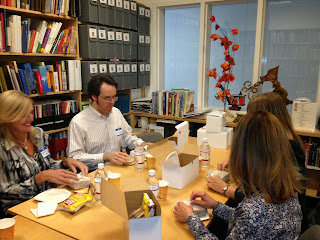
When I've had a chance to finish my account of last week's UConn panel, rest assured that I will give you a rundown on everything that happened today. In the meantime, enjoy this photo of my panel mates and our moderator having lunch. Hey, folks, this is the kind of insider, backroom information you don't get at just any blog.
And, yes, it's proof that I was in the insider backroom.
This was another of the NESCBWI programs run by children's science writer Melissa Stewart for the Published and Listed Program. The Society of Children's Book Writers and Illustrators has a large membership of prepublished writers that it serves very well. In recent years it's been making an effort to provide programs for members who have been traditionally published. Melissa has been in charge of the New England divisions PAL programs and has creating creative short-term experiences like today's.

When I've had a chance to finish my account of last week's UConn panel, rest assured that I will give you a rundown on everything that happened today. In the meantime, enjoy this photo of my panel mates and our moderator having lunch. Hey, folks, this is the kind of insider, backroom information you don't get at just any blog.
And, yes, it's proof that I was in the insider backroom.
Thursday, October 17, 2013
Report On The Panel On The Status Of Women In Children's Publishing

Women Writers
Lisa Rowe Fraustino, a children's book author and another professor at Eastern, spoke about her experience coming up through the academic world as a woman studying children's literature and writing. She mentioned at one point that the study of English education (vs. English literature) was not considered hefty in the past, a reference to that fact that children's literature was, and sometimes still is, taught as part of an education program rather than as part of a straight literature program. She also said that the people who had helped her as a writer were women.
Rowe Fraustino pointed out that the bulk of the students in her children's literature classes are women. The young people in the audience who would pursue children's writing would find that their teachers are women, their conference and workshop instructors would be women, the members of their critique groups would be women.
During Rowe Fraustino's talk I felt my dormant interest in graduate school stirring. It's gone now, but it was there for just a moment last night.
Women Illustrators
Interesting factoid about author/illustrator Barbara McClintock, who spoke about women illustrators: Long, long ago, I lived for a year in a tiny town next to the tiny town she lives in now. So we are neighbors in a Lake House sort of way.
McClintock talked about the 22% of Caldecott winners who have been women in spite of the fact that they dominate the profession. Women in other professions find themselves in similar situations in which they are up against a male world. The difference is that in professions like medicine, law, engineering, and tech fields, traditionally they have been male worlds. Children's illustration has not.
What's more, the Caldecott Medal winners are chosen by librarians, another profession dominated by women. So one profession dominated by women is passing judgment on another profession dominated by women and passing by them to select men. What is that about?
One striking comment McClintock quoted involved someone's perception that male illustrators are more serious about their work because they support families while women work as a hobby. I loved this, finding it delightfully retro. How, say, 1959! This is what used to be known as the pin money theory--women were wives who were supported by their husbands and only worked for "pin money," for trivial sums for nonessential items. This was considered a legitimate reason to pay them less. In my women's history class in college, we learned that the pin money theory was disproved by President's Commission on the Status of Women in 1963. But, of course, not everyone took that class.
Now, my legions of followers are aware that I don't get highly excited about awards. I might be expected to feel that all this concern about who gets them is petty. But here's the thing. Awards are about money. Earnings from the Caldecott Medal come in a number of ways. Straight sales, of course, but according to McClintock, Medal winners can expect to get more support from publishers for their future work as well as invitations to take part in events. The odds are against women getting access to these benefits. Why?
I knew before I left my house last night that children's publishing is a woman's domain yet the minority of men in the field get the bulk of awards. McClintock's talk, though, made this known situation more interesting than I expected it to be.
Women In Graphic Novels
The third speaker on the panel discussed women working in graphic novels. This was new information to me, and I'm going to give it a post of its own tomorrow.
Subscribe to:
Posts (Atom)