Showing posts with label multipliers. Show all posts

Tuesday, November 30, 2021

Time Management Tuesday: The "Four Thousand Weeks" Read Part 6

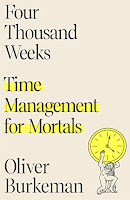
At one point in Four Thousand Weeks, Oliver Burkeman discusses rushing, speed, and impatience. A major point in his book is that constantly structuring time for something that’s going to happen/be completed in the future has a negative impact on our present. He’s very much about quality of life..

Here at Original Content, I've been interested in whether or not slowing down might actually make it possible for us to do more writing in our present. I want to do more with less effort and angst.

Some Speed Issues Unique To Writing

Writing isn't the day job for many writers. We're working writing around a regular income-producing job or family care or both. The desire to rush and get more done in whatever writing time we have is less about impatience and more about necessity.

In addition, two other situations encourage speed for writers.

Traditional Writers. Somewhere around the turn of the century, series became very popular in traditional writing, particularly in fantasy. I can't speak so much to adult series, but for children's and YA, many of these series were actually serials, meaning Book A didn't have an ending, readers had to wait until Book B. Book B might not have an ending, either, you had to go on to Book C.

To keep readers, writers and publishers had to crank out the next book as quickly as possible. Everyone had to work fast. A book a year or even every year and a half or two years is pressure in the traditional publishing world. 

Additionally, even a buzz-worthy book may not generate a lot of buyers, whether it's part of a serial or a stand-alone. In children's publishing, it's not unusual for books not to make back their advances. So writers hoping to make a living or even just create and maintain some kind of career feel a need to rush the next project along.

Self-Published Writers. In the past, at least, self-published writers often didn't get large numbers of readers per book, since distribution was such a problem for them. To make up for that, they had to produce a larger number of books. Smallish number of readers per book + more books = more income. For them we might be talking a book every couple of months or less.

In the early days, self-published writers could produce books that fast, because they didn't have to deal with editors and layout and design people. More recently, the more successful self-published writers are hiring editors and design people to better compete with traditional professionally published books. But, keep in mind, publishing companies provide all those services. Self-published writers have to seek all that out and pay for it, themselves, which means more work, which means more rush.
 
Income generating self-publishing exists now for short-form work, too. Sites like Medium are self-publishing platforms. People who are able to generate income on Medium generate it by the reader, and it's a very small sum. The way for writers to try to produce more income there is to produce more writing. They do that by writing a lot, which means speed.

Methods For Slowing Down 


Burkeman suggests accepting that a project is going to take the amount of time it's going to take as a method for slowing down. While that sounds promising, it won't be very helpful for writers who have contractual deadlines or need to generate income sooner rather than later. 

Some other options:
  • Create writing goals and objectives for a specific period of time, be it a year, a quarter, a month, or whatever you want. Goals are what you plan to do, objectives are the steps you are going to take to meet the goals. Try to stick to these goals and objectives. If something new comes up that can be an objective for one of your goals, go ahead and do it. If not,  try to set it aside for another planning period.
  • Take your to-do list seriously. It should be focused on your goals and objectives.
  • Work with multipliers, one task that addresses multiple goals, instead of multi-tasking, which can't be done, anyway. This blog post is an example of a multiplier, since I will publish a version of it it at Medium. It meets both my community building/branding goal and my short-form writing goal.
  • Create concentrated blocks of time during which you work on one project. This could be a weekend, a week, a month, a retreat or anything you want. For instance, National Novel Writing Month is an example of a concentrated block of time. School breaks for teaching writers could be examples of concentrated blocks of time. Days children are at school could be examples of concentrated blocks of time for parent writers. 

The idea is to try to slow down without cutting output. That could improve the quality of life Burkeman is interested in in Four Thousand Weeks.


Tuesday, July 21, 2020

Time Management Tuesday: Slowing Down By Eliminating Multitasking

For a few years now, I've wondered if slowing down could actually make us more productive.  I considered this question in:


Recently I stumbled upon Why You Should Be Single-Tasking, Not Multitasking & How To Make The Switch by Anne Marie O'Connor. She actually includes some strategies for staying with a single task. They look to me as if some of them could help with the slower work I'd like to be doing. Over the coming weeks, I'll address how they could apply specifically to writers.

The Multitasking Issue


O'Connor isn't the first person to suggest eliminating multi-tasking in order to improve productivity. The issue with multitasking is that it doesn't actually exist. Humans can't do two things at the same time, they're just switching, even if only psychologically, back and forth between tasks or thoughts. O'Connor sites research going back twenty years (meaning this isn't new news) that suggests multitasking actually slows people down. "...multitasking may seem efficient on the surface but may actually take more time in the end and involve more error. Meyer has said that even brief mental blocks created by shifting between tasks can cost as much as 40 percent of someone's productive time." More recent information supports the idea that multitasking shouldn't be your first time management choice. (And, yes, I did notice that one of the people quoted in this article is named Gauthier.)

A simple example--Do you do other things while you're watching TV? Write blog posts, letters, journal entries? Catch up on social media? Picture yourself on your couch, with your TV in front of you and whatever other thing you're doing on your lap. Are your eyes on the TV all the time you're working on something else? Are your eyes on your laptap or phone all the time you're watching TV? No, you're switching back and forth.

And that's what happens when you think you're doing any kind of multitasking. You're not doing two things at the same time, you're switching back and forth between tasks.

 Multitasking Vs. Multipliers 


The time and productivity difficulties created by multitasking can be illustrated when comparing it to using multipliers.

With multitasking you believe you're doing more than one task at a time, but in reality you are just quickly switching from one to another. This means that at various points you're in the midst of multiple tasks, at various points you have multiple tasks uncompleted and hanging over your head. Getting a sense of rush, pressure, and overwhelm? I am.

With multipliers, instead of switching among different tasks, you're working on only one task at a time. But that one task addresses more than one goal. You'll get more than one benefit from the one task. A quick and recent example is my effort last week to write a 53-word piece of flash fiction. That one task resulted in:
  • material to read at a workshop I'm attending
  • material to submit to a contest
  • material for a blog post (two, since I'm using it for part of this post, too)
  • material on eating/food, something I've been wanting to write about for a while
You can see how much more effort I would have had to have made and pressure I would have been under if I had been trying to switch between four different tasks to get four different results.

Coming Next Week


Next week I'll begin discussing some of Anne Marie O'Connor's suggestions for eliminating multitasking from your work life, how they can relate specifically to writers, and how this might slow down work while making us more productive. 
 

Tuesday, July 14, 2020

Time Management Tuesday: A Real Life Time Management Experience That May Not Be That Helpful

My primary work goal today was to write a 53-word story about a shell-shaped noodle. That's how I got caught in my bathrobe out in my deck garden reading about food writing when a delivery truck pulled into my driveway. I had to duck behind the gas grill.

That was a half-hour ago. I now have my 53 words on the conchiglie and can get dressed.

This, people, is what we call staying on task. Also, since I got a blog post out of it, milking an experience for all it is worth, known, too, as a multiplier. 

Tuesday, May 29, 2018

Time Management Tuesday: Use Multipliers For Both Work And Play

On Saturday we did our first bike ride of the season, taking a spur on a rail trail that ended a half mile from the snf where one of our elders lives. So we biked up the road to see her, went out to lunch afterwards, and got back on the trail.

Remember Multipliers?


Multipliers, you may recall, are "activities that meet more than one goal." Don't confuse multipliers with multi-tasking. Multi-tasking is the attempt to do more than one thing at a time, which has fallen out of favor, since researchers say all multi-taskers are doing is switching back and forth between tasks, not doing more than one thing at a time.

With multipliers, on the other hand, you are doing only one thing. This one task, though, serves more than one goal. So while you're not trying to do more than one thing, you're trying to do one thing that will serve you in multiple ways.

It might help to think of multipliers as killing two or more birds with one stone.

My biking multiplier hit three goals:
  • The weekend elder visit
  • Increasing my walk/bike mileage for the week.
  • Training for a fall biking vacation


Why Should You Care About My Biking?


My bike riding multiplier is an example of how we need to be managing all our time, work time and free time, in order to find or make hours for things we want to do. Like writing. Addressing those three goals separately last Saturday could have taken me all day. I took care of all of them in half a day. If I hadn't stopped for lunch, I could have done it in less. That left me with another half day for other things.

As a general rule, when this happens for me it's accidental. It's rarely a result of real planning. Trying to spend some time at the beginning of each week planning for one multiplier would be an interesting exercise.  

Friday, May 20, 2016

What Did You Do This Week, Gail? May 16 Edition

Goal 1. Adhere to Goals and Objectives. I feel as if I'm doing this because I'm feeling all creative and motivated. Would like to see a little more material in hand, though.

Goal 2. Prepare Mummy Hunters for Submission. As a result of reading a book recommended by a NESCBWI workshop leader, I'm actually thinking of doing another revision of this. (Multiplier!) My writers' group will be thrilled. Also, I have some editors lined up to submit to.

Goal 3. Generate New Short Work/Programs.
  • Still working on the flash and liking what's happening with it. That's influenced by the book I'm reading, too.(Multiplier!)
  • I also made a submission
  • Am reading the new issue of Carve. 
  • I knocked off a 500-word flash essay
  • Received a rejection on an essay submission. However, that rejection came from publication that had ignored an earlier submission, not responding at all. So this response suggests to me that I did a good job of matching submission to market. Just not good enough, of course.

Goal 5. Community Building/General Marketing/Branding

  • Weekend Writer Print Resources post--Promoted to Google+, Google+ community, Facebook community, Twitter
  • Sherlock Holmes post--Promoted to Google+ and Twitter
  • Books from Sherlock Holmes post reviewed at Goodreads
  • TMT post--Promoted to Facebook, Google+, and Twitter
  • Arts Center East post--Promoted to Google+, Facebook community, and Twitter
  • Call for CCLC material
  • Submitted material for CT Center for the Book website

Goal 6. Generate New Work: I'm considering doing NaNoWriMo this year.

Am I using anything I learned at the NESCBWI Conference? I'm reading the book I mentioned above (and will write about here at length at some point) and what I'm taking from that I am planning to apply to a couple of different writing projects. Which makes reading that book a Multiplier. It applies to more than one goal.

Tuesday, December 08, 2015

Time Management Tuesday: Multipliers

Multipliers are activities that meet more than one goal. This way of using time is the first really new time management concept I've come across in a while. At least, it was new for me when I read about it a couple of weeks ago.

Jennifer Aaker is the name I see most often associated with multipliers. In Rethinking Time: The Power of Multipliers, you can see her speak, and briefly, on the subject.

Multiple Goals, Not Multiple Tasks


Note that we're not talking about multi-tasking here. You're not trying to do more than one thing at a time, something that researchers now say can't be done, anyway. Multi-tasking is simply quickly flipping back and forth between tasks, not working on them simultaneously.

Multiplying is doing just one task that addresses more than one goal. It's the goals that multiply. One activity is working toward more than one of them. That's why you're getting more done. You're not having to work on one goal at a time.

Which Goals?


When I've read about multipliers, the writers played up this strategy as a way of helping people meet personal goals. One example was a parent who has to bring work home and does it with her children while they're doing their homework. She meets a work goal and a parental goal. Another example is a woman who has goals related to fitness and maintaining social connections, so she invites a friend to run/hike/whatever with her. (I've got to pause and say how poorly that would go over in my circle. I mean it. I was part of a social walking group. As my sister would put it, it was like herding cats.)

How about using multipliers on multiple work goals? Because I've been assessing how well I stay on task with goals and objectives this past year, I'd already noticed that I sometimes do take part in activities that meet more than one of this year's work goals. I just hadn't realized it was "a thing," and that maybe I could be thinking about doing it in a more organized, pro-active way.

For instance, The Mummy Hunters draft is a goal for this year. So is community building. When I attend writers' group and we discuss Mummy Hunters, I'm hitting two goals with one activity. When I attend a book fair and use the material here in the blog, which markets me, I'm hitting the community building and marketing goals.

You Need Goals And Objectives To Make Multipliers Work For You


You recall, I'm sure because I'm always yammering about it, that goals are what you want to do and objectives are the tasks you will undertake to achieve the goal. Those objectives/tasks are the activities that you can use to meet more than one goal. To make multipliers work, you have to be aware of your goals and objectives. If you hope to find activities that can meet personal goals, too, you'll need to be thinking about objectives for them even if you don't formally create them. For me, a lot of my reading could be described as a personal goal, something I simply want to do. Yet a lot of my personal reading ends up in this blog, part of my professional marketing goal. (And community building, for that matter.) This post is an example. I read about multipliers in More Magazine, not Poets & Writers.

I've read that the multiplier concept is a new way of thinking about time. But I wonder if it isn't also a new way of thinking about goals and objectives.

Since January will be here shortly, it's time to be thinking about goals and objectives for next year. Try to think about objectives differently so you can try to get more out of them.

Yes, I hope you'll be hearing about this a lot from me next year.