Showing posts with label self-discipline. Show all posts

Tuesday, May 22, 2018

Time Management Tuesday: Pick Your Companions Carefully


Salon has a new article, Identifying With Others Who Control Themselves Could Strengthen Your Own Self-Control that revisits the famous experiment in which children were tormented to see how long they could control themselves without wolfing down some marshmallows. The kids who could do without the longest  ended up doing better later in life. Were they born with good control? Could it be taught?

The Salon article describes a new study tormenting children who had been assigned to groups. Kids who thought their group members had waited before scarfing down marshmallows were better able to wait before doing so, themselves. The research is "the first to show that group behavior motivates young children's actions that involve self-control."

Haven't We Heard Something Like This Before?


Why, yes, we have. According to Kelly McGonigal (Hmm. I have her new book on my Kindle. When am I going to read that?), self-control is contagious. We are influenced by others in the groups we are part of, just like those kids.

"What does this have to do with managing time," I asked a few years back, "particularly managing time for writers? The May Days, people! National Novel Writing Month! Your writers' groups. All these group initiatives involve setting aside time (a month, a meeting every week or two) and pulling people together with the hope that we will "catch" initiative, work ethic, etc., from each other."

Right Now


Right now I'm taking part in  May Days, binge-writing with others. Looking for some self-control from other writers.  On the other hand, I didn't go to writers' group last week. No hope of getting self-control help from them this month. Yikes.

And, finally, I don't know if I've ever mentioned this here, but I really don't care for marshmallows. They would have had to pay me to eat those things.

Tuesday, October 24, 2017

Time Management Tuesday: And More On Focusing

I'm still working on focusing. Have you noticed?

How Self-Control Works, and How to Boost Your Willpower by Better Understanding It at Lifehacker includes some thoughts on the subject, since being able to stay focused requires willpower. My favorite thought was the first one, practice.

Practice


The article suggests picking something you do in excess and practice not doing it for a week. And once you can not do it for a week, practice not doing it for another. Work up to a month. A month is supposed to be a significant time in terms of changing behavior. I think I've read six weeks elsewhere, but you get where they're going with this.

Now, I see two things going on with practicing not doing something: 
  1. You're toughening up willpower and improving focus in general. I can't find my support for this, but I've read that improving willpower/discipline in one area of your life should improve it in others.  Thus, if I could develop the discipline to not eat all the time I'm cooking, I could, presumably, not have to read articles about Chip and Joanna Gaines or hunt up actors on-line while I'm watching them on TV in the evening. We believe that monks and athletes have iron focus. Maybe because discipline in one area of their lives transfers to another?
  2. If you practice not doing something time consuming, you could end up with some more time. For instance, practicing not reading those articles about Chip and Joanna Gaines and not hunting on-line for info on actors will leave me more time for blogging and relaxing in the evening, since, I swear, that's the only time I do those things. You can always practice not doing time consuming during the work day.
So the idea is that by practicing doing less you can save time because you've become a disciplined badass.

Tuesday, July 25, 2017

Time Management Tuesday: Working In Chaos

As a general rule, I find that material disorder--the kind where your stuff piles up around you, the kind where you lose your cell phone under some unopened mail on the kitchen counter, the kind where you find clothes you'd forgotten you had in the ironing or maybe that's the mending--saps my chi. It distracts me. As I've said before, "I do not deal well with mental and physical disruptions and confusion." I never suggest that homemaking has little value and that writers or anyone else can just laugh it off in order to make time for art. That kind of thinking is sure to come back to take a big old chunk out of your butt. Really. Somebody did a study that showed that very thing.

However...


...I've been working in the bedroom for a month or two now, because my desk in the office is a mess, and who has time to deal with that? A couple of weeks ago, I had twenty or thirty minutes to work. That was it for the day. Probably that was it for the next couple of days. A couple of hours earlier, I had stripped my bed. Disorder! When I used to have a yoga sanctuary in that room, I couldn't roll out my mat if the bed wasn't made. Work? Ha!

But, remember, I had no more than 30 minutes to work. How much of it did I want to spend looking for sheets and making up a bed with them. Wouldn't I be better off, I thought, if I had such incredible concentration that I could work no matter what kind of surroundings I found myself in?

Well, you might describe my concentration as "incredible"depending on how you define the word. I can assure you that we're not talking the kind of incredible that allows you to get much done unless the stars are lined up just right. Nonetheless, I sat down at my desk, with my back to the bed, and worked.

Improving Concentration


I've been interested in improving my concentration for a long time. Self-discipline. Impulse control. Fortunately, I'm the kind of person who enjoys the journey, because I'm sure not getting to the destination.

But this summer is different. It's one thing to let your mind wander where it will when you have three or four hours a day to work. It's another when you have three or four hours a week, if you're lucky. I'm feeling a little more motivated to get some kind of power brain thing going.

So next week, and maybe the week after, I'll be focusing on focusing.

Tuesday, March 14, 2017

Time Management Tuesday: A Goals And Content Marketing Failure

For a couple of years I've been keeping track of what I've been doing each week, making sure I've been spending time on my yearly goals. My inspiration for this came from a book called 18 Minutes by Peter Bregman. Eventually, I added  working with a content marketing calendar to this. Both the goal check and the content marketing calendar have been working well for me. I've been getting more work done (goals) and getting my blog posts out in the world regularly.

Until the last couple of months.

I went on retreat in January. I came back sick, and the sickness turned into bronchitis. I wasn't flat on my back, but up-and-down, lying around on the couch, replacing meals with ice cream. I was doing better when, at the beginning of February, the vehicle I was driving home from writers' group was hit by a flying tire. I wasn't injured, but lost another day to dealing with the fallout from that. (By the way, my suv still isn't back from being repaired.)
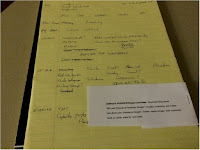
So I had a few weeks when I wasn't at the top of my game. I slipped up on yellow pad planning (which some day could be as famous as bullet journals) altogether, and even when I got around to doing that, I dropped the ball with the content marketing calendar addition (the white section in the picture to your right). And then a few weeks led to some more weeks.

This doesn't speak well for the power of habits. I'd been maintaining content marketing calendars since last spring (I think) and my yellow pad planner for much longer. Shouldn't those actions have been habits? Well, Kelly McGonigal warned me.

So, What Are You Going To Do About This, Gail?


Last week I managed to get back on the content marketing calendar wagon. I've made one for this week, too, though I'm behind in creating my yellow pad plan. (I was on the road all day today, okay? But we're having a blizzard tomorrow. I should be able to do it then.) But I managed that by simply gritting my teeth and soldiering on. I don't think that's going to work for long.

Kelly McGonigal's Thoughts:

Back in 2013, I did a post on a talk McGonigal gave on habits. Two of her suggestions that might help me:

"Automatic Goal Pursuit--This is different from habit. You're trying to keep goals in mind instead of relying on automatic habits. You are always focusing on the goal, instead of behavior." I'm kind of obsessed with goals, anyway.

"Distress Tolerance--Work on becoming comfortable with uncomfortable situations, the distress of wanting. For time management for writers, this could mean becoming comfortable with working alone, which could go a long way to control the "craving" or desire to keep checking your e-mail/Facebook wall hoping for some human contact." Distress here can mean anything--the struggle to finish writing a paragraph. The overwhelm felt about starting a new writing project. Fear of having work rejected. Or the discomfort of maintaining some kind of workload while sick or getting back to work after a break. I'm not as keen on distress tolerance as I am on goals, so clearly this should be something I'm focusing on.

Distress tolerance, distress tolerance, distress tolerance.

For You Yoga Folk


The February, 2017 issue of Yoga Journal carries an article by Kate Siber called Fuel Your Willpower to Transform with Tapas. According to Siber, tapas is translated from Sankrit as self-discipline. She says, "On a psychological level, tapas can be interpreted more metaphorically: It’s the friction or resistance that arises when we go against the overwhelming momentum of our ingrained habits."

That "friction," "resistance" sounds like the distress McGonigal talks about. Siber comes up with a very quick and easy reason for becoming comfortable with it, so you don't use distress to avoid sticking with a task important to you. "The yoga greats, including B.K.S. Iyengar, knew the power of the seemingly simple concept that self-discipline allows for growth and transformation."

That's assuming we want to grow and transform, of course.

You remember I mentioned that this article is in Yoga Journal, right? Well, with the article comes a yoga series to help build tapas, or self-discipline. The theory is "When we practice tapas on the mat, we practice sitting with whatever sensations and conversations arise for 
us, without running away." (Heather Lilleston, founder of Yoga for Bad People. Gotta love that name, don't you? I do, anyway.)

Without running away, people. Running away is what we're doing when we give in immediately to the desire to surf on-line instead of making a content marketing calendar for the week or lie in bed reading instead of getting to work on yellowpad planning for the week.

Siber also explains why yoga can help create self-discipline.

Once again, what am I going to work on? Distress tolerance, distress tolerance, distress tolerance.


Tuesday, November 03, 2015

Time Management Tuesday: The October Purge Results Post

Oct. 31st
We did, indeed, each find an item a day in October to get out of this house. That's sixty material possessions we don't need to spend time dealing with. That's more than 22 cubic feet of belongings that won't cause disorder in our lives, leading to self-regulatory failure. Seriously, someone (not mentioning any names, Civil Guy) measured the heap, did some calculations, and came up with 22+ cubic feet. Evidently that's not much when you're talking loads of gravel or concrete. But we're talking stuff.
Oct. 1st

Now, why does anyone need a specific unit of time in which to clear out? Why not just do it on a regular basis? I think we're pretty good at that, and we've become quite good at not bringing unnecessary material things into the house in the first place. But I noticed something happening last month that suggests providing yourself with a dedicated Toss Time makes sense.

It's All About Mindfulness


22 cubic feet from another angle
What I noticed was that I was noticing things. The misshapen work gloves I haven't worn in years, for instance. I'd just been dumping other gloves on top of them. I've known for a long time that I can't do a thing with the ravioli attachment for my pasta machine, but I've hardly been aware of its existence. That didn't mean it wasn't taking up space in the pantry. Every year when I pull out winter clothes in the fall and put them away again in the spring, I've seen but haven't seen, if you know what I mean, a pair of black pants that are two sizes too large for me. They looked very good on me when I was 25 pounds heavier than I am now, so I've been holding on to them in case I gain back that weight. I've had them for, maybe, fifteen years. Well, if I gain that weight now, I'll have to buy some new pants.

My point is that somewhere along the line we stop being affected by a lot of our possessions. We can't make a decision to keep or ditch them because we're barely aware of their existence. But exist they do. You could compare living with unnecessary junk to living with mild chronic pain. You've become accustomed to it. It's become a norm in your life. But it still impairs your function.

A dedicated time for cleaning house requires mindfulness of us.When we're done, some of the things that have been lying on the raised hearth and the dresser will be gone. We won't have to spend time moving them around looking for things. They won't have a negative impact on our willpower, wrecking our ability to stay on task with work.

Ha-Ha, Gail. Now What Are You Going To Do With That Pile Of Junk?


Fortunately, the last day of October was a Saturday. While I was busy baking cookies with my leftover Halloween candy Sunday afternoon, someone else cleared off the entire worktable. Some things were thrown away. Some were placed in the church tag sale area of our cellar. A couple  of books are going to family members, the others will be going to a library book sale later this month. There's a large pile of clothes waiting to be bagged for the Salvation Army. But that's an easy task. Getting to that point is what is difficult.

And, no, I have not yet read The Life-Changing Magic of Tidying Up.  I ordered it on Interlibrary Loan, and it came in while I was on vacation. I'll try to read it before next year's purge.


Tuesday, October 27, 2015

Time Management Tuesday: How This Year's Purge Is Different From Last Year's

As you can see, we've started pulling out the big stuff now. My cellar TV room is beginning to look as if we're getting ready for a tag sale. I'm talking about the October Purge at Chez Gauthier, in case someone just surfing by is wondering what this picture is about.

During last year's purge I started focusing on one spot or another in the house.

"I realized that just getting rid of thirty random items out of an entire house wasn't going to do much to help me organize my environment, improve my impulse control, and manage my time. But focusing on specific areas, like that kitchen counter, could. Thus I got rid of table cloths from the china cabinet in the dining room so that I won't have to spend time on my knees in front of it looking for linens when I'm expecting guests. I worked on the pantry so I, well, could walk through it, to be honest.

I got rid of some random things, too. But, really, the way to get a usable result from a possession purge is to apply a little logic, do a little planning. I may do an annual purge."

Weeeeellll, that's not how things have been going this year. I definitely have just been scooping things up, and I think that's what my husband has been doing as well. Me, I've been picking up what I'm going to call "floaters"--things that were just lying around here and there through the house. If I was in the attic putting away suitcases, I would see something that hadn't been used in years and didn't work very well, anyway. An item that had been moved into the pantry months (a year?) ago to get it out of the way is now on the purge table. It's really going to be out of my way soon. Picking up one item to get out of here sometimes led to finding more.

It's been more random than last year. This probably says something about the state of my house and my mind recently.

Next week: The 2015 Purge Finale with a complete set of pictures.


Tuesday, October 13, 2015

Time Management Tuesday: Okay. Let's Go Over This Purge Business Again

We're on Day 13 of this year's October purge. As you can see, we're not quite halfway through the month, and the dreck we don't need is piling up.

What Does Stripping Your Environment Of Unnecessary Material Items Have To Do With Managing Time?


Last year I wrote about the Environmental Disorder Leads to Self-Regulatory Failure study. I found the following quote related to it: " ...people who sat by a messy desk that was scattered with papers felt more frustrated and weary and took nearly 10% longer to answer questions in a color-and-word-matching task, in comparison with those who were seated by a neatly arranged desk."

Okay, you may say. That's a good reason to purge my desk. But why the whole house?

Because many writers work in our homes. Many writers also have day jobs or families or both. We don't have all the time in the world to write to begin with. If our extended environment is causing frustration and weariness, impairing self-regulation, that's going to impact how effectively we can use our time.

There are all kinds of of nonwork-related reasons for getting rid of material things you don't use. But we only deal with time here, so I'll pass on that.

I have fifteen more days of stuff to get out of this place. We haven't gotten to the big stuff yet.


Tuesday, October 06, 2015

Time Management Tuesday: So I Guess The Purge Is Going To Be An Annual Thing

I am sure you all remember last year's October Purge chez moi. It did not involve ridding myself of people who didn't agree with me. Nope. Can't help you with that. What the October Purge was about was imposing order, working on the theory that maintaining  order in your physical surroundings helps to maintain order of other kinds--self-regulation, self-discipline, willpower.

Quite honestly, I hadn't given a lot of thought to doing this again this year. But someone else who lives here was psyched to do it. And now the fire has been lit under me.

The October Purge was inspired by an essay about Joshua Fields Millburn, who got rid of one possession a day for a month. We're doing a variation this year, because two of us are getting rid of one item a day. And, for novelty, by which I mean, fun, we're making a heap of this stuff to get a nice visual of what two items a day for thirty days looks like.

Here is the difference between Day One and Day Five.

Purge 2015 Day One
Purge 2015 Day Five


Check back to see how we do with this. You know I will keep you informed.


Tuesday, June 10, 2014

Time Management Tuesday: Habit Falls Apart, Leading To Disordered Surroundings

This past April, I wrote about whether or not a disordered environment could have an impact on work. A recent study suggested it could cause "reduced stamina on tasks that require advanced thinking skills." At that time I also wrote about my own disordered office environment and how the system I'd set up the year before for keeping filing done and order maintained had fallen apart.

Well, things haven't improved. They're, uh, actually somewhat worse. Back in April, I thought I needed to get some kind of cleaning routine back into my life. Now I'm wondering if routine is the problem.

My self-discipline goddess, Kelly McGonigal, has voiced doubts about the value of habit, saying that it's a nonthinking behavior that works best for small tasks. Managing my environment doesn't appear to be a small task. What advice does she have that I could somehow apply to this issue?

Automatic Goal Pursuit--Keep a goal in mind instead of relying on automatic habits. Remember that I need to maintain order so I can have more time to work instead of relying on automatically and mindlessly doing it.

Implementations--Plan what to do in certain situations. In this case, planning to work on the office at certain times of day. This worked well when I was planning to work on the office every morning. When I started implementing work sprints in the morning, the office cleaning got lost. Yikes.

Well, I know habit isn't working for me on this one. I'm going to try to combo automatic goal pursuit and an implementation. It's worth a try. My office, as it is, is definitely making me feel out of control and undermining my discipline.

Tuesday, May 06, 2014

Time Management Tuesday: That Do More With Less Time Plan Fell Apart For A While

My May Days Project got off to a really bad start.

The Plan


You will recall that I was planning to generate work on a project that I'd set aside last year and, at the same time, work on increasing my word count as a way to do more with less time. So I've been using 2,000 to 10,000: How to Write Faster, etc. by Rachel Aaron to help me do this. Aaron writes that a key element in writing faster is knowing what you're going to write before you get started. So in addition to bringing myself up to speed with this project by revising the few chapters I'd already written, I was going through my materials on characters, historical elements, timing, etc., to help me plan some scenes, which as far as this organic writer is concerned, would be knowing what I was going to write.

Last Tuesday, two days before the beginning of May, I took a look at the scene file I'd started last year. Yikes! It was a mess. I had made a list of scenes, but the beginning scenes didn't entirely match what I'd actually written (not a problem, it's the result that matters) and later scene plans weren't all that helpful, in part because of how the story now started. Well, I said, you will spend tomorrow, Wednesday, cleaning this stuff up and getting some scene plans in order.

What Could Go Wrong?


However, Tuesday evening I received a request for chapters and a synopsis for another manuscript that I had submitted to someone. Yikes again! This was good news, right? Of course, it was.  Someone was interested in one of my projects. But I didn't have a synopsis ready to go. As I told you this past weekend, I spent five days writing it. That included the Wednesday I was going to spend on scene planning and the Friday I was going to spend writing. (Thursday is family/runaround day at Chez Gauthier, and I've given up pretending I work on weekends.)

We have talked about these time management issues here before. That synopsis was what is known as reactive work. I needed to drop the creative work I was doing to react to an incoming request. It was also an example of situational time management. I had to adapt very rapidly to a new situation.

What The Hell, Right? No.


The synopsis went out Sunday, so my situation has changed again. What should I do now? I wasn't able to finish my planning and I wasn't able to get started with writing. What the Hell. I might as well do something else.

That is what's known in self-discipline circles as the What-the-Hell Effect. It's a major reason for self-discipline failures. Instead of staying on task with a diet, people say what the hell at ten in the morning because they ate two doughnuts at nine and figure they might as well give up and start again tomorrow. In reality, they've got many hours left in the day during which they can stay with their program. The same is true with managing time, whether you're talking about a day or a week or a month. I have a lot of time left in this month that I can use for my planned project, even though I've lost some of it early on.

Fighting The What-the-Hell Effect Leads To Results You Can See


Last week was then, this is now, and now is an entirely different situation to work within. Additionally, I don't need to feel bad about myself for not working on my May Days project last week. (Feeling bad is the big reason for giving into the What-the-Hell Effect.) I was working and working on something significant, just not the significant something I planned to work on. Yesterday I continued with the last of the revising of the early chapters of my May Days manuscript, and I have the next few scenes planned. Since I'm an organic writer, just knowing what I'm going to be doing a few scenes ahead may be the best I can expect. We'll have to see how the rest of the month goes.

Oddly enough, I had What-the-Hell issues with last year's May Days project, too. And, yet, the work I ended up doing that month led to more work later in the year, and I'm back on the same manuscript now.  That, lads and lasses, is an example of why fighting the What-the-Hell Effect is so important.

Tuesday, April 01, 2014

Time Management Tuesday: Can Our Environment Impact How We Use Time?


Earth Day is coming up on April 22, and I'll be observing it off and on all month. Yeah. Earth Day Month. Today I'll begin by stretching the meaning of environment and pondering whether our immediate environment, and lack of order within it, can have an impact on how we use time.

First off, I'd argue that without a doubt lack of order in our immediate environment will be a time buster just because it makes it difficult for us to keep track of things. Time gets sucked up hunting for things in the office or even going out to buy more of what we can't find. That's a practical matter.

But last month in a Chicago Tribune article, Self-control, Smells, and Spending, Gregory Karp wrote about some recent studies that concluded that our immediate environment has a less obvious impact, as well. The studies, he says, indicate that a "disorganized environment can leave you feeling out of control, which drains your reserves for future self-control, leading to poor decisions including impulse spending." What does impulse spending have to do with time management? It's not the spending we should be concerned with, it's the draining self-control or discipline. If a disorganized environment makes people feel out of control enough to impulse shop, won't it make us feel out of control enough to shake up our work schedules? In fact, according to ScienceDaily, the researchers on one of the studies Karp refers to, Environmental Disorder Leads to Self-Regulatory Failure, were "looking for changes in behavior like impulse spending as well as poor mental performance or reduced stamina on tasks that require advanced thinking skills."

"Reduced stamina on tasks that require advanced thinking skills"--that's what we're concerned with.

Environmental Disorder (Boyoun (Grace) Chae of the University of British Columbia and Rui (Juliet) Zhu of the Cheung Kong Graduate School of Business in China) is quoted all over the Internet. A blog at The Harvard Business Review picked up this point in the study: "...people who sat by a messy desk that was scattered with papers felt more frustrated and weary and took nearly 10% longer to answer questions in a color-and-word-matching task, in comparison with those who were seated by a neatly arranged desk."

The irony here for those of us interested in managing time is that maintaining order takes time. I have set up a new work station for my new(ish) laptop without ever really organizing the spot where I put it. Doing that would eat into my work time. But things are closing in on me, as you can probably see from the pictures accompanying this article. At some point, the disorder will reach some kind of tipping point, and I'll have to do something about it in order to continue working. Last year I had a system set up by which I spent 15 minutes in the morning doing some filing and pick-up so this kind of thing wouldn't happen. That fell apart when I had a health issue earlier this year and wasn't working regularly. I need to get some kind of clean-up routine back into my life to address this kind of problem in an efficient, timely way. (You can bet that will become another Time Management Tuesday post.)

Another issue relating to disorder in our immediate environment is that many writers work in their homes. How "immediate" does "immediate work environment" mean in that case? Not many of us have someone coming in to do laundry or clean bathrooms or...Well, anyone who works at home in any way knows where I'm going with this. "...disorganized environment can leave you feeling out of control, which drains your reserves for future self-control." Everyone's tolerance for disorder is different, but I will admit that sometimes having to walk through my kitchen on my way to the office drains my reserves.

I'd also like to point out that over the last few decades the value of homemaking has taken a few hits. Letting housework go and not being a perfectionist about it are the center pieces of many articles on how to manage time and stress. How often is the traditional suburban housewife some kind of heavy/bad guy on TV shows or at least a laughable cliche? (Not Alison on Orphan Black, by the way. I love her.) And, yet, without the order they once maintained many of us find ourselves in a disorganized environment that often drains our reserves of self-control.

Well, I've used up a couple of units of time writing this blog post, and now I need to use my break to fold the towels I washed yesterday. They're up in my living room. Talk about disorder.

Tuesday, March 25, 2014

Time Management Tuesday: When To Do What

The Best Time to Write and Get Ideas, According to Science by Kevan Lee at Buffer suggests that when considering managing time we might want to keep in mind when we do things. Some times are better than others for particular activities.

Creative vs. Analytical Work


We've discussed here that willpower can be depleted. Our biggest store of self-discipline is early in the day. We try to duplicate that morning boost of willpower experience by breaking our day into units, so that we keep starting over again. The Unit System! Lee suggests that that early period of the day is best for creative work because that's when the prefrontal cortex of the brain is most active. A "study looked at morning and evening MRI scans and observed that mornings showed more connections in the brain—a key element to the creative process." He says this study also indicated that "analytical parts of the brain (the editing and proofreading parts) become more active as the day goes on."

Conclusion? Writers who have a number of projects underway may want to work on the ones that involve generating new material earlier in the day and the ones that require revision-like activities later.

Don't Care For Mornings? Try A Routine During Another Part Of The Day.


What about those of us who don't see ourselves as morning people? Set your time and stick with it. "Routine," Lee says, "reinforces neural circuitry, and the more you work at the same routine, the stronger those connections become." So you can compensate for not using what scientists consider the best creative time by maintaining a routine.

As For Me


I like to do a sprint in the morning before I actually get started working. Stopping after a short, intense burst of work gives my mind something to dwell on while I'm doing the less challenging activities involved with getting ready for the day. After reading The Best Time to Write and Get Ideas, According to Science, I'm going to be sure that that sprint involves new writing and not editing, research, or formatting manuscripts. I can do that much later in the day.

Tuesday, October 15, 2013

Time Management Tuesday: Remembering That We Were Going To Practice Self-discipline

Okay, the first thing we need to do here is remember what we were talking about last week, which was:
  1. When, in the course of our lives, are we actively taught self-control, which we need to practice self-discipline?
  2. Those of us who don't learn self-control when we're young have the additional issue of remembering that self-discipline is something we want to practice because the whole self-control/self-discipline business is not a natural part of our lives.
And why do we writers want to become self-disciplined? Because self-discipline relates directly to being able to stay on task and manage our time.

Yeah, I Really Want To Remember To Do That


Part of being self-disciplined involves remembering that you're going to do it. How so? Think of any new behavior you want to engage in. Say I want to look over the entire buffet for healthier choices before I start filling my plate. Or I decide to exercise before I have breakfast. I also want to write 20 minutes on weekends and holidays when the family is here. In any of these cases, willpower failure can be due to a number of things, but I would like to add just plain forgetting what we'd planned to do to that list. We walk into a restaurant and truly just forget that we had a plan for dealing with the buffet because we'd never had a plan before, so it's not something we naturally do. We get up in the morning, eat breakfast, and go "oops" when we realize that we forgot the exercise plan.

Please, Gail, how about a writing-related example. Okay. Here's one. I didn't do my 20 minute writing sprint on Saturday. I could easily have done it in the morning, but I spent several hours cooking random things instead. In thinking about it afterward, I realized there was no reason in the world why I had to cook all those things. I could easily have squeezed 20 minutes of writing in, which would have kept me in the world of my WIP. I really just forgot that I had a plan. Maintaining self-discipline isn't something I'm accustomed to doing, at least, not with that particular task.

So Now We Have To Work On Improving Memory, Too?


Well, it certainly can't hurt anything, can it? So how are we going to do it?

  1. We can try creating habits, which are like self-discipline without any thinking. Muscle-memory for the memory. Presumably with a habit, we would simply do something we wanted to do. However, Kelly McGonigal, my personal self-discipline guru, isn't a fan of habit. She believes habits work best for small behaviors that don't require a lot of us, which explains why I'm now flossing my teeth regularly. It's not brain surgery. She talks about using things like automatic goal pursuit, implementations, and commitments instead of habit. But you have to remember the goal you're pursuing automatically, you have to remember the plan you're going to implement in certain situations, you have to remember your commitments.
  2. We can try meditating, because it appears to be a cure-all for what ails you. Now that we have ways to study the brain and the impact of various activities upon it, there is some science to back up its use. Again, my friend Kelly McGonigal says that meditating helps with self-control and attention because it develops the prefontal cortex, the portion of the brain that deals with impulse control. The effort to keep your mind from wandering actually develops the brain.
    Memory, Gail, memory. Remember we're talking about memory. I do remember that. Maybe because I started a short meditation practice in June, one that I'm only able to keep up with 3 or 4 days a week. I didn't notice any revolutionary gains in concentration, but I did wonder if my memory was improving. It wasn't that I wasn't forgetting things. What I was noticing was that I "recovered" from the forgetfulness faster. Meaning I remembered where my cell phone was as soon as I realized I didn't have it. I remembered I hadn't turned the timer on while baking as I was leaving the kitchen. Sure enough, a little time on the Internet turned up a very recent article on a study that indicates that meditation does, indeed, improve memory.

    What Will Memory Do For Us?

    My theory is that improving memory will lead to improved self-discipline will lead to improved time management. Because absolutely everything is tied in with time.
       

    Tuesday, October 08, 2013

    Time Management Tuesday: Wish I'd Learned Self-Control In Kindergarten

    Kelly McGonigal tweeted a post on Activities for Practicing Self-Control. It's a kindergarten teacher's description of things he does to teach self-control to his students. He says, "I often hear teachers complain (including myself) about kids lack of self-control but what are we doing to help kids learn about it?" Good point. I would argue that self-control/self-discipline is a big part of managing time. It seems to be the kind of thing most of us pick up or we don't. It isn't specifically taught the way, say, addition is. Those of us who find ourselves undisciplined adults are going to have to muddle along on our own.

    The Piece of Cake


    Matt Gomez, the teacher who wrote the post on self-control activities for kindergarten students, writes about modeling self-control for his class. "I give examples often of adults that have to have self-control so they know we all have to make choices. For example: “guess what class, I saw a piece of chocolate cake in the staff refrigerator. I could have eaten it but I chose not to because it wasn’t mine.”" I found this interesting for several reasons.
    1. Gomez is interested in self-control in relation to people getting along with one another. He says he didn't eat the cake because it wasn't his, not because it wasn't good for him, a reason many people exercise self-control around food. I'm interested in self-control in relation to staying on task with my work and getting more done faster, not because it will improve my relations with others. However, according to Kelly McGonigal's book, The Willpower Instinct, working on improving willpower in one area of life often leads to improvement with other areas that require willpower. It doesn't appear to be a spot specific strength. Therefore, the children learning to control themselves so they can get along within a group, may find themselves better able to control themselves when needing to stay on a task. If I am able to improve my control with my work, I may find myself getting along better with others.
    2. Unless we've been receiving some kind of self-control instruction or are undergoing some kind of training in it, how often are we actually aware that we are practicing self-control or need to? For instance, take the example of seeing a piece of cake in the refrigerator. How often do we see something like that and consciously think, Time to exert a little control here and walk away from that thing? I think it's probably much more common for us to realize we've experienced a self-discipline success or failure after the fact (I knocked off a chapter today! I lost half the day to phone calls!) than while we're in a position to do something about it. Is this because that's the nature of humans or because we simply haven't learned a particular behavior or skill?
    3. Gomez's description of modeling self-control for his students raised this point for me--I would have to remember I was looking for self-control examples, particularly if I wanted to find any coming from me, before I would recognize that not eating that cake was a golden opportunity to create one. And that brought up the whole issue of memory and self-control.
    Now you know what I'll be writing about next week.

    Tuesday, June 18, 2013

    Time Management Tuesday: The Fourth And Last Week Of Developing Discipline With Meditation

    I've seen a little bit around the Internet lately about writers feeling pressure to write faster and more. Meditation, I suspect, is just not about speed. I've already used the watched-pot-never-boils metaphor/cliche in relation to meditation. If it is going to improve concentration and discipline, meditation should help us stay on task with work and manage time better. Yeah, maybe we'll be able to work faster. But how quickly is that going to happen?

    Here's a little tale I may have told here before but not in relation to meditation. It may illustrate how meditation works:

    Eleven years ago, I started training in taekwondo. After a few weeks of hating class and only sticking with it because I'd paid for three months and I was too cheap to leave that money on the table, endorphins started kicking in and I was totally into the other-world experience I was living during my hours in the dojang. I was into it.

    I found an old beat up book on martial arts in my local library. This is one of those mystical book type deals where you are probably the first person in years to touch a volume on a shelf, and it has something just for you. The book has been waiting for you. In this case, what the book had for me was the advice that I should train for the sake of training. I totally got that. I didn't know anything about rank advancement when I started. I never cared about it. I just liked to train. My only goal was to have my dobak clean for the next class.

    The martial art experience was so huge to me that I believed something from it would surely extend into other aspects of my life. My work, for instance. Something good was going to happen with how I worked because I was doing taekwondo. I kept waiting and waiting. What would it be?

    A couple of years ago, I realized that I was writing for the sake of writing. I wasn't selling anything anymore. Blog readership and feedback and dropped dramatically. I wasn't getting any of the traditional rewards people get from their work. I was simply working for the sake of the work, just as I trained for the sake of training. And I had been doing it for a while. I just hadn't noticed. It had become part of my work life without me being aware of it. No bells and whistles or releasing of balloons.

    My point? I suspect something similar will happen with meditation. If I am able to keep up the practice, at some point I will notice an impact on my work, probably one I don't expect and can't predict. It will be something that will have become part of my work life without me being aware of it. No bells and whistles or releasing of balloons.

    Actually, that's kind of exciting. What will it be?


    Tuesday, June 11, 2013

    Time Management Tuesday: Week Three Of Developing Discipline With Meditation

    If this were not a discipline initiative, I would continue with the mediation but blow off writing about it here because meditation is one of those things that's difficult to see results from. What am I supposed to tell you here, particularly in relation to meditation and time management? No, I am not noticing any big difference in my management of time, especially since I've had unusual things going on here the last few weeks in relation to my nonworking life. Sickness, sick relatives, elder care--those things pop up at their pleasure and wreak havoc with a work schedule, making it difficult to determine whether or not something you're trying is having an impact on your self-discipline.

    As if two weeks of doing anything would have an impact.

    This is the issue, though, with much of what we writers do with our time. Everything is a gamble, and we often can't tell if the gamble paid off. Will the ten or fifteen minutes spent meditating instead of writing make a difference and when? Will the time spent developing workshops and author presentations instead of writing advance our careers? Will the time spent studying process instead of just hoping all the words come out on the paper okay mean a real improvement in our work? Will the time spent self-publishing an out-of-print book generate sales for it? Or should we have worked on a new book instead? And, of course, the question that is raised over and over again and never, ever answered because no one can--does the increasing amount of time authors spend marketing instead of writing make one bit of difference to their professional lives?

    The ten-to-fifteen minutes a day I'm spending on meditating instead of writing is nothing compared to all the other so-called work related activities I'm involved with instead of writing.

    Brain Pickings has a little essay relating to Annie Dillard and the tradeoffs between presence and productivity, though it's less about the gambling I'm talking about and more about living mindfully. Not terribly helpful for those of us who really want to produce more, but those who don't want to forget "how to be truly present in the gladdening mystery of life" might appreciate it.

    Next week will conclude our Developing Discipline With Meditation arc here at OC. After that, I'm going to do a time management summer reading series. We'll begin with Manage Your Day To Day: Build Your Routine, Find Your Focus & Sharpen Your Creative Mind, which is already loaded onto my Kindle. This book may or may not deal with some of today's issues relating to anxiety over which way to go with our work time.

    Tuesday, June 04, 2013

    Time Management Tuesday: Week Two Of Developing Discipline With Meditation

    Not a lot to say about a week's worth of meditating, engaged in hoping to improve concentration. I suspect this is a "watched pot never boils" type of situation. It's probably not a good idea to start asking yourself, "Am I concentrating better now? What about now? Now?"

    I can say I've had a couple of maintain-the-mind-of-a-beginner experiences this week:

    First off, because I've tried meditating before, I didn't bother watching the how-to-sit videos that are part of the Yoga Journal meditation program I'm using. Hey, I knew how to sit, right? Even after changing my mind and watching the videos a couple of days in, I'm still struggling with finding the best seated arrangement of props and me for sitting.

    Secondly, again, because I have tried meditating before, I at first found Week One's guided meditation annoying. Am I not supposed to be working on thinking nothing? I thought. This woman's constant chatter is distracting me from my nothingness. However, I can recall in my earlier efforts struggling to even try to meditate for 4 or 5 minutes. The guidance did keep me on the cushion for nearly 8 minutes, which at the very least was getting my body used to the position.

    Perhaps the ego must be broken down before discipline can be improved.

    Last week someone at the May Days Facebook page noted that while she was working on being more disciplined in her writing because of her involvement with the group, she noticed that her house was cleaner. She was becoming more disciplined about that, too. In The Willpower Instinct, Kelly McGonigal says it's not  at all unusual to see that kind of thing happen. While someone is working on one willpower goal, they'll report an improvement in other aspects of their lives that require willpower.

    I may not care that much about a clean house, but improved discipline spilling over into other aspects of life is certainly motivating.

    Tuesday, May 28, 2013

    Time Management Tuesday: Developing Some More Discipline

    Last week's TMT post on discipline included the following:

    "McGonigal even explains why meditating helps with self-control and attention, something I've been hearing about for years, though no one felt a need to explain why it would work. Meditating, it appears, develops the prefrontal cortex, the portion of the brain that deals with impulse control. Good impulse control helps people stay on task with goals. Find meditation difficult because your mind keeps wandering and you have to keep bringing it back to the breath? That's actually good, according to McGonigal. The effort to do that develops the brain just as physical effort develops muscles."

    Later in the week, I happened to find an Aug., 2012 Yoga Journal open to Everybody's Meditating--Why Aren't You? somewhere in the house. I think on my desk, but I thought I'd been keeping it cleaner so I don't know how that could be. At any rate, this article related to a 28-day meditation training event similar to the Boost Your Willpower thing we all did this past January. (We did all do it, right?) Given what I'd just learned from reading The Willpower Instinct, this seemed as if the Universe was sending me a message. I find the Universe to usually be on the attack, but this is one of its more benign offerings, so I'm going to run with it.

    So yesterday,  I started using YJ's Meditation Invitation to try to develop the ol' prefrontal cortex, hoping to become more disciplined and less likely to give in to the impulse to go on-line and see what's happening with Angelina Jolie. It appears that you can still sign up for the daily e-mails at the Meditation Invitation site, even though the program is from last year, because I did this morning and received a response.  However, you can also just follow the link to How To Sit to get to each week's videos and guided meditations.

    Now, I'm feeling sort of goal-driven over this project, and I'm wondering if you're supposed to do that with meditation. So, we'll have to see how that goes.

    Regarding the first week's guided meditation--If you have any experience with meditation at all, you might find it annoying to have someone chattering while you're trying to keep your mind on your breath. However, I'm a big believer in maintaining the mind of the beginner. We may find that the next few weeks' guidance will be different, and this intro week will make sense in relation to the others.

    So I've had two days of meditation, each time a little under ten minutes. I wonder how things are going with my prefrontal cortex.

    Tuesday, May 21, 2013

    Time Management Tuesday: Seeking Discipline

    Early on in my time management study I became interested in discipline, how becoming disciplined can help us manage time. (It probably would help us manage just about everything else in our lives, but I only discuss time management at this blog.) What I didn't do when I was mulling over discipline was carefully define it. That is always a mistake in my experience. Discipline, as it turns out, involves training and maintaining behavior through control. That is a disturbing idea if you're applying it to others. Personally, I love it when applying it to myself. I love the whole idea of training. I'm shakier on the control part, as in self-control, but, hey, that's something I can train for, right?

    Which brings us to The Willpower Instinct: How Self-control Works, Why It Matters, and What You Can Do To Get More Of It by Kelly McGonigal. I mentioned McGonigal's name so frequently in the Situational Time Management Workshop I led earlier this month that I finally suggested we could use the name as the basis of a drinking game. The fact that I would even think of such a thing indicates that I need a whole lot more discipline and self-control.

    McGonigal never actually writes about time management. She writes about goals of all kinds, especially those involving changing behavior, and using willpower to achieve them. Well, managing time is both goal and behavior.  There are a number of things she has to say that can apply to managing time, particularly for writers.

    A few examples:
    • People who are distracted have poor impulse control and are less likely to be able to stay on long-term goals. Many writers work out of their homes and have trouble maintaining a strong barrier between their professional and personal lives. Personal life distractions undermine our ability to stay on task.
    • Thinking in terms of being "good" or "bad" relating to a goal undermines willpower. For instance, having been "good" and accomplishing a great deal this morning can be used as justification for being "bad" and not working this afternoon.
    • We tend to think of the future as a wonderful place where we will accomplish great things. Thus, believing we'll feel more like working tomorrow or will get a lot done tomorrow justifies taking today off.
    • Willpower failures and successes are contagious. A strong argument for writers' groups and group writing projects like NaNoWriMo.
    • Giving in to the What-the-Hell-Effect when experiencing setbacks. We  actually lose valuable work time when that happens.
    McGonigal even explains why meditating helps with self-control and attention, something I've been hearing about for years, though no one felt a need to explain why it would work. Meditating, it appears, develops the prefrontal cortex, the portion of the brain that deals with impulse control. Good impulse control helps people stay on task with goals. Find meditation difficult because your mind keeps wandering and you have to keep bringing it back to the breath? That's actually good, according to McGonigal. The effort to do that develops the brain just as physical effort develops muscles.

    This book has masses of material that can be applied to managing writing time, even though it's not about managing writing time at all. It's a marvelous aid for those of us who are interested in training for self-control.


    Tuesday, May 14, 2013

    Time Management Tuesday: The May Days Set-Aside Time And The What-the-Hell Effect

    Well, my May Days experience has not been all I'd hoped for.

    The conference I attended at the beginning of the month didn't cut into my May Days project work time all that much, since I was home one day and worked on it during a three-hour workshop at the conference on Sunday as well. However, those five days I spent getting sicker and sicker last week were definitely not part of the plan. I did May Days work three of them, at least once with a laptop in bed, but then lost the rest of the week, any hope of squeezing some time in on the weekend, and yesterday, too. As our May Days leader pointed out yesterday at our Facebook page, we've reached the halfway point for this project.  I  think I have nearly four pages of intro and a number of pages of notes for characters and scenes. 

    Back in February, I wrote here about the What-the-Hell Effect. My understanding of the phenomena suggests that guilt over willpower/discipline setbacks is the big instigator in the "What-the-Hell Effect"--individuals feel guilt and frustration, a little self-hate, maybe, over what they see as their lack of ability to stay on task and figure, What's the point? What the Hell, this initiative is shot, I might as well give in.

    I'm not feeling guilty over picking up a bacterium. However, losing time for any reason is always a frustrating setback. In this case, the loss isn't just related to The May Days, but to every other work and personal task I needed to do these past six days. This May did not work out the way it was supposed to. Things are not the way they were supposed to be. Since The May Days can't be what I'd planned, should I accept that they're a lost cause?

    Well, that's a pointless question for me, because I'm too obsessive to give up on a short-term project like this. I said I was going to do this for a month, and I'll do it for a month, if I have to finish it on my knees. Or in bed, as I did last week. But for those readers who want to make a more rational decision, consider this:.

    I still have a half a month.

    Yes, we can do some rah-rah talk here, get a little Zenny about putting last week into the past (which, you know, is where it is), but the hard fact is that giving in to the "What-the-Hell Effect" in this case means losing half a month of work. When we're talking about time management, giving in to the "What-the-Hell Effect" always means losing the time we would have worked if we had picked ourselves up off the mat after our discipline slip and kept going.

    To make a long story short, I'll be working for a while on my May Days project today.