Friday, December 21, 2018

A Terrific Granny Book

I picked up Hubble Bubble Granny Trouble by Tracey Corderoy with illustrations by Joe Berger because the grandmother on the cover looked like fun. It turns out, she is.

Hubble Bubble is a good example of a picture book in which the text works very well with the illustrations. The word witch is never used. We get that totally from the illustrations, where it is obvious that Granny is a witch.

More importantly, though, she is a vigorous, healthy, even kind of hip grandmother witch. No sign of creaking joints. No hints of cognitive loss. No aging jokes. No aging sadness.

She's pretty unique, and not just because she's a witch.

Tuesday, December 18, 2018

Time Management Tuesday: There's Always Time For Blueprinting

Or almost. It's definitely something you can do when you don't have time to do much.

I sometimes lump blueprinting in with outlining. It's different, though, in that it's a method of generating material for new writing, while outlining is more about organizing material you already have.

The Basic Blueprinting Method


As described by Wendy Maas in a workshop I attended in 2016, blueprinting involves coming up with eighteen events that could happen in your book, which become your chapters. Then for each chapter, come up with ten things that could happen in it. For each of those ten things, use who, what, when, where, why questions to elaborate upon them.

There's more to it than that. Take her workshop. Or read her article on the subject.

How It's Been Working For Me


I've used this quite a bit for an adult book I'm working on. I don't worry a lot (or at all) about getting the numbers right. But the system is very helpful. When it's working particularly well, I can practically drop my blueprint notes right into paragraphs.

Why Can Blueprinting Help During A Time Crunch...Like December?


Blueprinting can help when you don't have a lot of time because you can do it in bits and pieces. You can work on coming up with a few things that could happen in a chapter at any time, wherever you are. In the car during a twelve hour road trip, for instance.  You can answer who, what, when, where, why questions about the items you came up with in odd moments. Make some notes on your phone, tablet, or any scrap of paper nearby. If you can grab ten or fifteen minutes, pull the notes together.

When you can get back to regular work time, you'll have at least a part of a blueprint to use. You can get back to producing content a lot faster.

Also, just tinkering with your blueprint whenever you can will help keep your head in the game, because you won't have gone days or weeks without even thinking about it.

Next Week: Time Management Tuesday will publish on Thursday to avoid the actual Christmas holiday. It will be my annual recapitulation post. What has Gail done this year?  

Friday, December 14, 2018

Environmental Book Club

Sierra, the national magazine of the Sierra Club, has a nice round-up of environmental book gifts for readers. The list includes a wide variety of titles.


And if you're looking for an eco-comedy for a humor-loving Kindle reader, there's always Saving the Planet & Stuff.


Tuesday, December 11, 2018

Time Management Tuesday: Why Going Over My Whining Is Helpful

Last week my TMT post was a round-up of December Whine Posts. ("Whine Posts." I'm going to make that a thing.) I found them oddly helpful.

You Don't Need To Do Much To Keep Your Head In The Game


The day I did that blog post I worked maybe twenty minutes sometime in the afternoon. Yeah, that's pathetic. Except with those twenty minutes I managed to figure out a transition, either getting from one time period to another or moving someone from place to place. I can't remember now. I can tell you, though, that I often have trouble making those kinds of transitions. That little bit of work meant that the next time I worked, I was able to move forward far more easily than I would have been without those twenty minutes.


Dec. 12, 2017
This experience made going over my whine posts more useful than it might have been. One of them involved using the unit system, short segments of time, which was what I had done that day. It served me very well and that success, such as it was, encouraged me to keep sneaking in little segments of work whenever I could. I'm staying on tasks better this year than I did last.

Remembering What We're Supposed To Do


Dec. 10, 2018
Writing last week's whine post about my old whine posts reminded me that it's all well and good to be constantly studying time management and coming up with schemes for how I'm going to work more efficiently and get more done. But I've also got to remember
  • all I've planned to do
  • what I've planned, tried, and liked
  • what I've planned, tried, and decided to discard
In all the chaos of juggling work and life, we may have to make an effort to recall that we have ways of dealing with all that stuff.  But it's definitely worth doing.

Tuesday, December 04, 2018

Time Management Tuesday: A Collection Of December Whine Posts

December is upon us. I dislike December. I dislike it so much that last January I created a goal to deal with it.

Goal 5. Expect the end of the year to be a disaster. Get as much done professionally and personally before mid-November. Putting it in writing so I won't forget. 

I have been getting ahead professionally, not so much before mid-November, but ahead. Sort of. Nonetheless, yesterday I only managed to write about twenty minutes. And it was only December 3rd.

So last night, because I was teetering on the brink of what we call here the Overwhelm, I decided to do a round-up of my December misery posts, primarily because I was too overwrought to come up with any new material.

The Whining I've Done About December Over The Years


Dec. 12, 2017 December Continues To Suck Up Time I was sick last year at this time. Well, at least I'm healthy this time around. So far.

Dec. 21, 2015 Know When To Give Up This post actually has a positive suggestion for dealing with Overwhelm. Pick something to not do. Seriously. It's a good idea.

Dec. 16, 2014 The Unit System Lifeline During That Time Of The Year The title of this one says it all.

Dec. 3, 2013 Will Sprinting--And A New Laptop--Get Me Through The Holidays. Another one with a title that pretty much tells you what's going on. Sprinting really is helpful, like not doing something.


Helpful Much?


Oddly enough, I found these posts helpful. I'll go into why next week, because I'm choosing not to do any more this evening.


Wednesday, November 28, 2018

December Connecticut Children's Literature Calendar

Merry Christmas month, folks. Make like those Icelandic folk and give a book for Christmas.

Sun., Dec. 1, Michael Belanger, Bank Square Books, Mystic 1:00 to 3:00 PM

Sat., Dec. 1, Lane Smith and Randall de Seve, The Hickory Stick Book Shop, Washington Depot 2:00 PM

Fri., Dec. 7, Mark Dursin, Book Club, Bookstore & More, South Windsor 5:00 PM to 7:00 PM

Sat., Dec. 8, Greg Wolfe, The Storytellers Cottage, Simsbury 11:00 AM

Sat., Dec. 8, Ron Kramer, Barnes & Noble, Waterbury 5:00 PM

Sun., Dec. 9, Jessica Bayliss, Barnes & Noble, Milford 10:00 AM to 1:00 PM

Sun., Dec. 9, Chase Taylor, Barnes & Noble, West Hartford 12:00 PM

Thurs., Dec. 13, Jessica Bayliss, Beacon Falls Library, Beacon Falls 6:30 PM

Fri., Dec. 14, Octavia Ashburn, Bank Square Books, Mystic 5:00 to 7:00 PM

Sat., Dec. 15, Julia Garstecki, Barnes & Noble, West Hartford 1:00 PM

Tues., Dec. 18, Brian Lies, Bank Square Books, Mystic 5:00 to 7:00 PM

Monday, November 26, 2018

Now THIS Is A Babysitters' Club

I came to A Babysitter's Guide to Monster Hunting by Joe Ballarini after reading two and a half books I call "crush and make-up" stories, because they're about girls with crushes who are into make-up. I am not the woman to read crush and make-up stories, though I respect that there are people who are.

I am the woman to read clever, witty stories about young people taking on the supernatural and grinding it into dust. It was a great relief to realize that was what I had when I started reading Babysitter's Guide.

The basic premise here is that the monsters under kids' beds are real and the only protection from them is a group of highly trained babysitters. Unfortunately, main character Kelly doesn't know this until her charge on her first babysitting job is stolen by monsters. She ends up spending the evening with the babysitters' group hunting for her kid. As luck would have it, she has a gift for this kind of thing.

A Babysitters Guide to Monster Hunting could be described as a lighter, less end-of-the-world-is-coming Skullduggery Pleasant. In both books there is a group no one knows about that is taking care of things that no one knows about, as well as wise-cracking characters who are able to crack wise and make it stick.

A second Babysitter's Guide book came out this past year.


Saturday, November 24, 2018

The Weekend Writer

That office purge I've been talking about includes wading through dozens of writers' journals, which will be the subject of a blog post somewhere down the line. What I'm writing about today is something I found in one of those journals.

I had copied a quote from a review by Tim Sandlin (who might be this Tim Sandlin; it's been a long time, so who knows?) of Let the Dog Drive by David Bowman.

"Plot, character and voice are the holy trinity of fiction, and each has its own area of dominance. Theoretically, plot controls genre novels, character drives literary works, and voice powers humor."

Now the business about plot and genre and character and literary writing I've heard before. A number of times. But the bit about voice powering humor is new. Or not exactly new since I read it in a book review years ago. But this time around it it was like a light going off.


Voice Powers Humor


Think of all the times you've read a book that was supposed to be funny but wasn't. More likely than not, it was because the character speaking was just speaking. Just saying words. A narrator, whether first-person or third, was just telling things. The character...narrator...book...had no voice.

Voice or no voice in a humor book is the literary equivalent of stand-up comics performing a set. They can recite a joke or they can sell it. Voice is how writers sell it.

You often hear of writers "searching for their voice" on a project. You can tell when you're writing humor whether or not you're selling it. And when you're not, it's probably because you haven't found a voice for a particular character or characters or narrator or narrative style. Once you do find it, the humor comes easier. It comes out of the character, because voice has a lot to do with attitude.

More on voice at Original Content.

Tuesday, November 20, 2018

Time Management Tuesday: Can A Minimalist Office Help Us To Manage Time?

This is my last post on New Minimalism: Decluttering and Design for Sustainable, Intentional Living by Cary Telander Fortin and Kyle Louise Quilici. The point of this blog arc has been exploring how a minimalist lifestyle can help us manage time.

Two of the most telling things I think Fortin and Quilici do in this book is suggest that

  1. people ask what is the number-one activity they expect to take place in a particular room and 
  2. make sure whatever they have in that room supports the activity they plan to use it for.  
One of the most obvious examples of an activity-based room is probably a kitchen. It's for cooking, right? So should a third of my counter space be turned over to holding junk that's collected there because no one has the energy to decide what to do with it? How does that support the room's function? Huh?
 Thinking like this could be a game changer for me.

Consider Offices


What is the number one activity we expect to take place in our offices? Archiving books? Storing old computer parts? Stacking up boxes of stuff we brought from the grandparents' houses?
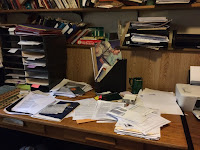

Oh, wait. No. Offices are for working. So how do decades old history text books support that? Or photos of the kids, nieces, and nephews? Or the Lord Peter Wimsey books we read in college? Or our husbands' grandfathers' collections of classics that they got for subscribing to newspapers in the 1930s? Yes, I have mentioned that before. It bears repeating. It does.

Do We Need A Nice Office?


You hear stories (or I used to) of writers working on ironing boards and working on their lunch hours. Books have been written under all kinds of less than ideal circumstances. No, no one needs a nice office. Or an office at all. When I'm feeling particularly tough and gnarly, I think that in spite of what Virginia Woolf said, writers don't need a room of their own. (Note...Woolf wasn't talking about rooms.) With enough will power and impulse control, we should be able to work in any place and under any conditions. Right?

But then there are those four-year-old studies I keep dwelling on, the ones that showed that disorder in our environment lowers the impulse control I was just talking about. No impulse control and there goes your ability to stay on task, to finish a project, a chapter, a short story, an essay, a letter to an editor. There goes your ability to manage time.

In which case, the shelves and shelves of old books, the old computer parts, and the heaps of stuff from Grandma's house piled up around us are significant in a bad way.

Can Minimalist Offices Help Writers With Time Management?


It's worth a shot, isn't it? And creating a minimalist office doesn't mean going out and buying some special minimalist furniture or minimalist organizational boxes and files. Go back to  Fortin and Quilici's instructions.
  1. Decide that writing is the number-one activity you want to do in your office.
  2. Make sure everything in your office supports writing. 
In my case, this has meant getting Gramps' multi-volume set of classics that no one has opened in three generations out of my office, as well as the outdated history books. I'm working on moving out maybe thirty mystery novels, too.

Impulse control may be coming.


Sunday, November 18, 2018

Wish This Library Was In My Town

I'm sure I have many, many followers who are fans of Civil Engineering: The Magazine of the Society of American Civil Engineers. This month's issue has a cover story on a pretty amazing library in Binhai, China. Actually, it sounds as if its atrium is what's pretty amazing.

Now, I didn't read the whole article, because I saw the word "truss" several times, as well as phrases like "dynamic elasto-plastic time-history analysis." But what's going on, basically, is that this central atrium has shelves that are
also steps and walkways and seating.The upper walls with their shelves bend inward, as you can see in the picture to your left. It's pretty spectacular looking.

Now, I'm no engineer. But I looked at those upper walls and couldn't see any way to get to the shelves on them. I thought, well, the shelves must be accessed from behind. Good idea, Gail. According to the CE article, that was the original plan. But they only had three years to build this thing, so the rooms on the other side of the atrium walls were ditched. The upper shelves hold fake books. There are more traditional library rooms in the building with more books.

The builders and planners were interested in creating a site for gathering, as well as for archiving books, and they've certainly done that. It's hard for a book person not to be excited about the way the Binhai Library turned out.