Thursday, December 11, 2014

The Environmental Book Club

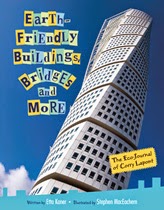
Not every page of Earth-friendly Buildings, Bridges and More by Etta Kaner with illustrations by Stephen MacEachern contains Earth-friendly content. Nonetheless, this is quite a marvelous book about the work that goes into building a variety of structures and how many of them are being built greener.

Though this is a nonfiction work, the basic premise is that an imaginary girl has been traveling with her engineer parents, and we are reading her scrapbook. She is one enthusiastic kid. Among the things I liked about Earth-friendly B, B and M:
  • While there is certainly content related to large buildings being made more green, there's also material about designing buildings to withstand earthquakes and storms. It's as if technology is working with Earth, not against it.
  • It gives readers a good idea of the number of people, the variety of engineers, for instance, necessary just for the planning of a big construction project. This is important because it helps to explain why building takes so long and is so expensive.
  • Technology has had a bad rap for many years now. The 1950's were filled with movies about science gone amock. I've read that The China Syndrome was a turning point in how science was perceived by the public in the '70s, that technology would lead to very bad things. First some guy is messing around with creating life, and the next thing you know, dinosaurs are coming back and eating people. But in Earth-friendly Buildings, Bridges and More, technology is portrayed as a good thing. Mom, Dad, an uncle, and a cousin are all engineers, all involved in creating or fixing things. Even if you're not a fan of tech, this is different.
The stereotype about environmental living involves natural fibers, whole grains, and funny light bulbs. But it takes technology to make real environmental progress, to find ways to heat and cool enormous buildings, for instance. Earth-friendly Buildings, Bridges and More can help young people recognize that.


"Devil's Intern" Kindle Edition Available Free Today

The Devil's Intern by Donna Hosie is available free TODAY for Kindle. It's a Cybils nominee in the Young Adult Speculative Fiction category.

Tuesday, December 09, 2014

Time Management Tuesday: Are Writers Ahead Of The Curve In Integrating Work And Life?

If you visited CNN's website today, you may have read an article today called Work-life Balance is Dead by Ron Friedman, a social psychologist who has a brand new book out, The Best Place to Work. He says that the idea of work remaining something that's done outside the home is a fairy tale. Well, it certainly is for writers. "Until we come to terms with the fact that separating work from home is a fantasy, we can't begin to have an intelligent conversation about what it means to create thriving organizations," he writes.

He's talking about traditional work sites where people go to work, to do something that they don't do at home. For writers, our work sites usually are in our home. Which is why you sometimes hear about writers heading out to coffee houses and libraries for mini-retreats. They're trying to escape the home demands or the home habits so they can work more. Or, as Friedman might say, they're trying to get some control. "...placing employees in control of their schedules encourages them to work during hours when they are most effective." Or perhaps where they are most effective?

Friedman writes that for "many of us, compartmentalizing our work and personal life is simply not possible and not just because of the ubiquity of email. In a growing number of companies, work now involves collaborating with colleagues in different time zones, making the start and end of the workday a moving target."

I would argue that many people can't compartmentalize their work and personal lives because their work is so much a part of their identity that it is their personal life. Of course, I'm going to mention writers here, who are always working, if for no other reason than that they are constantly taking in information that can become a new idea. But if you've known engineers and people in many medical and technical fields, anyone whose job involves solving problems, for that matter, they are often integrating what they're seeing around them with whatever is going on in their work lives.

"Instead of endorsing the work-life balance myth, organizations are far better off empowering employees to integrate work and life, in ways that position them to succeed at both," Friedman concludes. Integrating work and life is pretty much what writers are already trying to do.

Monday, December 08, 2014

Wouldn't This Make A Neat Little Sitcom?

When I picked up The Misadventures of the Family Fletcher by Dana Alison Levy from the library, I told the librarian that I'd heard the book was like The Penderwicks but with boys and two gay dads. She said, "Ah, bringing the story into the present." I think that is the case. I liked The Penderwicks very much and found it contemporary, probably compared to/contrasted with Little Women, which it is a spin on. But I also thought "This book, simply by being a throw-back to Little Women and, perhaps, other pre-nineteen-fifties stories, is different." It had a retro thing going for it, it was "a story about sisters who worry about the family's honor and don't even mention a TV."

The Fletcher boys may be viewed as a little innocent and other-worldly not because they're retro in any way but because their stories and lives are very rooted in traditional child issues. This in spite of the fact that they are not genetically related, they are not even all the same ethnic background, and they are all the children of two men who are living and raising a family together. Each boy has his own storyline with his own issue:
  • Boy One is a popular athlete who is considering trying something different 
  • Boy Two is dealing with growing apart from a friend and moving on, as well as trying to interview the crotchety old guy next door for a school project
  • Boy Three is highly intelligent and has begged Dad and Papa to let him go to a school for the gifted
  • Boy Four has the "stereotypical" imaginary friend. Or does he?
You know the one problem none of these kids have? Those gay dads. The men are just there, doing any kind of dad stuff. There's nothing didactic or instructive here about accepting families with nontraditional parents. These guys have had children in the school system for a number of years now. People know they're there. Halloween parties are held. Ice rinks are made. Holidays are celebrated. Life goes on.

This is not to say that no one ever raises an eyebrow over the gay family. When they are attending an open house at a new school, oldest brother Sam feels compelled to address questions. "We were all adopted as babies. Our dads have been together for ages. They got married two years ago"..."Do you have any other questions? Want to know our birthdays? Height and weight?"

That was a neat way to handle back story, by the way. The newspaper article written by an eighth grade student about the Fletchers and their annual Halloween party is also a clever way to get the back story on how the Fletcher kids became brothers.

As I was reading this book, I thought this premise would make a charming sitcom. The various chapters here could be the first season's episodes. Then the story could expand with episodes about the gay dads dealing with their boys going to camp, getting babysitting jobs, heading to high school, getting jobs, dating girls. 

The Misadventures of the Family Fletcher is a Cybils nominee in the Middle Grade Fiction Category.

Sunday, December 07, 2014

Sunday Sentence

A contribution for the  “Sunday Sentence” project, a sentence I've read this week, no explanation or commentary.

"Alien abduction is part of the American poetry of loneliness." M. T. Anderson, He Laughed With His Other Mouths, A Pals in Peril Tale

Saturday, December 06, 2014

The Weekend Writer: An Opportunity For Children's Writers In And Near Connecticut

Write Yourself Free, a creative writing workshop in Westport, Connecticut that offers writing instruction, will be offering an eight-week Writing for Children program (scroll down) in January and February. There are three options for times. Author Victoria Sherrow is the instructor.


Friday, December 05, 2014

My Word Count Is Higher Than Your Word Count

Toward the end of last month, I began to see "I Won" badges being shared by Facebook friends who had hit their NaNoWriMo goal of writing 50,000 words during November. It was neat to get a little buzz off their excitement. But then I began to see links to blog posts that included variations of "I Lost" in the title. Not so buzzy. It's been many years since I've taken part in NaNoWriMo, but I don't recall this Win/Lose thing. I may not have a good grasp of the word "lose," but I can't imagine a universe in which having started a book length project and worked on it at all makes anyone a loser.

Having those "I Lost" images in my mind left me particularly interested when I stumbled upon When Did Writing Become A War? by Lev Raphael at the Huffington Post. Raphael says, "The sensible suggestion that beginning writers should try to write something daily to get themselves in the habit has seemingly become interpreted as a diktat for all writers all the time. What we write doesn't matter, it's how much we write every single day... As if we were the American war machine in 1943 determined to churn out more tanks, planes and guns..."  "There's nothing wrong with having a daily goal if that works for you as a writer," he goes on, "but why should you be ashamed or crazed because you don't reach that daily goal -- what's the sense in that? Why have we let the word count become our master?"

Focusing on word count as a way to help stay on task or get more done in a specific amount of time are logical work strategies. But the shame thing is counterproductive. Feeling bad about ourselves undermines willpower, and willpower is necessary for that staying on task business.


Wednesday, December 03, 2014

And Now For Something Totally Different

I just finished three fantasy books in a row, mainly because I needed to get them back to the library in a certain order. You'd think fantasy would be different, wouldn't you? As in, it's not real world stuff, so it should be different. But when you read so much of it, there's a certain sameness. And then real world YA is often very similar in its own real world way.

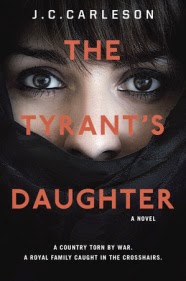
Which is why The Tyrant's Daughter by J. C. Carleson is so exciting. It's real world, but very different YA real world.

Laila is a princess, daughter of the murdered king of an unnamed, presumably Middle Eastern country. Except after she has resettled with her mother and brother in a seriously modest two-bedroom apartment outside Washington, DC she realizes that no, she's not a princess at all. Mainly because her father was never a king. He was a third-generation strongman tyrant and when he wasn't being Dad at the palace, he was behaving in a typical tyrannical way.

Laila has a terrific voice, slightly reserved and stiff as she describes, for instance, her appreciation of her new American friend's kindness even though she can't help noticing that she dresses like a prostitute. She's a kind person, herself, recognizing that a classmate is suffering because her parents are divorcing and becoming attracted to that nice guy who works for the school paper. But  those traditional YA experiences pale compared to those of a fifteen-year-old whose father was gunned down in his home on her uncle's command, who saw her mother covered in her father's blood, whose life was saved by a CIA operative. The Tyrant's Daughter isn't about the world of teens. It's about a teen in the world.

What's missing from this novel is cliched nasty teenagers. There are no mean girls. There are no bullies. There are no jocks trying to force themselves on girls. Adults might find the CIA operative familiar, as well as the brilliant, manipulative widowed tyrant wife. But I don't think they appear often in YA.

So that's just the basic set-up to this thing. As the truth about Laila's family is slowly revealed to her, the fact that this book is a political thriller is slowly revealed to readers. Why is that CIA op hanging around? What's he paying Laila's mother (but not very much) to do? With whom? Why is her mother talking to Laila's uncle, the tyrant who had her tyrant father killed?

And what will Laila's involvement in all this be? She is a tyrant's daughter, after all.

This is a marvelous book, extremely well written. But it's undercut a bit by the essay on women in the Middle East that follows. Even though the essayist ties it to The Tyrant's Daughter by questioning what will become of Laila after the end of the action of the novel, I think most readers are going to wonder why it's there and feel that this great reading experience is being turned into some kind of lesson.

The Tyrant's Daughter is a Cybils nominee in the YA Fiction category.


Tuesday, December 02, 2014

Time Management Tuesday: What Kinds Of Work Are Best For Sprints?

I've written here a number of times about sprinting. Perhaps you've read about my plans for sprinting. Or my speculation as to whether or not sprinting would get me through Thanksgiving, 2013. You may remember that creating a morning sprint habit wrecked my morning office management habit, something that I never recovered from, by the way. And, quite honestly, the whole sprinting thing had pretty much disappeared from my radar recently, possibly because of that lengthy vacation I took in September. But, then, there was last month's excitement over ten-minute sprints on the hour!

Well, I used that ten-minute on the hour thing during the lead-up to Thanksgiving with some good results. Last month I was on a submission binge. During those pre-Thanksgiving days I had my laptop on the kitchen counter and while I was by myself prepping for the Big Day I would stop every hour (at least several times a day, anyway) and do a ten-minute market search. I found two journals appropriate for submissions and submitted manuscripts to them.

This was a revelation, of which I have so many.

In the past, I thought the best part of sprinting on days when writers can't maintain a normal schedule is to allow them to work just enough so they can stay in their projects. Then it won't take them as long to get up to speed again when they can get back to work. That probably is the best part of sprinting. But in the chaos of family and day jobs, getting into a real work project for even just twenty minutes (the traditional sprint time) can be way too much, in my experience, at least.

But what about using some ten-minute sprints for some of the many other tasks writers need time for?
  • Market research
  • Submissions
  • Getting started on blog posts
  • Twitter work--those welcomes to new followers and thank yous for retweets and favorites, following new people yourself. There's masses of Twitter work
All these chores suck up time we could be using for work. If we can find a way to knock some of them off during periods when we can't do traditional writing, that should free up our traditional writing time for writing.

Well, shouldn't it?

We will see.


Sunday, November 30, 2014

December Connecticut Children's Literature Calendar


Connecticut author Martha Seif Simpson is in several venues this month with her seasonal book, The Dreidel That Wouldn't Spin. Speaking of seasonal, Christmas appears to have chopped off appearances for the second part of December.

Wed., Dec. 3, Michaela MacColl, Barnes & Noble, Westport 3:30 PM

Wed., Dec. 3, Christine Pakkala, Barnes & Noble, Westport 6:30 PM

Thurs, Dec. 4, Martha Seif SimpsonTemple Beth Sholom, Hamden 7 to 8 PM Signing with proceeds to benefit TBS Sisterhood

Fri., Dec. 5, Martha Seif SimpsonWilton Library, Wilton 4:30-5:15 pm Storytime for ages 4 and up, followed by a book signing. Town's annual Holiday Stroll follows

Sat., Dec. 6, Martha Seif Simpson, Stratford Library, Stratford 10:30 AM Storytime and signing

Sun., Dec. 7, Andrea West, Bank Square Books, Mystic 2 to 4 PM

Sun., Dec., 7, Martha Seif Simpson, Greater New Haven Jewish Community Center Arts & Crafts Fair, Woodbridge 10 AM to 4 PM Book program at 11:30, book sale during rest of event
 
Sun., Dec. 7, Peter Sis, Pequot Library, Southport, 4 to 6 PM

Sun., Dec. 7, Patricia Dunn, New Canaan Library, New Canaan 2 PM

Wed., Dec. 10, Robie Harris, R. J. Julia Booksellers, Madison 4 PM

Wed., Dec. 10, Jarrett J. Krosoczka, Barnes & Noble, Canton 5 PM
Mon., Dec. 15, Martha Seif Simpson, Barnes & Noble, Milford 6:30 PM Proceeds to benefit Jonathan Law High School.