While working on next month's Connecticut Children's Literature Calendar, I noticed that the website for Jack and Allie's, A Children's Bookstore in Vernon is gone. What do you suppose that means, Gail? I thought.
I did a little hunting, and, as I suspected, the store has closed. The lease was up at the end of May, and the owner is looking for another site.
In addition to selling books, Jack and Allie's hosted events such as birthday parties, baby showers, fundraisers, and reading camps.
This is the second Connecticut bookstore to close this summer.
Showing posts with label Bookstores. Show all posts
Showing posts with label Bookstores. Show all posts
Sunday, August 18, 2019
Saturday, July 20, 2019
Connecticut Bookstore Closing
According to its website, Book Club, Bookstore & More in South Windsor will be closing July, 30, 2019. (In roughly a week and a half.)
Saturday, January 19, 2019
An Author Does Story Hour At A New Bookstore
 Human children and animal babies all go to sleep. That's the entry point that makes Snuggle Down Deep by Diane Ohanesian with illustrations by Emily Bornoff work. Each section involves both some light factual material with the "snuggle down deep" repetition. The book combines nature, poetry, and...sleeping. It's a lovely book with an ecological thread.
The Event
 |
| Cookies A Work Of Art |
 |
| Making The Story Interactive |
 |
| Treasure! |
Watching Diane illustrated why new writers should take advantage of opportunities to see writers experienced with speaking and dealing with the public.
The Venue
 |
Diane read at the new River Bend Bookshop in Glastonbury, Connecticut. It's a nook and cranny independent bookstore, the kind where browsers can get a sense of the intellect curating the offerings. I "have a bookstore" in Stowe, Vermont I go into once a year and walk around until something jumps off the shelf and tells me to take it home. River Bend
 |
| Children's Nook |
Of course, today I bought Snuggle Down Deep.
River Bend is hosting writers and other literary events.
Wednesday, August 01, 2018
Grand Opening For New Bookstore In Central Connecticut

Thursday, June 02, 2016
A Last Visit To The UConn Co-op's Storrs Location
Last week the Connecticut children's literature community learned that there will be no Connecticut Children's Book Fair this fall. This came about because UConn's bookstore will no longer be run by a co-op but by Barnes and Noble. All the UConn bookstores at all its campuses will soon be B&N stores. After June 7, I've heard.
Yesterday I was in beautiful downtown Storrs and paid a visit to the UConn Co-op Bookstore at Storrs Center, a satellite of the college bookstore that opened just a few years ago. Sixty-percent off select books! It, too, will be a Barnes and Noble store, soon, though a small one.
I've heard Co-op staff have an opportunity to move to the new chain. Things could work out for them, at least.
The offerings in an independent bookstore are often different from those you find in chains. You sometimes see things you've never even heard of. Edgy things. Lovely things.
When I'm in an independent bookstore, I like to walk around until a book tells me it's supposed to go home with me. Today I was waiting for a book with a sixty-percent discount to tell me that. Finally, one did, Terry Pratchett's A Slip of the Keyboard, a collection of his nonfiction, which I had never heard of. I had heard of Fay Weldon's memoir, Auto da Fay. It was on a discount shelf, and now it is on mine.
These may be the last books I buy in that particular store building. I have no objections to Barnes & Nobles. In fact, I appreciate that, in this state, at least, the chain seems to be becoming more active with promoting childlit writers by providing them with appearance opportunities. However, as a general rule I have to say that B&N books don't call to me the way indie store books do.
 |
| Why, yes, I do have a new shirt. |
I've heard Co-op staff have an opportunity to move to the new chain. Things could work out for them, at least.
The offerings in an independent bookstore are often different from those you find in chains. You sometimes see things you've never even heard of. Edgy things. Lovely things.
 |
| "I am the one. Take me home." |
These may be the last books I buy in that particular store building. I have no objections to Barnes & Nobles. In fact, I appreciate that, in this state, at least, the chain seems to be becoming more active with promoting childlit writers by providing them with appearance opportunities. However, as a general rule I have to say that B&N books don't call to me the way indie store books do.
Wednesday, September 02, 2015
An Internet Idea That Hopped Out Into The Non-Internet World

You see where I'm going with this.
This summer I heard about something that originated on the Internet being copied out here in what the Trek folk used to call the carbon-based world. Here in Connecticut this month we're going to have a Quilt Shop Hop.
Blog hops involve bloggers linking together, usually connecting posts on a similar subject. But I don't recall hearing about anything on that model outside the Internet until I stumbled upon a flyer promoting the Connecticut Quilt Shop Hop at my local sewing store.
This particular hop involves a $7 registration fee, which I believes gets you a mug as well as a "passport." You can take that passport into participating stores for special items. It looks as if there will be a pattern given away. Some stores will be featuring special material or kits. They have a Connecticut Quilt Shop Hop Facebook page. The salesclerk at my local store said a good time is had by all.
 Now, yes, I'm interested in this because I made a quilt top this year. And if I was going to be around this month, I'd probably take part in this hop because I need more material for the backing, and two of the participating stores are convenient for me to get to. But why am I writing about it at a writer's blog?
Because in addition to being intrigued by the movement from Internet to brick and mortar store, I see this quilt shop hop as an example of using community for marketing. I've been interested in that for a few years now. I don't know how well this community marketing effort works for these sewing stores, though they've done it five times now, so I'm guessing they must think it's worth it. Presumably they are sharing the expense of promotion. Presumably every store has promotional materials available for this event, meaning they are promoting other stores, even by just mentioning their names.
What if a group of bookstores did something similar? What if every participating bookstore offered a free book to registered hoppers instead of a free pattern? What if every bookstore offered a special event to hoppers? What if every bookstore featured a different local author with a signing, meaning the authors would get involved with promotion? What if they started promoting the hop months ahead of time, the way the Quilt Shop Hop people did?
How much would promoting the group benefit the individual?
Wednesday, September 10, 2014
Now That Is Handselling
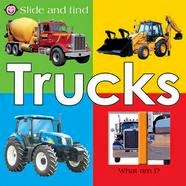
I saw a bookseller come out from behind the counter, and the next thing I know she's bringing us a copy of Trucks, a "slide and find" book from Priddy Books. It's a board book, which works very well for our guy, and there's no lengthy text for him to sit through. It's mainly "What is this?" type stuff with some color matching thrown in. It also has a little something for little fingers to do. Instead of the small lifting sections you usually see in kids' books, which often end up torn by those little fingers I was just talking about, this book has sliders. We'll see how those hold up.
I was incredibly impressed with the way that bookseller hit the nail on the head for us. I've never experienced real bookseller handselling like that. I also know a lot of people have never heard the term "handselling."
Well, if you haven't, that's what it is--matching customers/readers with books. I thought it was exciting.
Sunday, January 19, 2014
Why Can't I Shop In Both Places?
A Facebook friend linked to an old Slate article called Don't Support Your Local Bookseller. It has the kind of title guaranteed to attract irate readers.
The good point the author makes is one that I find few people want to discuss--the cost of books. There are people who truly can't afford to buy much in the way of full-price, hard cover books or even your classier paperbacks. Your really serious readers need to get their hands on a lot of books. How many of those people can support a local bookseller for all their reading needs? Making books available at more affordable prices and whenever readers want to buy them, as Amazon and Barnes & Noble do, makes books more available. It encourages the sale of books, and it encourages reading.
 Having said that, I did have a great independent bookstore experience while on retreat last week. Our cross-country ski spot was suffering from weather shock--too warm and too rainy. Trails were closed almost all week, and we never took our skis out of the car. I was worried about running out of reading material, which was ridiculous because I always overpack books and magazines. So we wandered down the mountain to Bear Pond Books, where I browsed and, yes, stumbled upon what was a perfect book match for me, Jo Walton's Farthing. I'd never heard of Walton, and I believe I'd never read an alternative history story. But what this book does is mash together the mid-twentieth century British Scotland Yard detective story, along with the British country estate story, and the British World War II story, all of which I've been known to enjoy over the years, and puts them into that alternative history world. This was kind of a custom made book for me, and it is unlikely I would have found it on Amazon.
Farthing is the first in a three-book series, and I'm interested in picking up the others. Is that great for that author? Yes. Is it great for her publisher? I hope so. And, yes, it's because of the classic independent bookstore experience.
But you know what? I may end up getting them through Amazon. And not just because I can get them cheaper there and may decide to purchase them for my Kindle. An equally important reason is that I have to go quite a way to find an independent bookstore. That one I visited during retreat week? It's five hours from here. Limiting myself to independent bookstores means limiting book purchases, both because of price and because those stores are few and far between in these parts.
Good independent bookstores provide a wonderful shopping experience for readers. But let's face reality. Amazon provides a good, though different, shopping experience, too.
The good point the author makes is one that I find few people want to discuss--the cost of books. There are people who truly can't afford to buy much in the way of full-price, hard cover books or even your classier paperbacks. Your really serious readers need to get their hands on a lot of books. How many of those people can support a local bookseller for all their reading needs? Making books available at more affordable prices and whenever readers want to buy them, as Amazon and Barnes & Noble do, makes books more available. It encourages the sale of books, and it encourages reading.
Having said that, I did have a great independent bookstore experience while on retreat last week. Our cross-country ski spot was suffering from weather shock--too warm and too rainy. Trails were closed almost all week, and we never took our skis out of the car. I was worried about running out of reading material, which was ridiculous because I always overpack books and magazines. So we wandered down the mountain to Bear Pond Books, where I browsed and, yes, stumbled upon what was a perfect book match for me, Jo Walton's Farthing. I'd never heard of Walton, and I believe I'd never read an alternative history story. But what this book does is mash together the mid-twentieth century British Scotland Yard detective story, along with the British country estate story, and the British World War II story, all of which I've been known to enjoy over the years, and puts them into that alternative history world. This was kind of a custom made book for me, and it is unlikely I would have found it on Amazon.Farthing is the first in a three-book series, and I'm interested in picking up the others. Is that great for that author? Yes. Is it great for her publisher? I hope so. And, yes, it's because of the classic independent bookstore experience.
But you know what? I may end up getting them through Amazon. And not just because I can get them cheaper there and may decide to purchase them for my Kindle. An equally important reason is that I have to go quite a way to find an independent bookstore. That one I visited during retreat week? It's five hours from here. Limiting myself to independent bookstores means limiting book purchases, both because of price and because those stores are few and far between in these parts.
Good independent bookstores provide a wonderful shopping experience for readers. But let's face reality. Amazon provides a good, though different, shopping experience, too.
Friday, December 27, 2013
New UConn Bookstore
I was in Storrs, Connecticut earlier this month and noticed the UConn Co-op Bookstore at Storrs Center. I didn't get in there, but should be able to do so in the next few months. Though the main UConn Co-op has a parking garage these days, this new bookstore should be even more convenient to shoppers.
Yeah, I'm a pragmatist. Things like parking matter to me.
Yeah, I'm a pragmatist. Things like parking matter to me.
Wednesday, July 24, 2013
Book Browsing
Here's How Amazon Self-Destructs at Salon inspired a little discussion on my personal Facebook wall recently.
Hughes contends that book buyers engage in "showrooming"--using bookstores as showrooms where they browse, then go home and buy their books through Amazon where they can get discounts. As more and more traditional bookstores fold, and there's plenty of talk about Barnes & Noble being part of that more and more, readers will have no place to browse. Without a place to browse, how can they buy at Amazon? Thus, Amazon's success at destroying the competition could actually hurt it in the long run, at least as far as book sales are concerned.
Amazon may have nothing to fear from the loss of browsers in traditional bookstores because if my small group discussion is any indication, that's already gone.
Will Amazon's Book Business Fall Apart When Bookstores Are Gone?
Author Evan Hughes says, "According to survey research by the Codex Group, roughly 60 percent of book sales — print and digital — now occur online. But buyers first discover their books online only about 17 percent of the time. Internet booksellers specifically, including Amazon, account for just 6 percent of discoveries. Where do readers learn about the titles they end up adding to the cart on Amazon? In many cases, at bookstores."
Hughes contends that book buyers engage in "showrooming"--using bookstores as showrooms where they browse, then go home and buy their books through Amazon where they can get discounts. As more and more traditional bookstores fold, and there's plenty of talk about Barnes & Noble being part of that more and more, readers will have no place to browse. Without a place to browse, how can they buy at Amazon? Thus, Amazon's success at destroying the competition could actually hurt it in the long run, at least as far as book sales are concerned.
But How Many People Browse In Bookstores These Days?
I was particularly interested in this article because my NESCBWI Conference roommate (Erin Dionne--she has a new book out. Just saying.) discussed browsing in bookstores during our late night roomie talk. We both agreed. We do not browse in bookstores anymore. We go in for something specific, and then we leave. Bookstores are no longer destinations for us. We aren't stumbling upon new books there. Why not?
- Time is an issue, of course. How many adults really recreationally shop anymore?
- The uniformity of the big box bookstores has become an issue for me. I thought I'd died and gone to heaven when the first Borders opened up in my area, because we didn't have any bookstores around here. But over the years it became clear that every Borders was like every other Borders and every Borders was like every Barnes & Noble, too. If I'd been into any of those stores in the last month, maybe even longer, I really didn't need to go into another, as far as browsing and discovering new things were concerned. It wasn't going to happen.
- Another issue for me with Barnes & Noble is that it prominently displays this season's big books and last season's big sellers. The books I'm going to run into easily there are the books I've heard about on-line, in magazines, and on NPR. Again, nothing new to discover.
So Where Are People Browsing For Books?
Two interesting areas for book browsing came out of our Facebook discussion:
- Libraries--One person pointed out that the cost of new books is high enough that she can't impulse buy, so she doesn't browse in stores. She, and other people, talked about using libraries.
- Used bookstores/sales--People also talked about browsing in used bookstores.
Amazon may have nothing to fear from the loss of browsers in traditional bookstores because if my small group discussion is any indication, that's already gone.
Thursday, July 21, 2011
So Long, Borders
Slate says it wasn't the Internet that killed Borders. But it is deader than a doornail, no matter what did it in.
Borders was the first bigbox chain bookstore to open near me. I loved it. I was totally blown away by all the books. And the big, cushy chairs. Back in those days, Borders would bring in entertainment, musical groups on a Friday night, say. Independent bookstores had already become scarce around here, so Borders was filling a need.
What cooled me on Borders was the sameness. The policy of using national buyers and carrying the same thing in every store meant that whether I was in a Borders in Connecticut or Delaware or New York or, later, Vermont, I always saw the same books, presented in the same way. And since Barnes & Noble does the same, and it was opening stores in the same areas Borders was, I'm just talking the same, same, same in every store wherever I was.
When you go into a privately owned, independent bookstore, you can almost feel you know something about the people who run the place, because they have chosen the books on display. They didn't just open a case that was sent to them and put the merchandise on the shelf. What might save Barnes & Noble (assuming it needs saving) is to follow a similar policy. Give up using national or regional buyers so that only a few books get a lot of display space and allow the local store managers to do their own purchasing. Shoppers will always be able to get the bestsellers for less at Amazon, so give them something different in the stores, something that surprises them and that they want right then.
Wednesday, June 22, 2011
Will You Pay Just To Be In The Same Room With An Author?
Too bad Come Meet the Author, but Open Your Wallet appeared in The New York Times the Tuesday before Save Bookstores! Day. It deals with the issue of bookstores charging patrons to see authors making appearances, something that's a bit of a turn-off for some. It's a method of generating income for struggling bookstores, but authors and publishers aren't one hundred percent enthusiastic about it.
From an author's point-of-view, an appearance isn't just about selling one particular book at one particular moment, which is, of course, what the bookstore needs to do. For authors, an appearance is also about creating name recognition with the public and promoting an entire career. The hope is that people who don't buy a book at that particular appearance, may ask for it as a gift, purchase it in a paperback edition later on, or buy a future book because they remember your name, which got them to lift the new title off a shelf and read what it was about. None of that can happen if people don't come into the store to meet us because they couldn't or wouldn't pay an admission charge.
R.J. Julia Booksellers, which is mentioned in the article, is here in Connecticut and has been doing this for some time, which I was certainly aware of because they promote their events in the press. They get big name authors, and the store's system of charging a fee, which can be used toward purchasing the book, appears to be working for them.
Bank Square Books, also in Connecticut, has a model I like, though I've yet to take advantage of it. They charge even more for some of their events ($25 vs. $10, which is the figure I usually see), but that includes lunch with the author and a copy of the book. I don't know what lunch involves, but that price still seems as if the store can't be making a lot. I wish I'd been able to go when they had Susan Cheever in.
If you live anywhere near Mystic, Connecticut, it would be worth your time to get onto Bank Square Books e-mail list. Or the store also has a Facebook page.
Friday, January 08, 2010
Sunday, August 09, 2009
We've Always Known About Those Bookstore Returns
Authors are very aware that booksellers return books that don't sell. Painfully aware, might be a better way of putting it. I'm sure I'm not the only author who was interested in To Return, or Not to Return at ShelfTalker. Be sure to read the comments, too.
Monday, June 29, 2009
So Long As I Get Paid...
If this is the future for bookstores, I can live with it so long as there's a way to determine royalties for authors. As a reader, I like the idea of being able to walk into a bookstore and truly be able to buy what I'm looking for.
Though I would miss being able to look through the book to make sure it's what I'm looking for. Once you've received a custom-printed book, I don't imagine the store will be eager to accept a return.
I was aware that Northshire Books was doing this, but hadn't heard much about how it was working out. Maybe next January on my trek north for retreat week, I can stop in Manchester to check the Espresso Book Machine out.
Monday, April 27, 2009
A Good Sunday
Yesterday I walked over to the UConn Co-op from a family member's home, a little under a two-mile walk round trip. I went over the weekend before, too, but hadn't brought any money with me. Thus the return trip.
The UConn Co-op is an independent bookstore, unlike some college bookstores that are run by chains. So you don't get the same old, same old when you're walking through its offerings.
Take graphic novels, for instance. When I look at the graphic novels at chain bookstores, I see a lot of superhero stuff and manga. The Co-op had a lot of the more unique, individual novels told graphically that I tend to be more interested in, as well as nonfiction, such as French Milk, that looked appealing.
I overheard something interesting while I was there. For some reason, a lot of parents and family groups were wandering around yesterday. (Perhaps the elders were there to make sure their kids hadn't been arrested at a spring break party.) One young man directed his family's attention to the book area by saying, "There's the Barnes & Noble stuff." Then he pointed out where the computer items were kept and maybe the tee-shirts, etc.
Think about it: When the big box bookchains first opened, they were modeling themselves on bookstores. Now people have to compare a bookstore to a Barnes & Noble in order to understand what goes on in one?
What are they teaching these young people at college these days?
Anyway, I blew my entire Christmas Co-op gift card on Leonard Marcus's Minders of Make Believe. I have a copy from the library, but I've already renewed it once, and I've only read a few pages. But those few pages made me want to underline like crazy! Lots of facts! About Puritans! I love the Puritans! Plus Marcus uses footnotes. Do you know how often I read nonfiction that has no footnotes? Do you have any idea how much that annoys me? So I decided I wanted my own copy.
So I'm walking back with my purchase, and I'm thinking that I can't start reading it until I finish reading Budo Secrets by John Stevens because I read only one nonfiction book at a time, and a guy from the dojang loaned me this thing maybe half a year ago. I would never mention Budo Secrets here because it's not related to my blog subjects, but as I was walking back to my in-laws' house, I suddenly realized that I could use a Budo Secrets-type book in the 365 Story Project! That means it is related.
I also realized that the 365 Story Project has no grandparents, and what's that about? The kids in the episodes are only ten and fourteen years old. What are the chances that all four of their grandparents would be dead? I decided I had to do something about that.
So it was quite a productive hour--a nearly two-mile walk, a happy wander in the Co-op, a book purchase, and some 365 Story Project work.
Training Report: I was away from the house a lot last week, which is why posting here was spottier than usual. I managed to get seven episodes written for the 365 Story Project, though, and a short story manuscript submitted to a journal. I was able to do that much because on Monday I happened to work out what the next seven or more episodes would be about. This means that either A. my father was right and a job well planned is a job half done; or B. I have now reached that stage at which if I'm given any topic I'll blurt out something about it no matter what.
I've got to step it up a notch or five or six because I'm still more than a month behind with these 365 Story stories. Trying to catch up is keeping me from working on other projects. I knocked off three segments today, though.
Thursday, October 09, 2008
Now Everyone Is Going To Want To Shop In Ireland
In case you think of bookselling as a job in a big box and not an exciting international profession that will make you loved in foreign corners of the world, check out The Adventures of an International Bookseller at Shelftalker.
Friday, March 21, 2008
Oh, Dear
I wasn't happy when I heard a brief mention of Borders' money problems on the radio yesterday, and even less so when I read about them in more depth today. True, I know Borders rarely carries my books or the books of many other writers. But struggling bookstores of any kind aren't good for writers. And probably not for readers, either.
Yes, I know it's ironic that one of the big box bookstores is ailing financially after they helped push many indies out of business.
Yes, I know it's ironic that one of the big box bookstores is ailing financially after they helped push many indies out of business.
Friday, February 08, 2008
Handselling Books And A Question About Big Advances
Alison Morris has an interesting handselling report at her PW blog, Shelftalker: A Children's Bookseller's Blog. Note that many of the titles her booksellers report handselling are not necessarily Big Name books. And, yet, the books are selling nonetheless.
Also pay attention to the quote from a speech by Karl Pohrt. He talks about selling the top selling 500 titles. While independent bookstores sell only 9 to 10 percent of the top 150 books, they exceed their market share for titles in the 150 to 500 range. He also says, "It should also be noted that the 150 to 500 range of titles is where publishers are making money, because they haven’t made huge investments that they have to recuperate in contracts with best-selling authors and large ad campaigns."
I've heard something similar before, but only recently. I find it extremely interesting, because years ago many in the publishing industry justified huge advances to bestselling authors by claiming those authors made big money for publishers, making it possible for them to use their profits to take risks on new writers/literary writers/you name it. That's not the case anymore?
Wednesday, April 25, 2007
Perhaps We're Defining The Word "Art" Too Loosely Here
Margaret Atwood and, to a lesser extent, Kazuo Ishiguro regret the loss of the book browsing experience in How internet booksellers are killing art of browsing from the TimesOnLine. Finding unexpected treats, flap reading, rubbing your fingers over those lovely new paperback covers (I added the last item) are all lost when shopping for books on the Internet.
Take a look at the comments to this article. Kind of eye-opening.
artsJournal provided the link.
Take a look at the comments to this article. Kind of eye-opening.
artsJournal provided the link.
Subscribe to:
Posts (Atom)