Showing posts with label Literary Tourism. Show all posts

Friday, October 05, 2018

Sandburg...Hemingway...Sandburg...Hemingway

Where I Went
You are all anxiously waiting, I'm sure, to see how things went with my trip to Ernest Hemingway's birthplace, which I told you about a month ago before I left for the great mid-west. Well, here's the thing. I ended up passing on Ernie H.

Hemingway Or Trolls?

Arboretum

What happened was that the only day the Hemingway Birthplace was open while we were in the areawe were also going biking in an arboretum. Which we had never done before. And that place has 1,700 acres, people. Still, our original plan was to finish up our 7.5 mile bike ride and 4.3 mile walk and head out to wherever Hemingway's birthplace is.

Troll

But, you see, there were trolls at the arboretum. And after we finished the biking and walking, we had the chance to take part in a troll hunt. A freaking troll hunt!

Remember, I'm not that crazy about Hemingway. Also, it just seemed to me that troll hunting outside was much more a Hemingway-like thing to do than going to a house. Hemingway was an outdoor guy, right? He ran with the bulls, I hunted trolls.

But all was not lost as far as visiting an author home on this mid-west vacation was concerned.

Carl Sandburg Will Do

Mississippi in Davensport, Iowa

So we were driving from Davensport, Iowa to Springfield, Illinois (Oh, Lincoln. Wow.) and we get off the highway in Galesburg, Illinois for lunch. We pass a visitors' center, except we don't pass it, because my traveling companion can't pass a visitors' center. Now I don't even go inside, because I can control myself. But while he's in there, he finds a brochure for Carl Sandburg's birthplace and it's right there in Galesburg. And what's more, he recognizes that Carl Sandburg is a writer! Seriously, how brilliant is he? So he talks to the woman working there, and she says, "It's open today."

This was meant to be, folks.


Now, I know less about Sandburg than I know about Hemingway. I read two of Hemingway's books. I know about the bull thing and his granddaughter who does yoga. All I knew about Sandburg a couple of weeks ago was something about fog coming in on little cat feet. But he was a writer. I was on vacation. The game was on.

Little House
The thing that is really remarkable about Carl Sandburg's birthplace is how small it is. I know that's superficial, but this place is small. Sandburg only lived here a year, and the museum docent said his only memory of the place was delivering milk to it when he was older. Sandburg's parents were Swedish immigrants, and his father worked for the railroad. The family moved on to three progressively larger houses. But all I could think about this house was that it makes a statement about what life was like at the end of the nineteenth century.

Little Parlor
The house doesn't look that small, you think. Get a load of  this front entry. And front parlor. And sleeping area for Sandburg's older sister. Who, sure, was a small child, herself, but still.

Little Bedroom

The parents had a room, which baby Carl shared.


Little Kitchen


There was a kitchen.

Little Dining Room
And even a mini-dining room.


We're not talking a family of four living in a one-room tenement. I'm just saying I was struck by how small this place was.


What About A Word Or Two On Sandburg's Writing?


Carl Sandburg is known primarily as a poet.

The fog comes
on little cat feet.

It sits looking
over harbor and city
on silent haunches
and then moves on.

But he also wrote some children's books, one of which I bought at the gift shop next to his home. Rootabaga Stories is not my favorite kind of book. An article in Poetry Foundation described the book as nonsense, but in the best sense of the word. "Nonsense is for everyone," the article begins. But not for me. I look forward to a younger family member finding it among my book stash some day and finding pleasure in it.

Get this: I don't think I'd ever heard of Rootabaga Stories a couple of weeks ago. But what do I see when I'm reading the September/October issue of The Horn Book? A review of Presto and Zesto in Limboland by Arthur Yorinks and Maurice Sendak in which reviewer Roger Sutton begins, "Yorinks and Sendak take a wander through something like Sandburg's Rootabaga country via their alter egos Presto and Zesto, who find themselves in Liboland just in time for the wedding of the sugar beets."

It freaks me out when something like that happens. But in the best sense of the word.

You can check out more pictures from my trip to the Sandburg Birthplace at my Pinterest stash. 


Thursday, September 06, 2018

Some Literary Tourism Coming Up With Ernest Hemingway

I'm going to be MIA for a while, for travel not family drama.

While traveling, I like visiting author homes or homes connected with authors somehow. Like James Thurber's in Columbus, Ohio. Green Gables on Prince Edward Island. One of Gene Stratton-Porter's homes, in Rome City, Indiana. This month I'm going to Ernest Hemingway's Birthplace Home Museum in Oak Park, Illinois.

Usually I read something by the author involved with these excursions. But I've got to be honest. I am not a Hemingway fan. Reading Girl of the Limberlost on vacation back in '15...that's an experience I don't want to repeat anytime soon. So no Ernest Hemingway for me.

Monday, October 17, 2016

On The Trail Of "Misty Of Chincoteague"

On vacations I like to visit author homes. This year I couldn't find an actual author home. So, instead, we ended up spending a couple of nights on Chincoteague Island, Virginia. Yes, that's Chincoteague of Misty of Chincoteague fame.

I read that book a long time ago. Loooong time. Pretty much all I remember is a pony...some kids...horses swimming... It was enough for me to drag my family there maybe fifteen years ago when we were driving south and saw a sign for Chincoteague. It was enough to take me back on this trip. However, I wasn't enthusiastic about rereading the book. As one of my relatives said, "You no longer want a pony."

So I have nothing to say about the book. But I had a neat time on the island. And I have pictures.

I'm not using any footnotes here. My info comes from signs on the walls in a National Park building, a municipal park kiosk, and a cool gift shop owner I was yakking with while waiting for the bearings on my bike to be replaced at Mid Town Bike Store, which I only mention because the place is fantastic.
Ponies on Va. end of Assateague

Backstory


Okay, first off, Misty may be of Chincoteague, but she wasn't actually from Chincoteague. She was from another island, Assateague, which is close enough to Chincoteague that, if you are a healthy horse, you can swim from one island to the other. Interesting bit of trivia--two-thirds of Assateague Island is in Maryland. One-third is in Virginia, like Chincoteague. Who knew?

To be clear, there are no wild horses on Chincoteague. They're all on Assateague.  They've been there for around 300 years. Two theories about how they got there: 

  1. They are descended from horses that escaped from sinking ships belonging to early explorers.
  2. They are descended from horses that were kept on Assateaue by settlers trying to avoid taxes. 

I kind of like that second story. It shows initiative.

Chincoteague Fire Department
There are two herds on the island now. One, on the Virginia end of Assateague, has been maintained by the Chincoteague Fire Department for something like forever. The herd on the Maryland side is maintained by the National Parks Service. Maintenance means controlling the size of the herds so they don't destroy the Assateague Island habitat with overgrazing. Which, of course, would not be good for the horses, either.

The Fire Department controls its herd with an annual auction of ponies that has been going for something like forever. A vet selects horses on Assateague that are healthy enough to make the swim to Chincoteague at the end of July. Supposedly ten thousand people descend on the island for the auction. Or maybe tens of thousands. I heard that, too. Horses that don't sell, swim back to Assateague.
Ponies on MD side of Assateague

Why the popularity for these horses? They are now a designated breed. Some of these animals can sell for over $10,000, though the average price is significantly lower.

Rumor has it that the National Park Service maintains its herd with neutering. Don't know what goes on with that.

Carnival grounds
The Fire Department also runs a carnival at the time of the auction. Early in the 20th Century, downtown Chincoteague experienced two serious fires. The fire department started running the carnival at that time, raising money for equipment to deal with crises of that type.


What About Misty The Book?


Miss Molly's Inn
Author Marguerite Henry went to Chincoteague in the 1940s. She was already a published author, often writing about horses. (As a Vermont child, I was familiar with her Justin Morgan Had a Horse.) And there she heard about a pony named Misty and came up with her book idea. Misty of Chincoteague was published in 1947. It was a Newbery Honor Book in 1948. Yeah, that's all I've got about the book, because, remember, I didn't reread it.

The inn in Chincotague where Henry stayed still exists, and visitors to the island can stay there. Though we didn't. Henry bought Misty, and the horse seems to have bopped around a bit between Henry's home...somewhere else...and the island.

Misty All Over Town


In 1961, a Misty movie came out. There was a premiere in the Chincoteague theater, which is still open. Misty showed up in town for this event. You can see her hoof prints in concrete outside the theater. And, wow, she signed them!

Misty's Descendants
Well, ponies don't last forever. Misty sure didn't. She died in 1972. She has descendants on Chincoteague, and I got some pictures of some. For the life of me, I can't remember where we saw these horses. And I've looked all over the Internet. (EDIT: A reader identified this place for me. It's the Chincoteague Pony Center, which describes itself as "the home of the largest herd of Misty family ponies on the Island." Thank you, Anonymous.)

Misty's Present Day Home
Misty is gone, but...not really. You can see her in a preserved (stuffed) state at the Museum of Chincoteague Island. Happy to say, we weren't there on one of the days the museum is open, so I missed out on this treat. If you hunt carefully on-line, you can find a photo here or there of what you might call Misty's Afterlife.

So there you have it people. Your Misty tour is complete.

You can check out more Misty-related Chincoteague  photos at my Following "Misty of Chincoteague" Around Town Pinterest board.


Sunday, September 27, 2015

Blogging The Limberlost Finale: Speculating About What Gene Stratton-Porter Was Doing

The Splendid Gene Stratton-Porter


In front of Gene's great house
Last weekend I visited Gene Stratton-Porter's Cabin at Wildflower Woods in Rome City, Indiana. Prior to moving to Rome City, she lived in the Limberlost Swamp for eighteen years before it was drained. But because of some confusion over where Geneva, Indiana is, I wasn't able to coordinate hitting that site, too.

Reading "Limberlost" on Gene's great porch
While at the Cabin at Wildflower Woods, though, I learned that Stratton-Porter was a multi-talented and remarkably successful woman. She was a published nature photographer and taught herself to develop her own pictures. She was a nature writer on top of her fiction writing. Her writing was so popular and sold so well that, while her well-to-do husband paid for their home in the Limberlost, Stratton-Porter paid for the one at Wildflower Woods. Oh, and she designed it herself with an open floor plan that would go over very well on HGTV.
Great library where Gene dictated to secretary

She had problems with fans showing up at her home. Her books were being made into movies, but, according to our museum guide, she was dissatisfied with what Hollywood was doing with them. She became ill during the flu  pandemic after WWI. While she survived it, it impaired her health. So because California is legendary for two things--the movies and the weather--she headed out there to start her own film company and maintain her health. If she hadn't been killed when a streetcar hit her car, she might have established herself in still another field.


Why Was Her Writing So Loved, Making Her So Successful?


Notice I said "loved." It wasn't necessarily well-regarded. Our guide at Wildflower Woods pointed out that critics didn't embrace Stratton-Porter's work. They found it "too sugary" and "overly sentimental and romantic."

Now I've only read one of her books. But by the writing standards of our day, A Girl of the Limberlost has a number of problems. The main character is "sugary" and perfect. She is successful at all she does. She doesn't do a lot in terms of resolving her own issues, either. As I said before, "saviors" keep stepping forward to do that. Other characters are far more interesting than she is. Today we would consider the book to have structural problems. A thread is introduced early on regarding a human threat to Elnora that is just dropped. So is a male character. And what's with the Billy the Orphan Boy thread? What does he have to do with Elnora? The book becomes a romance, but that element isn't introduced until well after the mid-point. Important characters are introduced very late. At the end of the book, there is a scene involving children playing Indian. Yes, nowadays most people would find it cringe-worthy. But, additionally, it has no purpose. It doesn't support any element of the book. Back then it was probably considered a cute, sentimental episode, but it's hard to see how it was necessary.

So why did readers love it so?

Poor Country Girl Takes On Society City Folk And Wins, Wins, Wins


I think what A Girl of the Limberlost is really about is the romanticizing of rural people. Elnora is introduced to us as a poor, ill-dressed girl attending the town school as a miserable outsider. With the help of the neighbor folks who provide her with the right clothes, she is well on her way to being loved by all. She beats everyone academically. She takes up the violin, and within in three years is so good that she's performing in public. She is too good to try to steal the well-to-do city boy who shows up in the swamp away from his socialite girlfriend. But her incredible superiority attracts him, anyway. He advises her to "give up the college idea. Your mind does not need that sort of development. Stick close to your work in the woods. You are becoming so infinitely greater on it, than the best college girl I ever knew." He also tells her that "The world never so wanted your message as it does now. It is hungry for the things you know."

Another character announces that the town where he is living with his family is "secure while the children are so small, but when they grow larger, we are going farther north, into real forest, where they can learn self-reliance and develop backbone." Even the society girlfriend who has lost her fiance to Elnora says to her new man, "If you could have your choice you wouldn't have a society wife, either. In your heart you'd like the smaller home of comfort, the furtherance of your ambitions, the palatable meals regularly served, and little children around you...I'll be the other kind of a girl, as fast as I can learn. I can't correct all my faults in one day, but I'll change as rapidly as I can."

The "other kind of a girl" she's talking about, of course, is the kind Elnora is. Elnora's knowledge of rural ways, of the natural world, makes her superior.

This was a message that, I'm speculating, readers of Stratton-Porter's time wanted to hear.

And Why Did They Want To Hear It?


Remember, this book was published in 1909. At the end of the nineteenth and beginning of the twentieth centuries, America was undergoing a demographic shift. It was going from being an agrarian, rural country to an industrialized, urban one. In A Girl of the Limberlost, Stratton-Porter was romanticizing the recent past and creating a sentimental portrayal of the life people were leaving behind.

In the September/October issue of Poets & Writers, Jeremiah Chamberlin argues in Know Thyself: The Linguistics of Place that many of his students "just don't interact with or have a connection to the rural any longer." This is due to the population shift Stratton-Porter's readers were living through. Chamberlin's students, he believes, see rural characters in fiction as unbelievable if they are eloquent about their emotional life or have any knowledge or understanding of themselves.

I'm thinking that a hundred years ago, Gene Stratton-Porter's readers definitely had a connection with the rural. Not only did they find rural characters who were eloquent about their their emotional lives believable, they wanted to read about them.


Wednesday, August 19, 2015

My Personal Shirley Jackson Photo Album

Okay, so get this. We were in Bennington, Vermont this past weekend. The North Bennington section of Bennington is where Shirley Jackson lived with her husband and children. Saturday night, after dinner, we did a Shirley Tour. I used information from these readings to plan it. I can't be certain of that info's accuracy, but it provided me with an incredible hour.

Where to begin?

Let's start with the house the Jackson family lived in. This turned out to be pretty easy to find because some of those other sites I mentioned gave her street name and included pictures of the house. I'm not going to name the street for the sake of the people who live there now. I am showing my gratitude, because no one called the police on me while I was there taking the pictures I'm showing you.

We hadn't been on the street long, when I started shouting, "That's it! That'sitthat'sitthat'sit!" My husband's immediate response was, "Perhaps I should drive."


I am not totally without shame. This side view of the house was the first picture I took, because I thought it was less intrusive than standing across the road and taking a picture head on. I got over that. We even have a picture of me standing in front of the house. It is not flattering of the house. Oh, who am I kidding? It's not flattering of me.

What I'm showing you now is the street leading up the hill to the Jackson house. I've read that Shirley was pushing a stroller up this street when she got the idea for The Lottery. Needless to say, I walked up it, too.


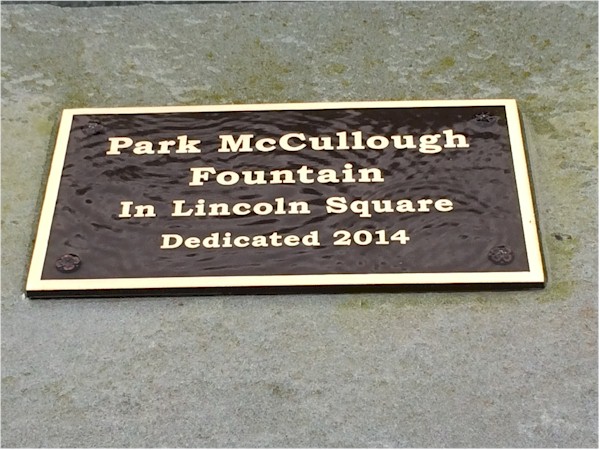
According to my reading, Shirley based the town green in The Lottery on Lincoln Square in North Bennington. Sure enough, Lincoln Square is right down the hill from the Jackson house. I don't remember a fountain in The Lottery, but the plaque I found suggests it wasn't there back in Shirley's day.

I'd read that I shouldn't expect to see any remembrance of Shirley in the Bennington area. However, Lincoln Square has an array of commemorative bricks, and there's one there for Shirley and The Lottery.


Finally, I read just last week that Shirley did her grocery shopping at Powers Market. Yowsa! It is still there! Talk about nerve! Not only did I have my picture taken in front of it (again, I did not flatter the store), I looked in the windows. (It was closed.) The interior looks remarkably like the interior of a store at a crossroads in Whiting, Vermont when I was a girl. We only went in for things like ice cream and bread, but I sort of shopped at a store like the one where Shirley shopped!

Powers Market is across from Lincoln Square, and they are both at the foot of that hill Shirley walked up with her stroller while she came up with The Lottery. It makes for a tight little loop, down to the store and back. I wonder how often she made it. A website about the town of North Bennington includes this line: "...her biographer, Judy Oppenheimer, describes a strained relationship between Shirley Jackson and the villagers of North Bennington." I've read that sort of thing frequently over the last few years. And now I can think about Shirley walking down that hill and back with a small child, probably over and over and over again.


Wednesday, October 08, 2014

Gail Gauthier Visits James Thurber or Pictures From My Vacation!

Yes, I'm still talking about my vacation. Have I mentioned that I had a great time?

While planning this thing, I decided that I wanted to visit an author's home. Pretty much any author. Seriously. I googled Ohio and authors.

And guess who was born in Ohio and whose early home is open to the public. Yes! Jimmy T! Well, we have more of a Mr. Thurber and Who? kind of relationship.

James Thurber was still a very big deal in my school days. I was quite excited about hitting Columbus and visiting his house. I own three Thurber books and reread what some call his autobiography (I think it's more a collection of memoirish essays, myself), My Life and Hard Times,
in the car last month. No, My World and Welcome To It was a television show.

This is me standing in front of the home Thurber and his family lived in during the My Life and Hard Times period. Sigh. I am wearing the sweater I lost on the road. Hard times, hard times.

Thurber House is a terrific spot. The Thurber House organization both preserves the past and maintains an active present with all kinds of literary and educational programs.

Each room has only one modest sign giving information. But it was terrific information about living in the house. For instance, this is a Victorian era building, but the Thurbers were living in it post 1900. Victorian front parlors were changing by that time, I read. People were using them for more than company. Kitchens and dining rooms were the spots in a home that were most impacted by style changes. And in James' room there was a sign describing how the women's magazines of the era advised mothers to decorate their sons' rooms.

Do you know any of those families that likes to go through museums pointing at things and saying, "We've got one of those at home...And one of those...And look! I've got that thing. But better?" Yeah, I come from one of those. And I married into another.

This sewing cabinet to the left that I saw at Thurber House? I've got one just like it in my office. It came from my mother-in-law who had two of them. Came from some other family member, I'm sure. At the Thurber House, they have a sewing machine on top of it. I use mine for holding stationery. I call it the stationery cabinet. The younger members of my family don't even know what the thing really is.

Then this table to the right, which the Thurber House people have a typewriter on? Interesting story. These things are known as library tables, by the way. I don't know why. Anyway, ours was in my mother's house when I was growing up, but one of my sisters doesn't remember it. Then my understanding was that the table came from my grandmother Gauthier's house. But no one else in the family has any memory of that. Which is why it is appropriate that I should be the one to have the table. No one else.           .

We're using it for a changing table now.

So, anyway, the Thurber House is great. And those educational programs I mentioned? I learned that James Thurber and I had relatives with similar taste in furniture.


Monday, September 27, 2010

My Weekend With The Transcendentalists


Concord, Massachusetts was everything I hoped it would be. Knowing, as I do, that not everyone shares my fascination with the Transcendentalists, I will skip over my trip to the home of Ralph Waldo Emerson (where we got a private tour because, oddly enough, we were the only ones there) and the Concord Museum (which is built on the site of Emerson's orchard--the guy appears to have owned a lot of property in Concord, including a nice chunk around Walden Pond) and expound, instead, on Wayside.

Why do I think you'll care? Well, it turns out the Alcotts lived at Wayside before they lived next door at Orchard House. The life Louisa lived at Wayside is the life she wrote about at Orchard House.

On top of that, Nathanial Hawthorne lived at Wayside after the Alcotts. Turns out that Nate wrote a children's book, because who doesn't?

Things become even more interesting, if that is possible, after Hawthorne's death. Evidently he had quite a following post-death (I'm hoping for that for myself), and when his home came up for sale it was purchased by one Daniel Lothrop. Lothrop and his wife were both Hawthorne fans.

They were also book people. Lothrop was a publisher whose company eventually (and after his death) became part of Lothrop, Lee & Shepard. His wife, Margaret, also known as Margaret Sidney was the author of...The Five Little Peppers and How They Grew! As well as a bunch of other Pepper books. And other things.

The people at The Wayside claim the Pepper books were the Harry Potters of the 1890's. I don't know if that's entirely accurate or a bit of wishful thinking on their part, but it does cause one to reflect, does it not? Because while I have read the first of the Pepper books, a whole lot of people have not. A hundred years from now will Harry have gone the way of the Peppers? We'll never know.

Oh, and while I'm on the subject of children's literature and Concord, we went to Walden Pond on Sunday, and while I can't say that Thoreau wrote any children's books (though very little surprises me in terms of kidlit authorship), I can tell you that D.B. Johnson was going to do an appearance there that afternoon. D.B. Johnson, of course, is the author and illustrator of the Henry books about a bear who is a great deal like Henry You Know Who.

We walked over five miles over the two days, also.

Transcendentalists, children's authors, and walking...it's hard to ask for anything more.

For more images relating to the Transcendentalists, check out my The Transcendental Writers of Concord Pinterest board. 

Friday, October 15, 2004

The Land of Anne


Back to my vacation, which I am sure you are all anxiously waiting to hear about.

So, we went to the Maritime Provinces, or at least some of them. Since Prince Edward Island (or P.E.I., to those of us in the know) was one of them, I decided to read Anne of Green Gables by Lucy Maude Montgomery.

By the time I started reading the book we were in New Brunswick. We started seeing Anne of Green Gables dolls in gift shops. As soon as we got over the bridge onto P.E.I. we stopped at the first tourist area and found an entire shop full of Anne paraphernalia. Anne of Green Gables the Musical was playing in Charlottetown when we got there. Evidently, it's been playing in Charlottetown every summer since 1965. There is an Anne of Green Gables gift shop in the city as well as an Anne of Green Gables Chocolate Shop.

Then we went to Cavendish, where we visited Green Gables.

No, I did not have too much Anne.

Another day I'll talk about the book itself.

For more Anne of Green Gables images, check out my Land of Anne Pinterest board.