Showing posts with label Terry Pratchett. Show all posts

Thursday, May 21, 2015

Sam Vimes Finds A Picture Book Flaw And Fixes It

I had a chance to read Where's My Cow? by the late, great Terry Pratchett this past weekend. I ordered this book, and it arrived encased in plastic. Since I purchased it as a gift, I didn't open it. So my first reading was a bit of a surprise.

I thought it was the book Sam Vimes, head of the nightwatch of Ankh-Morpork, runs home from work each evening to read to his son. What Where's My Cow? is really about is Sam Vimes reading Where's My Cow? to his son. It is more than I expected.

Sam Vimes may be my favorite Discworld character. He's essentially a cop, and I understand cop stories pretty much wherever they're set. Because he is a superior character, he recognizes an interesting point about animal picture books. And he fixes it.

A review by Steven H. Silver does a great job of describing Where's My Cow's artwork. I agree with Silver's conclusion that the book is probably best appreciated by Discworld followers.

Thursday, March 12, 2015

We Can Keep Reading, Anyway

I've been reading Terry Pratchett tributes all day and particularly liked Tanita Davis's at Finding Wonderland. Discworld readers will appreciate it. Also, Emily Dickinson fans.

I've started my son and niece on Discworld books. If I hadn't just bought three Jane Eyre-related books for Becki, whose birthday is next week, I'd run out and get her Monstrous Regiment, one of my favorite Pratchett books. It will have to wait for another event.

Check out the photo above. That's another generation holding his first Discworld book. Where's My Cow? is a picture book version of a story that appears in at least one of the Discworld books. Every night, Sam Vimes runs through the city to get home in time to read Where's My Cow? to his son before he goes to bed.

I haven't finished all the Discworld books. Some I like better than others. I'm planning to concentrate on the City Watch books, which feature Sam Vimes.

The reading can go on and on.

Friday, July 12, 2013

"Pratchetty" YA Books

Sheila Ruth from Wands and Worlds, Charlotte Taylor from Charlotte's Library, and Tanita Davis from Finding Wonderland all attended the North American Discworld Convention earlier this month. The three of them served on a panel recommending YA fiction for fans of Discworld author Terry PratchettSheila and Tanita both have posts on the event. Charlotte, who was the panel's moderator, has the list of books they recommended at her blog. A number of them are titles or authors I'm familiar with.

For instance, I haven't read The Book of Lost Things by John Connolly recommended by Tanita. But I have read another of his books, The Gates, an adult book with a child main character, definitely an option for YA readers.

I also haven't read the Diana Wynne Jones titles Tanita recommended. Faithful OC readers know I'm a big fan of her Chrestomanci books. They do have a Pratchett-like feeling--a developed world, some recurring characters, definite wit, and sophisticated writing.

Sheila recommends all the Bartimaeus books and both Lonely Werewolf Girl titles. I'm in total agreement.

One of Charlotte's suggestions is the Skulduggery Pleasant series. I happen to be reading the 5th book in the series now, having purchased 5 and 6 for my...yes, YA...niece's birthday. They just came my way a couple of weeks ago. Reading my niece's copy and knowing it's hers because of me makes me feel like one fine aunt.

Now that I think of it, I've given her a Bartimaeus book, too. And at least some of the Chrestomanci books. Oh, my gosh, I've given her at least one Tiffany Aching title! That's Discworld!

I am a stellar aunt.


Thursday, March 24, 2011

Pratchett News

You may recall that in January I announced that I was starting to read all Terry Pratchett's Discworld books. I have actually completed the first three, and the fourth is floating around upstairs.

Therefore, you can understand why I was interested to read that a Discworld TV series is being planned. It's described as a mystery series about the Ankh Morpork city watch. Having read some of the later Discworld books, I'm familiar with that group, and a TV series about those folks sounds fine with me.

Tuesday, November 23, 2010

Crivens! I Love Them Wee Free Men!


I don't usually do one reader response right after another, but yesterday I noticed that I Shall Wear Midnight by Terry Pratchett has been nominated for a Cybil, and since I'm going to be blogging about my Cybil reading over the Thanksgiving weekend, I thought I'd get something up about this book first.

I Shall Wear Midnight is the finale to the Discworld novels about Tiffany Aching who starts out as a nine-year-old in her first book and is, I believe, around fourteen or fifteen in this one. Tiffany is a witch, for sure, but in Discworld witches do a lot more than fly around on broomsticks (though they do that) and scare people. They pretty much devote their lives to traveling around their neighborhoods as a sort of one woman Visiting Nurse Association. They tend wounds, help the sick, deliver babies, all your traditional manner. Additonally they do nontraditional things like removing pain from the suffering. They can remove physical pain, but not the psychic kind that comes from, say, grief. It's not a particularly easy life, and Tiffany is young to be shouldering all this responsibility.

She has some folks watching out for her, though--a clan of six-inch high blue beings, the Nac Mac Feegle, also known as Feegles, also known as the Wee Free Men, also known as drunks, liars, brawlers, liars, and thieves. They are most endearing.

Now, I have read the first book in the series, The Wee Free Men, and I have read the third book in the series, Wintersmith. I thought I'd read the second one, but I can't find any record of it. My point being, I Shall Wear Midnight makes references to those earlier books, especially Wintersmith. I, of course, remember little about them. Even though the crisis Midnight deals with came about because of something Tiffany did in Wintersmith, not recalling it didn't really bother me. I was able to brush off what I didn't know and move on, probably in part because I've read enough Discworld books now that I know I want to be there in the world of those stories, and I'm willing to ignore anything that bothers me in order to get there.

And, of course, when there are Wee Free Men in the mix, it's easy to ignore all kinds of things.

I Shall Wear Midnight has some allegorical elements. It involves someone called the Cunning Man who appears to be the personification of evil. He is able to spread hate among people, making them turn on others. Witches, for instance. He comes, spreads his evil, is defeated for a while, and years later comes again. I think we're talking ugly mob mentality in many places, the kind of thing that has cropped up over and over again throughout history.

As a general rule, I don't care for allegory because it strikes me as being very holier than thou. However, there are Wee Free Men in this allegory. I'll put up with a lot of holier than thou for their sake.

This book includes a fascinating Author's Note in which Pratchett writes about a story from his childhood that inspired one element of this book. It's an interesting piece about how long something can sit in writers' minds before they finally are able to use it.

I've mentioned before that I've read two series this past year, one of which included eighteen or nineteen books. Maybe twenty. The author hasn't been updating her website, and I lost the sheet on which I was keeping track. I Shall Wear Midnight has a very nice list of all the Discworld books, and I'm considering reading all of them now. Perhaps I'll wait until January. Yeah. That's the ticket. I'm going to wait until January, and then start reading Discworld.

Plot Project: Yes, this plot could be one in which the protagonist wanted something--to destroy the Cunning Man--and the author kept giving her obstacles to getting it. But first the author had to come up with the Cunning Man. This is what is so simplistic about this whole give characters something they want and then throw obstacles in their way scenario. How do you come up with what they want in the first place?

Thursday, March 19, 2009

Island Of The Blue Dolphins Meets The Admirable Crichton


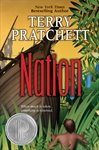
Nation by Terry Pratchett is set in an alternative nineteenth century world where an enormous wave washes away all the residents of an island except for a young boy, Mau, who had been about to pass his manhood ritual. He is now alone. Until, that is, he finds Ermintrude (who, quite understandably, decides to rename herself Daphne). She is a young member of the British royal family who is washed onto Mau's island home, the only survivor of a ship that was destroyed by that same wave. Daphne brings with her orderly so-called civilization. She is well-mannered and ladylike, as one would expect from someone of her station, but she also has a trained, scientific mind. She is familiar with both Darwin and Agassiz.

Mau's tremendous loss triggers a crisis of faith. You could say that Daphne helps him find another belief system.

This is a novel about the place of religious belief, something I don't think I've seen a lot of in YA fiction. (That might be what His Dark Materials is about, but I couldn't understand the second two books in the trilogy.) Occasionally Mau's spiritual quest got a little deep for me, too, but the humor and terrific characters got me past those points.

For a while I was concerned that this was going to be a rant against evil Europeans destroying other societies. Not that there isn't plenty of historic precedent for that, but it is a subject that has been done before. Pratchett, however, goes in another direction.

Nation is one of this year's Printz Honor Books

Today's Training Report: I fell behind on the 365 Story Project so I could immerse myself in the never-ending story. So today I tried to bring myself back up to speed with that by trying to track a character I want to do something with soon. I also made a hard copy of the draft I finished yesterday. I always edit a hard copy. I'll leave that for next week because drafts should sit like stews and sauces.

Saturday, January 05, 2008

And This, My Little Lads, Is How You Handle Stereotype. Or Archetype. Or Whatever Those Types Are.


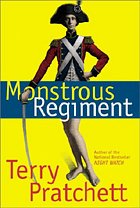
One night at dinner I described Monstrous Regiment by Terry Pratchett to a couple of family members.

"This girl wants to find her brother who had enlisted in the army so she disguises herself as a guy and enlists, too," I began.

A family member said, "That's been done."

"There's this really tough sergeant," I went on.

"That, too," he said.

"And an officer who doesn't know what he's doing."

"And that."

All of which is true. These are all elements that have been used in fiction before. It's what Pratchett does with them that's so terrific.

Monstrous Regiment is one of Pratchett's Discworld books, but you don't need much knowledge of that series to enjoy the book. (That's the difference between a series and a serial, my little lads.) I didn't totally understand the politics of the war that was being fought, but it didn't matter. What was going on in young Polly's regiment was engrossing enough that I didn't care about the bigger picture. Polly is in a regiment of brand new recruits, among them a troll, a domesticated vampire, and an Igor, which appears to be a zombie of some type. The zombies here are very adept at sewing and medicine, meaning they are a whizz at sewing body parts back on. They're even good at sewing on spare parts.

Are these "monsters" what make the regiment monstrous? Hmmm.

Polly's sergeant, Sergeant Jackrum, assures his recruits over and over that they are his little lads and he will take care of them. It appears that ol' Jackrum has been taking care of little lads for decades. Generations. This guy goes way past your run-of-the-mill screaming and spitting sergeant to become the stuff of myth and legend. At one point while I was reading the book, I wondered if he didn't have some kind of connection to hell. He should have been forced out of the army because of age long, long ago, but he's fought everywhere, knows everyone, and more than a few people owe him.

He is one incredible character, and Pratchett is always revealing something new about him.

Our lieutenant is as inept an officer as you could ever wish to find in a book, but he's saved from becoming a one-dimensional stereotype by his flashes of compassion and technical knowledge. Of course, it's not military knowledge, but you have to give a little respect to a man who knows anything at all and isn't afraid to put on a dress.

Except for the trolls, domesticated vampires, Igors, and the occasional werewolf, Monstrous Regiment reminded me of the historical fiction I enjoyed as a teenager. I read an array of hissyfic (none of it of an improving nature) but what I really liked were books about long ago young women who had adventures. The American Revolution and Civil War were good periods for girl adventures, but nothing beat the Napoleonic Wars for a time period when a young woman could find herself stumbling onto battlefields, fighting off stray soldiers, or doing a little spying.

Monstrous Regiment seemed like a takeoff of the books I was reading years ago, with a far better heroine who has no interest in ending up with a guy, the way so many of the heroines in my old books did. Oh, no. Our Polly can do way better than that.

Monday, July 02, 2007

Welcome To My Nightmare

I have to knock this off in a hurry because I have an evening class today. Let's see what kind of godawful editing error I can make and have to correct first thing tomorrow morning.

I finished The Wee Free Men by Terry Pratchett, which I did like. Love them wee free men. But I did think that without the wee free men the book would be...kind of run-of-the-mill.

I'm a Reading Fool said in a comment that her reading group felt the last third of the book took a strange turn. I think what she might have meant is that at that point The Wee Free Men turns into one of those alternate world books with hidden doorways and people passing back and forth. Dreams and controlling dreams begin to figure prominently in the mix. It's sort of formula stuff.

Except for the wee free men.

I'm not a fan of the alternate world scenario. For one thing, I always get confused. For instance, in The Wee Free Men when Tiffany makes Granny turn up in a shepherdess outfit--what was that about? Granny didn't seem to do anything. And the doorways between worlds always seem a little mumbo jumboish to me.

But the wee free men saved the book for me.

I do have a question about the audience for the Tiffany Aching Adventures. In this first book, she's only nine years old. But, come on. She doesn't act nine by a long shot. Do nine-year-olds get this? Will teenagers read it when the main character is only nine years old?

I'll certainly continue reading, for the sake of those wee free men. But I do wonder how kids respond to these books.