Showing posts sorted by relevance for query time management tuesday. Sort by date Show all posts

Tuesday, May 16, 2023

Time Management Tuesday: Where Are You?

I have been skimpy with the Time Management Tuesday posts for many months, if not longer. I've got a number of reasons I could, and will, give for this.

  1. I've been doing this for eleven years. Technically, new time management material is always turning up. After all this time, though, a lot of it is variations on a theme or contradictory. I don't feel enthusiastic about a lot of it.
  2. While I have gained a lot from what I've been studying and have favorite methods for managing my time, after all these years, I've had to accept that my life is chaos and I'm always just struggling to contain it. Given that, I feel a certain amount of discomfort writing for others about time management.
  3. My plan this year was to write more extensive time management pieces using research I've done these last ten years and try to publish them with some of the publications on the Medium platform. Then I would announce my publication news here with a link. I didn't expect to be doing that every week.

The Situation With Medium And Self-Help

If you spend much time on Medium, you learn that it is just snowed under with self-help articles, a lot of them about personal management, a lot of them about writing, a lot of them about writing specially for Medium, and a lot of them about time management. Many of these articles are written by people without any particular qualifications or expertise, much like myself. Many of these people have no qualifications to write these articles other than that they have written other articles on the subject. Again, a lot like me. Many of these articles don't have much in the way of new information to offer.  Last fall, Medium had 725,000 paying members. I'm presuming a lot of them are there to publish their work and not just read, since you can read a few articles a month there for nothing. Time management information, no matter how basic, may be new and helpful for them.

Nonetheless, I'm thinking long and hard about whether or not I want to spend valuable time writing about valuable time and pouring my output into a publishing world that is overwhelmed with similar material. My experience publishing time management material there, either on my own or with a publication, has not been at all positive. The work I've already done there disappeared. 

Look At The Numbered Items Above Again

You can see why time management material has not been showing up here regularly and won't in the immediate future. The desire to meet the Tuesday deadline was huge in the past. Now I desire something interesting and potentially useful to write about.

For instance, I saw an article on Medium a while ago about some apps to use for time management. I may try that and get back to you about it.

Wednesday, April 08, 2026

Seeking Time: A Rebrand

I have been writing about time management, specifically for writers, since January, 2012 as part of a feature I called Time Management Tuesday. That's more than fourteen years for those of you who don't like to do math. The month before I got started writing about time management I wrote here: 

"Organization and self-discipline are not things I learned at my mother's knee. Or at all. I have to make major efforts to manage my time so I can write. Always. It's not a linear process. It's more two steps forward and one step back, if I'm lucky and I haven't fallen over altogether, metaphorically speaking. Then I get started again. I'm always reading about better ways to manage time in all aspects of my life in order to isolate time to work. This has been going on for years. I won't even get into how many years."

I've tapered off with the time management writing, because, as I said last week, many random on-line people claim the expertise to write about time management, and I don't want to be another one of them. But, also as I said last week, in the time that I haven't been writing about time management my management of time has been spiraling. Back when I was writing about time, "I was hungry for ways to get things done and sometimes even finding a few." 

Finding those occasional ways to get things done provided a sense of optimism that I'd enjoy feeling again. 

Seeking Time


Among the things I've learned these last fourteen years is that time cannot be controlled. There is always more to do than there is time to do it, and the more to do comes at you when it will, not when you want it. Knowing that, the old title, Time Management Tuesday, seems woefully inaccurate. It also gives the appearance of expertise that I can't claim. I am only a seeker, one who is willing to seek everywhere, not just in what might be called the field of traditional "time management." So, I'm changing the title of this feature to Seeking Time.  


Additionally, without the "Tuesday" in the title I eliminate the pressure to write and publish a time-related post every week and give myself the option to post any day. 

A positive impact on my time! I'm feeling optimistic already.


Saturday, December 29, 2012

That Recapitulation Post I Was Talking About

Yes, I was talking about unit end recapitulation last Tuesday. Not to worry. I'm not talking about recapitulation in the sense of "recalling a charged event" and "feeling remorse if appropriate." I'm talking about what I did and how successful I feel I was with it. Because that will be a factor in my planning for next year.

Time Management Tuesday

I managed a Time Management Tuesday post, every single Tuesday. Even during Retreat Week. Even on Christmas Day. In terms of managing time and perseverance, terrific. But did it do me any good in terms of work?

First off, my time management research last year led me to submit a workshop proposal to the New England SCBWI for its spring conference. It was accepted, and I will be teaching a Situational Time Management workshop that weekend. I have spoken at professional conferences before, even at a writers' retreat. This is the first regional conference.

Secondly, I have been using the unit system (which has evolved a lot since I first wrote about it back in February), transitional time, and constant planning to manage my time.

Which leads us to...

The Saving the Planet E-book Edition

Preparing this e-book has been hugely time consuming for both my computer guy and myself. I will go into his work at some other time. I spent huge amounts of time seeking out and planning ways to publicize the book. The unit system and constant planning (see above) were significant here, because for many months I was working part-time. Planning units for the various research helped to make good use of the time I did have. Given that I often had only two days a week and that they were frequently Mondays and Fridays, trying to get into a big writing project might have been extremely difficult. So this was a good use of the time I had. But the fact that it took up so much time will definitely influence what I do next year.

Submission Binge

I did a binge of submitting short stories and essays early in the year, which resulted in a short story being accepted for publication at Alimentum. Again, that will have an impact on my plans for next year.

The NESCBWI Blog Tour 

This is a little project I assigned myself last year and finished this year. This was worthwhile for a couple of reasons. It provided content for Original Content, of course, but was also a community building effort before I even got into building community. (See below.) I friended some of the bloggers on Facebook and made connections of one kind or another. And it could have an impact on my planning for next year.

May Days

Last year I took part in a Facebook event called May Days, which was sort of like binge writing for a specific unit of time. I wasn't prepared for the project, so I just wrote two pages of anything every day. At least one piece I worked on was reworked this fall into a press release for Saving the Planet & Stuff. Again, this will be coming up again during my planning for next year.

Community Building

When you consider how late in the year I became interested in community building, I managed to do quite a bit with it--at least, by my standards. The Connecticut Children's Lit Calendar, the weekend reading roundups, and the Next Big Thing Author Meme, which I expect to be posting next weekend, all involve community building. I've also been more conscientious about taking part in the Carnival of Children's Books this past year and have taken part in the Carnival of Creativity a couple of times. How will community building figure in to my plans for next year?

Not only are these the bigger projects I've been involved with this past year, they're the projects I've written about here at Original Content. I'll use them as examples for next week's Time Management Tuesday post.

Tuesday, April 21, 2015

Time Management Tuesday: Decision-making

Last week's Time Management Tuesday post dealt with an article from the Coaching Positive Performance website. So I went back to take a look at what other time management bits I could find over there and, lo, I came upon this post on decision-making. I promised back in August, 2012 that decision-making would be a long-term study topic here. And, look! I'm carrying through with that!

Why Is Decision-making Part of Time Management?


Decision-making takes time. And it's time when you're not doing anything except thinking about what you're going to do. It's time that doesn't produce much.

You want to spend as little time deciding what you're going to do as possible, so you can spend more time on real work. How to do that?

How To Decide What To Do?


The CPP folks talk about knowing which of the tasks you have to do will give you the biggest payoff. That means knowing your goals and objectives. You have to have those in mind all the time. I like to make them at the beginning of the year and check in with them regularly. I've been doing it weekly this year.

The CPP people also talk about figuring out what you can do and how much time you have available. That's always going to change. And why? Because everything is situational. Our situations are always changing, so we always have to work out what we can do with the time we have available.

A case in point? Last week's Time Management Tuesday was about managing sick time. With that we're definitely dealing with a specific situation, different from the situation we were dealing with before we got sick, and different from the situation we'll be dealing with after we're back to what passes for normal. Getting anything done in that particular situation requires making some decisions.

If All Else Fails...


Do something. Anything. Again as the CPP writer says, the only way you can fail is to do nothing at all.

Remember, that's the reason decision-making is an important part of time management. You don't want to spend too much of your available time thinking about what you're going to do instead of doing something.

I decided what I was going to do this week yesterday morning. So now I'm off to do it.

Tuesday, March 31, 2026

Time Management Tuesday: Recalling "Four Thousand Weeks: Time Management for Mortals" Brings Back the Good Old Days

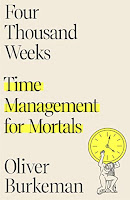
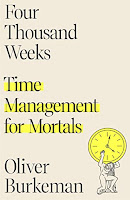
Recently--Sunday, in fact--author Ryan T. Pozzi suggested on BlueSky that people read Chapter 13 of Oliver Burkeman's Four Thousand Weeks: Time Management for Mortals. I have that book! And it was Sunday, when I feel as if I should be able to go off on deep tangents with my reading. (I often go off on tangents with my reading, they're just not deep as a general rule.) And Chapter 13 isn't that long. So, I did, indeed, read it.

Back in 2021, I did a seven-part arc on Four Thousand Weeks, a blog-while-you-read thing. I found the book to be much more about time philosophy than time management, and Chapter 13 is very representative of that. Burkeman seems more concerned with how we should live than he is with finding ways for us to manage our time so we can live as we want to live. That is not a criticism. We're just talking two different ways of thinking about and talking about time. 

For those of us who are intent on trying to manage our time so we can live as we want to, Four Thousand Weeks: Time Management for Mortals doesn't seem to have a lot to offer. However, rereading Chapter 13 led me to skim my Four Thousand Weeks blog posts. I was reminded of some philosophical points I want to try to keep in mind.

Chapter 13 Cosmic Insignificance Therapy

Chapter 13 deals with the idea that individually we're not all that important in the grand scheme of things. And this is good for us. We can lower the bar and use our time to enjoy the small moments of life, knowing that we are not expected to struggle to use our lives to accomplish something big and profound. Enjoy your time in your pollinator garden, Gail, without worrying that it doesn't attract much in the way of bees, which is what you're supposed to be doing with it. It's okay to admire the spring ephemerals you planted, even though you know they don't do much except please you.

This knowledge can be a relief, as Burkeman says, though, personally, I've known people who would take a we're-not-that-important-in-the-grand-scheme-of-things philosophy to mean that there's no reason for them to make an effort with, say, environmentalism or voting. One person doesn't make a difference, after all. I feel this attitude carries a bit of risk. 

But it's good for me, since it's pollinator garden time!

We Pay for What We Do with Hours of Our Lives


In another portion of the book, Burkeman writes that when we become distracted with something like social media, we pay for the time we spend on the distraction with hours of our lives, the hours we could have been using to do something we value more. He didn't elaborate on this point, but it was meaningful to me, because it was similar to something I'd read about minimalism. When you buy something, you really pay for it with the hours of your life it took to make the money you exchanged for it. 

I'd forgotten about Burkeman's view of social media, though I have been applying something like it, nonetheless, to my on-line reading in general. Do I need to read any more about the man formerly known as Prince Andrew? Do I need to read about this week's best memes? If I could stop doing that, wouldn't I have more time for reading the New Yorker and all the links to journal articles I keep saving? It's a possibility, at least. 

Procrastination is a Solution to a Problem

Time management writers usually deal with procrastination as a problem to be solved. Burkeman has a fascinating spin on it. He sees procrastination as a solution to a problem we may not even know we have. The real problem is that the work we're doing is hard. Or it's boring. Or we know it's going to get us nowhere. We may not even be aware that we're trying to escape it when we rush off to Facebook or BlueSky, where we can find something easy and interesting to do and quickly. We just think we're procrastinating. 

Figuring out what problem we're trying to escape and trying to deal with it might be a better use of time than heading to social media. Maybe it could make some kind of change in our lives.

I Need to Do More with Time Management 


I haven't been reading or writing much about time management the last few years, because I've seen so many people on-line writing about the subject who clearly have no background to be doing so. They've just read a book or even some on-line material about it. Which sounds a lot like me. I'd rather not be that person.

But while I haven't been reading or writing about time management, my ability to manage my own time has been spiraling. Going over my Four Thousand Weeks blog posts brought back the days when I was hungry for ways to get things done and sometimes even finding a few. I'm going to go back to some time management writing because it makes me feel good, which I think Oliver Burkeman would appreciate.

One thing I've done to manage time recently is revise blog posts for essays that I could submit to publications on the Medium platform. As luck would have it, one of the first essays I wrote in this way was We Are All Going to Die, In Case You Weren't Feeling Enough Time Pressure, which was published back in 2022. It's a review of Four Thousand Weeks: Time Management for Mortals


Tuesday, June 18, 2019

Time Management Tuesday: The Impact Of Stress On Time Management

My family member the archivist has, for many years, been studying and preserving old television. For the last twenty months, he's also been the daytime caregiver for a baby, now toddler. Recently he said that he frequently can't work during toddler nap time, because he's worn out from the twenty-four hour a day stress of dealing with what a child should be eating, how he should be sleeping, whether or not he is sick, why he is crying, and keeping him safe and alive. When he gets a break because someone is napping, the archivist finds himself collapsing in front of the TV or with his phone. The stress of Dad Life often makes it difficult for him to take advantage of his small amounts of work time.

This was very interesting to me, because I had just experienced a drop in my stress level after many years of dealing with another family member's illness. I had less to do, less hanging over my head, and less to worry about. Was this new lack of stress, I wondered, going to have some kind of positive impact on how I managed my time?

What Time Does To Stress Is Not The Same As What Stress Does To Time


I went out looking for information on this situation and didn't find much. There's a lot written on weak time management skills causing stress, but far less on stress causing a collapse in time management. One article I did find, How Stress Affects Your Work Performance by Christina Hamlett at the Houston Chronicle's website, deals with stress in traditional work places. A couple of points that could pertain to people who work for themselves:

  1. Stress contributes to job burnout and strained relationships. What happens with people who work alone and have no relationships to strain? Maybe burnout was what was contributing to my family member collapsing during nap time instead of working. Or my struggle to get up in the mornings because here's another day of problems, what's the hurry? Or get up off the couch at night to go to bed.
  2. Stress affects ability to remember things, evidently both short- and long-term, and makes you easily distracted. Do I have any new followers on Twitter this morning? I should look again this afternoon. Have any of my friends posted pictures on Facebook? Oops. Gotta go check my blog stats.
  3. Stress pounds away at your health. It's hard to work if you're sick. Or going to the doctor. Or the pharmacy. Or using the Internet to research what's wrong with you, which kind of relates to what we were just talking about with being distracted. 


Some Why From The Time Management Tuesday Archives


Speaking of archives, as we were earlier,a few things we've talked about here at OC's Time Management Tuesday feature could relate to what's happening when we're stressed enough to blow up our ability to manage time.

  • According to our old friend Kelly McGonigal in The Willpower Instinct, people who are distracted have poor impulse control and are less likely to be able to stay on long-term goals. Stressors...hugely distracting. And then there is the What-the-Hell Effect. In the case of people under stress, the more worn-out they get and less they do because of it, the worse they feel about their ability to get anything done and...What the Hell? They might as well watch TV during work time. They might as well stay in bed another half hour.
  • Timothy Pychyl in The Procrastinator's Digest says that a big part of the reason procrastinators procrastinate is that they're giving in to the need to feel good immediately. Say what you want about social media, it can be an immediate feelgood. McGonigal also writes about how undermining feeling bad can be in The Upside of Stress. People who are shamed or frightened by their doctors over things like weight, smoking, or drinking, frequently engage in those behaviors even more, because now they feel bad. They're humiliated and frightened, and the quickest way to escape those feelings for them is eating, smoking, or drinking. Well, people under stress feel bad. Often for years, if the stressor is child rearing or eldercare. TV, bed, and the Internet are immediate feel goods. Work, not so much. This spring I've noticed people on Twitter tweeting that they're having a bad day and asking to see images of cats, because that will make them feel better. I'd rather look at celebrity gossip on my tablet while lying in bed in the morning or plastered to the couch at night, but to each of us our own immediate escape. 


So What?


Well, exactly. We've got some why, but can we do anything about stress's impact on our work time? I've got a couple of things in the OC archive that might help, and I've started a summer blog read,  The Upside of Stress, which I mentioned above. I know I've said I was reading it before, but I must have gotten distracted or stressed or something. I'm really reading it now.

More to come.


Tuesday, March 06, 2012

Time Management Tuesday: Routines And Inner Editors

In today's post you will learn that I was concerned with doing more with less time long, long before Original Content started.

July 1, 2009 Trying To Manage Time

Teaching Authors has a post up called "Ideal" Life vs. "Real" Life: Where Does the Time Go?". It's about writing and time management.

Get ready for a laugh--I once taught a workshop on time management for secretaries and administrative assistants. This was decades ago, when I'd been working for an agency that did management development and personnel management training for state and municipal employees. My bosses did time management programs for managers. Those programs focused on delegating work as a way to manage your time. You don't have time to do something? Get someone else to do it! Problem solved!

Why anyone thought I was qualified to teach time management I no longer recall. And note that the people I was teaching the time management workshop for were at the bottom of the executive chain. They were the people work was delegated to. Delegating wasn't an option for them. What I focused on was using "forms." Creating templates (pre word processing) for anything you possibly could so that you didn't have to come up with a new letter, memo, etc., for every single occasion. My plan was to save as much time as possible by cutting down on decision making and avoiding having to reinvent the wheel.

I only taught the workshop once.

I still think that you can save time with routines--do the same thing at the same time on a regular basis so that you don't have to spend a lot of time thinking about what you're going to do. Send the same letter to as many people as possible. That sort of thing.

It doesn't help a whole lot with managing writing time, though.

In her post on time management at Teaching Authors, Carmela Martino says that she procrastinates because of perfectionism. That's a classic problem for writers, one that is sometimes referred to as an inner editor. When I first heard about inner editors, I thought the idea was laughable, some kind of touchy feely, navel gazing thing. (That was before I started dabbling in zen, of course.) Then, after struggling with some of my later books and finding myself reading anything, absolutely anything, so I could avoid working, I began to suspect that perhaps my problem was, indeed, that I had been invaded by an inner editor. My weak ego couldn't face the knowledge that the manuscript I was working on was going to need draft after draft after draft. It was just too soul-sucking. I could make myself feel better by reading--something someone else had written. It's good to get some in-depth knowledge about politicians, isn't it? There was always a chance that reading would lead me to come up with some brilliant idea. It wasn't really wasting time.

Hmmm. Perhaps there's medication for that?

My latest time management twist involves looking over a writing project in the middle of my morning workout. (I have little problem working out for close to an hour in the morning. Why should I? When I'm working out, I don't have to work! You'd think writers would be the most fit group on the planet because exercise is such a fine procrastination device.) Then, while I'm on the treadmill or whatever, the material I've just looked over is in the back of my mind, and I often come up with some satisfying tweak for it. This is what is known as forcing a breakout experience, by the way.

Go to the original post to read the comments.

Tuesday, March 05, 2019

Time Management Tuesday: Carry On Carrying On

I am not back at Original Content, or work, for that matter, in any kind of organized way. I am not back to normal after fighting the most recent eldercare fire. Of course, there has not been a normal for long periods of time at Chez Gauthier for over eleven years. I know one couple who dealt with the swings of eldercare "issues," as they're often called, for well over two decades. Maybe close to three. Open a paper or look around at your friends, neighbors, and relatives. Tens of thousands of people can never be sure of how they'll be able to use their time because they are caregivers for parents, spouses, siblings, or children. For some people, that may be the reality of big chunks of their adult lives. Their time goes to care giving and the kind of work that puts bread on the table. If there's time in their lives for other kinds of work, it's hidden somewhere where they have trouble finding it.

Recently I recalled my inspiration for starting the Time Management Tuesday feature here at OC. A memoirist had written an essay responding to new writers who had asked her how they could find time to write. She advised them to take a few hours from the time they used for exercising and housework. From all of us who use up most of our exercise and cleaning time making multiple emergency room visits, lining up home companions, connecting with visiting nurses, hunting for nursing homes and assisted living facilities, visiting said nursing homes and assisted living facilities a couple of times a week, researching medications and treatments, meeting with doctors, social workers, physical and  occupational therapists, audiologists, the occasional lawyer, and even a minister when a funeral needs to be planned, let me just say that that was enormously, enormously unhelpful. Glib. Shallow. I ran out of adjectives early on and became royally pissed. Time Management Tuesday came out of rage.

I'll be up front here and admit that being judgemental is my worst fault. Dwelling on what I've passed judgement on is probably a close second. But there you go. On the plus side, rage and holding a grudge led to a multi-year study of time management that has provided some help to me this past month.


A Three-Pronged Modest Proposal For Those Writing During A Crisis. Or Two Or Three.


So you have day after day and week after week and month after month of dealing with family problems. In all likelihood, year after year. It's clear this stuff isn't coming to an end any time soon--which is just as well, given how some of these family problems end--and you'd like to keep writing. Realistically, what can you do?


Situational Time Management. Don't expect to be able to manage your creative time or any of your time the same way every moment of your life. Our life situations are always changing, so we change how and when we work in order to work around them. What's more, our work situations are always changing. Are we prepublished writers trying to generate work? Are we making a living from our writing and have to keep the income coming? Are we established writers working on projects that aren't in the publishing pipeline yet or do we have books coming out soon so we have to work on marketing? Everything we do is dependent upon our life and work situation. We only have to wrap our time around the situations we're in, and we can do it in any way. What a relief. Shifting from situation to situation is a whole lot easier than trying to work with only one schedule, and if we can't conform to it, believing we're out of luck.

The Unit System.  One very good way to wrap our time around whatever situation we're in is to stop thinking that we need a full day to work. In the fields of time management and productivity, there's a lot of support for breaking work days into units or segments of time. The theory is that the first 45-minutes of work are the most productive of the day. The longer we spend working past that point, the less productive we become. Thus working, taking a break, and working again tricks the brain into thinking that each new start is the beginning of a new day. Meaning that a short work period squeezed in before heading off for the nursing home or the couple of hours you have after you get back can be valuable. Doing something is always better than doing nothing, and it has the benefit of making you feel you're still in the game. Also, coming home to your laptop or a book you're reading for research can be hugely relaxing after having lunch with a table full of ladies all at different levels of cognitive decline but all certain that they don't like oven-roasted sweet potatoes.

Use Your Goals and Objectives. How can we make the best use of whatever units of time we have while in our particular situation? Make sure that we're always using them to work toward one of our work goals. That way, we're always making some kind of progress on the work we want to do. That's good both practically and emotionally. In addition, we're not wasting time, which we don't have very much of, trying to decide what to do. Having established goals at the beginning of the year that I could work toward was hugely helpful last month.

Does that sound more useful than "use some of your exercise and housework time for writing?"Am I still being judgemental here?

How Did You Use Your Units Of Time This Past Month, Gail?


Goal 4. Complete a second draft of Good Women by September. I've spent more time working on this goal than I expected to at this point. Why? Because so far it's been easier than I expected. This suggests to me that working on an easy goal while I have other kinds of stress going on in my life may be a very good idea.

Goal 1. Work on short-form writing, essays and short stories. I've hit a couple of objectives for this one. "Revise His Times Or Mine essay" and "Read an essay or short story every day."

Goal 2. Concentrate on submitting completed book-length projects as well as short form work. I submitted His Times Or Mine and received a very good rejection. Yes, there are good rejections.

Goal 6. Research and create notes for a happy apocalyptic story. I happened to stumble upon a book dealing with a historical event that should be helpful for this, so I've been reading that.

Carry On Carrying On


The above doesn't sound like a lot, but I've had periods when we had elder crises when I threw in the towel and didn't even try to work for months at a time. I ran into a member of my writers' group recently and she said to me, "Well, Gail, carry on." The fact that I've been able to carry on this much is probably due to my writing about situational time management, the unit system, and goals and objectives over and over again these past seven years here at Original Content and to my toughening up over these past eleven years of older relatives going up in flames over and over again.

Please excuse me now. After visiting the nursing home and dropping a hearing aid off at the audiologist (yes, I do go there a lot), I returned some books to a library where I stumbled upon still another book dealing with a historical event that relates to my happy apocalypse story. I have about an hour and a half left today, and I'm going to use it for research.

Tuesday, November 24, 2015

Time Management Tuesday: Okay, We Know What To Do During The Holidays

Every year I struggle with time during the holidays. It's a situational thing. One of my very first Time Management Tuesday posts was on the December Time Suck. For the record, according to the Christmas spark book I mention in that post, we need new lights for the tree this year. That's good to know.

Holiday Time Management Strategies 


No one has time to waste reinventing the wheel between the third week in November and the first week in January, so these holiday time plans come from the Time Management Tuesday archives.


So Here's My Plan For The Rest Of This Week


I'm going to use short units of time to sprint, then use routine to get over it when I'm disappointed in what I get done.

And, yes, I did sprint this morning. A real writing sprint, not a real posting a blog post sprint.

Tuesday, March 28, 2017

A Time Management Tuesday Rerun: Time Shaming

I've got a substantial start on this week's Time Management Tuesday post. Nonetheless, it's not going to happen. I'm running out of time.

Yes, I am feeling a little chagrined about that. So today, rather appropriately I think,  we're going to recall a post originally published in March, 2015...

 Time Shaming.


Things I Can Say About MFA Writing Programs Now That I No Longer Teach In One by Ryan Boudinot received quite a bit of attention, of one kind or another, from two different groups on my Facebook wall this past week. I have never been part of a MFA program, so I can't even pretend to address what he has to say about them. I will, however, address what he had to say about time.


Yeah, That Was Harsh


"If you complain about not having time to write," Boudinot said in bold, "please do us both a favor and drop out." While expanding on that thought, he said, "My experience tells me this: Students who ask a lot of questions about time management, blow deadlines, and whine about how complicated their lives are should just give up and do something else. Their complaints are an insult to the writers who managed to produce great work under far more difficult conditions than the 21st-century MFA student."

Talk about insulting.

I have heard others disparage people with, shall we say, "time management issues." They seem to believe that those who can't manage their time suffer from some kind of moral failing. Certainly, they are "other," not like the people who perceive themselves as being time masters.

Why Time Shaming Is So Very Odd


What I find particularly interesting about this situation is that there are so many workable time management techniques. Psychologists have studied procrastination and impulse control problems it is related to. There is even writing process related to writing faster, which has a definite impact on how much writers can do with the time they have. Why, then, do people in positions to help writers treat those who wonder how they can find the time to write as if they just lost some kind of life lottery by merely asking the question?

I can only speculate, of course.
  1. We are a very them-or-us type of culture.  "I write at the drop of a hat, you don't. I know I'm good, so you must be bad." See also: Organic vs. plotting writers. Lots of arguments over whether or not one writing method is better than the other.
  2. The shamers simply don't know anything about time management. Not knowing something makes them uncomfortable, knocking down someone else makes them feel better.
One final speculative question:  Why not teach writers how to manage their time?

Tuesday, April 19, 2016

Time Management Tuesday: Manage Writing Time As If You're Training For A Race

Getting Started Managing Writing Time


Recently in one of my social media circles I saw some talk from writers about nonwriters who said they would write if they only had the time. Evidently, saying that to a writer doesn't go over well. Don't do that.

I obsessed about this issue, as I obsess about so many things. What compassionate and helpful suggestions would I offer to people who told me they would write, if only they had the time?  Then through Twitter I stumbled upon a blog post called Time Management Tips for Athletes and Gym Rats. The training plan described could just as easily be applied to writing, especially for people new to managing writing time.

Think Like An Athlete In Training


Flexible Training/Writing. Alter your training/writing schedule when you need to. That's situational time management. No, you do not have to write at the exact same time every day or every week or whatever you do. If something happens and you've lost your assigned writing time, just shift to another time for your work. The value in this? If you can't adapt to your new time situations, you tend to just give up because your "writing time" is gone.

Create Time. You don't create time by waving a magic wand and actually creating time. Before you start working, look at your calendar each week and actually work out how many hours you can use for writing. Yeah, that's sort of another way of saying "planning." But creating sounds more creative, doesn't it?

Prioritize. Usually when writers talk about prioritizing, they mean "make writing a priority." But in this case, we mean prioritize writing tasks. Go through the various things you need to do for a writing project--research, character development, outlining, if you're interested in outlining, prepping for writing group, I could go on and on--and determine which needs to be your top priority right now. That's what you'll work on first.

Be Realistic. Don't set yourself up for failure by believing you can spend more time writing than you can. If you can't be one of those writers who cranks out a book-length manuscript every three or four months, accept that and be the writer who cranks out a book in a year or two.

Be Open To New Experience. Or, In Other Words, Be A User


This next bit isn't part of the sports analogy I'm working on here, but I think it's important. Time Management Tips for Athletes and Gym Rats was posted at a site called The Pinkwell. The Pinkwell is some sort of women's clothing sales site that appears to have a specific demographic, the population that works out in gyms and runs triathalons, in fact. (Writers are more into bicycling, yoga, and martial arts, in my experience.)  Pinkwell is not a writing site or a business management site or an academic site, the kinds of places I usually find time management information. Pinkwell's time management post turned up in my Tweetdeck #timemanagement column because someone tweeted it with the hashtag #timemanagement.

I think of myself as a user. When I find ideas that I can relate to something going on in my life, I grab them and use them, wherever they come from. And that may be a time management technique that could be particularly useful for a new writer with little time.

Always be thinking about how you can make something work for you.


Tuesday, October 19, 2021

Time Management Tuesday: I'm Starting A Book Arc! Oh, And Also, We're All Going To Die.

It's been a while since I've read a time management book and blogged about the experience here, so I am quite psyched to get started with a new one. A very new one.Last week I saw author Oliver Burkeman being interviewed by Roxanne Cody about his new book Four Thousand Weeks: Time Management for Mortals and now have my own copy.

During the interview, Burkeman said that while various time management techniques are presented to us as making it possible to reach some point at which we will have the time we're looking for, that can never happen. We will always have more to do, because we have an infinite number of obligations, professional and personal.

I have to say that, after spending, I think, nearly ten years writing here about time management for writers, that most definitely seems to be my impression. There's never an end to the things that eat away at time.  If you're a goal-driven person, you'd be wise not to make achieving some kind of time nirvana a goal, because it is not attainable. You'll go out of your mind.

Another impression I've come away with from my years of time management study is that a lot of writers on the subject have nothing new to say. They're just rewording the same thoughts, sometimes even renaming ideas that already exist. Four Thousand Weeks might actually be new and different, because it begins with the interesting premise that time management doesn't actually work.

We Don't Have Forever

In his introduction, Burkeman explains that his book is called Four Thousand Weeks, because that's the number of weeks in an eighty-year-old's life span. Usually with time management we think of time being limited because there are only seven days in a week, and, sadly, we need to spend a certain amount of that time sleeping. We don't think, Damn, there are a limited number of weeks, too.

But once Burkeman brought it up, I began to wonder if we don't all have that unspoken knowledge in the back of our minds when we try so desperately to manage our time, so we can produce and create and be dream parents or have some other really great relationships and maybe get in a little exercise and travel, too. We have to get control of our time now so we can do all these things, because there's not going to be any time to control in our future.

I will leave you with that uplifting thought. Part Two of my Four Thousand Weeks read will come next week.


Tuesday, December 31, 2013

Time Management Tuesday: 2013 Recapitulation Post

Last year I started doing recapitulation posts, an opportunity to assess what I had done during a unit of time, a year in this case. At the beginning of this year, instead of making New Year's resolutions, I created goals and objectives for 2013. That's going to make this year's recapitulation easy. Assessing how I did with last year's goals and objectives will have a big impact on my planning of goals and objectives for 2014.

Remember, goals are what people plan to do, objectives are the steps they will take to meet the goal.

Goal 1. Publish the Saving the Planet eBook at the end of January.

Objectives:
  1. Final copy editing of text
  2. Assign ISBNs
  3. Amazon/B&N product description
  4. Work with Computer Guy regarding the uploading of final copy to Amazon and B&N
  5. Deal with any problems that turn up when uploading of final copy 
  6. Make sure website update is completed and posted
  7. Upload book trailer to YouTube
  8. Check press releases
  9. Contact first bloggers I'll be working with  and work with them regarding material they need from me
  10. Do a number of Original Content and Facebook posts building up to publication
Assessment: Met goal in February instead of January

Goal 2. Publicize Saving the Planet throughout the year

Objectives:

I have a multitude of objectives for this and will be doing a blog post on the subject later.

Assessment: I spent an enormous amount of time on this goal, managing coverage for the book at the following sites:

Alison Pearce Stevens Marketing Monday

Dude, Sustainable! 

Green Bean Teen Queen

Finding Wonderland: Review

Finding Wonderland: Interview

Little Hyuts

The Bibliophilic Book Blog

Word Spelunking

I was also able to promote the book at a high school book fair, the NESCBWI conference,  and the NESCBWI New Media Day. However, things began to fall apart for this goal in August when I had a disruption in my personal/professional boundary and had to spend some more time on the personal side of things. I let promotion slide in order to use my work time for writing and never got back into the heavy research I needed to do to continue promotion.

Goal 3. Maintain Time Management Tuesday Project (Last year's project went so well that it led to a workshop that I'll be leading at a writers' conference this spring.) 

Objectives:
  1. Continue Tuesday posts at least twice a month during this second year
  2. Read The Power of Habit
  3. Plan NESCBWI time management workshop for May
  4. Look for opportunities to write on the subject
Assessment:  I did Tuesday posts almost every week, read The Power of Habit, and planned and ran the NESCBWI time management workshop in May. I did not spend much time looking for opportunities to write about time management for writers.

Goal 4. Submission Binge (Last year's submission binge resulted in a short story acceptance and 2 excellent rejections, so I want to do another)  


Objectives:
  1. Plan a month or two period to do revisions and submit, probably September and October
  2. Look for markets in the months leading up to that point
  3. By July have one or two old stories selected and be working on them to make use of "archived" material.
Assessment: I did make seven submissions this year, one piece being brand new work, but I wasn't able to do it in a binge-like month-long period. I haven't been able to spend as much time researching markets as I'd like, though I did do some.

Goal 5. Write and submit an essay on blogging (Idea came about as a result of the NESCBWI Blog Tour I did earlier this year) 


Objectives:

  1. Seek out possible markets to determine whether or not this is a worthwhile project
  2. Write essay
Assessment: I have some notes for this essay. That's as far as I got.

Goal 6. Work on an outline for "mummy book" during May Days (I wasn't prepared for May Days last year. I hope to be this year.)


Objectives:
  1. Finish reading Wired for Story because I think we organic writers often don't know what our story is prior to writing, which makes plotting difficult.
  2. At least skim The Plot Whisperer for same reason
  3. Go over old research for this project and continue with more.
Assessment:  Did read Wired for Story and The Plot Whisperer. I also went over all my old research and did some more. I worked with the May Days Facebook group in May and again in October to plan out a series of scenes for this project, which for this organic writer is like an outline. I even put in quite a bit of time on starting the first few chapters.
Goal  7. Continue with community building   

Objectives:
  1. Next week--The Next Big Thing post here at OC
  2. Next Big Thing round-up post later in the month
  3. Support Cybils with a round up post of my reading of nominees; also post to Goodreads
  4. Continue with Connecticut Children's Lit Calendar and try to make a real calendar template accessible in the sidebar so the calendar can always be found and isn't buried in each month's posts.
  5. Continue looking for ways to publicize Connecticut Children's Lit Calendar
  6. Look for short,  local writers' workshops/retreats/events to attend
  7. Continue with the weekend roundup of blog and Internet  reading to help build community with other bloggers
  8. Consider the possibility of creating some kind of networking group for published writers, either on-line or some kind of local gathering. (This is a very low level objective because I suspect I won't find much support for it)
Assessment:  I met many of these objectives with varying degrees of success. The Next Big Thing--not at all successful. I supported Cybils early in the year and tried to support it this fall, but couldn't give enough time to it. Instead of a calendar template for the Connecticut Children's Lit Calendar, we created a link in my sidebar so it can be accessed immediately. I joined a Connecticut bloggers Facebook community to help publicize the Connecticut Children's Lit Calendar. I attended a writers' retreat and a couple of events at UConn. The weekend roundup hasn't been working well lately. I did make one feeble effort to get a networking writers' group started on Google+. It came to nothing. However, I joined Twitter this year, which I think could be argued falls under community building. Not one of my objectives, but a step toward the goal.
Goal 8. Publish a free Hannah and Brandon e-short story to support the Hannah and Brandon e-books published by G. P. Putnam's Sons.   

Objectives:
  1. Determine just how much publishing a free anything will cost me
  2. Reread the Hannah and Brandon books
  3. Check journal and files for story ideas
  4. Read other short stories for younger children
  5. Write the short story
  6. Decide how we will handle the cover
  7. Work with Computer Guy on the technical publishing work
Assessment: I dropped this goal early on, deciding that if I go to the work of writing a Hannah and Brandon short story, I'll try to sell it to a traditional magazine. Didn't even begin a story.
Goal 9. Plan publication of My Life Among the Aliens and Club Earth eBooks for winter, 2014 (I want to publish them together hoping to cut down on the time spent planning the marketing, which was very time consuming this year for Saving the Planet & Stuff)

Objectives:
  1. Wait for the return of rights for Club Earth (I already have the rights to My Life Among the Aliens, and the request for Club Earth has already been submitted.)
  2. Wait to see how Saving the Planet & Stuff sells before deciding whether to go with professional covers or look for a cheaper type
  3. Look into companies that prepare texts for e-book publication
  4. Discuss with Computer Guy whether I should go with a company for these books or have him prepare them as he prepared Saving the Planet
  5. Wait to see how Saving the Planet sells before deciding how to market these books--whether to buy advertising right away or start with promotion through blogs and websites
  6. Plan at least one book trailer 
Assessment: I do have the rights back to all my books that G. P. Putnam's Sons didn't do eBook editions for. However, my experience with the Saving the Planet & Stuff eBook suggests that putting effort into creating more eBooks isn't a good use of my time. I gave this goal up mid-year in favor of getting back to more writing.

Next week I'll do my first Time Management Tuesday post of the new year. It will be my goals and objectives post for 2014. You'll see some carry over from this year, but you'll also see a big shift in where I'm going to be putting my time.


Tuesday, March 19, 2024

Time Management Tuesday: Beginning Again Again

I haven't been writing about time management much here for a couple of reasons, one being that I'm not doing a good enough job managing time that I should be writing about it. But something happened Sunday that impacted how I spent my time Monday.

I got three rejections Sunday and found a fourth one in my e-mail that I'd either missed or forgotten about, because when the rejections fly fast and furious that can happen. Rejection doesn't bother me the way it does a lot of writers I see on X, who are really broken up about it. Rejection is a big part of a writer's job. If you're being rejected, you're working. Nonetheless, I wasn't ecstatic about the whole thing.

But I leaned on one of my favorite time management techniques, which is arguably not time management at all, probably an indication that I shouldn't be writing about the subject. I'm talking about beginning again. 

Which is what I did yesterday. I began again. I finished revising the portion of the short story I've been working on for months, so I'm now finally ready to continue with it. I started a new humor piece. I registered for a workshop. I checked out a publication to submit one of Sunday's rejections to. I had the best day I've had for a while. And I may have also finished a rough draft of a plan for a September car trip. That was taking forever.

Beginning again. One of my most useful tools for managing life, if not time.

Here is a repub of what may be my first begin again post. I've returned to begin again several times since then. 

November 24, 2020 Managing Chaos By Beginning Again

I was sure I'd written about "begin again" here in the Time Management Tuesday feature. It seemed like just the thing for managing chaos. But search as I would, I couldn't find anything here. So I guess I'm going to have to come up with some new original content.

Okay, if you spend any time reading about meditation, you will see the phrase "begin again." If your mind wanders while you're trying to meditate, no problem. Begin again. If you find that you're no longer in the present moment, that your mind has tiptoed off to your miserable past or your worries of the future, so what? You can begin again.

You're not a bad person because you didn't stay in meditation. You haven't failed. You're just going to begin again. Here is Joseph Goldstein explaining a very positive aspect of beginning again. In less than four minutes, people! How much do I love that? I love it a lot.

Overwhelmed By Chaos? Begin Again

Writers who've become overwhelmed by the chaos of living or at least their own kind of living and find that they are no longer on task with their work can use the same begin again thinking. Beginning to work again is important. But I think the really beneficial aspect of begin again is the lack of judgement. Judging and beating up yourself for work failures:

  • Is time consuming. Now you have to spend time ripping into yourself, time you could have spent writing.
  • Leads to the What-the-Hell Effect. When individuals become distressed about not maintaining goals, they can respond by giving up. We're lousy at what we do, anyway, so what-the-hell?  What's the point of going on with this?

Developing a begin again mindset won't keep us from finding ourselves neck deep in chaos. But it could help us get out of it.


Tuesday, December 23, 2014

Time Management Tuesday: A Memory Rerun

You know how network TV is full of reruns this week? Yeah, I'm doing one here today, too. Trying To Remember What We're Supposed To Be Doing originally ran in February of this year. I'm bringing up the business of remembering our time management plans because over the last three years I've considered a lot of issues related to time. How to work these all into one life?

Trying To Remember What We're Supposed To Be Doing


Last year I did a Time Management Tuesday post on Remembering That We Were Going To Practice Self-discipline. It was an argument that the self-discipline required to manage time required remembering that we have time management/self-discipline plans.

I remembered the memory aspect of time management last week as I tried to move forward in getting back to work after weeks of being off my game due to a nearly month-long cold, a retreat week, and surgery preparation and recovery. How many things I was I doing back before this whole thing started.

I remembered the unit system first, both sprinting and the forty-five minute segments, which was hugely helpful. Then I recalled my plan to limit reactive, noncreative work to Fridays in order to prevent things like marketing from taking over all my work time. This week I remembered that I use some morning transitional time to maintain my office. Unfortunately, it's been a while since I've done that. Planning fell apart at the end of December, and while I do recall it from time to time, I haven't been able to get back to that, either.

Managing time does require remembering a lot.

I had my best workday in weeks yesterday, spending multiple units on one big writing project. And I managed a sprint over the weekend on a new essay I started last week. On Saturday I also dragged Computer Guy into helping me with some reactive work. Remembering the unit system, sprinting on weekends, and keeping reactive work out of the workweek all figured in to what I've been able to do in the last week or so.

Tuesday, October 08, 2024

Time Management Tuesday: Reading About ADHD Has Made Me Rethink Productive Procrastination

I haven't been doing much with Time Management Tuesday the last couple of years for two reasons.

  1. I see a lot of time management articles on Medium that are clearly written with minimal research and are often rehashes of material others have covered. Not much that's new there. It's a little bit book reportish. This left me with anxiety about producing the same kind of material, which I'd really rather not do.
  2. I don't feel I've been doing that great with managing my own time the last few years. Am I being a hypocrite writing about managing time or am I writing about how I deal with a professional problem? I can feel a headache coming on. Seriously. 
But recently I've read a couple of things that caused what we might call an interest flair. I am inspired again! I think I have a few months of time management material here, beginning with ADHD-related material for October, which is ADHD Awareness Month.

Can ADHD Behavioral Approaches Help Others Manage Time?


We recently had a family member diagnosed with attention-deficit/hyperactivity disorder. This was not a surprise, which I suspect is the case in many families. As a result, I am attracted to ADHD articles and definitely noticed the #ADHDawarenessmonth hashtag on Xitter. That led to one thing and another and some reading on ADHD and productivity and time management. Some of which sounded as if it could be helpful for any of us.

First off, the National Institute of Mental Health defines attention-deficit/hyperactivity disorder as a "developmental disorder marked by persistent symptoms of inattention and/or hyperactivity and impulsivity that interfere with functioning or development."  The inattention part is of particular interest to writers, because it involves problems "staying on task, paying attention, or being organized."

Staying on task and being organized are hugely important for writers, because of the incredible, some of us might say overwhelming, array of things we need to do to write something, get it published, and market it. Each one of those aspects of the job require a large number of tasks. On top of that, the majority of us are working other jobs and possibly acting as caregivers for family members. So many balls to juggle. So many possible distractions.

How to decide what to do?

Procrastivity


In Why the ADHD Brain Chooses the Less Important Task--And How CBT Improves Prioritization Skills in ADDitude J. Russell Ramsay describes what he calls "procrastivity" in which people with ADHD procrastinate by working, but working at lower-priority activities. So they are doing things, but not making progress on a more important task. 

Productive Procrastination


When I read about procrastivity, I immediately thought of productive procrastination, something I've written about here a few times. I thought it was such a fine idea I republished the original post in 2022. My favorite willpower guru, Kelly McGonigal (She has a new book out! Or, at least, one I haven't heard of!) used the term "productive procrastination" in a Life Hacker piece on how she works and said, "I may have built my career on web searches I've done when I should have been doing something else." In another Life Hacker interview Ira Glass said, "I procrastinate by working." Though he did describe working at low-priority tasks when he should be writing as a bad habit. He wasn't as positive about it as McGonigal was.  

I've been feeling good about productive procrastination, believing that all those things I did while I should have been working on that last book for four years were a good thing. I was doing something. Anything. Now, after Ramsay's description of what goes on when someone with ADHD ends up in less necessary activities, I'm wondering about what I've been doing. 

Oh, and look. A far more recent Life Hack article, Productive Procrastination: Is It Good Or Bad? by Leon Ho, comes down firmly on the bad side. 

What To Do?


The Leon Ho Life Hack article includes time management techniques to avoid productive procrastination. But the J. Russell Ramsay ADDitude article has some fascinating stuff on why the ADHD mind leans toward low-priority tasks over the high-priority ones that could actually be more helpful for them to do. For instance, red flags for any of us might be noticing that we're spending a lot of time on tasks that are less demanding, more familiar, shorter, and with a very clear beginning and end rather than a big job that's waiting for us. Like writing a book. 

What I'm Going To Do


For the rest of October, I'm going to be looking for ADHD connected material that relates to time management and productivity, in recognition of ADHD Awareness Month. Next week I'll have a personal case study in how I spent an afternoon that illustrates some of what Ramsay talks about in his ADDitude article.

I think I should also give some thought to why I embraced productive procrastination in such a big way. Someone I liked did it? It gave me an excuse to get away from harder work? Yeah, I think that's it. Don't need to think about that any longer.

Also, I'm correct. As I said in the beginning of this post, I should be anxious about jumping into writing lightly researched blog posts.


Tuesday, June 26, 2012

Time Management Tuesday: Situational Time Management

Long ago, but not long enough, I worked for a management consulting/personnel management group that conducted training programs and consulting projects for municipal and state governments and agencies. Wait! Wait! Don't nod off. One of the people I worked for did programs on situational leadership. Situational leadership, as she described it, involved managers changing their leadership style depending upon whom they were dealing with. There was a chart. She used to use the movie Twelve O'Clock High as a case study. Evidently, she was not alone in doing this. This was back before video. I cannot tell you what a pain in the butt renting this movie was, which, no doubt, is why I remember situational leadership.

A couple of months ago, I was listening to a call-in show on friendship on my local NPR station. (My excuse? It was a weekend, and I was working in the kitchen.) So, this woman called in and started talking about what she called situational friendship. By this she meant friendships made while in particular situations. Thus, you have your PTO mom friends, your church friends, your writers' group friends, your walking group friends, your Boy Scout parent friends, etc. These are all friends unique to the situations in which you find yourself. When the situations no longer exist, neither do the friendships.

Last week, these different experiences from my distant and very recent past came together while I was thinking about the beginnings and endings of units of time--the different impacts those situations have upon us and how we use the time available during them. In terms of the ends of units of time, for instance, I've noticed that those hours, even days if the unit of time is a month, say, are often wasted if I've become discouraged with how I've managed my time up to that point. Just as a dieter will figure he might as well eat whatever for the rest of the day because he was unable to stick with the program around 3:30, I would believe a day was ruined because I didn't stay on task in the morning. I might as well blow off the rest of the day, too. To deal with that situation, I decided to have work tasks lined up that I could switch to if I found myself giving up on the planned/scheduled work. Doing anything, even if it's not the planned task, is better than wandering off to look for LOL cats.

This led me to think that what we sometimes do with time is create a management plan/schedule for ourselves and expect to adhere to it no matter what our situation is. When we don't, we're...out of luck, shall we say? How about instead applying a variation of the situational leadership/friendships model to time? With that model, we would expect to change the plan depending on our situation instead of believing the plan had broken down because our situation couldn't adhere to it.

I'm talking about more than a time plan for a big chunk of life, as in a plan for the years I'm in law school, a plan for the years when I am raising children, a plan for the years when I'm running a legal practice and raising children. I'm talking about constantly switching time management plans as situations change because situations change constantly.

For instance, this month I was able to commit to revising a book length manuscript. (May Days helped me think in terms of a month-long unit of time committed to one thing.) I should be done with it tomorrow, even though I've been down to working only three days a week again because of family commitments. (No crisis. The family member who was helping with elder care visits hasn't been able to get away from work.)

Now, next month I may be down to working only two days a week because of another family commitment. However, I've been able to plan for that situation. So next month whatever work time I have will go toward researching and planning marketing for the Saving the Planet & Stuff e-book I expect to publish later this year. Those kinds of work tasks shouldn't require the kind of continuity that writing a draft or revising a lengthy manuscript do, so they are better suited for working only two days a week. Thus, I have planned my time around my situation.

By September my situation should have changed again, maybe sooner. I will switch my time management plan again then.

Can someone do this kind of situational time management during, say, a lengthy family crisis? It depends, of course, on how soul-sucking the situation is. But maybe recognizing that you can plan your time around your situation could keep a management plan from breaking down altogether because the situation you find yourself in won't work with it.

Tuesday, November 02, 2021

Time Management Tuesday: The "Four Thousand Weeks" Read Part 3

Turns Out There Is Good Procrastination. Who Knew?

Unlike most time management books, Four Thousand Weeks by Oliver Burkeman is about thinking about/dealing with time in general and not with something specific in mind that we want to do with our time. Here at Original Content, it's important to remember that with Time Management Tuesday we do know what we want to do with our time. We're all about writing. We're all about protecting time for writing. When Burkeman writes about the issue of having too many things we want to do in life, we writers think, Too many things we want to do in addition to writing. 

Many time management programs, Burkeman says, lead us to believe that if we just organized our time differently, we could do more of all those things we want to do, when, in reality, we really ought to let some things go so that we're doing less. Less of what is not our focus. Remember, our focus here is...writing.

According to Burkeman, we should procrastinate on some of these other things--creating wall hangings, attending virtual art programs, subscribing to and reading multiple magazines, volunteering for everything, for example (I'm speaking for a friend)--to focus on what we've decided matters. Writing.

That is where good procrastination comes in. You choose what you're going to procrastinate on, so you can stick to what you want to do. Write.

I have to say, in my experience, this has been the case. The magazine subscriptions have had to go. The volunteering had to go. The virtual art programs never got started. Those things went, in the belief that I might get to them sometime in the future, so I could write now. Those things may never come in the future, but it's better to procrastinate on those items so I can write, than to procrastinate on writing so I can do all these other things.

Temporal Landmarks: A Humble Suggestion For Positive Procrastination

There are many things we can't, or maybe just don't want to, procrastinate on indefinitely. Using temporal landmarks--special occasions and calendar events that mark the passage of time and create new opportunities to begin new cycles--could help us to procrastinate productively on important things.

  • This past year I read about a writer who is also a college teacher. She limits herself to writing during one part of the year and submitting during another. She could be described as procrastinating on each task so that she can concentrate on it fully later.   
  • I frequently mention National Novel Writing Month here in relation to temporal landmarks. Many writers use that block of time to draft new work. Over the course of the year, they procrastinate getting started on a new project until November, a time when starting will work best for them.
  • Writers who have to work around school calendars either because they teach or have children at home often do one type of work when school is in session and another type when it's not. They are, arguably, procrastinating so that they use the type of time they have in the best way possible.

You can create your own temporal landmarks around anything--holiday months when you want to work less intently so you put off lighter work for that time; a day job's calendar when you can predict that work will be more demanding or less; travel time when you might be able to do more reading and research. Then you can plan what you're going to do (writing or even something else) during those times and put if off--procrastinate with that particular activity--the rest of the year.

However you do it, you're controlling the procrastination.